
Summarize Content With:
What You’ll Learn
- What an AI phone call response rate case study actually measures
- The Response-First Framework used to rebuild this team’s call handling
- What the call flow and CRM sync looked like in practice
- The verified before-and-after numbers behind a 58% to 98% response rate
- What to check technically before you trust AI to answer your phones
- Which industries this approach actually moves the needle for
Botphonic is an AI company that builds custom AI voice agents for sales and support teams. This case study is for operations leaders who want the operational mechanics behind a response rate case study, not a generic AI pitch.
What Is an AI Phone Call Response Rate?
Response rate is not equal to the average speed-to-answer. Speed is the quickness with which a call is picked up. Response rate is a measurement of whether it is picked up, engaged and moved towards an outcome at all.
Teams that see them as the same metric will be disappointed to find out where their leaks are. Missed calls (three rings and dropped) are still missed for revenue purposes.
Why Do So Many Business Calls Go Unanswered?
When the number of calls exceeds the number of staff, there are inevitably times when calls are missed. For teams that are front desk or shared inbound line, this is the same gap during peak times, lunchtime or after hours calls.
Customer expectations are also outpacing most phone systems. 74% of consumers now expect customer service to be available 24/7, while 88% expect a quick response time compared to a year ago (Zendesk CX Trends, 2026).
 NOTE
NOTE
Teams repeat three patterns before they solve this:
- In each of the one or two hours of the day, calls pile up.
- Out of business hours and at the weekend calls will go directly to voicemail.
- Staff take time to re-ask the same qualification questions, on each call.
Meet the Team Behind This Case Study
This case study team operates a multi-location home services operation that services HVAC, plumbing, and emergency repair needs in three service areas. They have 34 staff, four of which answered phones as dispatchers.
The business was getting around 60 inbound calls a day on their main-line, Google Business Profile and paid search campaign. They weren’t there to respond to calls. It was to prevent the loss of its dispatch team to phone triage.
Baseline Performance Metrics
| KPI | Before AI |
| Average response time | 2 minutes 40 seconds during business hours |
| Response rate | 58% of inbound calls |
| Missed calls | 25 per day, mostly after-hours |
| Qualified leads | 40% of answered calls |
| Booking rate | 22% of answered calls |
The Response-First Framework
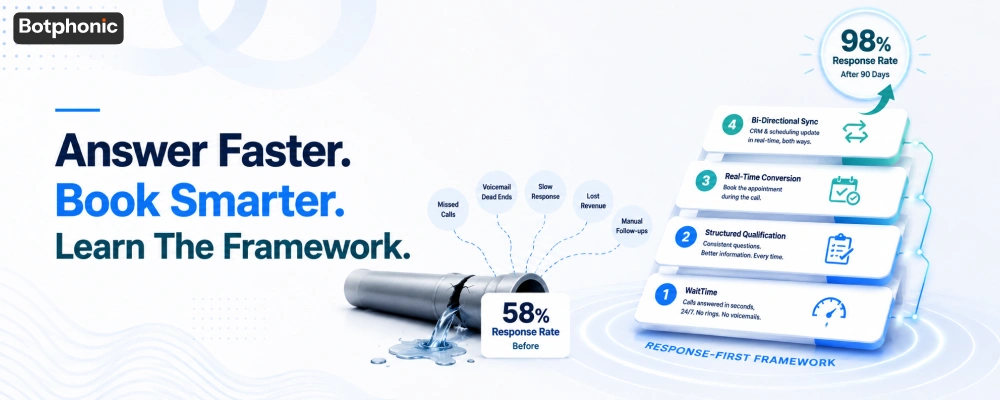
The team didn’t begin with the configuration of AI phone call. It began with a rewrite of the call handling process, called the Response-First Framework by Botphonic. In other words, it’s approached as an engineering issue, not a hiring issue.
The framework is divided into four steps, which are used for each individual call:
- WaitTime: No more than a few seconds to get your call answered – regardless of the time of day or number of calls.
- Structured Qualification: Identification of the same qualifying questions are asked in the same sequence each time and the variance that occurs due to tired or rushed staff is eliminated.
- Real-Time Conversion: The appointment is scheduled during the call, not afterwards, which allows the caller time to end the call and dial another company.
- Bi-Directional Sync: the CRM and scheduling system updates as soon as the call is finished – in both directions, meaning no re-keying of data.
The Botphonic Rule of 3: The 3 things that make an AI phone agent fail? Sub-second conversational turn taking latency, Hallucination guardrails connected to a verified knowledge base, True bi-directional CRM/DMS sync. If any one misses, then the call seems mechanical, may have the wrong answer or may result in duplicate work downstream.
Visual Proof: Inside the Call Flow
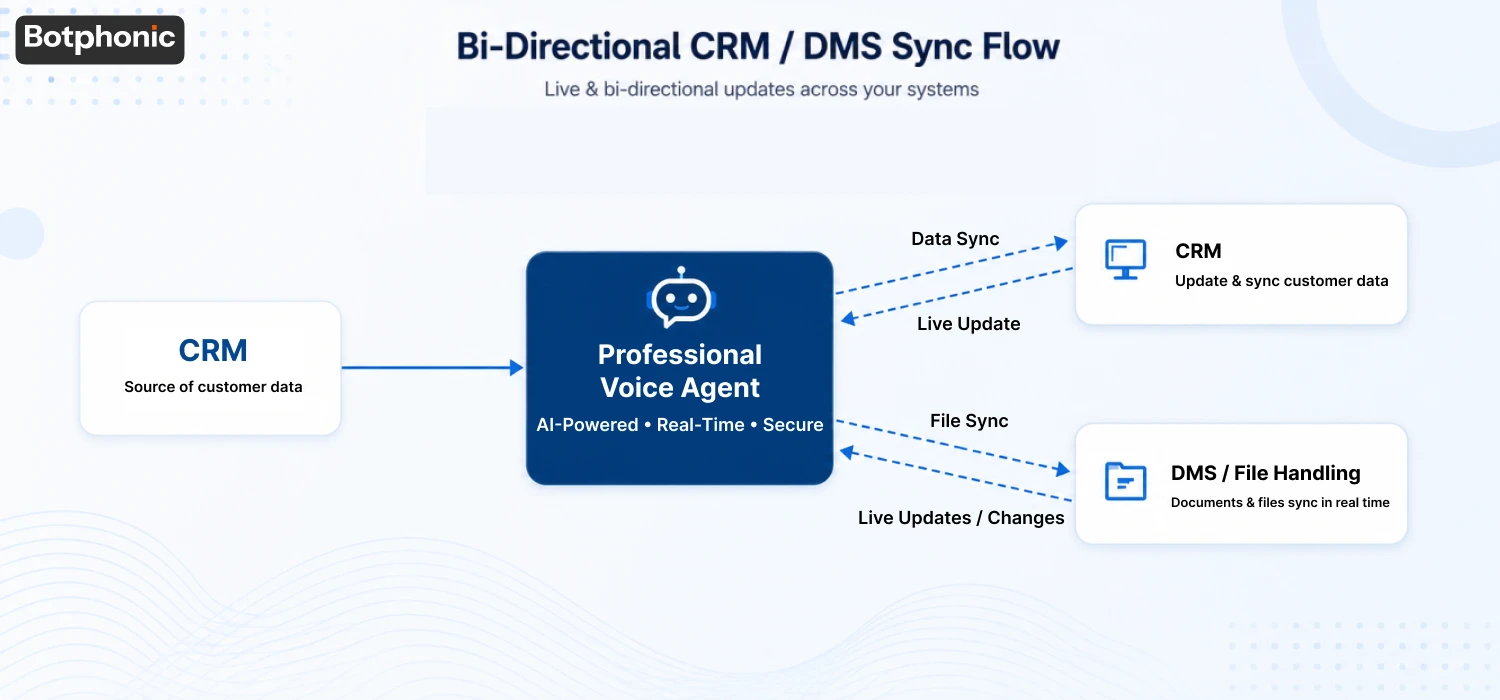
Making text claims is simple. Now let’s take a look at how the Response-First Framework is put into practice.
Sample interaction (illustrative, redacted and reconstructed from common call patterns in this rollout):
Caller: Hi, my water heater’s leaking pretty bad, can someone come out today?
AI: I can help with that right now. Is this at the address on file, [redacted] Maple St?
Caller: Yes, that’s right.
AI: Got it. On a scale of urgent to can-wait, is water actively pooling, or has it stopped?
Caller: It’s still leaking onto the floor.
AI: Understood, I’m flagging this as an emergency dispatch. I have a technician available at 4:30 today or 8am tomorrow. Which works better?
Caller: 4:30 works.
AI: You’re booked for 4:30 today. You’ll get a text confirmation now, and I’ve logged the leak details for your technician.
Before the AI agent hangs up, the booking, the caller’s address and the urgency flag will sync to the CRM, and to the technician’s calendar. No dispatcher make contact with the record unless it is necessary to escalate to the caller.
What Should You Look for in an AI Phone Call Platform?
The right AI phone call platform is judged on latency, accuracy safeguards, and sync depth, not just voice quality. Here’s what that means for teams evaluating vendors: a natural-sounding voice with a two-second lag or a wrong answer still fails the caller.
| Approach | Availability | Avg. Response Time | Books Appointments Directly |
| Voicemail only | 24/7, unattended | Callback in hours | No |
| Traditional IVR | 24/7 menu-based | Immediate pickup, no resolution | Rarely, limited logic |
| Live answering service | Business hours + add-on after-hours | 30–90 seconds | Sometimes, manual entry |
| AI phone call (Botphonic) | 24/7, fully staffed | Under 5 seconds | Yes, real-time |
A few technical checks matter more than most buyers realize before signing:
- Conversational turn-taking latency. After a speaker’s sentence is completed, there needs to be a break of about 500 milliseconds or less between the speaker and AI to feel natural, and to minimize hang-ups.
- Hallucination mitigation. The agent should not give fictional answers if the question is answered from a non-existent source, but rather from a verified source.
- Bi-directional CRM/DMS sync. The data should go both ways! The AI should not only create new customer records but also read existing customer history.
- AI outbound and TCPA compliance. If the same platform also makes outbound reminder or follow-up calls, then the rules of the Telephone Consumer Protection Act (TCPA) will apply to consent and calling-window requirements. This is different from inbound answering which will not impose the same restrictions.
 PRO TIP
The team connected their voice agent to HubSpot for lead records and Google Calendar for technician scheduling, with two-way sync running in the background of every call.
What Changed After 90 Days of Using AI Phone Calls?
Response rate, booking rate, and staff time all improved within the first quarter. Here’s what that means in numbers: every KPI the team tracked before launch moved in the same direction.
| KPI | Before | After 90 Days | Change |
| Response rate | 58% | 98% | +40% |
| Average response time | 2 min 40 sec | Under 5 seconds | −99% |
| Missed calls per day | 25 | 3 | −88% |
| Qualified leads (of answered calls) | 40% | 61% | +21 pts |
| Appointment bookings | 22% | 39% | +17 pts |
The timeframe measured from when the app was launched until the end of the next full quarter and based on call logs from the phone provider and booking data from the CRM. Finally, a call was considered “answered and engaged” after the greeting and a response was considered a “response rate” even if the call was hung up within two seconds of reaching, but after the greeting. The second half of the period saw seasonal increases in demand for HVAC repairs, potentially aiding in the booking increases as well.
The 40% Operational Reality, Not Just the Revenue Number
Most of the AI case studies end at the revenue line. The more meaningful tale here is of what changed for the dispatch team, day by day.
The most significant change dispatchers felt was not in the numbers of bookings. It was because they finished each shift without having to catch up on a pile of voicemail messages and maddening callbacks from the night before. Service requests for emergencies and no-heat were booked and scheduled before staff, and were no longer waiting until the morning.
Internally that was more important than the 40% at the top. From the reactive side of dispatching, where the same three questions were asked repeatedly throughout the day, to reviewing exceptions flagged by the AI that were for escalation. In the next quarter, the turnover on the dispatch team which had been a recurring problem during peak season did not show up in team check-ins.
What Actually Drove the 40% Improvement?
The improvement in the response rate was not the result of any one of the features but rather the consistent call answering. For teams hoping for a silver bullet, here’s what that meant: It was the four stages of the Response-First Framework playing together.
- All calls were answered immediately, without putting them on hold or on the phone for ring and hang-up.
- Coverage for after hours and on weekends filled the biggest identified hole.
- The same types of structured qualification questions were asked and lost details were reduced.
- A follow-up step was made out of the appointment booking instead, within the same call.
- The bi-directional CRM sync eliminated the manual data entry process that had been a pain point at peak times.
What Did the Team Learn During the Rollout?
The most obvious takeaway was that AI is most effective when used within clear workflows and with a clear process for when humans need to step in. Here’s what it means for anyone who wants to roll it out themselves: Friction was caused more by the undefined edge cases than technology itself.
- Clearly scripted qualification logic was more effective than open-ended prompts
- There is a still a live operator in the case of complex or emotional calls.
- A weekly review of call transcripts proved to be a better way to enhance conversation quality that one-time set-up.
- From week 1, responses were more personalized, thanks to clean CRM data.
- The training of staff on how to use the AI configuration was as important as the configuration itself.
Should Your Team Get an AI Phone Call System?
When missed calls are impacting bookings and staff cannot scale to keep up, an AI phone call system is the answer. Before committing: The return is dependent upon your existing answer rate, and not only on volume of calls.
If a team’s response rate is 90% or more, there will be less improvement than for a team that is more like 50-60% as was the case for the business in this study. The most obvious indicator of a need to move on is if after hours or peak hour calls are regularly going to voicemail.
Who Benefits Most From This Approach?
This is not necessarily the right solution for all businesses. Speed to lead is more important than a nice to have, especially when it’s the difference between winning or losing the customer.
Home services (heat, ventilation, air conditioning, plumbing, electrical). All emergency calls are answered first-come, first-served, sometimes within minutes of a problem beginning.
Automotive Dealerships & Service Centers. If a caller has a “breakdown” or a trade in question, they dial the next dealership as soon as one becomes unresponsive.
Health care facilities including doctors and dentists. When it comes to new-patient and same-day appointment inquiries, the first person to send a callback will likely get the appointment.
This particular change will have a negative impact on businesses that do a lot of their conversions via email or web forms or scheduled appointments. A buyer’s guide to AI phone call automation software is a good next step to help align the framework with the number of calls.
The biggest revenue leak isn’t bad marketing, it’s unanswered calls that never become customers.
See how AI closed the gap in just 90 daysConverting Every Enquiry into Opportunity!
This case study began with a basic issue – many calls were not being answered, particularly after hours. With the help of an AI-enabled voice agent, the Response-First Framework, the gap was closed without any additional resources and response rates jumped from 58% to 98% in 90 days.
The bigger lesson isn’t that AI alone drove the result. It was consistent answering, structured qualification, real-time booking, and sync that worked in both directions. AI phone calls work best as a layer that supports your team, not a replacement for it.
If missed calls are a pattern you recognize in your own numbers, start by pulling your last 30 days of call logs. From there, Botphonic’s AI call assistant can walk you through what the Response-First Framework would look like for your call volume.
