Summarise this article with
Key Takeaways
- Prices differ due to features & scale : The Call center software pricing generally ranges from $15 to $500 per month for the base plan, while enterprise-level models significantly increase pricing based on different features like omni-channel support, premium voices, and advanced AI capabilities.
- Examine the hidden costs : There are several factors like integrations, API usage, and add-ons, which increases the entire cost.
- What this blog includes : Complete guide about the pricing structures, what factors affect it, detailed pricing models, feature-based comparison, about hidden costs, compare pricing across all software solutions and how you can pick the right software platforms that perfectly fits to your budget.
Quick glance at the top Call center software providers :
| Botphonic | Best from SMBs to large enterprises due to exceptional functionality |
| Vapi AI | Start ups and small teams that have engineering teams |
| Retell AI | Mainly for E-commerce & brick-and-mortar stores |
| Cognigy | Required by large enterprises due to handle complex NLU |
| Voiceflow | Majorly useful for conceptualize and managing the communication flows |
| Five9 | Effective for conventional contact centers for exceptional client service |
| Dialpad | Handles intricate business communications (UCaas) |
| RingCentral | Best for enterprise level organizations |
What Is Call Center Software?
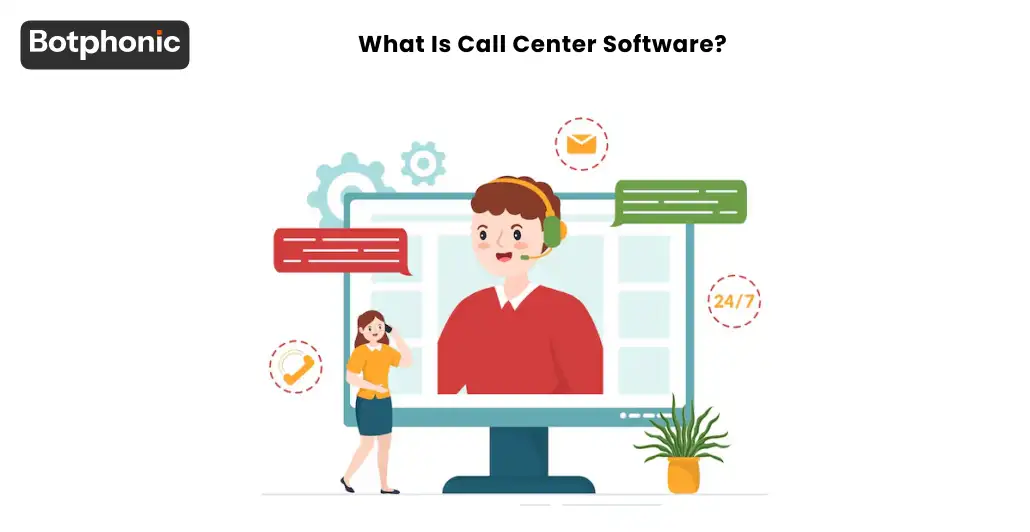
The traditional call centers cost you more than the Call center software and have become insufficient to fulfill the increasing demand for immediate customer service. Call center software uses automated systems together with intelligent call distribution and real-time data analysis.
Vendor presents Call center software pricing structures through multiple methods which include per-minute usage charges, per-agent subscription fees, tiered pricing systems, and hybrid billing approaches. Each vendor price varies because they provide different functionality and advanced AI capabilities. Also, the pricing model influences the AI call center costs.
The Call center software functions as an intelligent customer service system which provides more than its advanced telephone capabilities. The AI call center solutions use artificial intelligence with natural language processing and automation to manage common tasks. While the Call center software intelligently directs incoming calls and delivers immediate operational insights which enhance agent productivity.
Core capabilities include
- AI Voice Agents : Answer customer inquiries without needing human assistance.
- Conversational IVR : Provides interactive menus which allow users to speak their requests instead of using buttons.
- Intelligent Call Routing : Sends callers to the correct agent or department by using evidence from the call’s context.
- Omnichannel Support : Combines voice communication with chat and email and messaging services into one unified platform.
- Analytics & Reporting : Monitors performance indicators together with customer feedback and identifies operational areas that experience delays.
The AI call center solution improves the client interaction due to integrated functionalities like smart call routing, instant automated response, and intent recognition. It reduces long-waiting times, delivers personalized services, and reduces operational expenses.
How AI Call Center Pricing Works
The Call center software pricing differs due to the varied functionalities, actual usage, and what the vendor offers so understanding the price-affecting factors is important before selecting the plan. The general price ranges between $15 to $150 per month and if talked about the usage charges, it costs $0.05 to $1.25 per minute. Cloud-based solutions, deployment type, and additional integrations highly affect the Call center software pricing.
Pricing is determined by four main factors which include the following elements :
- Call Volume & Interaction Minutes : Most AI platforms charge per minute or per interaction. High call volumes can increase their expenses, while small business owners may pay only for what they use.
- Number of Agents or Seats : Even if AI handles most interactions, you’ll still need human agents for complex queries. The number of live agents in the system determines the pricing structure which increases with each additional agent.
- Features & Integrations : Basic plans cover standard voice AI and routing. Advanced analytics, CRM integrations, multilingual support, and custom workflows usually cost extra.
- Deployment Model : Cloud-based solutions reduce upfront infrastructure costs but may include usage-based fees. On-premise systems often have higher initial setup costs but more predictable ongoing expenses.
- Data Storage & Compliance : AI platforms that store sensitive customer data will charge businesses for the three services which include storage and encryption and compliance certifications.
Your monthly expenses will vary according to your decisions about how much to use, which features to include and how much work to automate. Your ROI will increase when you design your plan in a way that aligns AI capabilities with your actual support requirements. The next section explained the pricing models in more detail.
Main Pricing Models Explained
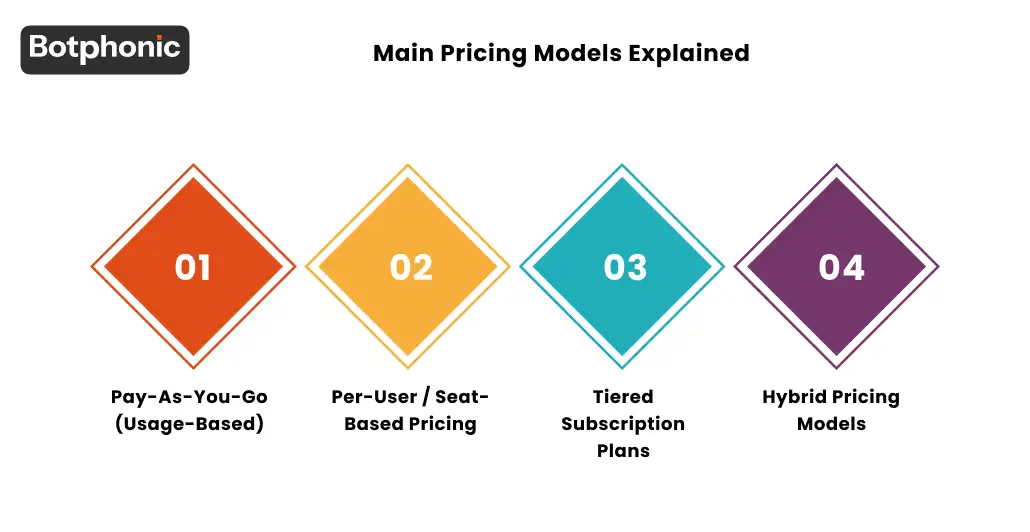
Comprehending the pricing model for AI call center software for better evaluation and making quick decisions. According to the Forrester, 2025 report, ‘CCaaS Vendors Thrive In A Wild Market’, CCaaS vendors shift from monthly subscription model to usage based pricing model.
Vendors typically construct their pricing methods around four distinct models which present different advantages and disadvantages according to your business size and call volume and future development goals.
1. Pay-As-You-Go (Usage-Based)
The payment structure requires you to pay for every minute of time spent or each call made or every interaction performed. Businesses which experience varying call volumes and especially partners and businesses which have either seasonal operations or start-up status can use this. For eg : A start-up manages 300 calls/month at $0.05/minute, would pay $15 per month compared to minimum $25 per month on the seat plan.
Optimal for : New business ventures and seasonal businesses
Average cost : In between $0.05 – $0.10/minute.
Vendors Using This Model
| Plivo | Budget-friendly substitute for voice & messaging |
| Aloware | Mainly emphasizes on PAYG & APIs |
| Vonage | Carrier network usage & tailored-made routing |
What’s the best : Low upfront costs, flexible scaling.
The overall cost increases during the peak demand times.
2. Per-User / Seat-Based Pricing
The service requires users to pay a monthly fee for every seat who accesses the software. It suits businesses which experience constant employee needs for their staffing requirements.
Optimal for : Those ventures who have consistent call volumes & support-group teams.
Average cost : In the mid of $25 to $150 per month
Vendors Using This Model :
| Ringover | Best VoIP phone system and CPaaS API |
| Aloware | Sales-based platform that provides unlimited minutes |
| CloudTalk | Pay-per-month pricing model |
What’s the best : Predictable monthly costs, easy budgeting.
The system incurs extra costs for users who want access to AI minutes and advanced features and integration capabilities.
3. Tiered Subscription Plans
The vendors provide three subscription options which include basic and pro and enterprise plans that deliver extra features in their upper tiers. Companies that need both standard and advanced capabilities should choose this solution.
Optimal for : Businesses that requires customization & feature expansion
Average cost : Using the per agent pricing model
- Primary (basic) : From $25 to $50 per user
- Advanced (pro) : from $50 to $100 per user
- Large-scale(Enterprise) : Ranges between $100 to $200 per user
Vendors Using This Model :
| Zixflow | Providing marketing tiers + pay-as-you-go system |
| AiSensy | Initial pricing from $45 monthly |
| Wati | SaaS tired plans along with automation capabilities. |
What’s the best : Easy comparison of features at different price points.
The higher tiers impose charges that apply to features which users will not use.
4. Hybrid Pricing Models
The AI call assistant operates through a basic subscription system which charges users based on seat or tier selection combined with usage fees. The service suits medium-sized to large companies which require both adaptable operations and stable fundamental expenses.
Optimal for: Businesses that have fluctuating calls & intricate needs
Average cost: Between $70 to $200 per month
Vendors using this model:
| Zendesk | Per month + subscription + add ons |
| Dialpad | Subscription + usage based per month |
| Genesys | Usage based + metered based charges + session pricing |
What’s the best : Balances predictable costs with scalable usage.
 PRO TIP
Cost Breakdown Based On Value-driven Features
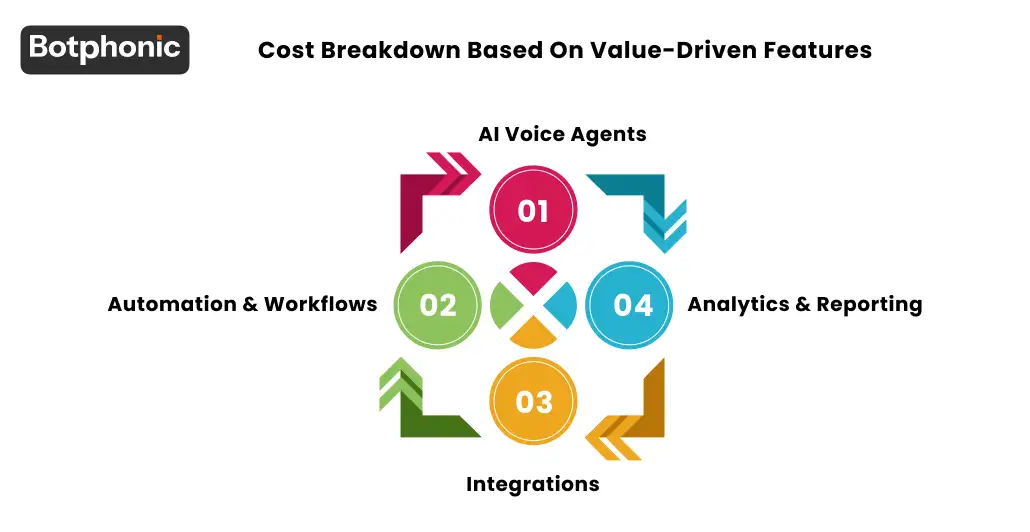
The pricing for AI call centers depends on their specific requirements which include both the number of seats and the duration of minutes but their total expenses rise from the specific features they select.
According to SkyQuest Nov, 2025 report, ‘Contact Center As A Service (CCaaS) Market Size, Share, and Growth Analysis’, the CCaaS market is swiftly shifting towards the paying model based on the individual functionality.
You need to know which features your plan provides and which features require payment to determine your actual costs. The following section provides an extensive examination of the subject:
1. AI Voice Agents
Pricing model: Most services charge customers based on either their total call time or their number of customer interactions.
Factors influencing cost: The costs of AI voice agents depend on three factors which are multilingual support requirements, voice quality standards and also the level of natural language processing skills.
PRO TIP
2. Automation & Workflows
Included vs premium: Basic automation (smart call routing, IVR menus) is usually standard; advanced workflows like auto-resolution, sentiment detection, or task orchestration may cost extra.
Impact: Companies experience reduced human resource needs because they implement advanced automation which results in reduced operational costs.
3. Integrations
CRM & third-party software: The system requires additional payment to establish connections with Salesforce and HubSpot and other platforms.
Custom API integrations: The service requires additional payment for custom API integrations which also needs customers to pay for setup costs.
 NOTE
NOTE
4. Analytics & Reporting
Basic dashboards: The basic dashboard exists as a standard feature which comes with all basic plans.
Enterprise clients receive access to advanced AI insights which include predictive analytics and churn forecasting and call sentiment scoring.
Consideration: The use of advanced reporting systems enables organizations to make better decisions however these systems require additional payment to access their specific features which should match the requirements of the organization.
The focus of your vendor comparison should center on features which you receive instead of their associated costs. Businesses frequently fall into the trap of paying for premium services which they do not use.
Your planning should center on your current operational needs and your future growth predictions instead of focusing on trendy features.
Side-by-Side Comparison Of Critical Factors
| Attributes | Botphonic | Vapi AI | Retell AI | Cognigy | Voiceflow | Five9 | Dialpad | RingCentral |
| Intelligent routing | Yes | Yes | Yes | Yes | Yes | Yes | Yes | Yes |
| Multi-channel support | Yes | No | Yes | Yes | No | Yes | Yes | Yes |
| Speech analytics | Yes | No | Yes | Yes | No | Yes | Yes | Yes |
| HIPAA & GDPR compliance | Yes | No | Yes | Yes | No | Yes | Yes | Yes |
| Post-call actions | Yes | Limited | Limited | Yes | Limited | Yes | Yes | Limited |
| Sentiment analysis | Yes | Limited | Yes | Yes | Limited | Yes | Yes | Yes |
| API customization | Yes | Yes | Yes | Yes | Yes | Limited | Limited | Limited |
| Scalability | Yes | Limited | Yes | Yes | Limited | Yes | Yes | Yes |
| Predictive dialing | Yes | Limited | Yes | Yes | Limited | Yes | Limited | Yes |
| Live coaching | Yes | No | Yes | Yes | No | Yes | Yes | Yes |
Extensive Pricing Comparison of AI-powered Call Center Software
| Vendors | Pricing Model | AI functions | For whom | Initial price |
| Botphonic(As of March 2026) | Subscription-based model | Visual-workflow builderPost-call actionsLow-code platformPredictive routingMulti-lingual support.Sales & lead management | Small, medium to large-enterprises regardless of any sector. | $22/ month |
| Vapi AI (As of Jan 2026) | Usage-based model | Telephony integrationReal-time interaction | Developers that want custom AI applications. | $0.30 to $0.33 per minute |
| Retell AI (As of March 2026) | Pay-per minute model | Knowledge-base integrationPost-call analytics | Product teams and retailers. | $0.07 per minute |
| Cognigy AI | Subscription-based model | OmnichannelData security | Large-scale enterprises | Not publicly displayed |
| Voiceflow (As of April 2026) | Hybrid | CRM integrationNo-code | Designing teams and who develop chat apps. | $60 per month for one editor. (pro plans) |
| Five9 (As of March 2026) | Pay-per-minute model | Call managementWorkflow automation | Enterprises level contact centers | Talks to their sales team for pricing |
| Dialpad (As of March 2026) | Monthly subscription | Sentiment analysisSmart call routing | Those ventures who need unified communications. | $80 per month |
| RingCentral (As of March 2026) | Pay-per month subscription | Analytics & reportingIntegrations | Integrated platform that can handle all functionalities. | $20 per month |
After careful analysis of the above table, Botphonic pricing is one of the cheapest platforms after the RingCentral for start-ups, small businesses, and even the enterprise level can afford and have a wide set of functionalities that attracts everyone.
Which Platform Has Free Trial In 2026?
| Vendors | Free Trial or Not | How |
| Botphonic | Provided | Offer 15-day free trial |
| Vapi AI | Provided | $10 free credits |
| Retell AI | Provided | 1 hr free or $10 for every account |
| Cognigy AI | Not provided | |
| Voiceflow | Provided | Provide 7-day trial period |
| Five9 | Provided | Offer 14-day free trial |
| Dialpad | Provided | Provide 15-day free trial |
| RingCentral | Provided | Provide 14-day free trial |
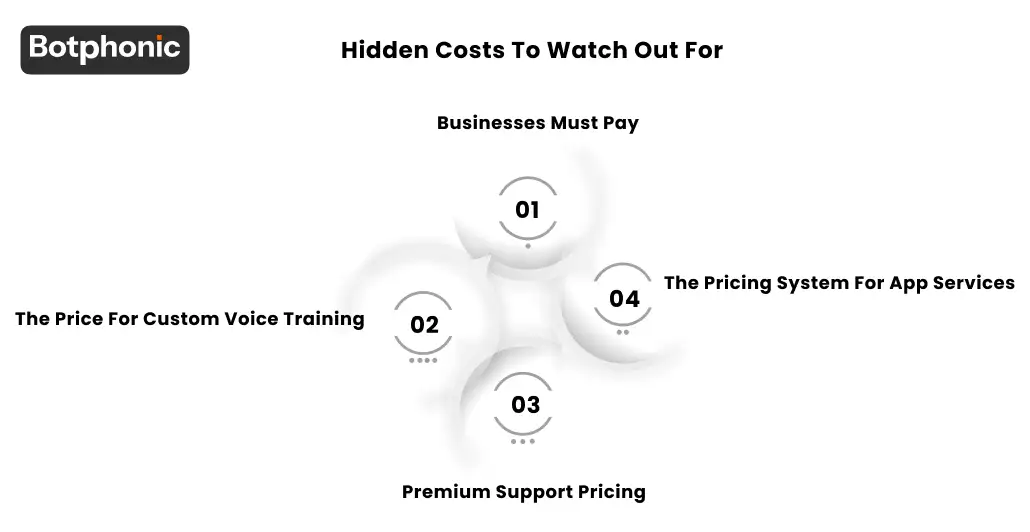
AI call center software can seem straightforward until the fine print hits your budget. Many businesses underestimate these hidden costs, which can quickly add up if you’re not careful. Here’s what to watch for:
1. Implementation and Onboarding Costs
Business operations require payment of all associated expenses. The initial setup requires three essential steps which need extra payment. Some vendors charge thousands just to get your system live.
2. The Price For Custom Voice Training
Training costs apply when you want AI agents to learn your specific brand language and special terms and distinct accents. The monthly expense for secure storage that meets GDPR and HIPAA and PCI requirements will increase because of additional costs. The expense of storage will increase with the amount of incoming calls.
3. Premium Support Pricing
Basic support is usually included, but 24/7 assistance, dedicated account managers, or faster response SLAs come at a premium. For eg: a call center system provides free email support, while having additional charges of $50 to $200 for round-the-clock assistants.
4. The Pricing System For App Services
Usage-based plans often have caps on minutes or interactions. After surpassing those boundaries, customers will incur significant overage fees.
A large share of expenses comes from training human agents to work alongside the new AI call center software. This learning curve can also temporarily reduce productivity.
The misrouting not only misguided the customers but it also incurs the unnecessary expenses, enhances the after call work time and decreases the efficiency level, affecting the complete business financial architecture. Misrouted calls cost around $5 to $25, which is a quite huge amount.
Always request a full cost breakdown upfront. The initial budget-friendly appearance of a plan will become costly when you overlook the hidden expenses.
The TCO Concept For Enhancing Operational ROI
Examining the subscription cost of the Call center software is not enough, you should contemplate the TCO (total cost of ownership) concept for a smart financial decision.
Representing the entire Call center software pricing over the period of time. It Includes direct + indirect expenses.
Encompassing several factors for calculating the total costs :
- Implementation & onboarding fee
- Support tiers
- Integration expenses (Sales automation and CRM)
- Tele-communication price
- Storage expenses
Let’s look at the practical example :
Suppose a business purchases the AI Call center for $100/month price.
Subscription cost : $100
Variable cost : $200
Set-up: $300
Support : $70
Integration : $80/month
Total TCO = $100 + $200 + $300 + $70 + $80/
Total TCO = $750
So, these all include the TCO costs. Sometimes the price looks cheaper but the TCO is higher, The tip is for you selecting that plan where the TCO is lower.
For eg : There are two vendors that have pricing and TCO
Suppose the price of
Vendor A : $500/month but the TCO is $750 per month
Vendor B : $1000 /month but the TCO is $600 per month
Then, you should choose the second vendor, not the first one.
To know the exact Call center software pricing, it is necessary to consider the above factors. Instead of just having a subscription fee, the TCO actually answered you
How much total investment is needed over the number of years?
It is considerably important for your organization to know what the hidden cost is, scaling charges would be, helps in creating future investments, and support in examining vendor pricing models for better evaluation. Also, it provides the correct ROI computation, avoids sticker shock.
Critical Elements of The TCO
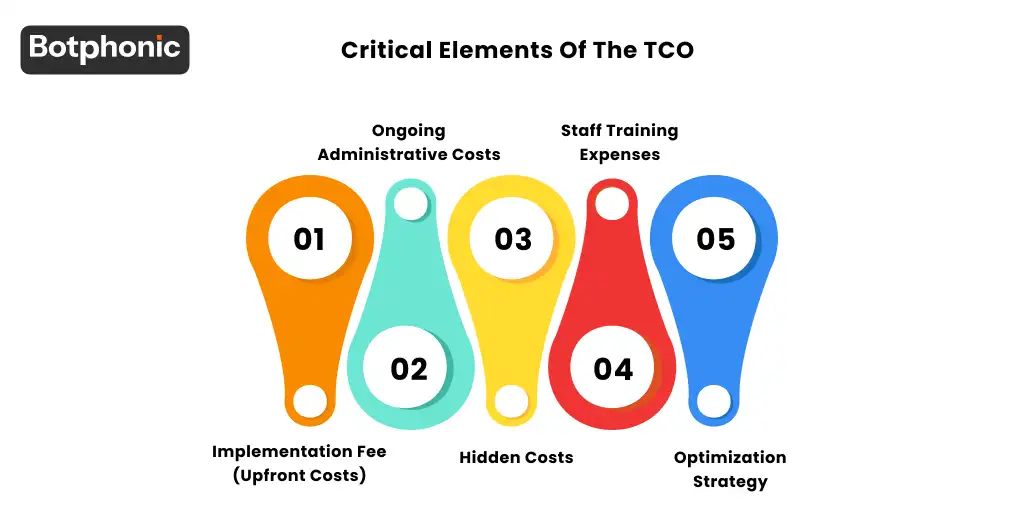
1. Implementation fee (Upfront costs)
Majorly it depends upon the implementation complexity, it can vary from $0 for no-coder platforms like Voiceflow to over $100,000 per annum for enterprise deployment like Five9. Encompasses no-code, custom pricing, professional onboarding, and speech recognition functionalities.
The Zero dollar makes it happen only for the no-code tools but the enterprise deployment can cost higher.
2. Ongoing Administrative Costs
Mainly considered in the usage-based model – it encompasses minutes of conversation + telephony charges. The key drivers of the administrative expenses include :
- Price paid based on the minute-based conversation
- Standard tool fee is between $30 to $500 per month.
- Large-enterprise solution to $1000 over monthly
- Integrates with salesforce, CRM, and ticketing system
- Per escalated call price in case of an intricate conversation.
- Telephony charges like call recording & purchase toll-free numbers.
3. Hidden Costs
It is an unexpected expense that usually increases the budget range to above 60% and affects the entire business infrastructure. These include:
- The multi-turn conversation of 10 minutes costs more than the 30 minute conversation due to handling multiple tasks during the single call.
- The bulk calls sent in case of outreaching to customers, it includes those which have failed or detect incorrect numbers. Not all but some vendors include.
- In case of the interruption by the client or user, it charges for the generated response, which has no meaning or no use.
4. Staff Training Expenses
While the AI call center software claims to reduce the operational cost to an extent, it happens in the real-time as well. However, the training cost is an unavoidable expense. The typical cost of the AI TCO includes :
- Technical staff Training: Based on Technource (2026), the AI call center training costs generally range between $5k-$20k, mainly for prompt engineers & IT staff. The Genesys & QCall.ai vendors charge this price.
- Human agent training: The Squadstack calculates $1000 to $5000 per agent.
- Deployment training: Basic training expense from $5000 to $20,000 based on employee count. Dante AI (2026) finds that training & Onboarding teams to deploy the new AI call center costs between $5k to $20k.
5. Optimization Strategy
It includes multi-layered approaches that tackle the set up fee and ongoing operational costs. The AI call agent can cost around $0.30 to $0.50, seamlessly replaced by the human agent that costs around $12/hour. However, you can easily optimize them well :
- Use the standard options rather than advanced models
- Allowing the prompt caching that minimizes the substantial amount of cost.
- The prompts should be around 300-500 words.
The ROI Factor Contributes In TCO Calculation
The ROI plays an important part in the TCO computation process. No doubt, hidden costs significantly enhance the entire expenses and that’s the reason it is mandatory to consider while figuring out the TCO cost. Otherwise, you might end up losing 25% more money than required. Thus, the ROI calculation is essential to know the actual return from the investment.
The following formulae helps you to know how AI call center software affects the organization revenue. Glancing the TCO & ROI guides you to have the entire financial picture, helps to make the smart financial decision.
Now, just computing the TCO by using the below formulae :
Total cost of ownership (TCO) = Initial cost + Maintenance costs – Residual value
For eg :
Let’s take a hypothetical question. Suppose you might acquire the AI call center software for $500 per month. After several years, you will spend the maintenance costs of $200 and the left residual amount is $150.
The total costs of ownership is :
TCO = $500 + $200 – $150
TCO = $550
After that, you should compute the ROI by using this formulae :
Below is the Call Center ROI calculator :
ROI = (Net profit/ total cost of ownership) X 100%
Suppose the net profit is $1000 after employing the AI call assistant and TCO is $550.
The AI call center ROI should be approx.
It means that when you invest 500$, you will get 181.81 % ROI. In other words, you will earn $1.82 in exchange for each dollar invested.
Secure, Integrated HIPAA Compliant AI Call Center Software
In the healthcare practice, nothing is more than the adherence to HIPAA compliance. Not a one day or single employee task, it requires consistent efforts. However, the AI call center maintains continuous HIPAA practice and minimizes workload efforts.
Do you know how much HIPAA integration costs?
No more hidden surprise cost. The HIPAA usually costs between $85 to $300 per month, it is usually higher than the normal software due to mandatory security protocols like data encryption, access control, and continuous monitoring for securing the medical information.
The AI call center platform solves many challenges that healthcare providers face in the daily routine. It increases data security, generates the administrative documents, increases data-protection safety, and away from any kind of risks.
The HIPAA-compliant AI call assistant increases patient trust, mitigates the costly violations, and augments the privacy rate. Furthermore, these specialized call center automation platforms use encrypted communication and apply strict protocols, which simplifying activities such as :
- Scheduling management
- Manage patient records
- Administer medication records
- Treatment planning
- Securely connecting with patients
And many other healthcare duties, it improves the complete healthcare workflows and increases the efficiency level.
How to Choose the Right Pricing Plan
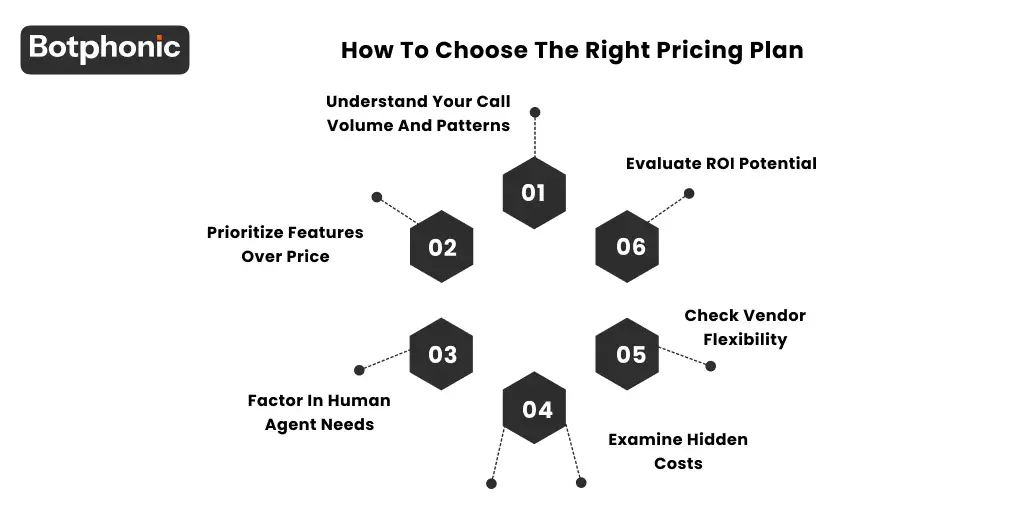
The process of selecting a call center software pricing plan requires more than selecting the least expensive option because it requires finding an appropriate financial and operational match to meet future demands. Here’s a standardized approach to make the right choice:
1. Understand Your Call Volume and Patterns
You should estimate your monthly interactions together with your peak call times.
Usage-based or hybrid plans function better at high volume situations while per-seat subscriptions work better for predictable workload situations.
2. Prioritize Features Over Price
You need to create a list of essential features which should include AI agents and analytics and integrations and multilingual support.
You should not spend money on attractive features which you will never use because feature creep functions as a concealed expense which destroys your budget.
3. Factor in Human Agent Needs
The best AI systems cannot resolve every customer inquiry. You need to determine your required number of live agents and which plan will charge you per seat.
4. Examine Hidden Costs
The total Call center software pricing includes setup fees, onboarding costs, custom voice training expenses, storage costs and premium support services. A complete cost breakdown should be requested before you make any signing decision.
5. Check Vendor Flexibility
Ensure to know if you are able to:
- Upgrade or downgrade tiers easily?
- Are overage rates reasonable?
The system must allow users to easily add extra minutes and seats and features whenever their needs increase.
6. Evaluate ROI Potential
The plan cost should be evaluated against potential savings which result from fewer agent hours and decreased churn and quicker resolution times.
The company should accept a slightly higher upfront cost because it will provide efficiency improvements which lead to better customer satisfaction results.
The business should start with its present requirements and make accurate growth predictions while selecting a plan that will support future expansion. The company should focus on finding its most valuable products instead of selecting the least expensive options.
Finally, you can consider the October 2025 review of Gartner peer insights (Contact Center as a Service Reviews & Ratings) to analyze the best AI call center software as they provide the vendor comparison with the verified ratings.
Conclusion
The Call center software pricing normally ranges between $15 to $500 per month but it can vary depending upon the functions you choose and vendor offerings. The most important cost factor is the hidden costs like integrations and add-ons. Exists as a budget item but actually serves as a critical investment for your business. The ideal plan establishes a balance between cost-effectiveness and product capabilities while actual expenses differ between vendors and product functions and user requirements. Your business should concentrate on its actual requirements while planning for growth and acknowledging all undisclosed expenses. Also, consider the factors that affect Call center software pricing. Select the plan which provides maximum worth instead of choosing the most economical option. Implemented correctly, AI call centers achieve financial self-sufficiency through their role in decreasing human tasks while enhancing customer satisfaction and building future-ready support systems.
Experience our platform that provides 50+ human voice, omnichannel support, integration facility, and a lot more. Get a free trial. No hidden charges. Cancel at any time.
Book a demo