
Summarize Content With:
What You’ll Learn
- How AI call bot lead qualification works in modern sales funnels
- Why lead qualification is the biggest bottleneck in revenue growth
- How Voice AI for Lead Qualification uses BANT and lead scoring frameworks
- The difference between lead generation and lead qualification
- How AI Voice Agents qualify, score, and route prospects automatically
- When to use voice bots vs chatbots for qualification
- How AI-driven qualification improves sales efficiency and conversion rates
Introduction
Most organizations don’t have a lead generation problem, they have a lead qualification problem.
Businesses invest heavily in SEO, advertising, content marketing, outbound prospecting, and referral programs to generate leads. Yet many sales teams still struggle to build a predictable pipeline because not every lead is ready to buy.
According to MarketingSherpa, nearly 79% of marketing-generated leads never convert into sales, often because they are poorly qualified or lack purchase intent. At the same time, Sales representatives spend approximately 60% of their day on non-selling operational tasks, largely due to manual research and chasing low-quality leads. To combat this administrative drag, systems like HubSpot Sales Hub utilize AI Sales Prospecting and automation to instantly verify lead data, assign contacts, and enrich lists based on your Ideal Customer Profile.
The challenge is no longer generating more leads. The challenge is identifying which leads deserve immediate sales attention. This is where AI call bot lead qualification is transforming modern sales operations.
Instead of simply answering inquiries, AI call bots engage prospects in real-time conversations, identify buying signals, ask qualification questions, assess intent, and collect structured data automatically. They can determine whether a lead is sales-ready and route high-value opportunities to the right representative instantly.
Speed also matters. Contacting inbound inquiries within five minutes makes a business 21 times more likely to qualify the prospect and yields up to 8X to 100X better conversion odds compared to waiting just 30 minutes.
The result is a smarter sales pipeline, faster response times, and better sales productivity. Rather than overwhelming teams with every incoming lead, AI ensures sales representatives focus on prospects most likely to become customers.
Learn More: 10 AI Voice Agent Use Cases That Save Money
What Is AI Call Bot Lead Qualification?
AI call bot lead qualification is the process of using conversational AI to evaluate whether a prospect meets predefined sales criteria before involving a human salesperson. Rather than sending every inquiry directly to sales, the system conducts a structured conversation and collects information necessary for qualification.
The AI evaluates:
- Need
- Budget
- Authority
- Purchase timeline
- Use case complexity
- Intent signals
- Buying urgency
Based on these responses, the lead receives a qualification score. This score determines the next action.
The lead may be:
- Routed to sales immediately
- Assigned to a nurture workflow
- Sent additional information
- Disqualified automatically
Why Lead Qualification Has Become a Revenue Problem
Many organizations measure marketing success by lead volume, while sales teams focus on qualified opportunities, pipeline value, conversion rates, and revenue generation. This difference in priorities often creates a significant gap between lead generation and revenue outcomes. Marketing may successfully fill the funnel with thousands of prospects, but sales teams still need to determine which leads are genuinely worth pursuing.
The traditional qualification process is largely manual. Sales representatives review inquiries, research prospects, make outreach attempts, and assess buying intent before meaningful sales conversations can begin. While necessary, this process consumes valuable time and resources. According to the Salesforce Report, 94% of sales leaders with agents say they’re essential for meeting business demands. This confirms that sales teams with AI agents are fully bought in on the gains.
The problem becomes even more severe when response speed is considered. Today’s buyers expect immediate engagement and often evaluate multiple vendors simultaneously.
In competitive markets, those delays can directly impact revenue. High-intent buyers may lose interest, engage with competitors, or move further into the purchasing process before receiving a response. As a result, businesses often lose opportunities not because they lack leads, but because they fail to identify and engage the right leads quickly enough.
This is why lead qualification has become a revenue problem rather than simply a sales process challenge. The companies achieving the strongest growth are not necessarily generating more leads, they are qualifying them faster, prioritizing high-intent opportunities, and ensuring their sales teams focus on prospects with the highest likelihood of conversion.
Poor lead qualification creates problems that extend far beyond wasted sales calls. It introduces friction across the entire revenue funnel, affecting marketing performance, sales productivity, customer experience, and revenue growth.
When qualification is handled manually, sales teams often spend valuable time engaging prospects who have little intent to purchase, no immediate need, or insufficient budget.
The impact is not limited to sales. Marketing teams also struggle when lead quality is inconsistent. Campaigns may generate large volumes of inquiries, but if those leads fail to convert, it becomes difficult to demonstrate return on investment. This often creates tension between marketing and sales, with both teams viewing performance through different lenses.
Poor qualification also affects management decision-making. When unqualified leads enter the pipeline, forecasting becomes less accurate and pipeline reports become less reliable. Leaders may believe they have strong revenue potential based on pipeline volume, only to discover that a significant percentage of opportunities were never likely to convert in the first place.
Perhaps the greatest cost is the opportunity cost. High-intent prospects expect quick responses and personalized engagement. While teams are busy filtering low-quality leads, serious buyers may experience delays, lose interest, or move to competitors that respond faster. In many cases, the revenue lost from missed opportunities far exceeds the cost of handling unqualified inquiries.
This is why organizations are increasingly adopting AI Voice Agent for Lead Qualification solutions. Unlike manual processes, AI systems can engage every lead instantly, assess intent, ask qualification questions, collect structured information, and prioritize opportunities in real time. They operate continuously, apply the same qualification criteria consistently, and ensure that high-value prospects are identified and routed to sales teams without delay.
Lead Generation vs Lead Qualification
| Function | Lead Generation | Lead Qualification |
| Primary Goal | Attract and acquire potential leads. | Identify which leads are most likely to become customers. |
| Focus Area | Volume and reach. | Quality and buying intent. |
| Position in Funnel | Top of the funnel. | Middle of the funnel. |
| Typical Channels | SEO, paid ads, content marketing, social media, webinars, referrals, events. | AI voice agents, SDR teams, qualification calls, lead scoring systems, conversational AI. |
| Key Questions Answered | Who is interested? | Who is ready to buy? |
| Success Metric | Number of leads generated. | Number of qualified opportunities created. |
| Output | Prospects and inquiries. | Sales-ready opportunities. |
| Ownership | Primarily marketing teams. | Primarily sales and revenue operations teams. |
| Technology Used | Marketing automation platforms, CRM forms, advertising tools. | AI qualification systems, lead scoring models, CRM workflows, sales engagement platforms. |
| Revenue Impact | Creates pipeline potential. | Directly influences conversion rates and revenue generation. |
The BANT Framework Still Matters
Despite the rapid growth of AI-driven sales technology, the core principles of lead qualification have remained surprisingly consistent. One of the most widely used qualification methodologies is BANT, a framework originally developed to help sales teams identify whether a prospect is a realistic buying opportunity.
Modern AI qualification systems may use advanced conversational intelligence, lead scoring models, and predictive analytics, but they still rely heavily on the same fundamental signals that sales professionals have used for decades. The difference is that AI can collect and analyze those signals faster, more consistently, and at a much larger scale.
Budget: Can the Prospect Afford the Solution?
A prospect may have strong interest in a product or service, but interest alone does not guarantee a sale. Understanding whether the organization has an allocated budget or the financial ability to invest is a critical qualification factor.
Traditionally, sales representatives gathered this information during discovery calls. Today, AI voice agents can identify budget indicators through natural conversation, asking questions about current solutions, spending priorities, company size, or investment plans. This helps determine whether a prospect is financially aligned with the offering before a salesperson becomes involved.
Authority: Can They Influence the Purchase Decision?
Many sales opportunities stall because the person engaging with the company is not the actual decision-maker.
Authority helps determine whether the prospect can approve a purchase, influence stakeholders, or participate in the buying process. In B2B sales especially, multiple individuals are often involved in evaluating and approving solutions.
AI qualification systems can identify authority signals by asking role-based questions, understanding job titles, and determining who else participates in the decision-making process. This helps sales teams engage the right people earlier in the sales cycle.
Need: Is There a Real Problem to Solve?
Need is often the strongest predictor of conversion.
A prospect may have budget and authority, but without a clear business challenge or pain point, there is little motivation to buy. Effective qualification focuses on understanding the problems a prospect is trying to solve and the impact those problems are having on their business.
AI voice agents excel at uncovering needs through conversational questioning. Rather than asking rigid survey-style questions, they can explore challenges, goals, operational inefficiencies, and desired outcomes in a more natural and engaging way.
Timeline: When Do They Plan to Buy?
Timing plays a major role in lead prioritization.
Some prospects need a solution immediately, while others may be months away from making a decision. Understanding the expected purchasing timeline allows sales teams to prioritize opportunities appropriately and allocate resources more effectively.
AI qualification systems can gather timeline information by asking about implementation goals, project deadlines, contract renewal dates, or planned evaluation periods. Leads with near-term purchasing intent can then be routed directly to sales teams for faster follow-up.
How AI Makes BANT More Effective
Traditional BANT qualification often relied on forms, manual discovery calls, or email exchanges. While effective, these methods can be time-consuming and inconsistent.
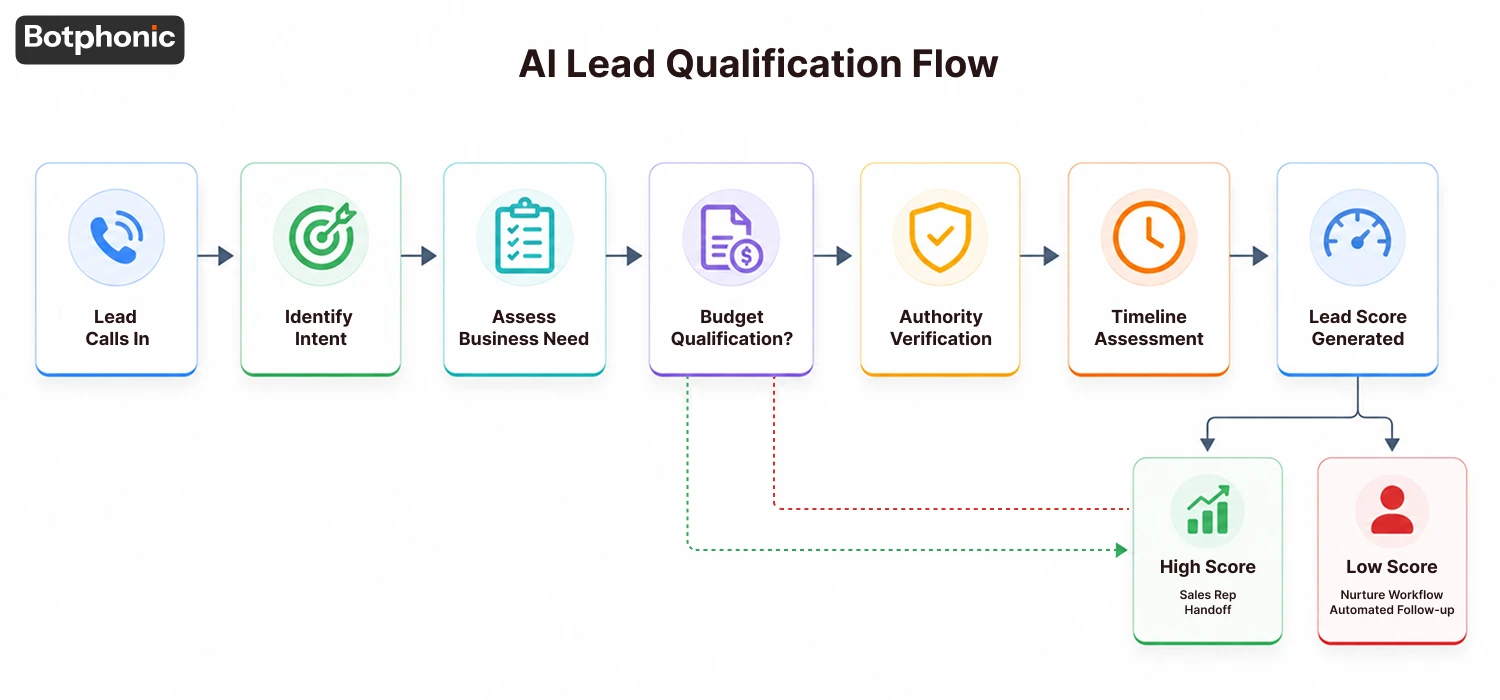
Modern Voice AI for Lead Qualification applies the same framework through intelligent conversations. Instead of forcing prospects to complete lengthy forms, AI gathers Budget, Authority, Need, and Timeline signals naturally during the interaction. The system then evaluates responses, assigns qualification scores, and routes high-potential opportunities to the appropriate sales representative.
As a result, businesses can qualify more leads, respond faster, and ensure that sales teams spend their time on opportunities with the highest likelihood of conversion. BANT remains relevant because it answers the same question it always has: Is this prospect likely to become a customer? AI simply helps organizations find the answer faster and more accurately.
AI Lead-Scoring Question
How Voice Bots Do Lead Qualification
The reason Voice Bots Do Lead Qualification so effectively is that voice conversations provide a level of context and insight that traditional forms simply cannot capture.
When prospects engage in a natural conversation, their responses reveal much more than basic contact information. Voice bots can identify signals related to urgency, confidence, decision-making authority, business challenges, and overall purchase readiness. These insights help businesses determine not just who the prospect is, but how likely they are to become a customer.
For example, a prospect who says, “We’re actively evaluating solutions and need to implement one this quarter” demonstrates a very different level of intent than someone who is simply gathering information. Voice AI can recognize these signals in real time and use them to prioritize leads accordingly.
Voice interactions also significantly reduce friction in the qualification process. Instead of asking prospects to complete lengthy forms or wait for a follow-up call, AI voice bots engage them immediately through natural conversation. This creates a smoother experience while increasing the likelihood that prospects will provide complete and accurate information.
As the conversation progresses, the voice bot can ask qualification questions, assess responses against frameworks such as BANT, assign lead scores, and automatically route high-value opportunities to the appropriate sales team. Low-intent leads can be nurtured further, while sales-ready prospects receive immediate attention.
The result is faster qualification, higher-quality lead data, improved response times, and a more efficient sales pipeline. Rather than relying solely on forms and manual reviews, businesses can use voice AI to identify buying intent and prioritize opportunities at scale.
 NOTE
NOTE
AI Voice Agent for Lead Qualification: Step-by-Step Process
Step 1: Intent Discovery
The qualification process begins by identifying why the prospect is engaging with the business. The AI voice agent analyzes the conversation to understand whether the caller is looking for pricing information, requesting a demo, comparing solutions, seeking support, or exploring options. This initial intent assessment helps determine the direction of the qualification process.
Step 2: Qualification Questions
Once intent is established, the AI Call Assistant asks structured qualification questions based on frameworks such as BANT (Budget, Authority, Need, and Timeline). These questions are presented naturally within the conversation, making the interaction feel less like a form and more like a meaningful discussion.
Step 3: Response Analysis
As the Prospect Enrichment responds, the system evaluates the answers in real time. It looks for indicators such as buying urgency, business need, decision-making authority, budget alignment, and implementation timelines. The AI Phone Call also captures contextual details that may influence lead quality.
Step 4: Lead Scoring
Using predefined qualification criteria, the AI Answering Service assigns a lead score based on the prospect’s responses. Higher scores are typically given to prospects who demonstrate clear intent, immediate needs, purchasing authority, and a realistic timeline for moving forward.
Step 5: Routing Decision
Based on the final qualification score, the system determines the next action. High-intent, sales-ready leads are immediately routed to the appropriate sales representative, while lower-priority prospects are automatically entered into nurture campaigns, follow-up workflows, or marketing sequences until they are ready to engage.
This structured process allows businesses to qualify leads consistently, reduce manual effort, and ensure sales teams focus their attention on the opportunities most likely to convert.
AI Chatbot for Lead Qualification vs Voice AI
| Metric | AI Chatbot for Lead Qualification | AI Voice Bot for Lead Qualification |
| Engagement Rate | Moderate engagement as prospects must actively type responses. Many users abandon conversations if they become too lengthy. | Typically achieves higher engagement because speaking is faster and more natural than typing, especially for complex discussions. |
| Data Collection Depth | Collects structured information effectively but is often limited by short text responses and form-like interactions. | Captures deeper insights through conversational dialogue, follow-up questions, and contextual responses. |
| Qualification Accuracy | Good for basic qualification criteria such as company size, contact details, and simple intent signals. | Better at identifying buying intent, urgency, authority, and purchase readiness through conversational cues and detailed responses. |
| Friction Level | Requires users to type answers, which can slow conversations and increase abandonment rates. | Lower friction because prospects simply speak naturally, reducing effort and improving completion rates. |
| Conversation Naturalness | Often follows predefined conversational paths that can feel scripted or transactional. | Supports more fluid and natural interactions that closely resemble human qualification calls. |
| Human-Like Interaction | Provides a conversational experience but remains largely text-based and structured. | Creates a more human-like experience through voice, tone, pacing, and real-time dialogue. |
| Intent Detection | Relies primarily on written responses and predefined conversation flows. | Can identify intent from both spoken content and conversational context, providing richer qualification signals. |
| Lead Scoring Quality | Effective for capturing explicit information provided by the prospect. | More effective at evaluating both explicit answers and implicit buying signals revealed during conversation. |
| Speed to Qualification | Fast for simple inquiries but can slow down as questions become more detailed. | Faster for complex qualification because multiple questions can be handled naturally within a single conversation. |
| Best Use Case | Website lead capture, basic qualification, and self-service inquiries. | High-value lead qualification, appointment booking, sales screening, and intent-based routing. |
The Rise of AI Chatbot for Lead Qualification Tools
For many organizations, the journey toward automated lead qualification begins with chat-based interactions. As website traffic increases and sales teams struggle to respond to every inquiry manually, AI chatbots become an attractive way to engage prospects instantly and collect qualification data at scale.
Modern AI Chatbot for Lead Qualification Tools are far more advanced than the simple rule-based chat widgets of the past. They can engage visitors in real-time conversations, ask qualification questions, capture contact information, assess buying intent, and guide prospects through structured qualification workflows without requiring human involvement.
These platforms can typically:
- Ask qualification questions automatically
- Collect contact and company information
- Assign lead scores based on responses
- Trigger CRM and marketing automation workflows
- Route qualified opportunities to sales teams
- Schedule demos or consultations
This allows organizations to qualify leads around the clock while reducing response times and improving operational efficiency.
However, as qualification requirements become more sophisticated, many businesses discover the limitations of text-based interactions. Prospects often provide short answers, skip questions, or abandon conversations before completion. While chatbots are effective for capturing basic qualification data, they may struggle to uncover deeper insights such as urgency, decision-making authority, business challenges, and purchase readiness.
This is why many organizations eventually expand beyond chat and incorporate voice AI into their qualification strategy. Voice conversations create a more natural experience, allowing AI systems to ask follow-up questions, gather richer context, and evaluate intent with greater accuracy. Rather than replacing chatbots, voice AI often complements them by handling higher-value qualification scenarios where deeper engagement is required.
Scoring Logic: What High-Performing Teams Measure
The most effective lead qualification systems do not rely solely on demographic information such as company size, industry, or job title. High-performing revenue teams focus on behavioral intent signals actions and responses that reveal how close a prospect is to making a buying decision. These signals provide a far more accurate picture of lead quality and help sales teams prioritize opportunities with the highest conversion potential.
| Signal | Scoring Impact | Why It Matters |
| Active Buying Timeline | High | Prospects planning to purchase within weeks or months are significantly more likely to convert than those simply researching options. |
| Defined Budget | High | Indicates financial readiness and reduces the likelihood of deals stalling during the evaluation process. |
| Decision Authority | High | Prospects who can approve purchases or influence buying decisions typically move through the sales cycle faster. |
| Product Research Activity | Medium | Actions such as requesting demos, comparing solutions, or reviewing pricing pages indicate growing interest. |
| Repeat Engagement | Medium | Multiple interactions across calls, emails, or website visits often signal increasing purchase intent. |
| General Curiosity | Low | Prospects gathering information without a clear business need are usually lower-priority opportunities. |
Modern AI qualification systems continuously evaluate these signals during conversations. For example, a prospect who confirms a budget, identifies a business problem, and plans to purchase within the next quarter will receive a much higher score than someone who is simply exploring the market.
This approach helps sales teams focus on purchase readiness rather than profile matching. Instead of asking, “Does this lead fit our target customer?” high-performing organizations ask, “How likely is this lead to buy?”
 PRO TIP
The Future of Lead Qualification
The future of lead qualification is moving beyond static forms, one-time discovery calls, and manual lead scoring. As AI technology continues to evolve, qualification systems will become more intelligent, proactive, and continuously connected to the buyer journey.
Modern platforms are already beginning to combine Voice AI, conversational intelligence, predictive lead scoring, CRM automation, and revenue intelligence into a single qualification ecosystem. Instead of simply collecting prospect information, these systems analyze conversations, behavioral signals, engagement patterns, and buying intent in real time.
Voice AI will play a central role by conducting natural conversations that uncover needs, urgency, budget alignment, and decision-making authority. At the same time, conversational intelligence engines will analyze every interaction to identify intent signals and changes in buying readiness.
Predictive lead scoring will further enhance qualification by using historical conversion data, engagement activity, and behavioral patterns to forecast which prospects are most likely to become customers. Rather than relying solely on predefined scoring rules, AI Appointment Setter will continuously refine lead prioritization based on actual outcomes.
CRM automation and revenue intelligence platforms will ensure that qualification insights are automatically shared across sales, marketing, and customer success teams. This creates a unified view of the customer and enables faster, more informed decision-making.
Most importantly, qualification will no longer be treated as a single event that occurs when a lead first enters the funnel. Instead, AI systems will continuously evaluate buying readiness throughout the customer journey, adjusting lead scores as new interactions occur.
The result is a dynamic qualification process that helps businesses identify high-intent opportunities earlier, prioritize resources more effectively, and create a more predictable path to revenue growth.
Conclusion
The future of revenue growth isn’t generating more leads. It’s qualifying the right leads faster.
Modern AI call bot lead qualification systems help organizations identify buying intent, apply structured qualification frameworks, and route high-value opportunities directly to sales teams. By combining conversational intelligence, BANT-based questioning, lead scoring, and automated handoffs, businesses can improve pipeline quality without increasing sales workload.
As Voice AI for Lead Qualification continues to evolve, the organizations that win will be those that focus less on lead volume and more on qualification accuracy, speed, and revenue impact.
Use Botphonic’s AI Voice Agent for Lead Qualification to automatically score prospects, apply BANT logic, qualify buying intent, and route sales-ready leads instantly.
Turn more conversations into opportunities