Call Deflection: 5 Proven Strategies to Cut Call Volume in 2026 (Complete Guide)

July 4, 2025 12 Min Read
Call Deflection: 5 Proven Strategies to Cut Call Volume in 2026, modern customer support concept showing a digital dashboard with declining call metrics, AI chatbots handling inquiries, self-service options like FAQs and knowledge bases, and a customer service team monitoring reduced call volume in a sleek, tech-driven workspace.

What Is Call Deflection

Call deflection is a contact-center strategy of deflecting inbound caller inquiries to a lower cost medium – such as a chatbot, knowledge base article, IVR self-service flow, or AI call assistant – before they are connected to a human agent. When done well, call deflection lowers call volume by 20-40%, cost per interaction by 80%, and allows agents to focus on more sophisticated and high-value issues that are best handled by humans.

Call deflection is not about deflecting callers. It’s about putting customers in the right place. When a customer calls to check on an order, change their password or reschedule an appointment, connecting them to an AI-powered voice agent or self-service portal will solve the problem quicker and cheaper than placing the caller on hold for a human agent.

Gartner research shows that 65% of executives consider customer service a profit driver. That makes call deflection a no-brainer for contact centers: it not only saves them money, it enhances customer experience by providing 24/7 service.

Call Deflection vs. Call Containment vs. Channel Switching

These three concepts are often conflated, even by CCaaS veterans. It’s important to understand the differences because they impact your metrics and self-service design.

TermWho initiates?Channel change?Example
Call DeflectionContact center (proactive)Yes, system routes to new channelIVR offers “get a text with your order status” instead of holding
Call ContainmentContact center (proactive)No, stays in IVR/botCaller says “track my order,” bot reads status, call ends resolved
Channel SwitchingCustomer (self-initiated)Yes, customer choosesCustomer hangs up and opens the chat widget instead

Key takeaway: Call containment is a type of deflection because they both prevent the caller from being transferred to a live agent – but containment does so by keeping the caller in the same channel (IVR or bot), while deflection does so by switching channels. Channel switching occurs at the customer’s initiative, beyond the control of the contact center. Containment is generally included in the deflection rate; channel switching is not.

Why Call Deflection Matters in 2026

Contact centers have a cost crisis. Labor costs for agent salaries, turnover and training have skyrocketed, and calls and interactions are on the rise. Average call costs are $6-12 per call for live agents; $0.10-0.50 for AI. And at scale, this is revolutionary.

  • 20–40% Average reduction in call volumes through deflection
  • ~80% Cost per interaction vs. agent interaction
  • 65% Of business leaders see support as a revenue driver (Gartner)

Aside from cost reduction, call deflection increases customer satisfaction. They get their questions answered – at 2 a.m. on Saturday, without music. So it’s crucial that the self-help option actually answers the question, rather than extends the discussion with a human agent.

5 Ways to Deflect Calls

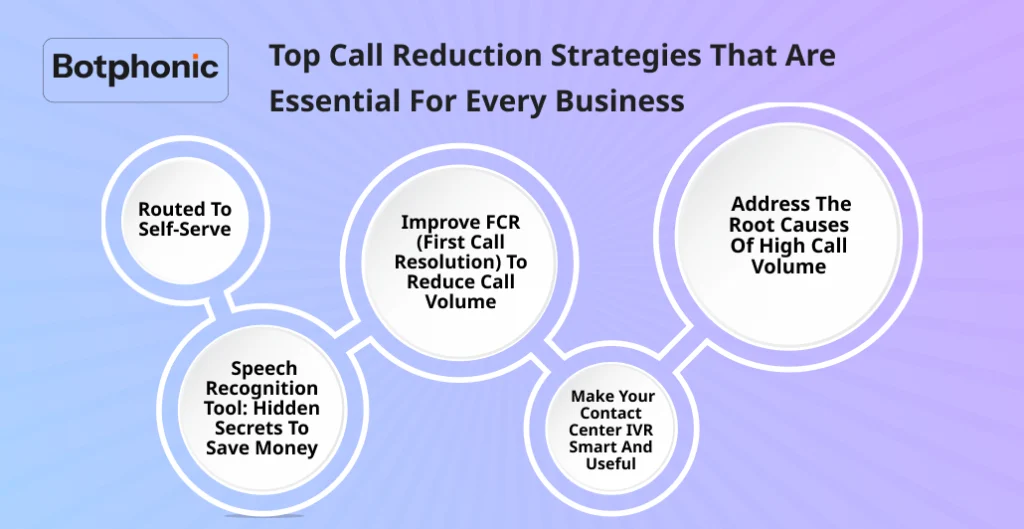
Strategies to deflect customer support calls, identify common call intents, use AI voice agents and conversational IVR, improve first-contact resolution, offer SMS alternatives, and reduce call volume through root-cause fixes.

1. Deflect Callers to Self-Service at Intent

Self-service deflection is based on the idea of defining the intent of the caller before they’re in the queue, and then connecting them to the channel that can address the issue automatically. The first step is to audit the top 10 most common inbound search terms weekly. Usually, 40-60% of your call volume falls into 5-8 recurring categories: orders, passwords, appointments, billing and basic product questions.

Knowing the top drivers, you can create self-service processes for each: knowledge base articles for informational calls, automated SMS/email follow-ups for status updates, and AI customer service agents for conversational support. In fact, Salesforce’s State of Service report finds 43% of customers are already comfortable with self-service for basic issues – and 41% prefer access to knowledge base articles over speaking to a human.

Actionable step: This week, check your contact reason report for the top 10 call drivers. For each, ask: “Can this be done without human interaction?” If so, create a deflection strategy. Beg with the top two categories.

Try Botphonic AI Customer Service

2. Use an AI Voice Agent (IVR with Natural Language)

Old IVR systems don’t work because they require callers to press buttons. AI voice agents employ natural language processing (NLP) and speech recognition to interpret what a caller says. The callers say “I want to check my delivery status,” and the AI agent solves the problem by looking up the order status and hangs up automatically.

The latest industry research shows that AI voice agents resolve a large proportion of simple, tier-1 calls – those repetitive, information look-ups that take the most time for agents but require the least human intervention. For call centres that handle hundreds of phone calls per day, this is the best bang for the buck in deflection.

Botphonic’s AI call centre platform answers tier-1 calls 24 hours a day, is integrated with your CRM, and escalates to agents when the question is too complex to resolve – ensuring an excellent customer experience for complex queries.

Call to action: Measure your IVR hang-up rate. If customers terminate calls while navigating your IVR at a rate higher than 15%, your IVR is not enabling, but preventing, deflection. A speech-enabled AI agent can help here.

See Botphonic AI Call Centre

3. Reduce return calls by improving first-contact resolution (FCR)

First-contact resolution (FCR) and call deflection go hand in hand. FCR is about calls that do reach agents; deflection is about calls that don’t reach agents. Both cut the call volume pie in two.

The target FCR goal is 70-75% (ICMI). Contact centers that fall below this benchmark create a greater volume of repeat calls from the same customer, who called back because they didn’t receive a solution on their initial call. Every repeat call is a deflection opportunity missed.

To boost FCR: build a shared knowledge base and AI-powered response recommendations for agents, use post-call surveys to detect unresolved contacts and build pathways to escalate complex issues to get them to the right place first time. Improving FCR will reduce inbound call volume – which will increase your call deflection rate.

Note Icon NOTE
If your FCR is less than 70%, cutting down on repeat contacts will do more to reduce call volume than a new deflection channel. Improve FCR, add self-service.

4. Conversational IVR: Smarter than a Smart IVR

Traditional IVR is heavy handed. AI-enabled conversational IVR turns the phone channel into a smart self-service channel. Rather than “Press 1 for billing, Press 2 for technical support” menus, callers express their problem in natural language and the IVR resolves it.

Smart IVR can support multiple deflection patterns: it can automatically verify callers (skipping a step in the call flow), read information from accounts (answering balance or status questions in-channel), and provide proactive callbacks (deflecting from hold), and escalate to the right AI or human agent when necessary.

Botphonic’s AI IVR uses intent recognition to match spoken input to resolution paths, to reduce IVR abandonment and increase containment rates without sacrificing customer experience.

Quick win: Prepend the option “Would you like us to text you the answer?” to your IVR. For questions about account status, this one prompt can save 10-20% of calls to go into an automated SMS response (no AI needed).

5. Deflect by Addressing Inbound Volume

The most effective deflection approach is addressing the cause of the issue. Root-cause analysis (RCA) of inbound calls identifies issues that, once fixed, will permanently deflect calls.

For example, a healthcare provider that received 1,000 inbound calls found 40% of the calls came from patients resetting passwords for their patient portals. Enhancing the portal with a self-service password-reset feature eliminated the calls – no IVR or chatbot required. This happens everywhere: calls about delayed shipments go down when carriers send out delivery SMSes; calls about confusing bills go down when bills are re-designed to be clearer.

Do a monthly contact-reason report. Discover your top 5 repeat offenders. For each, ask if eliminating the root cause (improving notifications, UX or outreach) makes sense before implementing a deflection layer. Deflection addresses the leftovers; identifying and eliminating root causes reduces the volume.

Pro Tips PRO TIP
Extract your 5 top contact reasons. List whether the driver is upstream (poor notification, poor UX) or inherent (customer needs the help). Only develop deflection flows for inherent drivers – address upstream issues upstream.

Call Deflection Rate Formula & Benchmarks

Explanation of call deflection rate with formula, example calculation (30%), and typical benchmark ranges by industry, showing how effectiveness varies based on complexity and customer needs.

Call deflection rate is the key performance indicator (KPI) for the effectiveness of your self-service program. This is the rate at which your inbound contact attempts are deflected (resolved) without an agent.

Call Deflection Rate FormulaDeflection Rate = (Deflected Calls ÷ Total Inbound Attempts) × 100Example:1,000 inbound call attempts300 resolved by AI / self-service700 reached live agents→ Deflection Rate = (300 ÷ 1,000) × 100 = 30%

Deflection rates vary widely from one industry to another, depending on the complexity and sensitivity involved with each customer inquiry. Here is an indicative range for deflection rates as found in studies conducted by ICMI and CCWeek, among others:

IndustryTypical Deflection RateWhy?
SaaS / Technology30–50%Tech-savvy customers, high self-service comfort, many FAQ-resolvable issues
Retail / E-commerce25–40%High volume of order-status, returns, and tracking queries — all easily automated
Financial Services20–35%Moderate — balance checks and card blocks deflect well; complex advice requires humans
Healthcare15–25%Patients often prefer human reassurance; emotional stakes limit forced deflection

Why Call Deflection Fails – and How to Avoid It

Common reasons call deflection programs fail, misusing bots in emotional situations, poor knowledge base design, agents bypassing self-service, and lack of analytics plus emphasis on balancing automation with human support.

The root cause of most call deflection program failures is not that deflection is a bad idea, but that it’s not done right. Contact centers with deflection rates of 15% or less tend to have one or more of the following flaws:

1. Deflecting for Emotional Reasons

When customers call about a bill, a health concern or a missed delivery, they are likely to be stressed. It seems dismissive to send them to a bot. Good deflection provides options

2. Poorly Indexed Knowledge Base

If you don’t provide easy to find answers, they’ll want to call. An unmaintained, untagged and non-searchable knowledge base actually creates calls.

3. Agents Reversing the Deflection

If agents reverse the deflection process by transferring calls from self-service channels because it’s easier to perform processes on the phone, the deflection rate implodes. Agents’ processes and incentives need to align to deflection.

4. No Analytics on What Got Deflected

Without deflection data, teams can’t tell which queries were deflected, which weren’t. Without deflection analytics, you can’t see the gaps, flows, or intents that aren’t working. The key to successful call deflection: choice + great self-service + AI that defers elegantly to a human when it can’t help. 

Without any of these three, deflection is frustrating. 

Top Call Deflection Tools Ranked for Performance in 2026

Comparison of top call deflection tools in 2026 ranked by use case, including Botphonic for voice-first AI deflection, Dialpad AI for real-time coaching, Genesys and NICE CXone for enterprise contact centers, and Intercom, Zendesk, and Talkdesk for digital and mid-market support automation.

There is no tool comparison in any of the top-ranking call deflection articles – this is your opportunity. Here’s a look at the top players, ranked for deflection:

1. Botphonic 

  • Best for: SMB – mid-market voice deflection
  • Artificial intelligence (AI) voice agent that answers tier-1 calls 24 hours a day, seven days a week, integrates with CRMs and booking platforms, and knows when to hand off calls to human agents. Designed for call deflection – not conversation.
  • From $0.40/min or $22/mo

2. Dialpad AI

  • Best for: Mid-market contact centers
  • AI coaching in real time, real-time transcription and call summarization. Enhances calls handled by agents while the AI Contact Center product provides deflection and self-serve flows.
  • Per-seat SaaS

3. Genesys Cloud CX

  • Best for: Enterprise contact centers
  • Predictive routing, AI-infused journey analytics and omnichannel orchestration for enterprise. A powerful deflection solution with many advanced features and deep CCaaS expertise. 
  • Custom enterprise pricing

4. Webex Contact Center

  • Best for: Cisco-stack enterprises 
  • AI-powered agent assist, deflection across multiple channels, and tight integration with the Cisco ecosystem. A good choice for businesses using Cisco communications infrastructure looking for deflection in a unified communications environment.
  • Custom enterprise pricing

5. Intercom Fin AI

  • Best for: Digital-first CX teams
  • Deflect chat and email tickets with an AI agent. Fin automates responses from help center articles – ideal for SaaS and digital businesses with high chat volume and established help center.
  • $0.99 per resolution

6. Zendesk AI

  • Best for: Help-desk teams
  • Article suggestion and Answer Bot for ticket deflection, using the knowledge base. Great for teams that receive the bulk of their inbound requests via help-desk tickets.
  • Per-seat SaaSS

7. Salesforce Service Cloud

  • Best for: CRM-native CX teams
  • Einstein AI bots and knowledge management. Best for teams with a contact center that is tightly integrated with Salesforce CRM – deflection is part of a customer data ecosystem.
  • Custom enterprise pricingg

8. Five9

  • Best for: Inbound + outbound blended centers
  • Visual IVR designer Studio (to build IVR and voice bot), good IVR deflection rate analytics. Ideal for teams who want to be able to control their IVR deflection flows without significant development costs.
  • Per-seat SaaS

9. Talkdesk 

  • Best for: Mid-market contact centers
  • Talkdesk Bot to manage calls and integration with Knowledge Articles for self-service. Nice mix of easy deployment and deflection reporting for expanding contact center teams.
  • Per-seat SaaS

10. NICE CXone

  • Best for: Large enterprise contact centers
  • Enlighten AI for self-service, predictive engagement and omnichannel orchestration. A very robust enterprise call deflection platform – great for 500+ agent seats. 
  • Custom enterprise pricing

To see how much deflection will save you, try the Botphonic ROI Calculator – free and instant?

Conclusion: Start Deflecting Smarter in 2026

Call deflection is no longer a luxury for contact centers it’s the key control lever to drive down the cost of contact while scaling improved customer experience. The five strategies outlined above cover all aspects of the inbound call cycle: avoiding calls that shouldn’t be there, deflecting routine calls to self-service, and solving complicated calls more quickly when agents are needed.

In 2016, the contact centers that will be the most successful aren’t those with the most agents, but those with the smartest deflection strategy. That is, AI voice agents that answer tier-1 calls 24/7, knowledge bases that actually work, natural language IVRs, and analytics to tell you what is being deflected and what is slipping through the cracks.

Three things to do this week:

First, get your top 10 contact reasons and determine which are ripe for deflection. Second, compare your call deflection rate to the industry standards above (if you don’t know your rate, that’s the first issue to address). Third, pull your deflection rate up by 10 percentage points and calculate the financial return on investment (ROI) with the calculator below.

Calculate Your Call Deflection Savings

Calculate the exact savings of moving your call deflection rate – in 30 seconds.

Book a Demo

F.A.Q.s

Call deflection is the practice in contact centers of deflecting inbound caller queries to a less costly channel or medium – such as a chatbot, knowledge base article, IVR-based self-service solution or a conversational AI voice agent – before they reach a live agent. Skilled call deflection can lower call volume by 20-40%, and cost per interaction by 80%, allowing agents to handle more complex and profitable interactions.

Call deflection rate is determined by the percentage of inbound calls that are answered by self-service rather than a live agent. Deflection Rate = (Deflected Calls ÷ Total Inbound Attempts) x 100. Benchmarks range from 15-50% across industries – SaaS/tech can be as high as 50% (inbound) and healthcare as low as 15-25%.

Call containment is when the caller remains on the IVR/bot and their issue is solved without human interaction – there’s no channel shift. Call deflection transfers the caller to another channel (chat, knowledge base, AI voice agent). Containment is a form of deflection – the caller doesn’t speak to an agent, and deflection involves a change in channel.

To boost your call deflection rate: use AI-powered voice agents or chatbots for level-1 inquiries, create and update a searchable knowledge base, integrate natural language processing into your IVR, root cause the reasons for repeated calls and resolve them, and track your deflection rate weekly to spot content and flow gaps.

Examples include: directing callers who want order statuses to an SMS update, deflecting callers who want to reset their passwords to a self-service website, sending callers who want appointment reminders to an AI voice agent, and deflecting callers who want to know their bills to a chatbot that reads account information. In each scenario the customer receives a solution without speaking to a live agent.

Deflection Rate = (Deflected Calls ÷ Inbound Call Attempts) x 100. For instance, 1,000 inbound attempts, 300 answered by self-service = 30% deflection rate, with 700 calls reaching live agents. Monitor this weekly and aim to increase by 5-10% every three months.

If done right, call deflection increases satisfaction – customers can get an answer instantly, any time of day or night, with no hold music. When done poorly (deflecting for complex or emotionally-charged queries), satisfaction falls. It’s important to make deflection an option, not a dead end, and to ensure that the self-service route actually answers the question (rather than pushing off a live agent interaction).

Critical call deflection KPIs are: deflection rate (%), self-service success rate, first-contact resolution (FCR), cost-per-interaction before/after, CSAT on deflected interactions, and re-contact rate (how many callers call back within 24-48 hours after deflection, which suggests deflection failure).

The best call deflection software in 2026 is Botphonic (AI voice agent), Dialpad AI, Genesys Cloud CX, WebEx Contact Center, Intercom Fin AI, Zendesk AI, Salesforce Service Cloud, Five9, Talkdesk, and NICE CXone. The right tool will depend on your team’s size, budget and whether you need voice, chat or omnichannel deflection.

Human-agent interactions range from $6-$12 per interaction; AI interactions (deflections) range from $0.10 – $0.50. This represents an 80%-90% cost savings per call. Assuming a 30% deflection rate for 10,000 calls per month, a contact center can save $15,000-30,000 per month (equivalent to $480+ paid-search value for 30 clicks on high-intent contact-center-as-a-service keywords).

Ticket deflection is the online support form of call deflection: solving a customer’s issue via a chatbot, knowledge base, or AI agent before creating a support ticket or routing it to an agent. Call deflection and ticket deflection both lower the live-agent load and cost of providing support: they are part of a self-service containment approach.

Channel switching is initiated by the customer – the caller hangs up and moves to chat or email. Call deflection is contact-center-initiated – it is the call center that will offer or move the caller to a different channel before being connected to an agent. In both, the caller doesn’t talk to an agent, but deflection is a measurable program; channel switching is customer-initiated.