
Summarize Content With:
What You’ll Learn
- How ai agent workforce customer service is reshaping modern support operations
- Why the shift from human-only teams to AI Workforce is accelerating in 2026
- How Workforce Automation and AI-powered Workforce Management improve efficiency
- The difference between traditional support teams and a digital workforce
- How companies deploy Automated Workforce Solutions at scale
- Real-world structure of Workforce automation software in enterprise systems
- Why “AI agents as employees” is the new operating model for customer service
Agentic Workforce Reality in 2026
Customer service is undergoing a structural transformation that goes far beyond chatbots or basic automation.
In 2026, companies are no longer asking how to reduce support costs.
They are asking how to design an effective AI workforce that operates alongside humans.
This shift introduces a new operational model called ai agent workforce customer service, where AI agents are not tools but active digital employees inside a structured AI Workforce system. Unlike traditional automation, these systems are managed like real teams.
They have:
- Roles
- Escalation paths
- Performance metrics
- Workflow ownership
- Resolution accountability
This is the foundation of modern Workforce Automation and AI in Workforce Management.
According to Deloitte’s 2025 Digital Operations Report, companies using AI-driven service automation reduced first-level support load by 32–57%, while improving resolution speed by up to 41%. The implication is clear. Customer service is becoming a digital workforce problem, not a staffing problem.
What Is AI Agent Workforce Customer Service?
AI agent workforce customer service refers to a structured system where AI agents function as operational units inside a managed service environment.
They are responsible for:
- Answering customer queries
- Handling repetitive requests
- Executing workflows
- Updating CRM systems
- Resolving Tier-1 issues
- Escalating complex cases
This is not simple automation. It is a digital workforce that behaves like a scalable support team.
Why AI Agent Workforce Customer Service Is Emerging Now
The shift toward an AI agent workforce in customer service is not happening by accident. It is being driven by clear structural pressures across demand, cost, and technology capability that are reshaping how modern support operations are built.
1. Rising Service Demand
Customer service workloads have increased significantly in recent years. Across US enterprise benchmarks, customer interaction volumes have grown by approximately 40% over the last five years. This growth is driven by more digital products, higher customer expectations, and increased reliance on real-time support across channels like voice, chat, and messaging.
At the same time, customers expect faster response times and 24/7 availability. This creates pressure on traditional contact centers, which must scale headcount just to maintain service levels, even before considering improvements.
2. Labor Cost Inflation
Operational costs for human support teams have also risen sharply. In major US metro-based contact centers, agent costs have increased by roughly 18-25%, driven by wage inflation, hiring challenges, training requirements, and high turnover rates.
This makes scaling traditional support teams increasingly expensive. Many organizations now find that adding human capacity does not scale linearly with business growth, especially when demand is unpredictable or seasonal.
3. AI Capability Expansion
At the same time, AI systems have reached a new level of capability. Modern large language models (LLMs) can now perform multi-step reasoning, execute tools and APIs, manage contextual conversations, and make real-time decisions based on customer intent.
This means AI is no longer limited to scripted responses or basic automation. It can now handle end-to-end workflows such as resolving queries, routing issues, updating systems, and escalating only when necessary.
The AI Workforce Operating Model
Modern enterprises are moving away from traditional “teams of agents handling all interactions” and shifting toward a layered system where AI and humans work together as a unified workforce.
Instead of every customer interaction being routed directly to a human agent, AI now handles the first level of resolution, decisioning, and routing. Humans are engaged only when complexity, emotion, or exceptions require judgment.
This creates a structured AI-first operating model that improves scalability, reduces cost, and increases consistency across customer service operations.
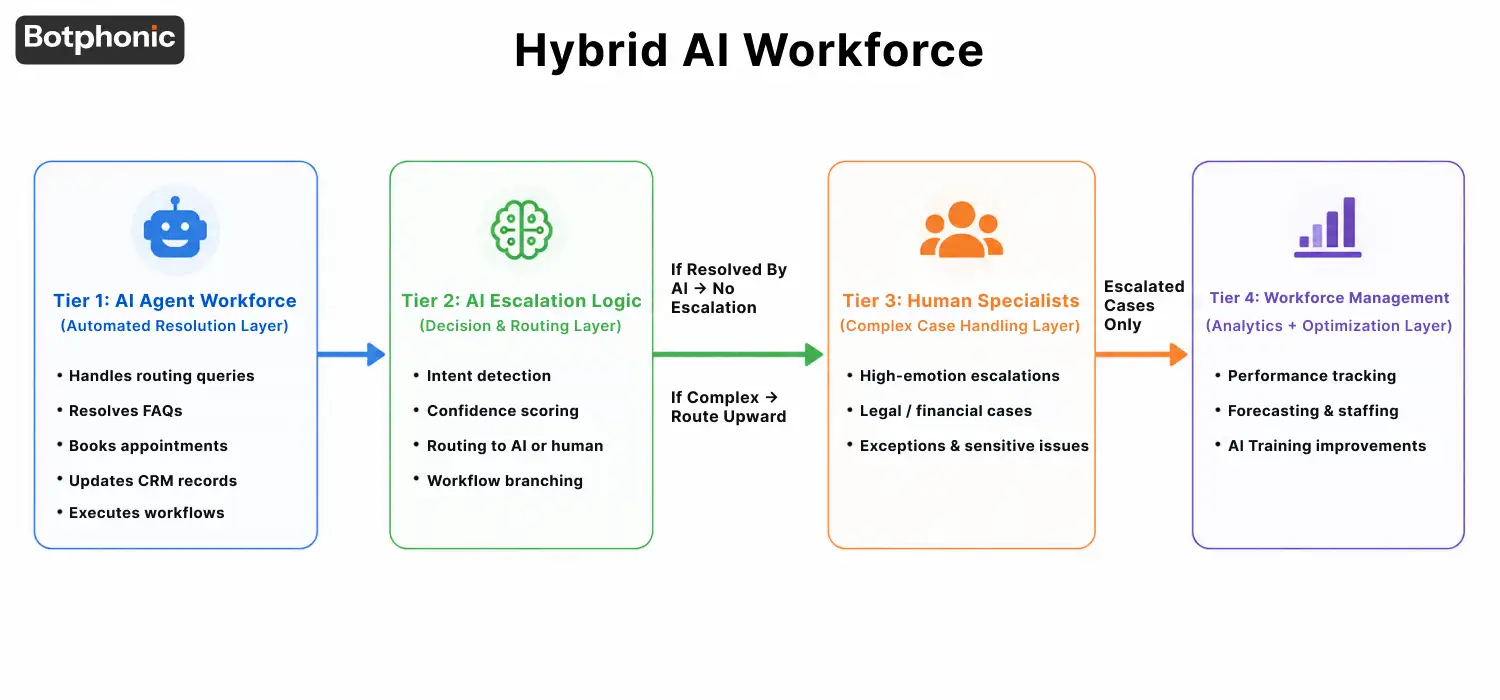
AI + Human Workforce Architecture
How the Model Works in Practice
In this structure, most customer interactions never reach a human agent. The AI agent workforce handles the majority of Tier 1 tasks, including repetitive queries, transactional requests, and basic support workflows.
If the AI Customer Service is confident in resolving the issue, the interaction is completed automatically. If not, the escalation logic layer evaluates intent, context, and complexity before deciding whether to continue with AI resolution or transfer the case to a human specialist.
Human specialists focus only on high-value or high-complexity interactions such as legal disputes, financial exceptions, or emotionally sensitive customer issues. This ensures human expertise is used where it has the greatest impact.
Above all layers sits the Workforce Management layer, which continuously analyzes performance data, identifies gaps, improves AI models, and optimizes staffing and routing decisions over time.
Why This Model Is Becoming the Standard
This layered structure is emerging as the 2026 standard because it solves three core enterprise challenges:
- It reduces dependency on linear headcount scaling by shifting routine workloads to AI.
- It improves consistency by standardizing responses and workflows through AI systems.
- It increases operational intelligence by continuously feeding performance data back into optimization systems.
Instead of treating AI as a replacement for human agents, organizations are now designing hybrid workforce systems where AI Answering Service handles volume, humans handle complexity, and analytics continuously improve both.
The result is a more scalable, efficient, and intelligent customer service operating model.
AI Workforce vs Traditional Customer Service Teams
| Category | Traditional Workforce | AI Workforce |
| Scalability | Limited by hiring | Instant scaling |
| Availability | Shift-based | 24/7 continuous |
| Cost structure | Fixed labor cost | Variable + lower marginal cost |
| Consistency | Human variability | Standardized responses |
| Speed | Moderate | Real-time response |
| Error rate | Medium | Low with controlled workflows |
| Workforce model | Human agents | Digital workforce + AI agents |
Core Transformation Layer For AI in Workforce Management
AI in Workforce Management is emerging as the central intelligence layer that governs how work is distributed between AI agents and human employees. Instead of relying on static rules or manual scheduling, modern systems use AI-driven decision-making to dynamically control how customer interactions are handled in real time.
This layer acts as the operational “brain” of the entire AI workforce model, ensuring that every interaction is routed to the most efficient resolution path based on intent, complexity, urgency, and system capacity.
What This Layer Controls
AI-powered Workforce Management systems manage several critical operational functions:
Task Distribution
Workloads are automatically assigned between AI agents and human specialists based on skill, availability, and complexity of the request. This reduces bottlenecks and ensures faster resolution.
Queue Optimization
Instead of simple first-in-first-out queues, AI Call Center continuously reorders tasks based on priority, SLA risk, customer value, and predicted resolution time.
Escalation Routing
When AI agents cannot resolve an issue with high confidence, the system intelligently routes the interaction to the right human agent or specialist team.
SLA Enforcement
Service-level agreements are actively monitored and managed in real time. AI systems can detect potential SLA breaches early and adjust routing or prioritization to prevent delays.
Performance Tracking
Every interaction is measured across resolution time, accuracy, customer satisfaction, and effort. This data feeds back into the system to improve future decision-making.
Workforce Automation vs Workforce Intelligence
| Aspect | Workforce Automation | Workforce Intelligence |
| Core Focus | Execution of predefined tasks | Decision-making and optimization |
| Primary Role | “Do the work” | “Decide how work should be done” |
| Functionality | Handles repetitive workflows automatically | Evaluates context, intent, and priority before action |
| Example Use Case | AI answers billing FAQs | AI determines if billing issue needs human escalation |
| Input Dependency | Rule-based or scripted triggers | Data-driven and context-aware signals |
| Flexibility | Low to medium (fixed workflows) | High (adaptive and dynamic decisions) |
| Scaling Behavior | Scales execution volume | Scales decision quality across systems |
| Failure Point | Breaks when edge cases increase | Reduces failures by adapting routing logic |
| Business Impact | Reduces manual workload | Improves accuracy, efficiency, and resolution quality |
How AI Agent Workforce Customer Service Works
- Customer Initiates Contact: The customer reaches out via voice call, chat, or messaging to request support, ask a question, or complete a transaction.
- Intent Detection by AI Agent: The AI system analyzes the message or speech to identify the customer’s intent (e.g., billing issue, booking request, order status, complaint).
- Context Retrieval: The AI pulls relevant data from connected systems like CRM, order databases, or billing platforms to understand customer history and current status.
- Instant Resolution: For routine queries, the AI provides an immediate answer or solution without any human involvement.
- Workflow Execution: If the request requires action, the AI executes business workflows such as refunds, appointment scheduling, ticket creation, or data updates.
- Decision Check / Confidence Scoring: The system evaluates whether the issue is fully resolved or if confidence is low based on complexity or missing data.
- Escalation to Human Agent: Complex, emotional, or low-confidence cases are routed to human specialists with full context passed along.
- Outcome Logging into Workforce System: Every interaction is recorded in the Workforce Management system for tracking, analytics, and continuous optimization.
- Continuous Learning Loop: The system uses interaction data to improve intent detection, routing accuracy, and resolution efficiency over time.
This step-by-step flow ensures higher automation coverage, faster resolution times, and improved first-contact resolution rates across customer service operations.
 NOTE
NOTE
The biggest mistake companies make is treating AI agents as add-ons.
In reality, AI agent workforce customer service is becoming the core operating system of modern support organizations.
Key Capabilities of Modern AI Workforce Systems
Modern AI workforce systems are designed to go beyond basic automation. They function as intelligent decision-making layers that coordinate customer interactions, business workflows, and human escalation in real time.
1. Real-Time Decisioning
Modern AI systems can analyze customer intent, context, and urgency instantly and decide the best resolution path without delays. Instead of following static scripts, they evaluate multiple possible actions in real time such as resolving the issue immediately, retrieving additional data, or escalating to a human agent.
This reduces response time significantly and ensures customers are guided to the fastest possible resolution path.
2. CRM-Native Integration
AI workforce systems are deeply integrated with platforms like Salesforce, HubSpot, Zoho, and other enterprise CRMs. This allows them to automatically:
- Update customer records after each interaction
- Log call outcomes and conversation history
- Pull real-time customer data during conversations
- Trigger follow-up tasks or workflows
This eliminates manual data entry and ensures every interaction is accurately recorded in business systems.
3. Multi-Channel Handling
Modern AI systems unify customer interactions across multiple channels, including voice calls, chat, SMS, and email.
Instead of treating each channel separately, they maintain a consistent customer profile and conversation history across all touchpoints. This ensures customers receive seamless support regardless of how they choose to engage.
4. Context Retention
One of the most important capabilities is the ability to retain context across sessions and interactions. AI systems remember previous conversations, customer preferences, and issue history. This allows them to provide more personalized and accurate responses without requiring customers to repeat information.
Context retention significantly improves customer experience and reduces friction in support interactions.
5. Escalation Intelligence
Unlike traditional systems that route calls based on simple rules, modern AI workforce platforms use intelligent escalation logic.
They evaluate factors such as:
- Issue complexity
- Customer sentiment
- Confidence level of AI response
- Business priority
Based on this analysis, they determine whether to resolve the issue autonomously or escalate it to the most appropriate human specialist. This ensures that human agents are only involved when necessary, improving efficiency and reducing unnecessary workload.
Cost Efficiency: Human vs AI Workforce
| Cost Factor | Human Workforce | AI Workforce |
| Per Interaction Cost | High, due to salaries, incentives, and per-agent operational expenses. Each additional customer interaction directly increases cost. | Low, since AI systems can handle thousands of interactions simultaneously with minimal incremental cost per interaction. |
| Training Cost | Continuous investment required for onboarding, retraining, upskilling, and process updates. High employee turnover increases recurring training expenses. | Minimal ongoing updates needed. AI models improve through periodic retraining, prompt updates, and workflow optimization rather than full retraining cycles. |
| Scaling Cost | Linear scaling model adding more customer volume requires hiring more agents, increasing infrastructure, HR, and management costs proportionally. | Near-zero marginal scaling cost—AI systems can handle increased volume without proportional increases in workforce size or operational overhead. |
| Error Correction Cost | High cost due to manual rework, customer callbacks, supervisor intervention, and quality assurance processes. Errors often impact customer satisfaction directly. | System-based correction through model updates, workflow adjustments, and rule optimization. Errors can be fixed centrally and deployed instantly across all interactions. |
Role of Workforce Automation Software
Workforce automation software acts as the central control layer that coordinates how work is assigned, executed, and monitored across AI systems and human teams. It ensures that customer interactions and internal tasks are handled efficiently without manual intervention at every step.
- It enables AI-human collaboration by allowing both AI agents and human employees to work within the same system, with clearly defined roles and seamless handoffs when escalation is required.
- It supports real-time task routing, where incoming requests are automatically assigned to the most suitable AI agent or human specialist based on skill, availability, and complexity.
- Through service orchestration, the software connects multiple systems and workflows, ensuring that tasks such as customer support, billing, and CRM updates are executed in a coordinated manner.
- It also enforces SLA (Service Level Agreement) compliance by monitoring performance in real time and prioritizing tasks that risk breaching defined timelines.
- Finally, it provides automated reporting, giving organizations continuous visibility into performance metrics, workload distribution, and resolution efficiency without manual tracking.
Overall, workforce automation software functions as the operational backbone of the digital workforce, ensuring structure, efficiency, and consistency across AI and human-driven processes.
 PRO TIP
Start by automating Tier-1 workflows first.
Do not replace humans immediately.
Instead, build a hybrid AI Workforce + Human escalation model for maximum ROI.
Key Use Cases of AI Agent Workforce Customer Service
AI agent workforce systems are being widely adopted across industries where customer interactions are high-volume, repetitive, and process-driven. These systems combine automation, decisioning, and workflow execution to reduce dependency on human agents while improving resolution speed and consistency.
1. Banking Support Automation
In banking, Conversational AI For Financial Services handles a large portion of routine customer requests such as balance inquiries, transaction history, card blocking, EMI details, and account updates. These interactions require high accuracy and compliance, making automation especially valuable.
AI workforce systems also assist in fraud detection workflows, where suspicious activity triggers automated alerts and escalations. By integrating directly with core banking systems, AI can complete secure actions while maintaining audit logs for compliance.
2. Telecom Issue Resolution
Telecom companies experience high volumes of repetitive support queries related to network issues, billing discrepancies, recharge status, and plan upgrades. AI Call Center For BPO Services can diagnose common connectivity problems, guide users through troubleshooting steps, and log technical tickets when needed.
Workforce intelligence layers help prioritize outages and escalate large-scale network issues to specialized teams, reducing downtime impact for customers.
3. E-Commerce Order Tracking
In e-commerce, AI workforce systems manage order tracking, delivery updates, return requests, and refund processing. Instead of waiting for human agents, customers receive real-time updates on order status and shipment progress.
AI Voice Agent For Logistics can also initiate return workflows, generate pickup requests, and update logistics systems automatically, significantly reducing support workload during peak shopping periods.
4. Healthcare Appointment Scheduling
Healthcare providers use AI Voice Agent For Healthcare to schedule appointments, manage patient queries, send reminders, and handle basic pre-visit instructions. This reduces administrative burden on staff while improving patient access to services.
Workforce systems ensure appointment slots are optimized, cancellations are automatically filled, and urgent cases are escalated appropriately based on predefined medical rules.
5. SaaS Technical Support
In SaaS environments, AI Voice Agent For Technology & SaaS handle common technical issues such as login problems, password resets, feature explanations, and usage guidance. They can also pull system diagnostics and provide instant troubleshooting steps.
If the issue requires deeper intervention, the system escalates the ticket to the correct technical support tier with full context, reducing resolution time.
6. Insurance Claims Handling
Insurance companies use AI workforce systems to manage claims intake, document collection, policy verification, and status updates. AI Personal Assistant For Insurance guides customers through claim submission processes and validates required information automatically.
More complex cases involving disputes or high-value claims are routed to human adjusters, while routine claims are processed end-to-end by AI workflows.
Across all these industries, AI in Workforce Management systems plays a central role in orchestrating tasks, reducing operational load, and ensuring faster, more consistent customer service outcomes at scale.
Future of AI Workforce (2026 and Beyond)
The future of the AI workforce is moving beyond basic automation toward agentic workforce orchestration, where AI systems not only execute tasks but also manage, decide, and optimize how work is performed across the organization.
Instead of functioning as simple tools, AI systems will increasingly operate as role-based digital employees. These White Label Voice AI Resellers will handle defined responsibilities such as customer support, lead qualification, scheduling, and workflow execution, working alongside human teams as part of a unified workforce.
A major shift will be the rise of autonomous resolution systems, where AI can independently resolve customer issues end-to-end. This includes understanding intent, retrieving context, performing actions like refunds or bookings, and closing cases without human intervention in most routine scenarios.
Another key development is self-healing workflows, where systems automatically detect errors or breakdowns in processes and correct them in real time. Instead of requiring manual fixes, AI Call Routing will reroute tasks, adjust logic, and maintain workflow continuity.
Enterprises will also move toward real-time workforce rebalancing, where AI dynamically distributes workloads between digital agents and human employees based on demand, complexity, and priority. This ensures consistent service levels even during spikes in volume.
Overall, the line between a “software tool” and a “workforce participant” will continue to blur. AI will not just assist employees, it will actively perform, coordinate, and optimize large portions of business operations, forming the foundation of the next-generation enterprise workforce.
Deploy AI agent workforce customer service models to reduce cost, speed up resolution, and automate support end-to-end.
Build a smarter AI Workforce Management system today.
Request a Free Demo