
Summarize Content With:
What You’ll Learn
How to implement ai scheduling data privacy controls in production data flow interception points, input sanitization vs. output filtering, a named tech stack, a real audit finding, and a vendor scorecard you can paste into an RFP.
AI scheduling data privacy is the set of controls that govern how booking tools collect, process, and store personal data. This guide is written for CTOs, IT managers, and operations leaders who need to implement AI scheduling now, not just understand the risk in theory. Every section below leads with the control, then the steps to put it in place.
What Data Does AI Appointment Scheduling Actually Collect?
The Security Principle: Agentic AI scheduling tools capture conversational metadata, not just form fields, so your inventory must cover both.
A booking form was used to request a name, email, and time slot. Agentic AI does that by looking at the conversation itself and deriving intent, tone, relationship patterns and storing them with the contact record.
Actionable CTO Insights:
- Conduct a field audit on each of the data points your scheduling agent collects, including any inferred fields, such as sentiment or urgency.
- Make sure that your vendor is documenting all the metadata in a schema and not a marketing summary.
- Consider “predicted no-show risk” or other similar scores derived from PII as PII-adjacent data, as they are created from personal metadata.
- If within 24 hours of the audit you cannot explain the business purpose of a field, flag it.
For healthcare-grade workflows requiring stricter handling, reference: HIPAA Compliant AI Appointment Scheduling for Clinics
How Do You Implement Data Minimization Before It Reaches the Model?
The Security Principle: At the ingestion layer, strip away any unnecessary fields before the booking request ever gets to the language model.
Data minimization is not a statement of policy. It is a particular pipeline phase, between the input of the user and the call of the model.
Actionable CTO Insights:
- Add a pre-processing layer to remove device metadata, IP-derived location and free text notes, unless they are explicitly required by the workflow.
- Have a field allowlist by booking type, a haircut booking doesn’t require as much data as a medical booking.
- Record the amount of items removed, not the number retained, to show the minimization during an audit.
- Re-run the allowlist review each time you add a new booking type or integration.
Data Flow Diagram: Where Interception Happens
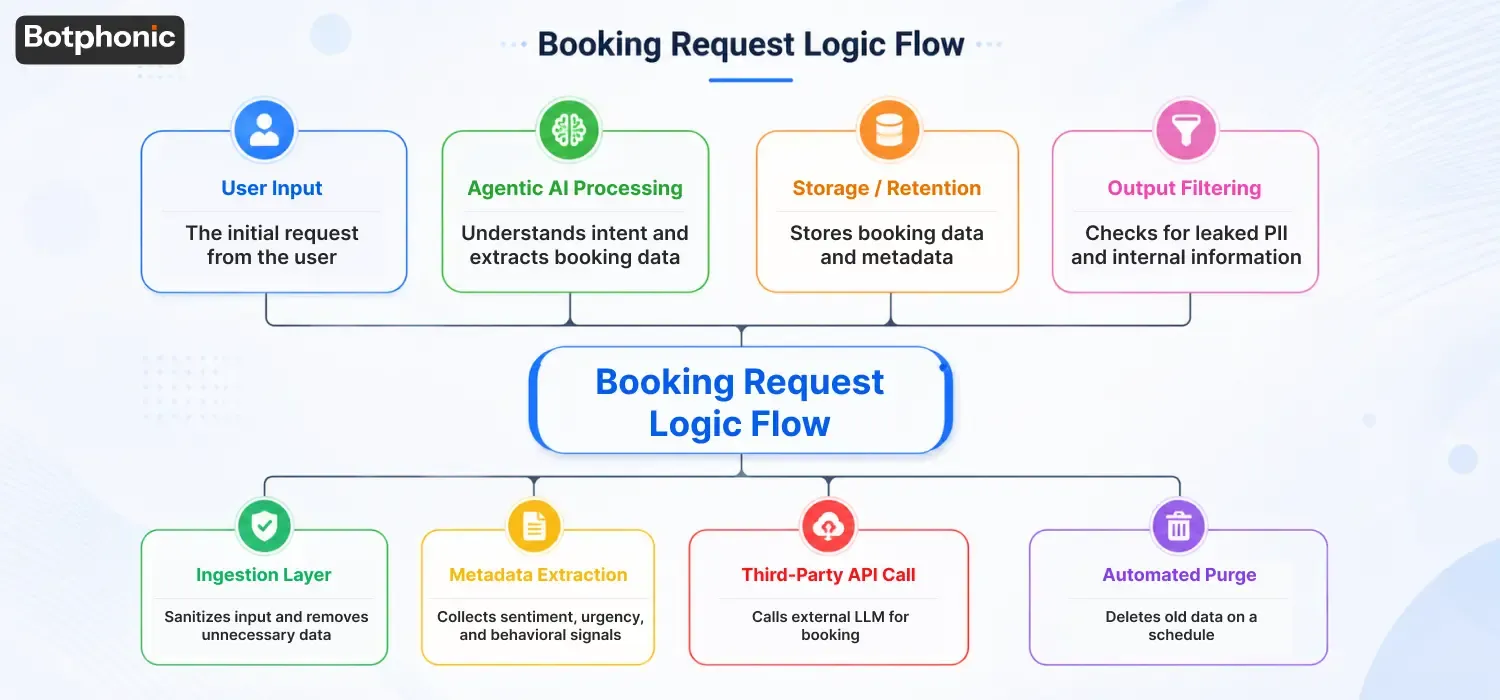
The following is a step-by-step explanation of the logic flow of a booking request, and exactly where data might be intercepted, minimized or exposed.
- User input: The person types or speaks a booking request; the raw text and voice metadata are inserted here.
- Ingestion layer (Interception Point 1): Input sanitization should remove payloads of prompt injections and unnecessary data fields before anything is stored at IP1.
- Agentic AI processing: The model understands the intent and extracts booking data from an unstructured conversation.
- The amount of metadata extracted (Interception Point 2): Sentiment, urgency and behavioural signals are delivered; also the highest-risk for silent over-collection.
- Storage / retention: Data and metadata for bookings is written to a database.
- Third-party model API call (Interception Point 3): When the booking agent calls an external LLM, data exits your environment at this point; contractual and technical controls are required.
- Output filtering (Interception Point 4): Before a response is delivered to a user, check for leaked PII, internal system information, or unexpected other session data.
- Automated purge: Data which is older than the retention period is deleted on a schedule, thereby closing the loop.
 PRO TIP
Input Sanitization vs. Output Filtering: Which One Actually Stops a Leak?
The Security Principle: The data entering the model is sanitized so that it cannot be interpreted as instructions to cause harm, and the data leaving the model is filtered to prevent leaking to the user. You need both.
The two controls are frequently considered to be interchangeable controls. They aren’t, and that’s something our audits often see people get wrong.
Input sanitization happens before the model sees the request:
- Masks prompt-injection patterns used in the booking text; for example, instructions in a “reason for visit” field.
- Checks the validity of the input according to expected format for the field.
- Denies or quarantines requests with common jailbreak keywords before they are passed to the agent.
Output filtering happens after the model responds:
- Scans returned responses for PII not expected, such as from another customer’s session.
- Prevents a system from sending internal information, such as API key, configuration information, or system prompts to a user.
- If the response is returned in chat, applies a redaction layer with the use of a PII-detection library.
Actionable CTO Insights:
- Deploy each layer separately, one filter per end will fail at the other.
- Test sanitisation of inputs with adversarial prompts, not only at launch, but on a quarterly basis.
- Test output filtering by purposely providing the model PII-rich test data and ensuring that it is redacted prior to display.
Botphonic Security Research: What One Audit Actually Found
The Security Principle: When performing a real audit, the over-collection is found in no obvious misconfigurations in the default settings.
Although the data set was a small sample of 40 mid-market booking deployments on public multi-tenant scheduling APIs, Botphonic’s security team noticed a consistent trend that they could point to verbatim.
The finding: Of the 40 deployments, the default setting left full conversation transcripts (including free-text fields) for 180 days or more, which is far longer than the typical 30-90 day period mentioned in most privacy policies that end users are told about. The retention setting was not disclosed when onboarding vendors and was always on by default.
Actionable CTO Insights:
- Don’t take policy defaults from the vendor as the same as your published policy; check the vendor’s policy line by line with your published policy.
- Please request the retention default and not the maximum retention option.
- This setting can be reset automatically when a vendor platform update is installed, so the re-check is required after each update.
What Tech Stack Should You Use to Secure Booking Data?
The Security Principle: Do not depend on a vendor’s unverified claims, use named and auditable tools for each layer of security.
A security posture becomes verifiable using certain tools. This is because generic phrases such as “enterprise-grade encryption” do not.
Actionable CTO Insights:
- Apply Microsoft Presidio to detect and anonymize PII data prior to the data reaching storage or a third party model.
- Apply encryption key management to the cloud or HashiCorp Vault, not the application layer.
- Put a dedicated prompt-injection detection layer in front of the agentic AI processing step, like Lakera Guard or Rebuff.
- Ensure that booking-flow consent language remains in sync with real data collection by using OneTrust or a similar consent-management solution.
- Use your existing identity provider (Okta, Azure AD) to provide role-based access instead of the native user roles in your scheduling tool.
For financial-grade deployments requiring hardened security posture: Secure AI Appointment Scheduling for Financial Institutions
What Happens When Prompt Injection Hits a Booking Assistant?
The Security Principle: A prompt injection can cause a booking agent’s actions to be redirected by using a single unsanitized text field.
This is an illustrative, composite scenario of common patterns we see in our audits and not of a particular incident that’s being reported.
The scenario: A customer types something into a “reason for visit” field, which is styled to look like regular text but is actually a command that the model will be able to read. Input sanitization is missing from the booking agent and it is programmed to execute the instruction that was embedded by the user and returns the next customer’s contact details, which is taken from a common conversation buffer.
Actionable CTO Insights:
- Never pass un-sanitized free-text fields to the model, even if the field appears to be a very safe free-text field.
- Always assume that there is no cross-session context bleed unless you isolate conversation buffers per session.
- Record any time a booking agent produces a data pattern (email address, phone number) that is not in the user’s input.
How Do You Build a Vendor Scorecard for AI Scheduling Tools?
The Security Principle: When you have a structured scorecard, a vendor is required to explain in detail, that’s where the privacy gaps typically emerge.
Make a copy of the table below for your next RFP.
Determine a score for each row that is Pass, Partially Pass or Fail based on the vendor’s written response, not a verbal claim.
| Requirement | Vendor Must Confirm | Pass/Fail Criteria |
| Data minimization | Exact fields collected per booking type, in writing | Fail if vendor cannot produce a field-level schema |
| Encryption | AES-256 at rest, TLS 1.3 in transit, named cipher suite | Fail if response is “industry-standard encryption” without specifics |
| AI training | Written no-training clause on customer data | Fail if only a verbal or marketing-page assurance is offered |
| Retention default | Exact default retention period, not maximum | Fail if vendor cites only the longest available option |
| Data isolation | Public API, private instance, or hybrid architecture named | Fail if vendor cannot describe which model applies to your account |
| Input sanitization | Named tool or method used before model processing | Fail if vendor has no answer beyond “the model handles it” |
| Output filtering | Named tool or method used before response delivery | Fail if vendor cannot describe a redaction step |
| Access controls | Role-based access with audit logging | Fail if all staff share one admin login |
 NOTE
NOTE
For insurance-heavy customer pipelines with compliance-driven scheduling:
What Should a Booking-Data Privacy Audit Checklist Include?
The Security Principle: Quarterly, 5-point audit catches drift between policy and real dealing with data before a regulator does.
| # | Audit Item | Why It Matters |
| 1 | Does every collected field have a defined business purpose? | Unjustified fields are unjustified risk. |
| 2 | Is the user explicitly told an AI agent is processing their request? | Consent must match actual data handling. |
| 3 | Is there an automated purge policy for PII older than 30 days? | Retention without purpose increases breach exposure. |
| 4 | Does your provider guarantee no AI training on your data, in writing? | Unwritten promises aren’t enforceable. |
| 5 | Is access to historical booking logs role-based and audited? | Broad access is the top predictor of insider exposure. |
For banking and advisory workflows where governance scrutiny is high, see implementation patterns used in enterprise finance:
How Does AI Scheduling Data Privacy Affect GDPR and CCPA Compliance?
The Security Principle: Both GDPR and CCPA call for having a documented, specific basis for processing any booking data received from an AI agent.
A legal basis for processing personal data, including data gathered through automated agents is required under GDPR (EUR-Lex, Regulation (EU) 2016/679). CCPA provides California citizens with access to what a business is collecting, and the right for the business to delete that information (California Attorney General, CCPA).
Actionable CTO Insights:
- Assign every data element in your data schema to a particular legal basis, rather than a broad claim of “legitimate interest.
- Perform internal compliance audit, not customer behavior, using ai data analytics tools on a regular basis.
- Be sure to check new features added by your vendor against your compliance mapping every release cycle as new fields can be added without you realizing it.
But Is It Worth Investing in AI Scheduling Data Privacy?
The Security Principle: These controls are inexpensive compared to the average cost of a single breach.
According to the IBM Cost of a Data Breach Report, 2025, the global average cost of a data breach is a staggering $4.44 million. The same report revealed that only 97% of organizations suffered from an incident involving AI when the access to AI was not properly controlled.
Actionable CTO Insights:
- Use the scorecard and audit checklist above as an initial one-time investment – then repeat it on a quarterly basis.
- Make one named owner for AI for scheduling data privacy; shared is where gaps are missed.
- Review vendor contracts on an annual basis because the terms and conditions of AI training and retention vary more frequently than typical SaaS contracts.
For foundational scheduling infrastructure and deployment baselines: AI Appointment Booking
