
Summarize Content With:
Summary
This blog discusses the adoption of the AI voice assistant for booking appointments, AI call assistant, and AI booking in 2025. Here we discuss the market data, technology, use cases, selection criteria, and also how Botphonic.ai is related.
Key Takeaways
- The voice AI booking of appointments and AI call assistant is gradually becoming a major part of the modern scheduling system.
- The robust growth of the market (AI, scheduling) indicates a positive trend for the further development of the AI booking tools.
- One point that clearly emerges in this context is that tools provided with actual integration, security, and analytics must be selected to make effective use of them.
- Humanoid voice is a key feature of Botphonic.ai, enabling you to accomplish voice AI appointment booking; thus, tasks can be managed automatically while increasing productivity.
Introduction
The world is swiftly transitioning to automation. The companies, in 2025, will be dependent on the technologies of the voice AI appointment booking and the AI call assistant to save their time and improve their service.
Though online calendars are still around, they have now become compatible with AI booking and voice systems. These are the ways that users allow themselves to talk to an AI assistant, who is capable of phone calls, confirmation, or instant changing of appointments.
AI scheduling statistics reveal that more than 30 percent of companies have turned to automated systems. Organizations track their success through call pick-up rates, conversion rates, and ROI saved in staff hours.
If you go for voice AI appointment booking, the number of calls that are missed will go down and the number of confirmed appointments will increase. The future is not just online booking anymore, it is voice + online automation.
Learn more: AI Appointment Scheduling Explained Simply
What is AI Scheduling & Appointment Booking?
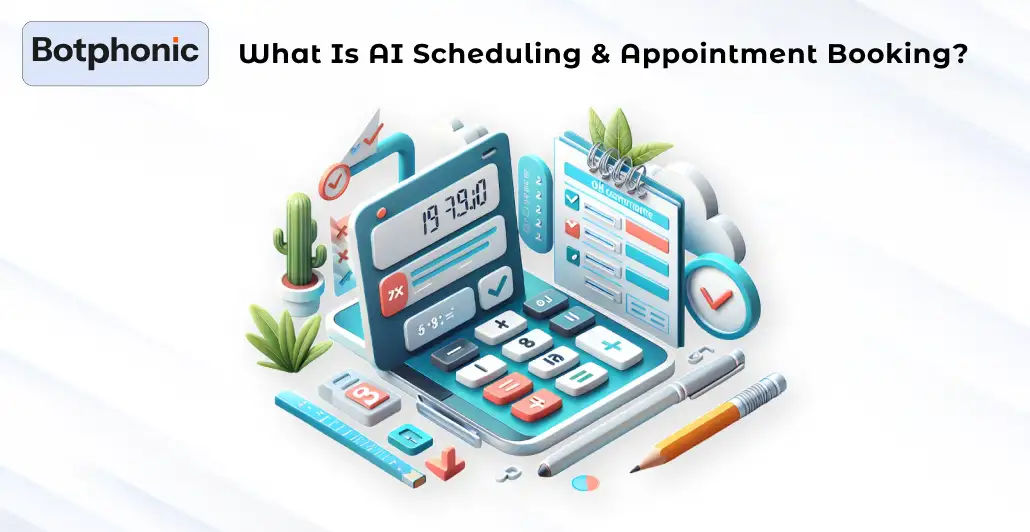
AI scheduling, voice AI appointment booking, and AI booking are tools that simplify the process of setting up meetings or calls. They work automatically.
AI scheduling makes use of adequately intelligent software that views calendars, looks for vacant slots, and confirms an appointment on the spot. It interacts with your schedule and likes or dislikes through natural language processing (NLP).
Voice AI appointment booking innovates further than that. It considers customers talking with an AI call assistant rather than filling out forms. The assistant comprehends speech, provides time slots, verifies the bookings, and even changes the appointment when necessary.
AI booking refers to all the different methods of booking that use technology. The first is an automated voice call system, there are chatbots, and there are forms you can fill out online. All these methods are used to help human beings work less and reduce the time needed for booking.
These tools rely on:
- Speech recognition to understand voice commands.
- NLU to understand the meaning of the caller.
- Calendar and CRM integrations to keep the details up to date automatically.
If one opts for voice AI appointment booking, then the customers would be able to simply make a call, speak, and have the slot allotted in a matter of seconds. AI booking is also an option for message lovers rather than call lovers.
2025 Market Snapshot: Numbers & Trends
According to the latest ai scheduling statistics, the market for automation and booking tools keeps expanding.
In 2025, the demand for voice AI appointment booking, AI call assistants, and AI booking tools will keep going up. Automations were previously luxury items but are now regarded as necessities by enterprises.
One of such reports is the AI scheduling statistics which provide information about the consistent double-digit growth that has been maintained year after year.
Fortune Business Insights states that the market for appointment scheduling software will hit a USD 546.1 million ceiling in 2025. It might be the case that the broader AI market reaches USD 371.7 billion this year (according to MarketsandMarkets).
| Market | 2025 Value | CAGR |
| AI Market | $371.7 Billion | ~30% |
| Scheduling Software | $546.1 Million | 13–15% |
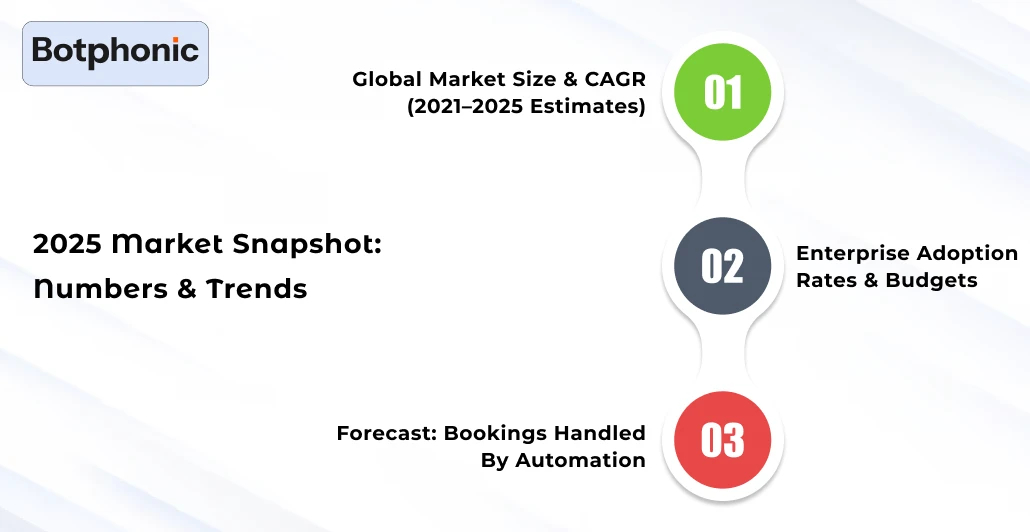
1. Global Market Size & CAGR (2021–2025 Estimates)
AI booking and AI call assistant tools have grown much quicker than traditional software between 2021 and 2025. The data revealed by exploding topics indicates that the market for AI scheduling systems has been growing at a double-digit CAGR, steadily over the last few years.
On average, AI software shows a yearly growth of around 30%, while appointment scheduling goes up 10-14%. The continuous increase of the market proves that voice AI appointment booking is not a product of the niche any longer but is a mainstream business tool.
2. Enterprise Adoption Rates & Budgets
In the year 2025, about 25–35% of enterprises will be active users of voice AI appointment booking or AI call assistant tools. Companies in these three industries, healthcare, real estate, and agencies, will invest 5–15% of their customer service budget into AI booking.
Firms are looking for systems that can easily be integrated with their CRMs, calendars, and telephony. They can, for example, consider Botphoni, which claims not only seamless integration but also a multilingual voice bot with over 200+ integrations.
3. Forecast: Bookings Handled by Automation
The five-year horizon is the time when the voice AI systems, as well as the AI call assistant products, will handle 40–50% of all appointments merely on their own. For instance, an automated call system would take care of inbound calls, reminders, cancellations, and rescheduling.
With continuous improvements in AI systems for booking, consumers will expect to be served at a higher speed and have their appointments without a hitch, but in a very smooth way. The automation trend is not slowing down but, on the contrary, is getting stronger year by year.
How to Choose an AI Scheduling or AI Call Assistant Tool
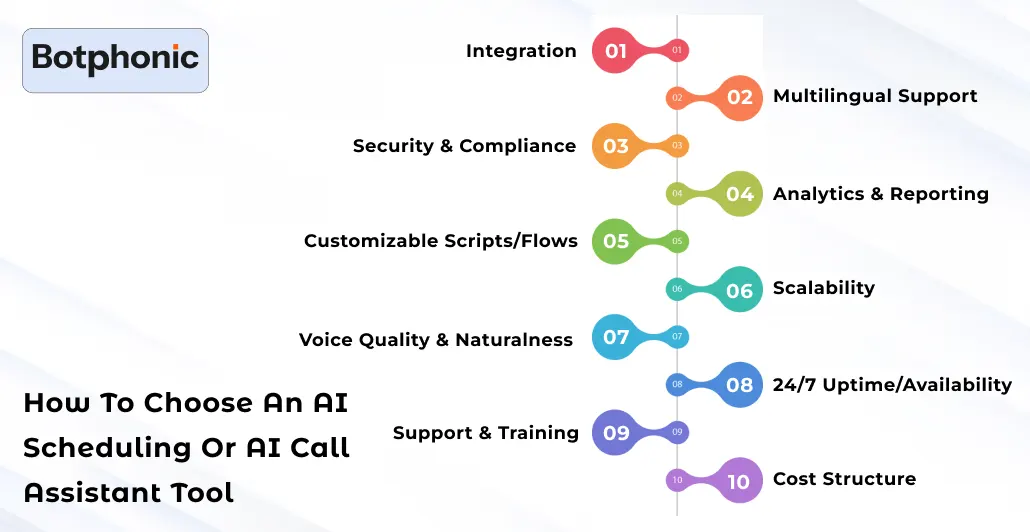
It is a crucial decision when you have to select an AI voice assistant or AI call assistant vendor. The main way to find out is by following these steps.
Requirements Checklist
- Integration: The product should function seamlessly with your calendar, CRM, SMS/Email, and telephony.
- Multilingual support: Supports the maximum number of languages if your clientele is internationally diverse.
- Security & compliance: Measures like Data encryption, GDPR, HIPAA (If needed) are in place.
- Analytics & reporting: Features such as call logs, booking metrics, sentiment, etc.
- Customizable scripts/flows: One should have the ability to create their dialogues and flows according to their needs.
- Scalability: The possibility to scale in call volume.
- Voice quality & naturalness: The AI voice should have a human-like sound.
- 24/7 uptime/availability: The scheduling system should not have any downtimes.
- Support & training: The vendor’s assistance in onboarding and keeping up with maintenance.
- Cost structure: Usage-based, fixed, per minute, etc.
Questions to Ask Vendors
- Do you provide a live demonstration script for voice AI appointment booking?
- What is your SLA for uptime and call quality?
- How long does customisation/training take before you are able to adapt to our flows?
- Can you provide me with the case studies of your company in our industry (healthcare, real estate)?
- What is your process for dealing with fallbacks / human takeovers?
- What security certificates do you have?
- How are you able to react to the sudden spikes in your scaling process?
- What is the number of languages you support?
- Do you have a trial or pilot project?
Is it a call that you will miss?
How about an AI call assistant who is there 24/7 to answer? Scheduling, reminders, and follow-up with clients are what you will be automating with Botphonic.ai. Voice AI appointment booking will simplify your work process, and your effortless bookings will be the growth of your business.
Request a Free DemoConclusion
The latest ai scheduling statistics make it clear: automation is the new standard. Voice AI appointment booking, AI call assistant, and AIi booking tools are not just simple online scheduling of a new generation. In 2025, with AI and scheduling markets soaring, this is the right time to embrace. If you choose a tool like Botphonic.ai, do your integration properly, keep an eye on your metrics, and customize your flows, you not only reduce your cost but also increase your bookings and customer experience as well.
Do you want to upgrade your bookings? Get started with Botphonic.ai and start automating your bookings.
