Summarize Content With:
There’s a moment every solar company lives in — the exact second a homeowner clicks “Get a Free Quote,” calls your number, or submits a form after watching a YouTube ad. That moment is worth hundreds of dollars in ad spend. And in most companies, it vanishes silently into a queue.
The lead sits. The homeowner cools off. Your sales rep calls back 47 minutes later. The homeowner says, “Yeah, I already got a call from SunRun. We’re good.”
This isn’t a team problem. It’s not a training problem. It’s a structural problem one that the AI appointment booking is purpose-built to solve.
This post breaks down exactly how solar companies are compressing the journey from first inbound ping to confirmed calendar booking into under 60 seconds — and why the companies that don’t deploy AI receptionists are quietly hemorrhaging revenue every single day.
The Costly Friction Point Between “I’m Interested” and a Booked Solar Consultation
The High-Intent Window: Why a Solar Lead Vanishes in Under 10 Minutes
A homeowner who just submitted a solar inquiry is at peak intent. They’ve done research, calculated their electricity bill, and decided they want more information. This is not casual browsing. This is commercial intent — and it expires fast.
Research from Harvard Business Review and InsideSales.com found that companies contacting a lead within 1 minute were 391% more likely to qualify them than those who waited 5 minutes. Wait 10 minutes, and your odds of qualifying that lead drop by over 400%.
In solar, the high-ticket nature of the sale and the comparison-shopping behavior of homeowners makes this window even more unforgiving.
The Financial Drain of Inbound Leaks: Calculating the Cost of Delayed Follow-Ups
Let’s put real numbers to this.
| Metric | Industry Average | With Delayed Follow-Up |
| Avg. Cost Per Lead (Solar) | $80–$150 | Same spend, worse outcomes |
| Lead-to-Consultation Rate | 15–20% | Drops to 8–10% after 10-min delay |
| Consultation-to-Close Rate | 25–35% | Unaffected — problem is upstream |
| Revenue Per Closed Deal | $15,000–$25,000 | ____ |
If you’re running 300 inbound leads per month at a 15% booking rate, you’re converting 45 leads. Improve that to 45% with instant AI engagement, and you’re converting 135 leads — without spending one more dollar on ads.
The “Speed-to-Lead” Illusion: Why Your Current Intake Speed Isn’t Fast Enough for Modern Homeowners
Most solar companies think they’re fast. They have a designated intake rep. They have a CRM with lead routing. They have a callback SLA of “within the hour.”
None of that is fast enough.
Modern homeowners — especially Millennials and Gen Z homebuyers now entering the solar market — expect digital-native, instant interactions. According to Salesforce’s State of the Connected Customer report, 83% of customers expect immediate engagement when they contact a company. “Immediate” means seconds, not minutes.
Your current SLA isn’t a competitive advantage. It’s a liability.
The Silent Budget Killer: Why Your Current Lead Capture Methods Are Actually Chasing Homeowners Away
The Webform Fatigue: How Multi-Step Qualification Forms Chase Prospects Away
The average solar company qualification form asks for: name, email, phone, address, utility provider, estimated monthly bill, roof ownership, shading conditions, and sometimes credit score range — before the homeowner has spoken to a single human.
Formstack’s Form Conversion Report shows that forms with more than 3 fields see significant drop in completion rates. Multi-step solar intake forms routinely lose 60–75% of users before the final submission.
The irony: the more rigorously you qualify upfront through forms, the less qualified your actual pipeline becomes — because only the most patient (and often least time-sensitive) leads make it through.
The Human Bottleneck: The Impossibility of Maintaining 24/7 Flash-Response Teams
Hiring human reps to handle inbound 24/7 with sub-60-second response times is mathematically untenable for most solar companies.
A single SDR handling inbound responses costs $45,000–$65,000/year in salary alone. To maintain true 24/7 coverage across time zones with multiple reps, you’re looking at $200,000–$400,000 in annual overhead — before benefits, training, attrition, and management costs.
And even then, a human team can’t guarantee a 60-second response to every inbound lead simultaneously during peak campaign windows.
 NOTE
NOTE
The “Double Chase” Dilemma: Why Inbound Leads Ghost Your Reps During the Call-Back Game
Here’s the sequence no one talks about:
- Lead submits form at 2:14 PM
- Rep sees the lead at 2:47 PM and calls
- Lead is now in a meeting / driving / distracted
- Rep leaves voicemail
- Lead doesn’t call back
- Rep tries again the next morning
- Lead has already booked with a competitor who texted them at 2:15 PM
This is the “double chase” — your rep is now chasing a lead who was, 90 minutes ago, actively ready to book. The intent window has closed. The emotional momentum is gone.
Lead Simple research shows that 70% of leads that don’t get an immediate response never engage with the original company again.
Replacing “Form Fatigue” with Fluid Dialogue: Why Static Fields Kill Intent and AI Keeps It Alive
Inside the 60-Second Conversion Sprint: From Inbound Ping to Live Calendar Confirmation
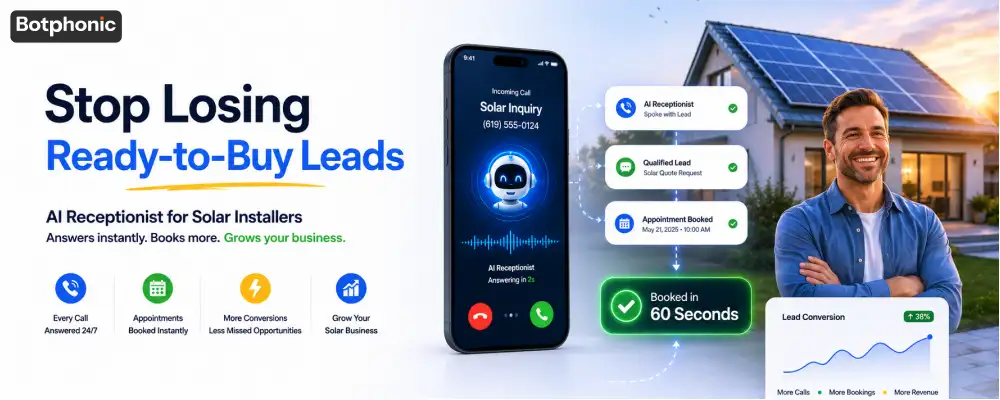
Here’s what a solar company AI receptionist actually does in under 60 seconds:
0–5 seconds: Lead submits form or calls → AI receptionist fires an instant SMS or picks up the call 5–20 seconds: AI greets the homeowner by name, confirms interest, and asks one conversational question (“Are you looking to reduce your electricity bill or go fully off-grid?”) 20–35 seconds: AI appointment scheduler for solar installers qualifies homeownership and property type through natural language — no interrogation 35–50 seconds: AI surfaces available consultation slots based on the nearest solar consultant’s live calendar 50–60 seconds: Homeowner selects a slot → calendar invite fires → SMS confirmation sent
What used to take 3 days of back-and-forth now takes under a minute. And because the homeowner never left the conversation, their intent never cooled.
Overcoming the Instant Drop-Off Traps: Deflecting Real-Time Objections Regarding NEM 3.0, Battery Mandates, and Credit Score Anxiety
AI receptionists trained on solar-specific scripts can handle the three most common cold-feet triggers in real time:
NEM 3.0 Anxiety (California): “I heard the new net metering rules make solar less worth it.” → AI explains that NEM 3.0 shifts value to battery storage and self-consumption, and that your consultants will model exact savings for their specific utility rate.
Battery Mandate Confusion: “Do I have to buy a battery now?” → AI clarifies current state-level requirements and frames storage as an option, not an obligation, while booking the consultation where a specialist can advise.
Credit Score Anxiety: “I don’t know if I’d qualify for financing.” → AI explains that many solar financing options don’t require prime credit, and that the consultation is a no-obligation assessment — not a credit application.
The Engineering Behind the Instant Consultation
Natural Qualification: Verifying Homeownership and Shading Without the Interrogation Vibe
The traditional question asks: “Do you own or rent your home?”
An AI receptionist asks: “Just so our consultant can prepare the right options — is this your primary residence?”
Same data. Zero interrogation energy.
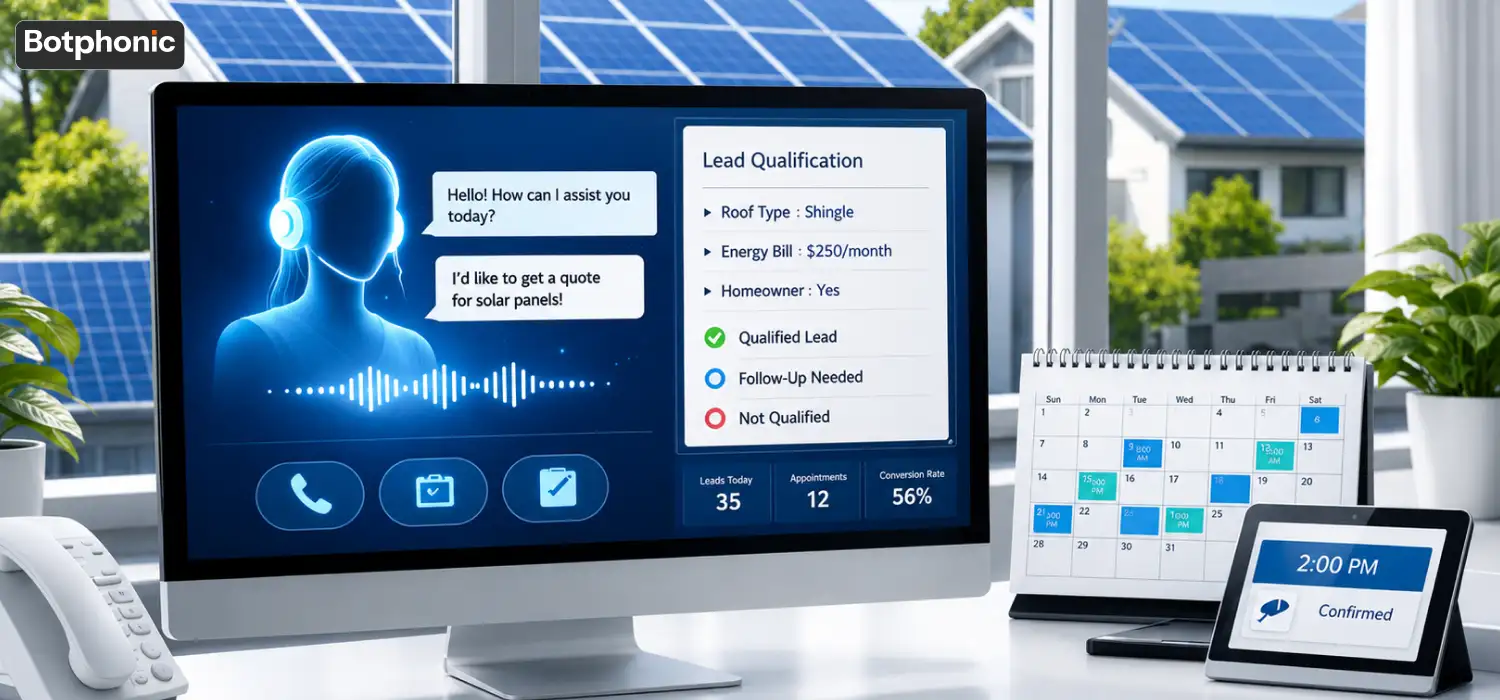
The difference is conversational framing. The AI voice assistant for solar industry solutions built on NLP (Natural Language Processing) models can extract qualification signals — homeownership, roof type, shading, utility provider — through questions that feel like a helpful conversation rather than a bureaucratic checklist.
This matters because research from Drift shows that conversational qualification improves completion rates by 36% compared to form-based qualification for high-consideration purchases.
Smart Data Harvesting: Incentivizing Instant Utility Bill Uploads via Conversation
One of the highest-value actions in solar qualification is getting the homeowner’s utility bill. An AI receptionist can prompt this naturally:
“To make your consultation as specific as possible, you can text a photo of your most recent utility bill to this number. It takes 30 seconds and your consultant will come prepared with real savings projections.”
When framed as a benefit to the homeowner rather than a requirement, utility bill upload rates increase significantly — giving your consultants richer data before they even say hello.
Frictionless Calendar Syncing: Direct Routing to Your Closest Local Solar Consultant
AI appointment booking software for solar companies are easily integrated with CRM and calendar tools (Google Calendar, Calendly, HubSpot, Salesforce) can:
- Pull real-time availability of the nearest local solar rep by zip code
- Surface 2–3 specific time slots (not an open calendar that overwhelms)
- Auto-assign leads based on territory, language preference, or specialty
- Fire calendar invites to both the homeowner and the rep simultaneously
The result: zero scheduling back-and-forth. Zero double-bookings. Zero leads falling through the cracks between form submission and first human contact.
What’s The Financial Return of a Sealed Funnel Leak
Reclaiming the Abandoned Lead: Projecting the Reality of Moving from a 15% to a 65% Lead-to-Consultation Rate
| Scenario | Leads/Month | Consultation Rate | Consultations | Closed Rate | Closed Deals | Avg. Revenue | Monthly Revenue |
| Current (No AI) | 300 | 15% | 45 | 30% | 13–14 | $18,000 | $243,000 |
| With AI Receptionist | 300 | 65% | 195 | 30% | 58–59 | $18,000 | $1,053,000 |
That’s a $810,000 monthly revenue increase on the same ad spend. The only variable changed is the speed and quality of the first-response experience.
These figures are projection-based models; actual results will vary by market, team, and offer. But the directional math is consistent with what conversion rate optimization research at WordStream and solar industry practitioners consistently observe.
Arbitragizing Paid Ads: How Stopping the Drop-Off Instantly Lowers Your CAC Across Meta and Google Campaigns
Your Cost Per Acquisition (CAC) isn’t just determined by what you pay per click. It’s determined by your entire funnel efficiency.
If you’re paying $120 per lead and converting 15% to consultations, your effective Cost Per Consultation is $800.
If you convert 60% to consultations with the same $120 CPL, your Cost Per Consultation drops to $200.
Same Meta budget. Same Google campaign. 75% lower acquisition cost — simply by closing the response gap.
This is what makes AI receptionists one of the highest-ROI investments in solar marketing: they make your existing ad spend dramatically more efficient without requiring creative overhauls, audience changes, or budget increases.
Securing the Show-Up: Leveraging Immediate Post-Book SMS Nurturing to Eradicate “No-Shows”
Booking a consultation is not the finish line. No-show rates in solar average 20–35%, representing thousands of dollars in wasted consultant time per month.
AI-powered SMS nurturing sequences deployed immediately post-booking can reduce no-shows by 40–60%:
- T+0 (Booking confirmation): “Your solar consultation is confirmed for [date/time]. Here’s what to prepare: your last 3 utility bills and any HOA guidelines.”
- T-48 hours: “Your consultation is in 2 days! Your specialist [Name] is reviewing properties in your area. Reply to RESCHEDULE if you need to change your time.”
- T-2 hours: “See you soon! [Name] will meet you at [location/Zoom link]. Got questions? Reply here.”
“The consultation you don’t show up to is the contract you never sign. Automated nurturing isn’t a nice-to-have — it’s the final mile of your close rate.” — Solar sales ops insight from Botphonic.ai practitioners”
The Opportunity Cost Framework: Auditing Your Funnel Leak vs. The Cost of Inaction
The “Leaky Bucket” Calculator: Quantifying Exactly How Much Ad Spend You Waste for Every Minute a Lead Sits Untouched
Here’s a simple audit formula:
Monthly Wasted Ad Spend = (Leads per Month) × (CPL) × (1 − Current Booking Rate)
Example: 300 leads × $120 CPL × (1 − 0.15) = $30,600 wasted every month
That’s $367,200 per year in ad spend that generated interest but never generated revenue. Not because the leads were bad — because the follow-up was slow.
 PRO TIP
The True Cost of Delay: How Giving Competitors a 5-Minute Head Start Devalues Your Cost-Per-Lead (CPL) by 80%
A study by Dr. James Oldroyd at MIT, referenced by Harvard Business Review, found that the odds of contacting a lead decrease by 10× after just the first hour. In a competitive solar market where 3–5 installers are running ads to the same homeowner, a 5-minute delay doesn’t just hurt you — it actively transfers value to whoever calls first.
Your $120 CPL doesn’t expire when the lead goes cold. It just gets credited to your competitor’s revenue report.
| Response Time | Contact Rate | Lead Value Retained |
| Under 1 minute | Very High | approx.100% |
| 1–5 minutes | High | approx. 60% |
| 5–30 minutes | Moderate | ~25% |
| 30 min–1 hour | Low | ~10% |
| 1+ hour | Very Low | ~5% |
The Operational Risk Assessment: Evaluating the Long-Term Overhead of Hiring More Human Call-Handlers vs. Deploying an Instant Scaling Digital Infrastructure
| Factor | Human SDR Team | AI Receptionist |
| Annual Cost | $200K–$400K (3–5 reps) | $5K–$30K/year |
| Response Speed | 5–60 minutes average | Under 60 seconds, always |
| Scalability | Linear (hire more) | Instant (handles 1 or 1,000 leads simultaneously) |
| Consistency | Variable (mood, fatigue, training gaps) | 100% consistent script adherence |
| After-Hours Coverage | Expensive or nonexistent | Full 24/7 by default |
| Training Time | 4–8 weeks per rep | 1–2 weeks of AI prompt tuning |
| Attrition Risk | High (SDR turnover ~35%/year) | Zero |
The operational math is unambiguous. Human reps are essential for the consultation — the relationship-building, the site walk, the close. They are structurally inefficient for the instant-response window that precedes the consultation.
AI receptionists don’t compete with your team. They protect the window your team depends on.
Every delayed response risks losing a qualified solar lead. An AI receptionist instantly engages prospects, qualifies them, and books consultations in under 60 seconds.
Schedule a demoConclusion: The Competitive Divide in the Solar Market
The solar market is not getting less competitive. More installers, more national brands, more digital ad spend — all chasing the same homeowners on the same platforms.
In that environment, speed is not a differentiator. Speed is survival.
The companies that will dominate the next 5 years of residential solar are not necessarily the ones with the best panels, the lowest prices or the most experienced sales team. They’re the ones that get to the homeowner first — and do it so smoothly that the homeowner never feels the need to look elsewhere.
An AI receptionist is the mechanism that makes that possible. It closes the funnel leak between “I’m interested” and “I’m booked.” And, it converts your ad spend from a cost center into a revenue engine. It gives your human team a pre-qualified, pre-committed lead instead of a cold prospect.
The 60-second window is real. The revenue impact is real. The question is whether you’re capturing it or giving it to someone who is.