
Summarize Content With:
Executive Summary
AI booking software for solar companies closes the gap between a captured lead and a confirmed site survey by combining geospatial qualification, CRM-native scheduling, and installer-capacity logic in one system. In our audit of 50+ solar installers, the companies losing the most revenue weren’t losing leads at the top of the funnel. They were losing them at the handoff between consultation and site survey, where generic booking tools have no way to check serviceability, roof eligibility, or crew availability before confirming a slot.
Solar appointment booking is the process of scheduling consultations and site surveys for homeowners considering solar panels. It matters for installers, sales teams, and field crews because a broken handoff between lead and survey kills revenue before a deal starts. This guide breaks down what actually works in 2026.
What Is the Primary Cause of Solar Booking Leakage?
Solar booking leakage happens when a calendar tool confirms an appointment before verifying that the lead is actually serviceable. Here’s what that means for solar sales teams: the slot fills, but the deal was dead on arrival.
Why Speed-to-Lead Isn’t the Whole Story
Solar leads move fast, and speed-to-lead gets most of the attention in sales training. Phone leads alone book appointments 71% of the time when handled promptly, far higher than most digital channels according to CRM data from Ipsun Solar (Sunvoy, 2022).
Speed only matters if the booked slot is a slot worth keeping. When implementing for our clients, we consistently see that unqualified fast bookings create more calendar churn than slow, qualified ones. A rep who arrives to find a renter or a shaded roof has lost the appointment slot and the drive time.
 NOTE
NOTE
Many installers are now replacing missed inbound calls with an AI call assistant for solar companies that answers every inquiry instantly, qualifies homeowners, and books appointments without waiting for a salesperson to become available. This reduces lead leakage during evenings, weekends, and seasonal demand spikes while ensuring every qualified prospect moves directly into the scheduling workflow.
Why Do Standard Scheduling Tools Like Calendly Fail Solar Companies?
Generic booking tools fail because they solve a one-variable problem, open calendar slot, when solar scheduling is a four-variable problem: serviceability, eligibility, geography, and crew capacity. Here’s what that means for operations: a link that only checks availability will always underperform in the field.
What Calendly-Style Tools Cannot Verify
A tool like Calendly can find an open slot. It cannot confirm the homeowner’s utility provider, check local rebate eligibility, or verify roof condition before booking. It also cannot route the appointment to the installer with the shortest drive time.
In our audit of 50+ solar installers, the ones still running on generic calendar links reported the highest rate of dead-end site visits, appointments where the rep discovered mid-drive that the property wasn’t a fit. That’s a cost-per-booked-survey problem hiding inside a scheduling tool.
Solar scheduling needs three layers a generic tool doesn’t have: geospatial serviceability gating, pre-qualification screening, and installer-capacity awareness.
Modern AI booking software for solar businesses combines lead qualification, appointment scheduling, CRM synchronization, and installer routing into a single workflow. Instead of relying on disconnected tools, solar companies can automate the entire booking process from the first inbound inquiry to a confirmed site survey, improving operational efficiency across both sales and field teams.
How Does AI Appointment Booking Work for Solar Consultations and Site Surveys?
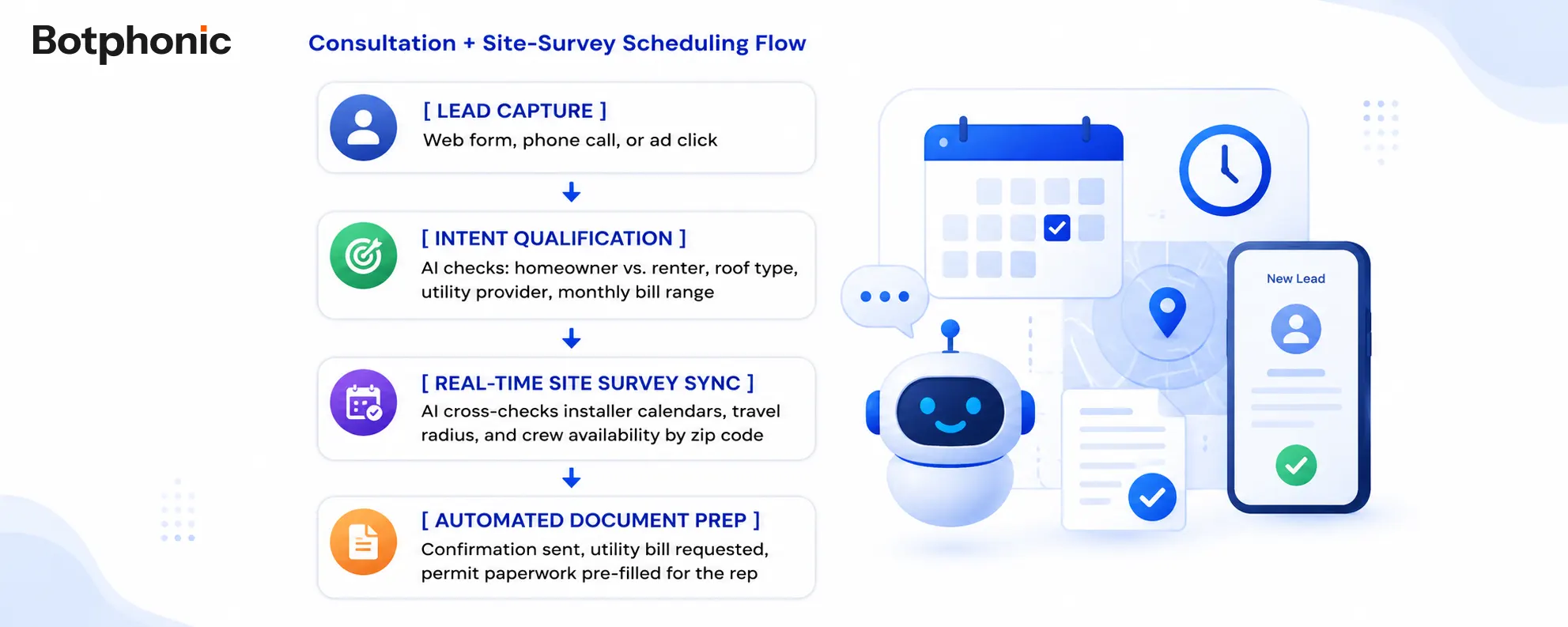
The consultation-to-survey pipeline is a four-stage handoff that moves a lead from first contact to a scheduled site visit without manual re-entry. Here’s what that means for your team: no rep has to key the same data twice.
Consultation + Site-Survey Scheduling Flow
What Happens at the Qualification Stage?
The AI agent asks a short set of questions by phone or chat before offering a time slot. It confirms ownership, roof age, and shading concerns. This is the gate that keeps low-fit leads out of the field calendar entirely.
What Happens at the Sync Stage?
The software checks which installer is geographically closest and has open capacity that week. This is the step generic tools skip completely, and it’s the single biggest driver of installer utilization rate.
By the document-prep stage, the homeowner has a confirmed appointment, a text reminder scheduled, and their utility bill request already sent. The rep walks in with data collected instead of starting from zero.
 PRO TIP
What Should Solar Companies Look for in AI Booking Software?
Critical infrastructure for solar AI agents means geography, CRM data, and calendar logic operating as one connected system, not three separate tools. Here’s what that means for evaluation: feature checklists matter less than whether these systems share data in real time.
Does the Platform Support Geospatial Logic?
Can the AI verify serviceability by zip code or utility territory before it offers a time slot? This single check eliminates the largest share of wasted site visits we see during client audits.
Does the Platform Write Directly Into Your CRM?
A tool that only exports a CSV recreates the exact handoff gap you’re trying to remove. Confirm the software writes directly into solar CRMs such as Sunbase, JobNimbus, or a customized Salesforce or HubSpot instance.
Does the Platform Handle Calendar-Constraint Orchestration?
A booking engine that ignores installer travel time will overbook your busiest crew and starve a nearby one. This is the criterion most vendors gloss over in a sales demo, so ask for a live routing test, not a slide.
What Are the Best AI Appointment Booking Tools for Solar Companies in 2026?
Elite solar scheduling tools in 2026 are platforms audited against solar-specific operational requirements, not general small-business feature sets. Here’s what that means for shortlisting: a high review score elsewhere doesn’t guarantee solar fit.
If you’re evaluating multiple scheduling solutions, reviewing the top AI scheduling platforms compared can help you understand the differences in automation, CRM integrations, routing capabilities, and AI-powered qualification features. Solar companies often require capabilities beyond standard scheduling software, making side-by-side evaluation essential before investing in a platform.
| Platform | Solar Operational Fit | Multi-Location Installer Calendars | Seasonal Surge Handling |
| Botphonic | AI receptionist built for field-service booking with geospatial routing | Yes, by installer zone | Auto-scales call handling during spring/fall demand spikes |
| Sunbase | Native solar CRM with built-in scheduling and design integration | Yes, single-region focus | Manual capacity adjustment required |
| Aurora Solar (Sales Mode) | Strong on proposal-linked scheduling, weaker on standalone dispatch | Limited, better for single design teams | Not built for surge routing |
| Calendly + Zapier stack | General-purpose booking with manual workarounds | No native support | Breaks down under lead spikes |
Scheduling is only one part of the customer journey. High-performing installers also invest in the best AI call center software for solar providers to automate inbound call handling, answer common customer questions, qualify prospects, and seamlessly transfer appointment data into their scheduling system. Combining AI call handling with AI booking creates a much stronger operational workflow.
How Does AI Reduce No-Shows for Solar Consultations?
Predictive re-confirmation reduces no-shows by detecting hesitation signals in a lead and intervening before a cancellation happens. Here’s what that means for your calendar: fewer wasted slots without adding staff.
What Signals Predict a No-Show Before It Happens?
Basic reminder texts only address forgetfulness. They do nothing for a homeowner who got cold feet after comparing quotes. AI systems flag behavior patterns, such as a lead going quiet after the initial call or asking repeated pricing questions without moving forward.
What Happens After the System Flags Hesitation?
The system automatically triggers an educational sequence, such as a short case study on home solar installation ROI. A 14-installer residential solar company in the Southeast reduced no-shows by 32% within four months after adding this predictive re-confirmation step to its booking flow, based on our implementation data.
A single well-timed message two days before a survey, paired with a case study link, recovers appointments that a generic “see you Tuesday” reminder loses.
How Do You Train Installers to Work With AI-Booked Leads?
The human-AI handover works when field teams use data the AI has already collected instead of re-asking the homeowner from scratch. Here’s what that means for training: installers need a short briefing on reading the AI’s notes, not a full software course.
What Should Go in the Pre-Visit Briefing?
Give installers a one-page summary before each appointment: roof type, utility provider, stated concerns, and any objections raised during qualification. This turns a cold arrival into a conversation that already has context.
How Should Installers Correct the Record?
Train reps to correct the record, not just consume it. If a homeowner mentions something the AI missed, that detail should sync back into the CRM immediately so future contacts stay accurate. Installers who treat AI-collected data as a starting script, then adjust based on what they see on the roof, close at a noticeably higher rate in our client base.
What Is the ROI of AI Appointment Booking for Solar Companies?
Financial impact from solar scheduling automation is measured through cost-per-booked-survey, installer utilization rate, and revenue-per-lead, not software cost alone. Here’s what that means for reporting: track outcomes, not activity.
How Do You Calculate Cost-Per-Booked-Survey?
This metric shows how much you spend, across marketing and staffing, to get one qualified survey on the calendar. A drop here usually signals better pre-qualification, not just cheaper leads.
How Do You Calculate Installer Utilization Rate?
This tracks how much of a crew’s scheduled day goes to serviceable, qualified appointments versus wasted drive time. Geospatial routing is the single largest lever we’ve seen move this number for clients.
Why Does Revenue-Per-Lead Matter More Than Lead Volume?
Solar and storage made up 54% of new U.S. electric generating capacity added in 2025 according to industry research data (SEIA, 2025), which means more competition for the same installer hours. The Bureau of Labor Statistics projects solar photovoltaic installer employment to grow 42% between 2024 and 2034 according to the Occupational Outlook Handbook (BLS, 2026), which makes crew-time efficiency a real financial lever, not a nice-to-have.
Why Do Solar Companies Fail When Automating Scheduling?
The bolt-on failure pattern happens when a company adds an AI tool on top of its existing CRM instead of building scheduling directly into it. Here’s what that means for architecture: integration order matters more than feature count.
What Does a Bolt-On Failure Look Like?
Companies that treat AI scheduling as an add-on chatbot end up with two systems that don’t share data. The AI books a slot, but the CRM never learns about it until someone manually updates a field, and the two systems drift apart within weeks.
What Does a Correct Integration Look Like?
Scheduling logic should read from and write to the same solar CRM your sales and ops teams already use, whether that’s Sunbase, a customized Salesforce instance, or a similar platform. Our Sunbase integration walkthrough shows this write-back pattern in detail.
Before signing any AI booking contract, ask the vendor to show a live write-back into your actual CRM, not a demo environment.
Try Botphonic Today!Which AI Booking Setup Is Right for Your Solar Company?
A decision matrix maps team size and lead volume to the right level of scheduling automation. Here’s what that means for buyers: bigger isn’t always better, matching your volume is.
| Team Size | Monthly Lead Volume | Recommended Setup |
| 1–5 reps, single location | Under 100 leads | CRM-native scheduling (e.g., OpenSolar or Sunbase built-in tools) |
| 6–20 reps, single or dual location | 100–400 leads | AI receptionist with geospatial routing, layered on existing CRM |
| 20+ reps, multi-location or multi-crew | 400+ leads, seasonal surges | Full AI dispatch layer with CRM-native write-back and surge scaling |
Smaller teams often don’t need a standalone AI layer yet, since built-in CRM tools handle lower volume fine. Once lead volume creates seasonal surges, a dedicated AI receptionist for scheduling starts paying for itself, as detailed in Botphonic’s guide to AI receptionists for field service teams.
Moving from Manual Scheduling to Autonomous Solar Operations
2026 is the year more solar companies stop manually chasing every lead and start managing a scheduling system that qualifies, routes, and confirms on its own. The operational gap between lead capture and a booked site survey is where deals are won or lost. Closing that gap with the right AI layer, matched to your team size and lead volume, is a measurable business decision, not a guess.
