
Summarize Content With:
Quick Summary
The failure of solar organizations to capture leads is due to their sluggishness in responding. However, this problem is easily solved using AI call center technology that will attend to all the incoming and outgoing calls round-the-clock, qualify prospects, schedule meetings, and integrate all into the CRM without the need for a human operator.
In this article, we will analyze some of the best AI call center software for solar providers in 2026 such as Botphonic, Rayne AI, Synthflow, Spyne, and Sunbase. It will look at what they have to offer the solar industry, some hidden expenses one may incur when using them, and finally calculate the return on investment.
Introduction
The solar business is flourishing and so is the rivalry of all qualified leads. Solar companies are under the perpetual pressure to be faster, smarter in their follow up, and do more deals without having to indefinitely expand their human resource base, between high volumes of inbound, long sales cycles and intricate customer queries. This is where the best AI call center software for solar providers comes in.
We deconstruct what solar companies are actually requesting about AI-powered calling center tools, which are leading the pack in 2026, and precisely how to determine ROI prior to signing a contract in this guide. You are a regional installer, or a national solar brand; either way, this blog will guide you to make a smart and data-driven decision for choosing an AI voice assistant for solar industry.
What Solar Companies Really Ask About AI Call Centers
Before deciding on the platform, solar companies must have the real answers to the questions that have the greatest importance. The following are the most frequented, and most significant questions that we hear when solar teams are exploring the best AI call center software for solar providers.
How Can AI Call Center Software Reduce Missed Solar Leads
All missed calls are missed opportunities in the solar space. A client who makes a call at 9 PM concerning their energy bill and receives a voicemail will just call a rival. And even the best AI call center software for solar providers have the ability to operate 24/7 and give instant response.
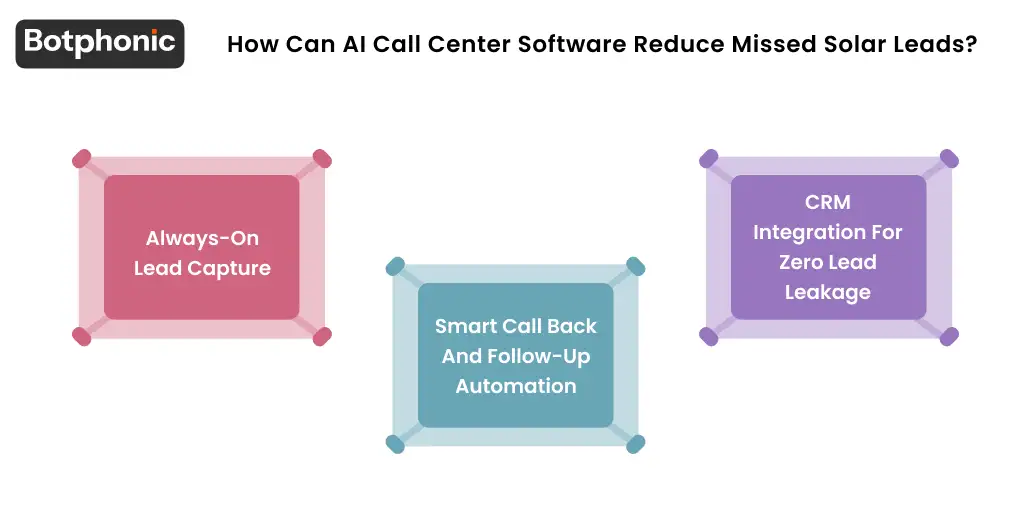
1. Always-On Lead Capture
Voice agents that are powered by AI do not sleep. They respond to all calls at night, weekends, holidays and instantly qualify the prospect with ready-made solar specific scripts. They have the ability to enquire about property, existing electricity bills, roof status and credit eligibility without involving human beings.
2. Smart Call Back and Follow-Up Automation
The current AI platforms do not simply respond to their outbound calls when they call inbound by default. When a lead completes an online form at 2 AM, an artificial intelligence agent can make a call in a few seconds, which will significantly boost contact rates. Studies have always revealed that leads received within five minutes of the call have a high likelihood of conversion.
3. CRM Integration for Zero Lead Leakage
A suitable AI-powered calling software for solar is one that can get directly connected to CRMs such as Salesforce and HubSpot. It allows tracking all conversations, labeling all leads, and no follow-up goes unnoticed. According to solar companies that adopt AI-based CRM workflows, reduction in unworked leads is up to 40%.
Can AI Handle Complex Solar Sales Questions
This is the huge worry of most solar companies. Solar sales are subtle: people are interested to learn about net metering, panel guarantees, financing, installation schedule, and payback period estimates. Can the best AI call center software for solar providers really handle all of that?
1. Conversational AI vs. Simple IVR
Interactive voice Response (IVR) menus of the old school are gone. The cutting-edge AI-based call center software available today to solar providers is based on large language models (LLMs) that can comprehend natural language, context, and follow-up questions. A customer can state like I am not certain whether my roof qualifies and the AI can respond to the conversation, collect information and send to a human expert when complexity is needed.
2. Solar-Specific Knowledge Bases
The most optimal platforms enable solar companies to feed their AI receptionist with product knowledge, incentive updates, state-level rebates, and financing FAQs. This implies that the AI can provide precise and company-specific responses instead of general responses. An example is Botphonic, which enables complete integration of knowledge base to ensure your AI agent learns your brand language.
3. Graceful Escalation to Human Agents
Superior AI does not attempt to do everything it understands when to delegate. In case a discussion gets too complicated or the client demands a human touch, the best AI call center software for solar will provide warm transfer to continue the process as a smooth and professional engagement.
 PRO TIP
How Do I Choose the Right AI Software Without Wasting Money
There are plenty of AI call center systems available, dozens of them, and it is simple to be hypnotized by slick demos and promises. The following is a realistic guide to the assessment of the best AI call center software for solar companies:
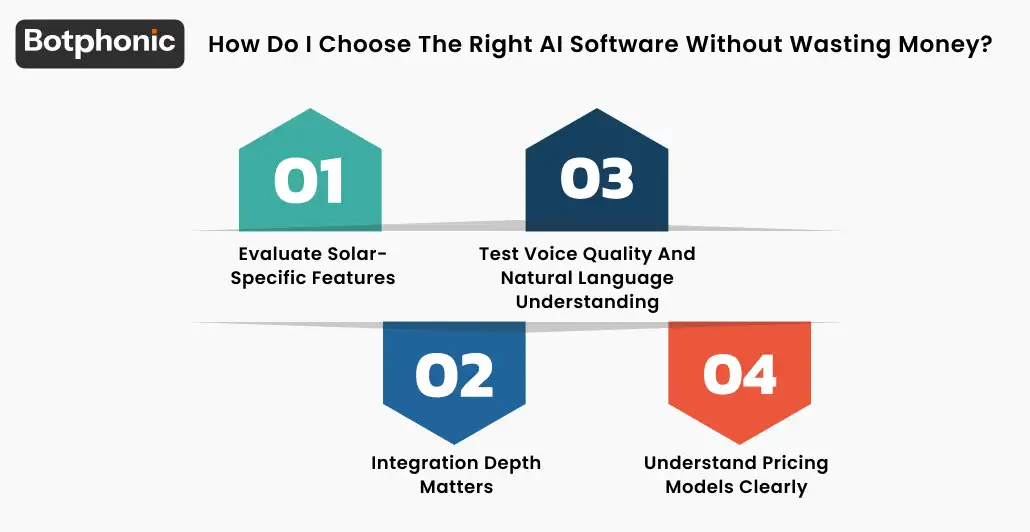
1. Evaluate Solar-Specific Features
The AI in a generic call center developed within the retail or hospitality sector will not be of much use to a solar company. Find websites with solar lead qualification software, utility bill analysis processes and appointment booking linked to installer schedules. The less customization you will have to pay.
2. Integration Depth Matters
Your AI platform should speak to your current tools. Make sure that it has native integrations with your CRM, your solar proposal software (such as Aurora or Enerflo), and your appointment booking system. The existence of a platform that costs a lot of middleware to bridge your stack is a warning.
3. Test Voice Quality and Natural Language Understanding
Not every AI voice is the same. Certain robotic sounds destroy brand loyalty. Request live demonstrations on the actual solar conditions and listen to the AI response to interruptions, accents, pauses, and multi-part questions. Leads will be frustrated and conversion rates will be harmed by a poor voice experience.
4. Understand Pricing Models Clearly
The cost of an AI call center can be fluctuated on a per-minute, per-conversation, per-seat, or a monthly basis. Per-conversation pricing can become costly quickly when it comes to solar companies that have no control over the number of calls they receive. Seek out the best AI call center software for solar providers with scalable levels and clear overage policies prior to committing.
What AI Call Center Software would Solar Providers Recommend
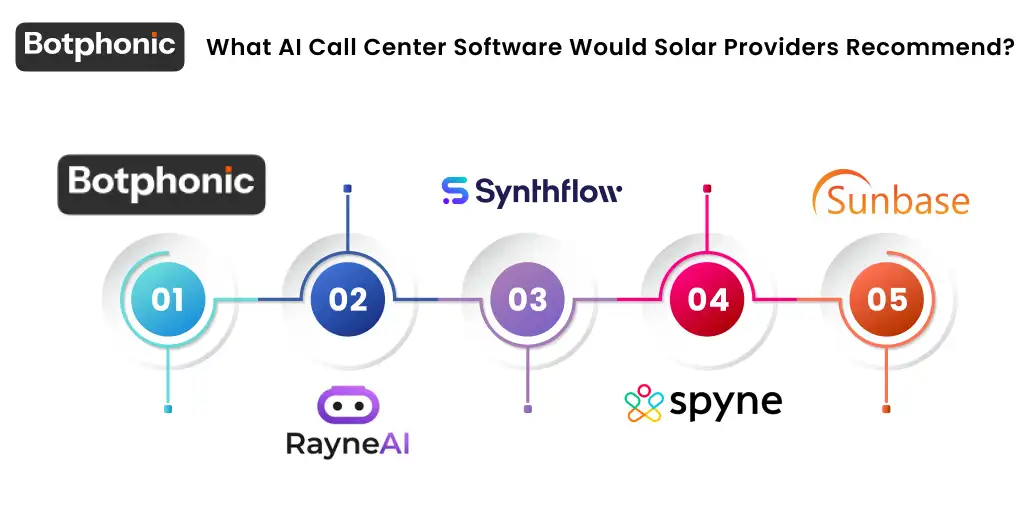
This is a candid analysis of the dominant vendors in the AI call center industry, and recent information about what each of them offers to the solar industry in 2026. When evaluating the best AI call center software for solar providers, these are the names that consistently come up.
1. Botphonic: The Solar-First AI Voice Platform
When there is one platform that is specifically designed to run the solar selling process, it is Botphonic. In comparison to generic AI call center tools, which have to be reconfigured extensively to support solar scenarios, Botphonic was built with the lead funnel of the energy and solar sector in mind. It is the best suggestion to solar firms that require the finest AI call center software without months of installation.
What Makes Botphonic Stand Out for Solar
The AI voice agents learning at Botphonic are trained to make and accept incoming and outgoing calls in solar sales with superb fluency. The platform has a set of built-in solar qualification processes, including questions concerning property ownership, rooftop eligibility, existing energy charges, utility company, and financing interest, to ensure that you can get online in a short time and avoid writing scripts.
The platform is natively compatible with the most popular solar CRMs and calendar booking in real-time, which means that the leads can book a site assessment or consultation directly during the AI call, no callback required, no drop-off. This compresses radically the time gap between the initial contact and the booked appointment.
Botphonic’s 2026 Capabilities
- Hyper-realistic AI voice and minimum latency, that is to say, it should sound like a live agent.
- Inbound call center and outbound lead follow-up in one platform.
- Integrated solar knowledge base support – educate the AI about your products, and funding, rebates, and frequently asked questions.
- Live lead scoring and hot-transfer to closers in case a lead has high purchase intent.
- Multi-lingual capabilities to cater to different markets among homeowners in both the Spanish and English language.
- Enhanced analytics dashboard monitors call traffic, qualification, booking of appointments, and conversion.
- CRM integration with Salesforce, HubSpot, and solar-specific applications (Sunbase and Enerflo).
Why Solar Companies Trust Botphonic
The two main results that solar companies that have switched to Botphonic share are a drastic decrease in the number of missed leads and a high number of booked appointments per day. Due to the fact that the platform is solar-native, the process of onboarding will be quicker and the AI will make relevant conversations as opposed to generic ones. The call recording and quality scoring capabilities of Botphonic are especially appreciated by sales managers who use it to train human closers and the areas where deals are failing to close.
Solar businesses looking to grow out of a regional to a national level should consider Botphonic enterprise tier, which provides multi-location management, team-level analytics, and dedicated support, becoming one of the most comprehensive AI call center solutions in the solar market today.
2. Rayne AI: Intelligent Conversation Automation
Rayne AI is a more recent firm in the AI call center market that has been attracting attention due to its robust natural language processing and adaptable workflow builder. It is a good tool that fits the solar companies that have complicated lead qualification, since it enables business to create multi-step conversation flows with conditional logic.
Rayne AI for Solar Use Cases
Rayne AI facilitates inbound call management, outbound drip campaigns and SMS follow-up sequences, providing solar teams with numerous touchpoints all in one platform. It has a visual workflow editor that enables non-technical teams to customize the scripts of qualification without the programmer intervention. Rayne AI introduced a more powerful intent detection engine that is more sensitive to when a caller is willing to be connected to a human sales rep.
- Drag and drop call flow graphical toolkit and solar template library.
- Multichannel follow-up SMS and voice.
- Most major CRMs can be integrated with it through API.
- Sentiment analysis to indicate frustrated or disengaged callers to be escalated immediately to humans.
Rayne AI would be best applied to mid-sized solar installers interested in flexibility and tailored workflow. It also needs more startup than solar-native systems such as Botphonic and can be served by a specific implementation resource.
3. Synthflow: Scale-Free No-Code AI Voice Agents
Synthflow is now one of the most available AI voice agent platforms available in the market, with a no-code builder that allows companies to make and deploy conversational AI agents without prior technical expertise. In the case of solar companies that do not have a development team, Synthflow reduces the entry barrier significantly.
Synthflow’s Feature Set
Synthflow added better real-time interrupt support, which is a vital aspect of solar calls when customers frequently interrupt agents or switch the conversation in the middle of the statement. The platform also increased its voice cloning feature where solar brands are able to create a unified AI voice that fits their brand image.
- No-code agent builder having pre-built sales and lead gen templates.
- Clone voice to produce branded voice AI characters.
- Call analytics and transcription in real time.
- Automated outbound dialing campaigns.
- Make and Zapier integration of lightweight CRM connections.
Synthflow can be a good fit in the case of small solar companies or startups that require an inexpensive and quick AI call center solution. Its features might be restrictive to more complex operations with routing requirements, and customizing it to solar-specific needs will be manual.
4. Spyne: Phone Call AI Automation
Spyne mainly works with visual and communication automation, which are mainly driven by AI, although its conversational AI features are also being embraced by solar companies aiming to automate customer communication using various channels. The strength of Spyne is that it integrates AI conversation and rich media that can be effective in solar companies, which send both visual proposals and site assessment images.
Spyne’s Role in Solar Communication Workflows
Solar businesses rely on Spyne to automate follow-up calls after sales which have visual elements, satellite roof imagery, preview of energy audit, or summary of proposals. Together with AI voice services, Spyne enables the development of a complete automated communication experience between the initial call and signed agreement.
- Multi-channel communication through AI: voice, email and visual content.
- Robotic sequences of follow-up depending on the result of a call.
- Solar proposal and site assessment visual development.
- Touchpoint tracking analytics.
Instead of a standalone, Spyne should be deployed as a complementary layer . With an exclusive platform of an AI call center one. The solar firms that already have Botphonic or Synthflow in use can combine with Spyne. It might help enhance the post-call communication with visual resources.
5. Sunbase: Solar CRM and Built-In AI Communication Tools
One of the limited sources on this list that began as a CRM dedicated to solar. And added AI communication tools is Sunbase. To solar companies that may already use Sunbase as their CRM, the integrated calling and automation features make it a convenient one-stop solution that does not need the integration headaches.
AI-Assisted Communication Features of Sunbase
The platform update at Sunbase added the artificial intelligence-powered call summaries. Including automatic lead status updates and predictive lead scoring with reference to the historical conversion data. The platform will be able to initiate automated follow-up processes. Even when the leads turn cold or when a proposal has been read but not signed.
- Indigenous CRM and AI calling under one solar platform.
- Call summaries and automatic pipeline updates through AI.
- Solar conversion data-based predictive lead scoring.
- Cold lead and unsigned proposal follow-up sequences are automated.
- Coordination of field teams and scheduling of appointments.
Sunbase is a great solution to solar firms that desire a one-stop shop. Nevertheless, dedicated platforms such as Botphonic will have higher functionality in businesses that demand the highest levels of AI voice quality or standalone call center infrastructure.
 NOTE
NOTE
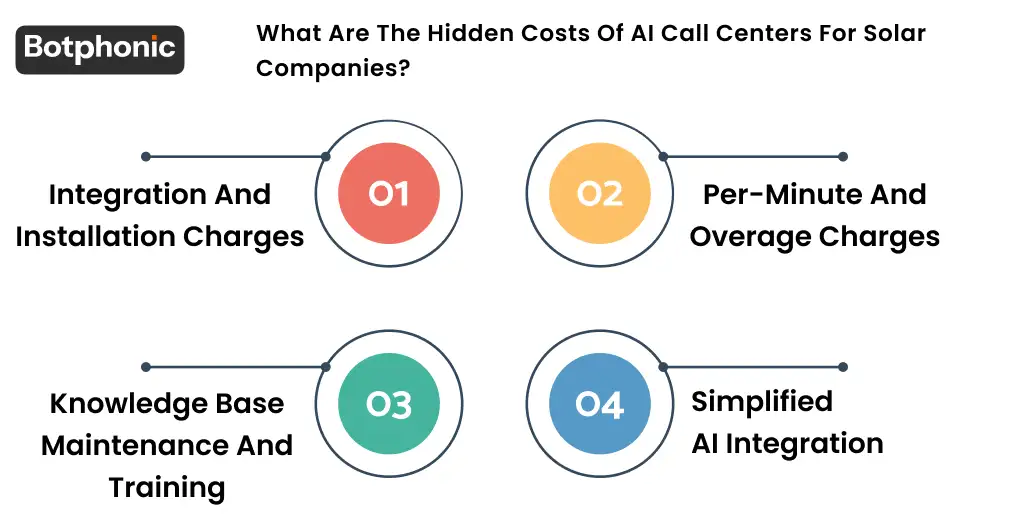
The price that best AI call center software for solar providers shows is hardly ever the whole picture. Solar companies must research the following cost areas that are often ignored before signing any contract:
1. Integration and Installation Charges
The communication between your AI call assistant and existing CRMs, dialers, and scheduling tools may require either custom API work or third-party connectors. Other sellers impose high set up costs which are not indicated on their websites. Request a complete scope-of-work document to sign.
2. Per-Minute and Overage Charges
Most voice assistant AI services have a per-minute call time fee. The high seasons when the solar leads take off, namely spring and summer, may result in a burst in costs. Make sure you know how many calls you will make and model your costs at twice the average to stress-test your budget.
3. Knowledge Base Maintenance and Training
Your AI must keep up with evolving incentives, new product lines, and new financing options. Other platforms are paid to update the knowledge base or have to be pushed by a developer. The self-serve knowledge base editor of Botphonic is a significant strength. In this case because it gives sales or marketing teams the ability to update the AI directly.
4. Compliance and Data Privacy
Consumer data call centers using AI need to adhere to TCPA, CCPA, and state-wide solar marketing laws. Outbound calls that are non-compliant may attract heavy fines. Make sure that the platform you are using has inbuilt DNC list management, call consent logs, and compliance records.
What is ROI on AI Call Centers in Solar Sales
The ROI of the best AI call center software for solar providers would have to be measured both in terms of efficiency gains and revenue results. The most important metrics to be tracked by solar firms are the following:
1. Lead Response Time
Mean time between lead inquiry and first contact. A decline of hours to seconds is a win that can be measured immediately. The average first-response time in most solar companies with AI call centers reduces by more than 90 percent.
2. Appointment Booking Rate
Percentage of qualified leads that book site assessment or consultation. AI call center automation for solar sales manages the booking process in the call (such as Botphonic). It tends to increase booking rates compared to systems that do not.
3. Cost Per Qualified Lead
Divide the monthly platform cost by the number of qualified leads your AI processes. To measure savings, compare this with your human agent cost per qualified lead.
4. Close Rate by Contact Channel
Separate your close rates based on the initial method of lead contacting AI-initiated and human-initiated. This will inform you that your AI is creating equivalent buyer intent or that some lead sources require human intervention.
5. Human Agent Productivity
Measure the quantity of deals that your human closers are dealing with each day. Prior to implementing AI and after implementing it. An increase in the number of closers who take their time in closing. Rather than qualifying is a direct ROI indicator.
Assess your existing lead handling process and determine where AI can have an impact now.
Schedule a DemoConclusion
The best AI call center software for solar providers is not merely a productivity tool, but a competitive weapon. With a market that is characterized by speed-to-lead as a determinant of winning, solar companies using manual processes are missing out on revenue in their pockets every day. The integration of AI in renewable energy sources has become a transformative way to enhance overall efficiency and reliability.
Of all the reviewed platforms, Botphonic appears to be the most solution-specific to the solar sales teams. Its native qualification processes are based on solar. Real-time booking of appointments, smooth CRM interaction, and superior analytics allows it to be highly recommended to solar companies. For companies that care about taking their call center operations into the smart zone.
You are either just beginning to learn about AI or are now ready to upgrade your current system. The steps in this guide provide a clear roadmap. For getting one of the best AI call center software for solar providers that pays back in leads collected, appointments and deals closed.
