
Summarize Content With:
What You’ll Learn:
- What Word Error Rate (WER) actually measures, and where it fails
- Why latency, not speech recognition accuracy alone, determines user retention
- How semantic accuracy and intent recognition outperform WER as business metrics
- Practical benchmarking steps for evaluating voice AI in production environments
- Which real-world metrics TSR, FCR, RTF, MOS, reveal true AI voice assistant performance
Human-like accuracy in voice AI is the standard by which AI assistants are judged in production. It matters to product teams, operations leads, and anyone deploying conversational voice technology where a slow or wrong response ends the call. This post breaks down exactly how to measure it.
Why Is “Human-Like” Performance So Difficult to Quantify in Voice AI?
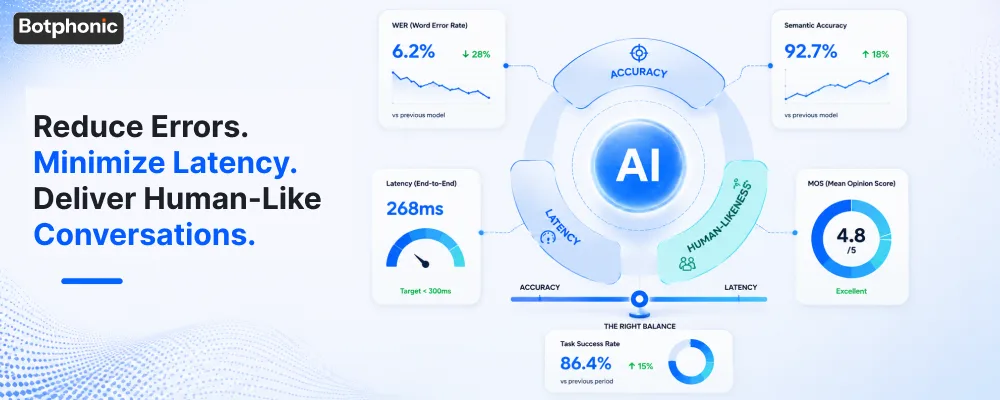
Being “human-like” is a combination of three simultaneous events: good transcription, right interpretation of customer’s intent, and timely reaction on it. The challenge is that typically voice product developers concentrate solely on one of those.
Word Error Rate (WER) optimization and nothing else. Two others are being ignored.
Perceived accuracy is how customers perceive the system. Calculated accuracy is what your ASR logs say. Those figures do not match often enough.
For organizations deploying an AI call assistant, balancing these three factors is what determines whether conversations feel natural or frustrating.
 NOTE
NOTE
What Is Word Error Rate and How to Calculate It?
Word Error Rate is the conventional measure for ASR performance. Formula is the following:
WER = (Substitutions + Insertions + Deletions) / Total Number of Words in Reference
Higher is worse. The meaning of 5% WER is five mistakes out of every hundred words transcribed.
And here’s what each error tells you about the state of your model:
- Substitutions – the model heard a word but used an incorrect one. Frequently a vocabulary or sound confusion issue.
- Insertions – the model added words not uttered. Usually results from background noise misinterpreted as speech.
- Deletions – the model omitted certain words. Often indicates problems with processing of rapid speech or foreign accents.
Reasons Why WER Became a Commodity Metric
WER considers all mistakes equally harmful. The metric cannot tell the difference between the omission of “the” and misinterpreting a name of a caller. From a business point of view, these two types of mistakes have completely different impact.
The research of Language Technologies Institute at Carnegie Mellon University shows that WER poorly corresponds to the downstream tasks’ performance metrics. This is known in the field since the early ’90s. However, WER continues to be the default metric in AI call assistant evaluations due to its simplicity rather than significance.
In reality, a WER of 8% from a model which transcribes the speech correctly and captures the intent of the caller will perform better than WER of 3% from a model which passes the transcription task but classifies the intent incorrectly.
What Is the Accuracy-vs-Latency Trade-off in Voice AI?
The accuracy-vs-latency trade-off is the challenge in engineering to use more accurate models but still keep the response time inside the boundaries of human conversations. Here is how this applies to anyone managing a voice AI product.
The bigger the ASR model size and the greater beam width configurations lead to WER decreasing. But at the same time, it requires more compute time. Each millisecond spent on enhancing transcription accuracy adds up to the end-to-end response latency.
This trade-off is especially important for AI phone call systems, where callers expect responses with little to no noticeable delay.
What Is the Limit After Which Lag Destroys Engagement?
It has been shown by research presented in ACM CHI Proceedings that turn-taking tolerance is broken beyond 300-500ms response delays. As soon as the voice assistant exceeds this limit, the user perceives the silence as an error state, not the processing.
And this has a very clear commercial meaning. A voice assistant that recognizes speech 97% accurately with 900ms response time will fail more calls than an assistant recognizing speech 93% accurately with 280ms response time.
How Do the Engineers Balance Speed and Accuracy?
There are two ways to optimize voice AI products:
Model Pruning and Quantization
Decreasing model weight precision from 32 bits to 8 bits (int8 quantization) results in a 30%-50% reduction in the inference time with less than 1% decrease in WER. It is reported in benchmarks provided in NVIDIA TensorRT docs. The described optimization is the most popular for Whisper/Conformer-based models used by various ASR services.
Beam Search Parameters Optimization
Beam width is the number of candidate transcription paths that the model is going to examine. The wider the beam, the better is the accuracy and higher the latency. Decreasing beam width from 10 to 4 allows reducing the latency by 20%-35% while accepting the moderate WER increase. In many cases, it is the appropriate balance in real-time communication.
Real-Time ASR and Partial Transcription
Real-time ASR performs audio transcription without pauses between segments and does not wait for the silence. For example, Google Cloud Speech-to-Text and AWS Transcribe Streaming produce partial transcriptions on-the-fly. This makes possible to start NLU processing before finishing transcription and reduce latency of the entire pipeline without changing the ASR model itself.
Real-Time Factor (RTF)
RTF quantifies the processing time of one second of audio. An RTF of 0.1 implies that 1 second of speech will take 100ms, an ideal production goal. RTF greater than 1.0 implies the inability of the system to operate in real time. It is common practice to measure RTF separately from WER to gauge the compute capacity under load.
| Optimization | Latency Reduction | WER Impact | Complexity |
| INT8 Quantization | 30–50% | < 1% degradation | Medium |
| Beam Width Narrowing (10→4) | 20–35% | 2–4% degradation | Low |
| Streaming ASR (chunked) | 40–60% perceived | None | Medium–High |
| Model Distillation | 50–70% | 3–6% degradation | High |
How Do You Measure AI Voice Accuracy Beyond WER?
The move beyond WER involves the measurement of understanding rather than transcription quality. This approach helps distinguish between voice AI testing and benchmarking ASR capabilities.
Semantic Versus Lexical Accuracy
The lexical accuracy is measured by WER: were the words transcribed accurately? Semantic accuracy indicates that NLU layer recognized the caller’s intent regardless of small variations in the transcription process.
Transcribing “I wanna book for two people Saturday night” as “I want to book for 2 people Saturday night” is flagged by WER as an error. Nevertheless, the intent was perfectly captured. Punishing such a substitution in a business assessment would be a mistake.
Intent recognition accuracy, as determined by the percentage of calls where the correct intent label was applied, is a more realistic measure of business success than WER alone.
How Can You Create a Real-World Benchmarking Dataset?
The answer is simple: use a Golden Dataset, which is nothing but a human transcribed corpus of real-world production call data that mimics the environment your voice AI system will run in.
What Should Go into Your Golden Dataset for Voice AI Benchmarking?
- Noisy environment samples: Calls made in environments with noisy backgrounds such as background music or street noise or speaker echo. While the Mozilla Common Voice dataset is a great place to start, it can never beat production-specific data in terms of accuracy.
- Accent mismatch in regional accents: Accent mismatch is one of the most frequent failure modes of ASR systems deployed in the real world. Research conducted at the University of Sheffield has shown WER difference in the range of 15% to 20% between American Standard English and regional English such as British and Indian on identical models.
- Telephony degraded audio data: Telephony degraded audio (at 8kHz) differs from non-telephony (16kHz) audio.
 PRO TIP
Which Metrics Actually Forecast Business Impact for Voice AI?
The business impact of a voice AI is determined by whether the call successfully achieves its objective. An absolutely accurate transcription resulting in an unsuccessful task completion is still an error.
Task Success Rate & First Call Resolution
Task Success Rate (TSR) represents the percentage of calls where the objective of the customer is successfully completed without escalation or follow-ups. First Call Resolution (FCR) indicates whether the matter was solved on the first try.
TSR and FCR are both strongly correlated with revenue and operational expenses in voice AI deployments. According to Forrester Research, every 1% increase in FCR results in a 1% reduction in operating costs – an example of a clear downstream cost impact of accuracy that WER cannot capture.
AN Endpointing Accuracy
Endpointing refers to the process whereby the system identifies the end of the speech input of a caller. Endpointing errors generate two types of failures:
of terminating the connection prematurely (false end) or responding late (missed end). Neither feels natural. Neither contributes to accuracy perception regardless of WER.
As an improvement over standard ASR systems, streaming ASR technology can benefit from VAD models working in tandem. Silero VAD is one of the most widely referenced free software solutions for production use.
Barge-in Recovery
Barge-in refers to interruptions made by the user while the AI is talking. A good voice AI needs to be able to stop itself, reset and reprocess the new utterance quickly and accurately. The measure of barge-in recovery rate shows how often the system does it right.
What really happens to dealerships and other high call volume organizations: barge-ins constitute an outsized portion of complaints. People who are barge-ins are usually frustrated and in a hurry. A failure in barge-in recovery that results in a delayed response or ignoring the new input is the quickest way to disconnect.
Mean Opinion Score
Mean Opinion Score (MOS) is a subjective human assessment of voice naturalness rated from 1 to 5. It measures what no metric can otherwise capture:
whether the speech flows well enough to prevent the caller from feeling that he/she is interacting with a machine.
ITU-T P.800 defines the standard MOS evaluation framework. Automated MOS estimation tools now exist, including NISQA, but human panel evaluation remains the gold standard for production sign-off.
How Do You Benchmark a Voice Agent Prior to Production Launch?
Benchmarking a voice agent prior to going live is a systematic procedure. The aim is not to make zero errors, such an aim is unrealistic. The aim is to make errors appropriate to the context.
Step 1: Create Ground Truth
Transcribe 200-500 calls from real production using humans. Tag each call with the right intent, proper entities (names, dates, figures), and outcome. This will be your benchmark corpus.
Step 2: End-to-End Latency Measurement
End-to-end latency covers the time from endpointing event detection to beginning of audio output generation. It must be measured for the 50th, 90th and 99th percentiles. The 99th percentile is where things break down in terms of user experience.
Step 3: Load Test at Peak Traffic Levels
Labs benchmarks do not take into account production degradation. Utilize a load testing framework such as Locust or k6 API-level testing) to model concurrent call volume. Determine WER, RTF, and TSR while under load. The majority of the systems degrade significantly between 2-3x average concurrent load.
Step 4: Test Accent and Noise Conditions
Test your Golden Dataset subsets, noise, accent, telephony degraded, as separate test suites. Provide WER and TSR measurements for each condition independently, rather than averaging the two together.
NOTE
Conclusion: Build Your System for the Callers, Not the Dashboard
WER metric is a valuable indicator. It is not the only thing that needs to be measured. Teams that build reliable voice AI system in production learn to treat latency as the key constraint, semantic accuracy as the main goal, and WER as yet another input.
Voice AI accuracy approaches human performance through iterations. There are no final releases. Golden datasets become old. User behavior changes. The models become better. Measurement capabilities are not deliverables at the time of go live — it’s an operational function.
In the case of real-time calls, consider latency first. Keep the average end-to-end response time within 300 ms for the median call. Use high-compute configurations for voice accuracy when you have complex interaction scenarios that allow a few hundred additional milliseconds.
If you’re evaluating a voice AI platform for high-volume call environments, explore how Botphonic handles real-time voice accuracy in production deployments, and what benchmarking data is available to support that evaluation.
