Summarize Content With:
“A patient calls in your hospital to reserve an appointment for open-heart surgery at 11:00 p.m. and waits for 12 minutes straight, ending up getting frustrated. It’s more your loss than theirs, you lose a hefty amount due to a single missed call.”
This is not the first time, it happens with your hospital most of the time. Generally, the hospitals manage 50-150 calls per day. Many of them have non-satisfactory experiences like delays in answering, misroutes, and callbacks that take a few hours.
That’s where Hospital Call Center Software comes into the picture – changing patient experience from manual to automated system, where it treats the patient like a friend and manages the conversation in a personalized manner and the exact human tone.
The hospital call center software not only automated your workflows but also provided clarity & speed from emergency inquiry handling to analyze conversation. It acts like a bridge between patient and efficient care. It minimizes your operational bloat, increases efficiency, enhances security, and reduces errors.
This guide helps you to know how AI call centers enhance the patient encounters across seven key points and deployed in four phases. Additionally, we talk about HIPAA compliant and discuss how patient experience metrics change.
The Patient Experience Problem In Hospital Call Centers
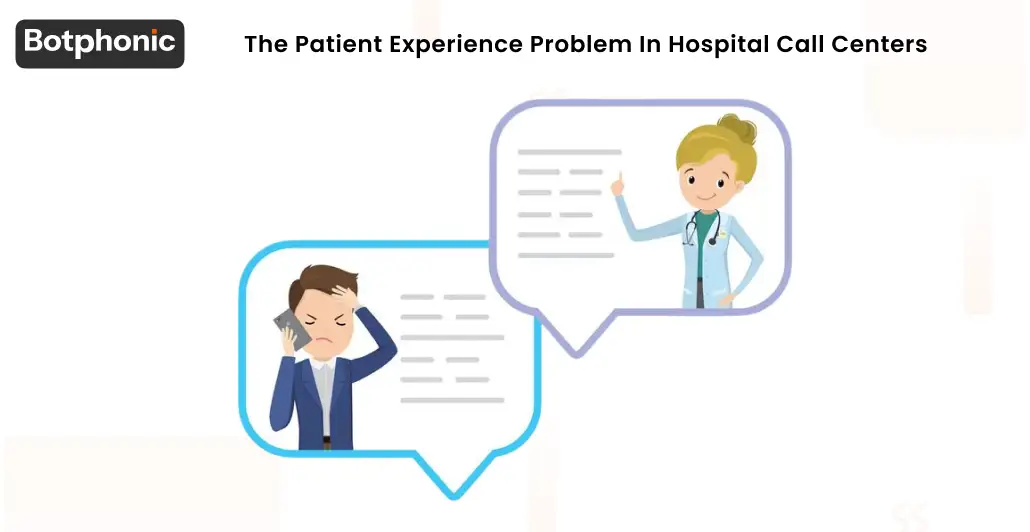
A single missed call means more to you rather than a single task – It is highly affecting your patient trust. One patient affects tens of your new customers as they share feedback of not hearing back or not even calling back on time. When your running system or operational work is not done efficiently – your patients might go to your competitors, be disappointed for a while, and might delay care.
How AI Call Centers Work In a Hospital Setting
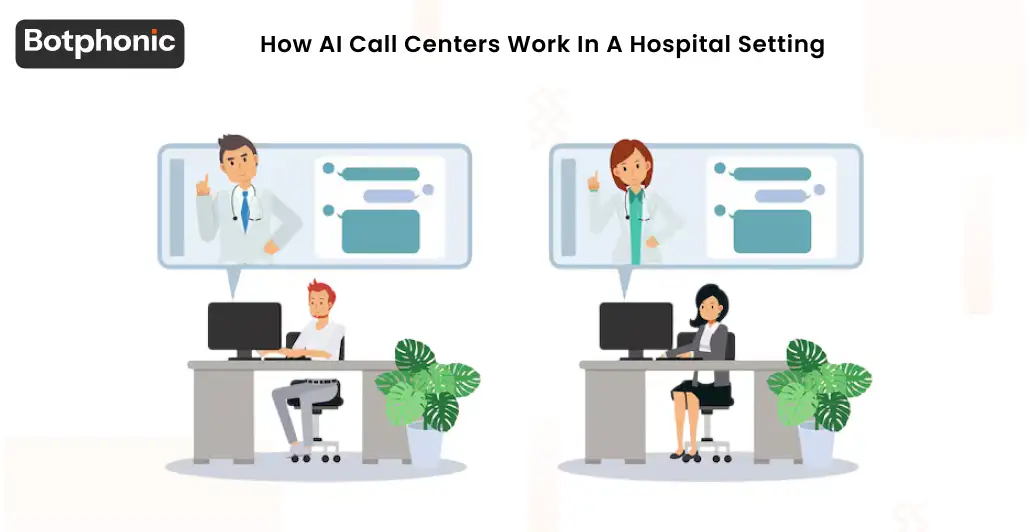
Putting more people in the same loop is not a solution to any problem – you should take the responsibility to fix permanently and completely eradicate the old management system that is not able to cope up with the patient demand. Now, welcoming the Hospital Call Center Software in a hospital setting and see how it multiplies the patient experience rate.
Patients are not only entitled for the expected but the deserved services. Only half of the proportion claim that their patients are satisfied. When patient calls flood in, the staff become overwhelmed and provide inconsistent service that grows dissatisfaction among patients. However, the healthcare Hospital Call Center Software solutions make radical changes from consistent replying to adherence to every healthcare protocol.
Based on the patient’s perspective, they have phenomenal experience and the critical factor, what they most like the natural sound. Instead of hearing press 1 and press 2 (rigid structure), they hear clear sentences more like human sound so it does not feel like speaking with the AI robot.
If the AI phone call technology is unable to resolve the patient inquiries, or in other terms, the confidence score is low, the patient call is immediately transferred to a human agent, mainly useful for the emergency cases.
Here is the brief comparison of IVR, AI agents, & chatbots from the patient’s point of view :
| Critical features | AI Agents | IVR | Chatbots |
| Speed | Quick | A bit slow | Fast |
| Personalization | High | Low | Limited |
| Empathetic tone | High | None | Moderate |
| Problem solving | Best | Poor | Moderate |
| Contextual awareness | Extremely high | None | Moderate |
The best part about the hospital call center software – it directly connects to any of your existing systems like EHR and can access and update information, it helps to maintain the smooth interaction.
Ways AI Call Centers Improve Patient Experience
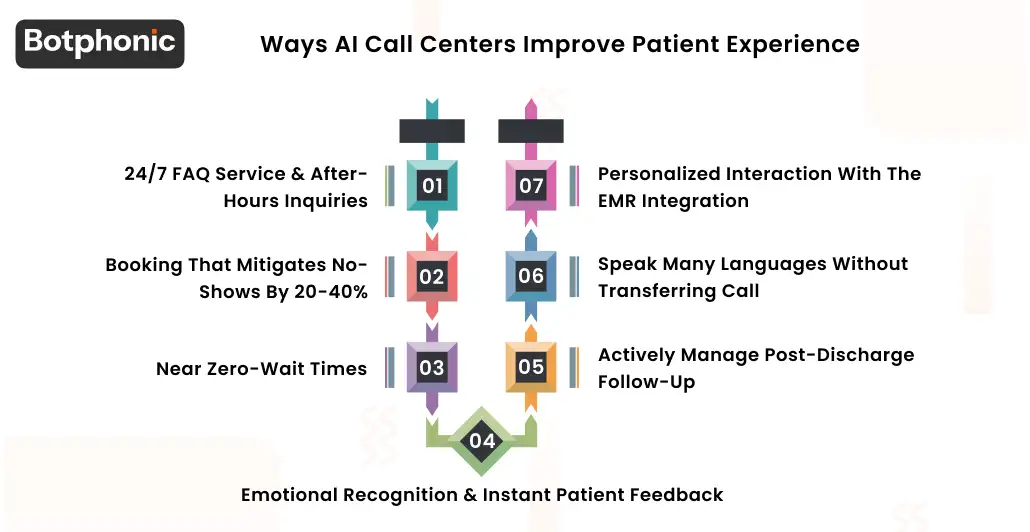
Understanding the patient experience and Hospital Call Center Software mechanism in the healthcare setting, now will talk about the critical key ways that improve patient experience. Let’s understand this :
1. 24/7 FAQ Service & After-Hours Inquiries
Health issues can arise at any time, it is not necessarily to come in the day-time. It is required to be available for your patients 24/7, which the Hospital Call Center Software technology can do perfectly. Patients call at 3:00 am for scheduling appointments or have any post-surgical inquiries, requiring the valid answers instead of robotic voice.
The AI receptionist for after-hours hospital calls – helps to guide patients whenever they require as the health emergency does not come with time, it arrives at any time.
2. Booking That Mitigates No-shows by 20-40%
Not only scheduling but also helps in altering the time, cancel, and confirming booking does not take much time, it just requires several seconds. The AI for hospitals makes the scheduling more frictionless, which minimizes no-shows rate. Solutions like AI appointment booking for hospitals streamlines to provide scheduling care at every phase.
3. Near Zero-wait Times
Now there is a longer need to wait in long queues for a single appointment, patients quickly take appointments, self-analyze medical reports, and receive every inquiry instantly. For patients, it feels whole-hearted rather than being anxious. As per the Press Ganey data 2022, more waiting time leads to a decreased satisfaction rate.
Source: as per the Press Ganey data 2022, (“https://www.researchgate.net/figure/Comparison-of-Press-Ganey-survey-scores-of-wait-time-and-information-of-delay-from_fig3_359767194”)
4. Emotional Recognition & Instant Patient Feedback
While a patient interacts with the hospital AI platform, it not only interacts but also helps in recognizing one’s emotions so they can answer perfectly. Beyond that, it doesn’t wait for the post-call surveys, the AI call centre for hospitals takes the instant survey after every conversation.
If they find the patient is a bit dissatisfied, the inquiry is transferred to the human agent for quick resolution & reduce adverse impacts. Also, it provides smooth traceability of patient satisfaction scores across divisions or call types.
 NOTE
NOTE
5. Actively Manage Post-Discharge Follow-up
The Hospital Call Center Software automation for hospitals does not end healthcare services with patient existence, it also continues even after the patient is discharged. Taking follow-up after 1or 2 days for recovery reports, asking about any issues faced, or adheres with the medication rules. The patient call center early inspects the complications and reduces the readmission rate. So, there is no need for enrolling in the hospital readmissions reduction program, it saves your hospital funds.
6. Speak Many Languages Without Transferring Call
Those patients who are not comfortable in speaking English or don’t know how to speak can smoothly communicate with their native-language. There is no requirement to waste time on unnecessary escalating calls or cancelling healthcare service. Based on the PubMed Central research 2021, only a few patients know English and the majority of the people are the native speakers.
Source: Based on PubMed Central research 2021, Limited English Proficiency and Disparities In Healthcare Management Among Patients With Breast Cancer.
7. Personalized Interaction With The EMR Integration
When a patient calls to the hospital, the Hospital Call Center Software agent fetches its personal information and understands the reason behind the calling. It feels like the Hospital Call Center Software knows everything about the patient – they don’t even tell their name and even provide the specific information within seconds.
How AI Call Center Stay HIPAA Compliant
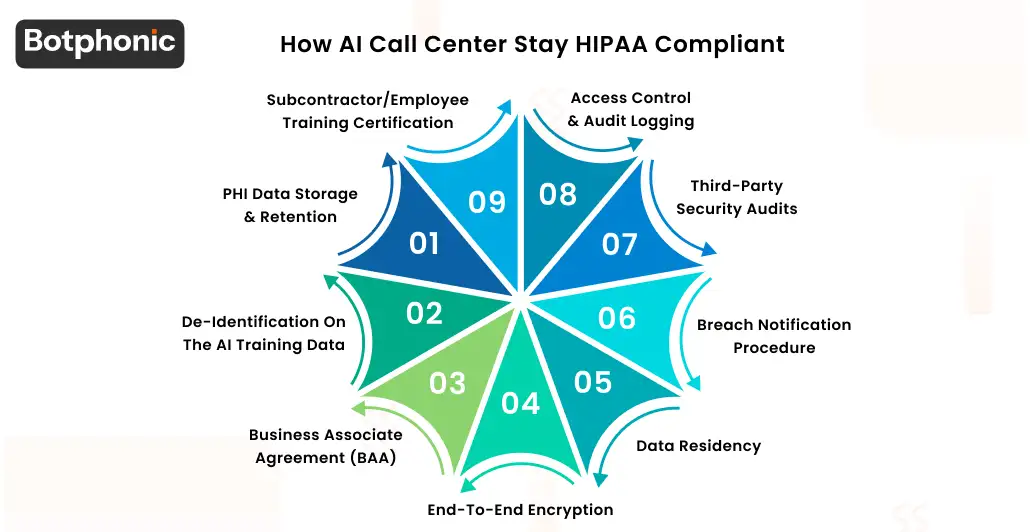
Protected patient information is the primary duty of healthcare organizations. With the AI call center, they share the confidential information which can be misused by anyone, if not stored with the authoritative regulations (HIPAA enforcement is a must).
The healthcare call center software accesses the entire medical information, booking history, and insurance or claim details. Therefore, compliance is not only needed but the mandatory one.
Patients expect high-end security and also, it is required for you to gain their trust. That’s why you want the HIPAA compliant conversational AI. In case you violated the HIPAA regulations, it costs you a million dollars not in thousands, the current penalty ranges from $145 to $2,190,294 per month.
Source : As per the HIPAA journal blog, What are the Penalties for HIPAA Violations? (“https://www.hipaajournal.com/what-are-the-penalties-for-hipaa-violations-7096/”)
Based on the tech target report, a cyber-attacked on the McLaren Health care, affected across 13 hospitals and 743,131 individuals. If the information stored in the AI Call Center, the data would be protected because it adheres with the regulations.
Source : Based on the TechTarget Dec’2025 report, 10 Largest Healthcare Data Breaches Reported To OCR In 2025, (“ https://www.techtarget.com/healthtechsecurity/feature/10-largest-healthcare-data-breaches-reported-to-OCR-in-2025“)
Factors to Consider During Evaluation
Following points your healthcare organizations should consider while evaluating the Hospital Call Center Software solution :
1. PHI Data Storage & Retention
Always choose that vendor, which does not retain the sensitive information not even a day, it removes after using it. Also, make sure that each information is encrypted even at rest.
2. De-identification on The AI Training Data
The Hospital Call Center Software trains on the dummy dataset to eradicate or change information so that one cannot be identified easily.
3. Business Associate Agreement (BAA)
The vendor must sign the BAA agreement before accessing and managing the protected health information.
4. End-to-End Encryption
Entire healthcare information should be stored in the encrypted format and also, private keys rotated periodically.
5. Data Residency
While selecting the AI voice assistant for hospitals, check whether the vendor stored the information within the geographical servers and ensure it meets local regulations as well.
6. Breach Notification Procedure
Vendors should have a crystal clear procedure and report timely based on the fixed timeframes and make sure the vendor administers immutable logs for forensic analysis.
7. Third-party Security Audits
Required for vendors to practice regular audits like SOC 2 Type II certification, search for those vendors which have HIPAA-compliant Hospital Call Center Software for real-time audit evidence.
Access Control & Audit Logging
Your vendor does not provide access to PHI or any other information to anyone without the hospital permission and closely monitors the data changing or accessible data.
9. Subcontractor/Employee Training Certification
Examine whether the vendor provides training to AI agent and human agent about standard regulations, which includes employees and subcontractors as well.
 PRO TIP
AI vs Traditional Call Centers : Which Do Patients Prefer?
The simple chatbots can provide the pre-recorded information but do not understand your intent or context while having the conversation. For that, you need the Hospital Call Center Software that provides the radical transformation in the patient communication. The call center artificial intelligence uses the ML algorithms, huge meta-dataset, or NLP for furnishing the personalized conversation.
Hospital leaders also want to know how much AI is effective as per the patient point-of-view. Here is the quick comparison for better evaluation :
| Features | Hospital Call Center Software | Traditional Call Center |
| Post-discharge follow-up | Automated and persistent answers. | Taking too much time even for small inquiries. |
| Patient satisfaction rate | High because of around-the-clock availability & quick response. | Low due to delays and inconsistent replies. |
| Multi-lingual support | Speak many languages | Need to train employees, which is quite expensive. |
| Call abandonment rate | Negligible | High even during seasoned hours. |
| Scheduling speed | Excellent | Takes a longer time due to script-based conversation. |
| After-hours availability | Yes | Available for only business-hours. |
| Avg. wait time | Less than 30 seconds | Take up to 45-60 minutes |
How You Can Deploy Hospital Call Center Software in Your Hospital?
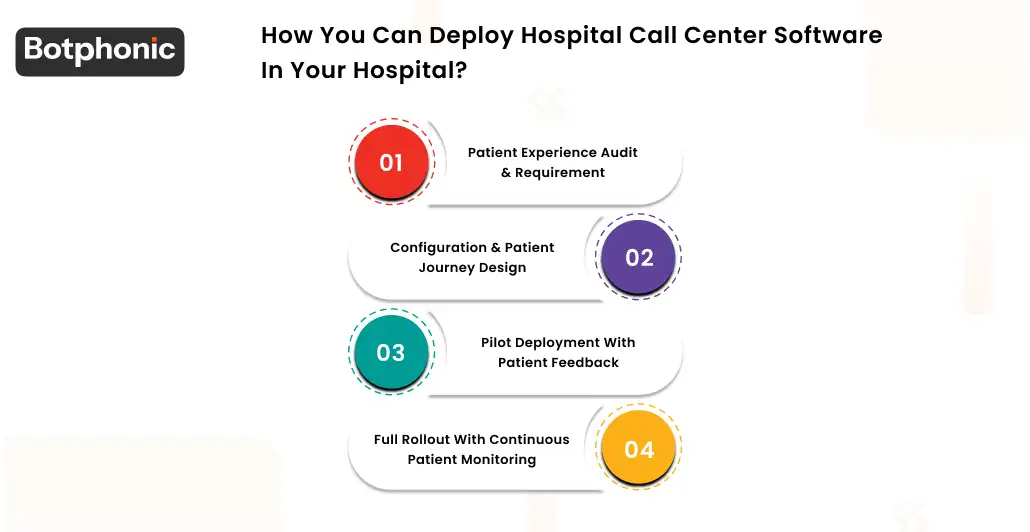
Deployment is the one-time process but its success demands continuous monitoring like constantly examining its critical KPIs and it is important to increase patient experience at each phase. Let’s understand which main 4 phases you need to cover :
1. Weeks (1-2): Patient Experience Audit & Requirement
The process starts with the examining of patient complaints that are based on the conversation, patient satisfaction score, and call abandonment rate. The system identifes the moment when patient get irritated. Then it proceeds to escalate the call to responsible department.
You also need to manage the technical as well as the authoritative regulations aspect like HIPAA compliant along with EMR integration. This step builds the baseline of your success. If you want the entire framework, you can read the conversational AI for healthcare call centers complete guide that gives you clarity from framework, role, to use-cases.
Based on the Qualifacts, the entire process of EHR implementation takes 6 to 12 months. If we talk about Epic – it takes around 12-36 months and Cerner about 9-18 months.
Source : Taction blog, Epic EHR cost 2026: Complete Pricing Guide & Budget Analysis, (“https://www.tactionsoft.com/blog/epic-ehr-cost/”)
2. Weeks (3-4): Configuration & Patient Journey Design
The map is not only based on the simple conversational flows but also designs based on the existing patient requirements. Train the Hospital Call Center Software based on the real patient requests, billing inquiries, and hospital’s terminology. Required to have escalation paths, which effortlessly divert the complex inquiries to the human staff.
It is expected to have first-call resolution, have multiple language coverage, and provide real-time personalization. Also, connects with EHR & PMS for better hospital conversational flows.
3. Weeks (5-8): Pilot Deployment With Patient Feedback
Initiate with the appointment booking – where there are enormous call volumes and patients are highly satisfied with this. If you want realistic results, you should compare the work of AI call systems and human agents, measure the difference in terms of outcomes, productivity rate, and experience.
This phase is the important one as it determines the patient feedback. Examine how patients interact with AI, note down patient satisfaction rate, what the issue resolving rate is, and minimize holding time.
Also, it determines whether patient frustration increases or decreases, accordingly making adjustments in the call system process.
4. Weeks (9-12): Full Rollout with Continuous Patient Monitoring
After taking validation, deploy the AI call systems across divisions. Such as, patient OPD system, invoicing system, and follow-up system. The uninterrupted monitoring is the key to success.
The hospital call center software provides real-time dashboards for strictly monitoring the patient satisfaction rate. Moreover, the connected AI performance with the HCAHPS communication is used for reviewing continuously.
Patient feedback improves the quality of service as they take actions accordingly.
Learn How Botphonic Powers Patient Communication
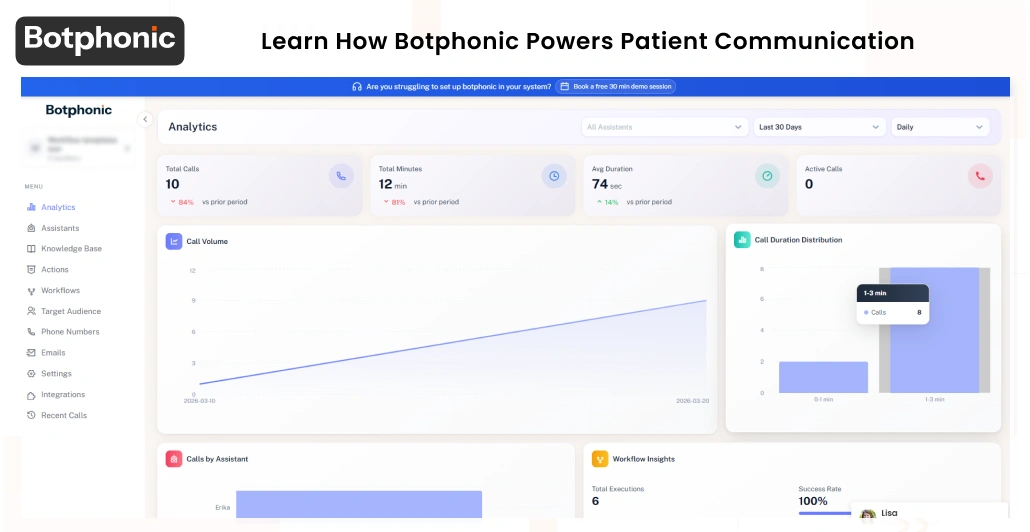
One of the best Hospital Call Center Software as it focuses on the patient satisfaction along with the healthcare service quality. Not only a better replacement of the traditional call center system but also focused on individual healthcare departments, reduces every employee burnout and emphasizes clinical efficiency.
Solutions like Botphonic platform manage appointment scheduling, invoicing workflows, smoothly update information, and handle multiple patient inquiries across all channels – whether its messaging, voice, or emails, the hospital call automation services significantly reduces operational overhead expenses.
It has the ultimate potency to adhere with the HIPAA compliant, PCI, and SOC 2 Type II standards so that the healthcare providers securely coordinate with the patients and confidently transmit the sensitive information.
In addition to signing the BAA agreement and applying the regulations. Smoothly integrates with the EHR, PMS, platform and other existing systems and fetches the recorded information because it links to the product page and hospital pricing plans.
The Botphonic’s healthcare AI platform conducts the post-charge duties, speaks multiple languages other than english, and has the live dashboard that helps to monitor patient emotion at any time.
Besides, its tailored-made functionalities run across every industry – whether it is manufacturing, retail, healthcare, car dealerships, or travel & hospitality. The exceptional aspect about Botphonic – it supports 20+ languages, 50+ human voices support along with ultimate voice customization support, and implement all regulation that peaks security level.
Securely handles all your healthcare workflow duties, compliant with the authoritative regulations like HIPAA, GDPR. Dive deeper to know more.
Talk to an ExpertConclusion
The hospital call centers are the gateways for improving patient experience and provide extreme support to customers. Meanwhile, in traditional call centers patients feel ignored, not disrespected and even not communicated properly with them. Lack of personalization upset them more.
However, the Hospital Call Center Software reduces their bottlenecks and provides phenomenal experience due to schedule an appointment that reduces 30-50% no shows, emotionally available along with 24/7 hour services, reduces waiting times nearly to zero, smoothly manage post- discharge follow-up, provide multi-lingual support, and renders more personalized services.
Also, these are considered the best tips to improve customer experience. Securely link with your current platforms, healthcare product page, and also the pricing page. Those healthcare centers who implement the Hospital Call Center Software will significantly boost the patient satisfaction score within 12 to 18 months.