
Summarize Content With:
TL;DR: Most leaders already know the future of technology in business is AI. What’s missing is the transition plan. This guide covers the forces behind that shift, proprietary deployment benchmarks, a Multimodal AI and vector database primer, and a four-pillar readiness playbook for the future of AI.
Most business leaders already agree that AI is the future of technology. Few agree on how to get there without breaking what already works. That gap, not the technology itself, is where most transitions stall.
AI adoption often fails for a specific reason: companies treat it as a software upgrade instead of a workforce restructuring. A new tool gets bolted onto an old workflow, nobody redesigns the process around it, and the pilot quietly dies. The future of technology belongs to businesses that treat this as a transition to manage, not a purchase to make.
What Is the Future of Technology in Business?
The future of technology in business is the shift from digital tools that store and display data to AI-driven systems that analyze, decide, and act with limited human input. Here’s what that means for leaders: intelligent business is no longer optional, it’s the baseline for staying competitive.
This change impacts four areas: AI-driven operations, automation maturity, connected decision-making and real-time judgement throughout the department. Rather than someone requesting a report and making a decision about it, a system brings the decision to the fore and, more and more, the system makes that decision. McKinsey’s 2025 Global AI Adoption Survey found that almost 90% of companies are already using AI on a regular basis, in ‘at least one business function’ (McKinsey, 2025).
That number gets to the bottom line of the answer to the question on the surface. It doesn’t address the more difficult question: why aren’t so many of the same organizations able to produce results from it?
 NOTE
NOTE
Why Are Businesses Moving Beyond Traditional Digital Transformation?
Traditional digital transformation is the transition of paper and manual processes to digital tools. It didn’t address a decision-making issue, but one of storage and access. But it’s a process that’s being left behind by businesses because it’s not the smartest process, it’s just the fastest one to look at.
The change takes place in three phases. The first thing was companies going digital-first and getting rid of paper files and replacing them with software. Then most people became AI-first and added in the predictive and recommendations to top that digital information. The next phase is the autonomous business, where AI agents perform multi-step workflows but are not responsible for approving every step, rather a human reviews the outcomes.
But, in reality, the dealerships, clinics and service businesses do not enjoy the neat middle ground. You may have a modern CRM system, but still assign all calls to one excessively busy receptionist. The technology is there, the process is not. The real challenge for the next ten years is to not purchase additional software, but to close that gap.
What Are the Three Forces Driving the Future of Business Technology?
Businesses are being driven towards intelligent operations in three directions: making better decisions, doing less manual work, and bringing people and AI systems together. They all affect a different aspect of everyday functioning.
Intelligent Decision Making
Intelligent decision making is using predictive analytics and AI recommendations to make decisions, rather than solely trusting instinct. Real-time insights means that the sales manager knows which leads are most likely to turn into customers before he or she dials a phone number.
For instance, a regional retailer who moved from a stock planning approach to a predictive analytics approach reduced stockouts dramatically by predicting demand at the store level rather than at the regional level. Wins that are small in the pattern recognition area are these that spread throughout a business.
Autonomous Workflows: A Human-in-the-Loop Case Study
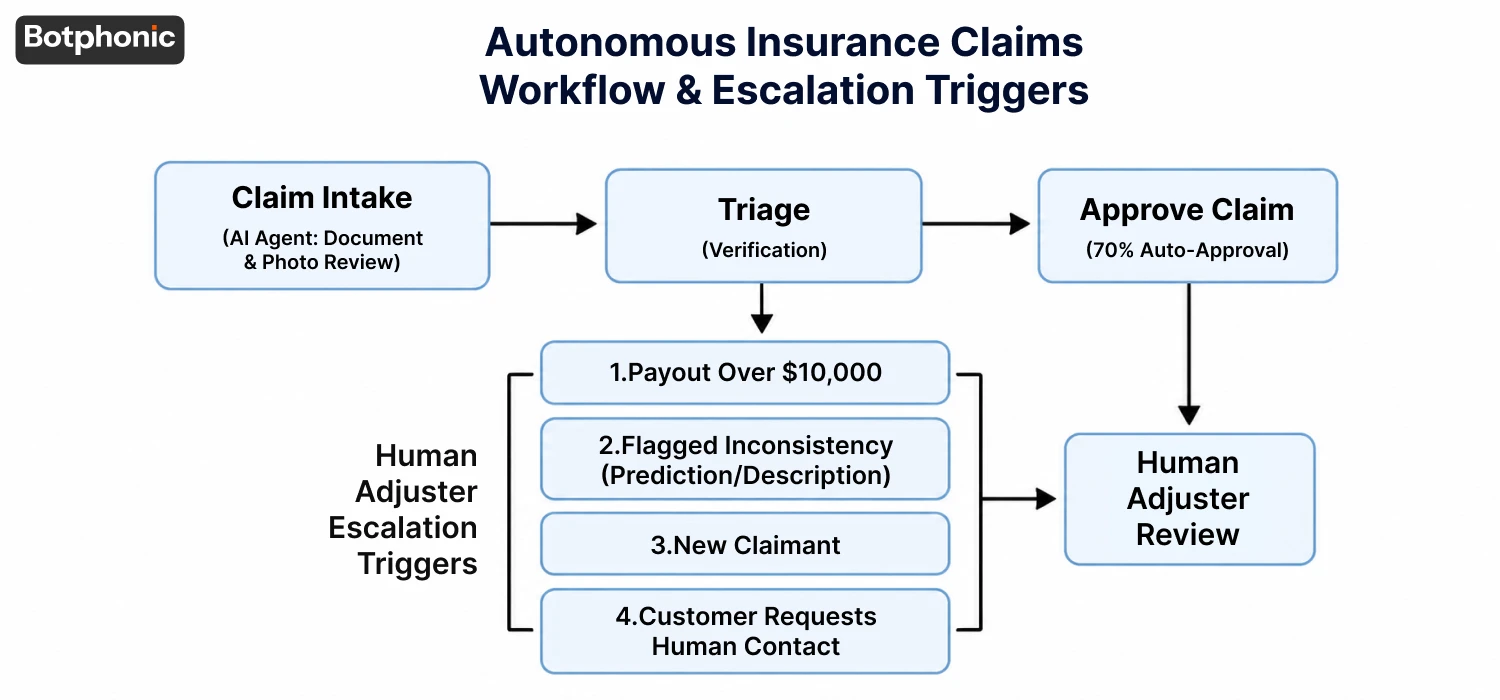
Autonomous workflows are flows of tasks where the AI Voice Agent performs them without any human initiating each one and there are checkpoints where a human verifies the result. Workflow orchestration tools transfer work from one system to another, while intelligent automation makes decisions on exceptions that require human involvement.
Let’s start with an intermediary-sized carrier with about 4,000 claims per month. Prior to automation, all claims, regardless of their type ranging from a simple windshield repair to a total loss vehicle had to go through the same six-step manual review process and typically took 5.2 days to close. The AI agent then collected the documents, reviewed the damage photos and verified the policy match on its own, and escalated a claim only if it reached one of four defined thresholds: a payout over $10,000, a flagged inconsistency in the damage photos and claim description, when the claimant is new or a customer requests human contact.
The outcome: the percentage of claims that passed through intake and triage without a staff member touching them increased to about 78%, the average time-to-close decreased from 5.2 days to 3.4 days, and adjusters’ freed-up time was spent handling 22% of the claims that were truly complex. There was no increase or decrease in the number of staff. The one thing that did change was their focus.
NOTE
Human-AI Collaboration
Human-AI collaboration involves performing repetitive analysis with AI so that people can apply their judgment. An augmentation isn’t about giving employees more tasks, it’s about providing them with more information.
 PRO TIP
Where Will AI and Automation Deliver the Greatest Business Impact?
The business impact of AI and automation is the highest in the functions that have the most repetitive, structured interactions: Marketing, Customer Service, Sales, HR, Finance and Operations. A different form of gain occurs for each function.
| Business Function | What Changes | Typical Impact |
| Marketing | AI generates and tests content variations, personalizes offers at scale | Faster campaign cycles, tighter audience targeting |
| Customer Service | Voice and chat agents handle routine inquiries, escalate complex ones | Fewer missed calls, faster first response |
| Sales | Predictive scoring ranks leads, AI drafts follow-ups | Higher conversion on qualified leads |
| HR | AI screens resumes, automates onboarding paperwork | Shorter time-to-hire, less administrative load |
| Finance | Automated reconciliation, anomaly detection on transactions | Fewer manual errors, faster close cycles |
| Operations | Predictive maintenance, automated scheduling | Reduced downtime, better resource use |
Customer service is worth a closer look, since it’s where the future of AI customer service is most visible to customers directly. In deployments we’ve tracked at Botphonic, businesses that shift call handling to a voice AI agent typically cut call handling time by around 50% and reduce human error on routine calls by roughly 20%, a pattern that lines up with the wider market trend Gartner also reports: conversational AI is projected to cut contact center agent labor costs by $80 billion in 2026 as routine interactions shift to automation.
Our Proprietary Benchmarks: What Botphonic Deployments Actually Show
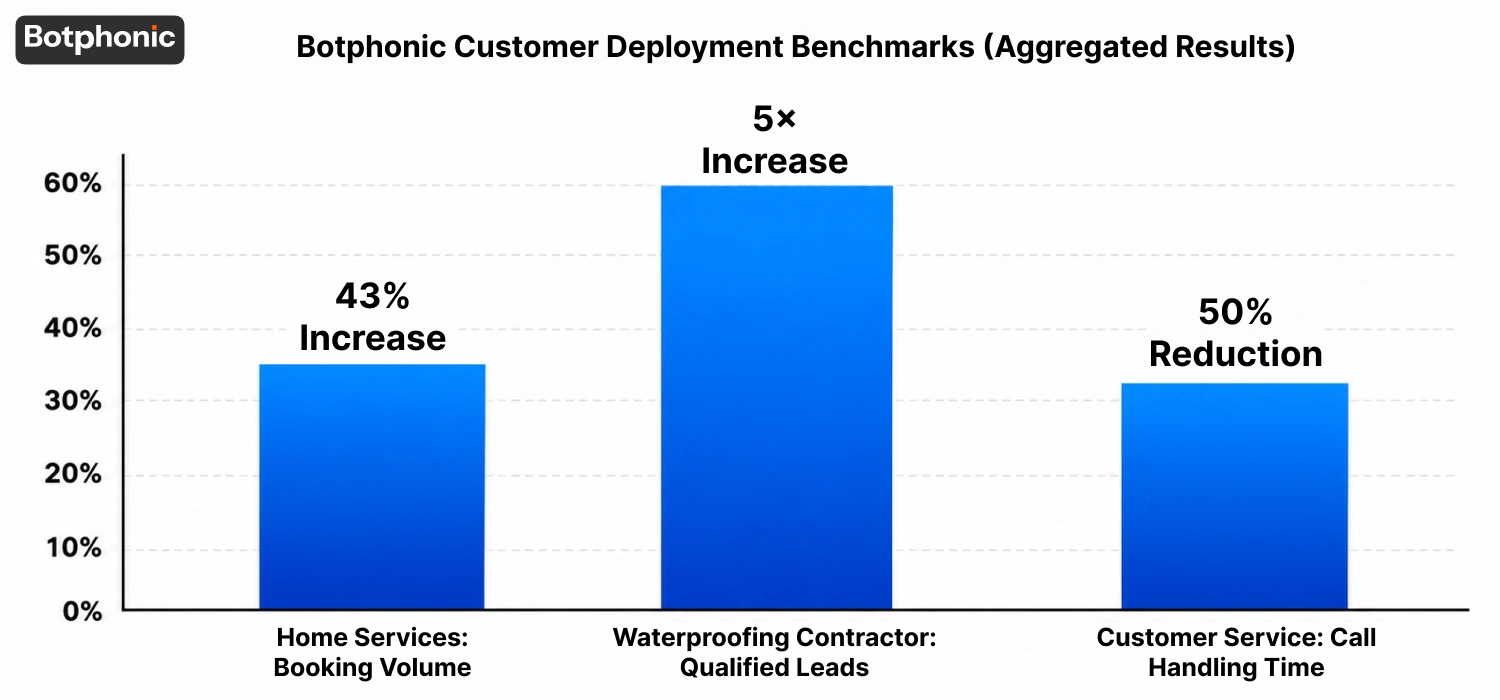
Third-party research describes the market. The numbers below come from Botphonic’s own customer deployments and are meant to show what these trends look like at the level of a single business, not an industry average.
| Business Type | Metric Tracked | Result |
| E-commerce brand | Support delivered via white-labeled AI voice | Built exceptional customer service without an in-house AI team |
| Home services (carpet cleaning) | Booking volume after deploying an AI voice agent | 43% increase in bookings |
| Waterproofing contractor | Inbound lead capture, 24/7 call coverage | 5X increase in qualified leads, no added headcount |
| Financial services firm | Client interaction handling at scale | 20% increase in revenue |
| Multinational tech company | Sales lead qualification automation | 60% reduction in demo costs, 40% less staff time spent |
| Digital agency | Call-driven sales outreach | 3X increase in sales, lower agent costs |
Source: Botphonic Success Stories, aggregated customer results, 2025-2026.
NOTE
What Technologies Will Shape Business Through 2030?
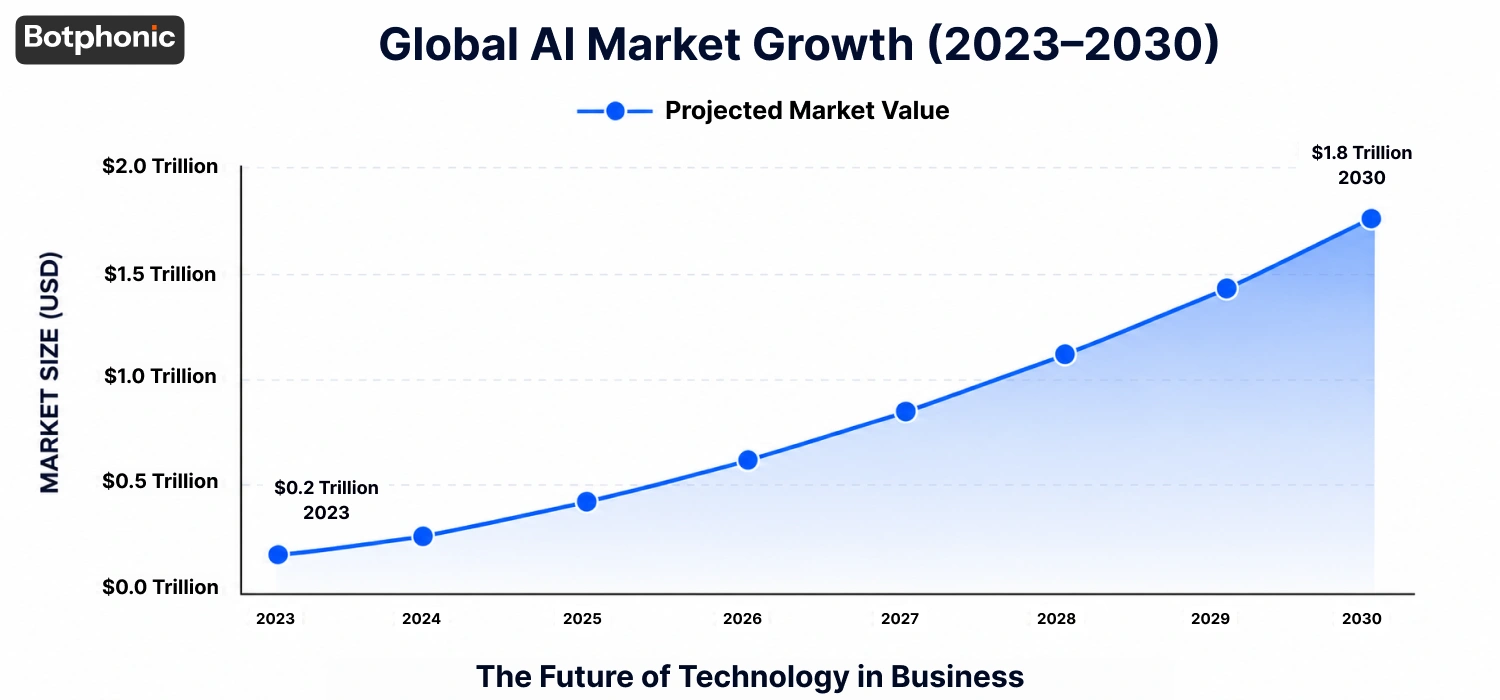
By 2030, seven technologies will redefine how businesses plan, execute, and control work: Agentic AI, Multimodal AI, Vector Databases, Hyperautomation, Predictive Analytics, Edge AI, and AI governance.
- Agentic AI: Executes multi-step tasks autonomously, moving beyond simple chatbots.
- Multimodal AI: Processes voice, text, and images simultaneously; for example, an AI agent can analyze a photo of a damaged product to guide a customer’s return.
- Vector Databases: Store information as mathematical meaning rather than exact keywords, enabling AI to retrieve the correct answer even when user phrasing deviates from source documents.
- Hyperautomation: Integrates RPA and AI to automate end-to-end processes rather than isolated tasks.
- Predictive Analytics: Forecasts demand, churn, or risk using historical data.
- Edge AI: Processes data locally for low-latency performance in voice applications or equipment monitoring.
- AI Governance: Provides board-level oversight of model decision-making and compliance risks.
The global AI market is an indicator of how rapidly things are evolving, with its value expected to reach nearly $1,200 billion by 2030, up from what is currently around $260 billion (Statista, 2025). Rather than a single project, this is a change that is interwoven through security, infrastructure, and daily operations in 2026, according to the Gartner 2026 technology trends briefing (Gartner, 2025).
NOTE
What Challenges Will Define Successful Technology Adoption?
These are six common challenges that must be addressed for successful technology adoption: governance, cyber security, skills, data quality, regulations and change management. If any one of these is missing, a project becomes stalled once it has reached the pilot phase.
AI governance involves defining guidelines on what AI models can make decisions on and what needs to be signed off by a human. As greater numbers of systems become autonomous, able to access customer information and internal tools, so does the potential for cyber risk increase, leading to an even higher prize for a breach. When workers are unable to trust or understand the tools that they are given, workforce skills gaps appear and even when the technology is working, adoption is stalled.
Most AI projects end up failing because of data quality: A messier, out-of-date system makes messier, out-of-date recommendations. There are variations in regulatory requirements across different industries and regions, and regulations are still trying to keep up with the capabilities of agentic AI. There are variations in regulatory requirements across different industries and regions, and regulations are still trying to keep up with agentic AI development. In layman’s terms, change management is about getting people to believe in a new system before they stop checking it by hand.
PRO TIP
What Does the Transition Playbook to Autonomous Operations Actually Look Like?
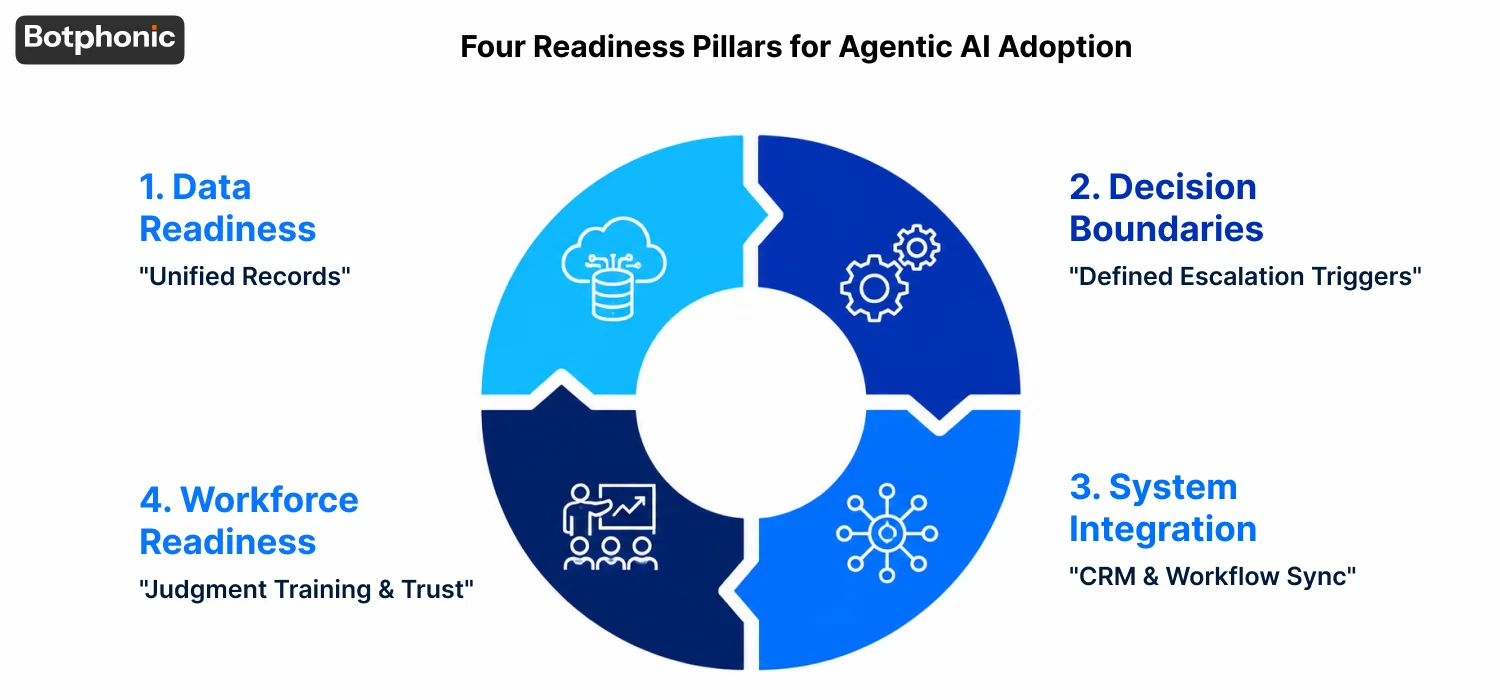
Most discourse focuses on the “what,” but successful transformation relies on the “how.” Moving from manual to autonomous processes without service disruption requires four foundational pillars:
- Pillar 1: Data Readiness: AI agents scale accuracy and error. Ensure your records are uniform and current. An agent trained on duplicate customer files or outdated pricing will simply automate those mistakes at scale.
- Pillar 2: Defined Decision Boundaries: Establish explicit “escalation logic.” You must clearly define what the AI handles autonomously versus what requires human judgment. Without this, you risk either excessive escalation (killing efficiency) or insufficient oversight (creating compliance risk).
- Pillar 3: System Integration. If the AI agent cannot read or write to the CRM or sync with your scheduling and appointment tools, it’s just another disconnected app. Most timelines actually get off track with integration work, rather than model quality.
- Pillar 4: Workforce Readiness: Transparency is key. Staff must understand the AI’s capabilities and limitations before go-live. When employees view AI as an aid to their judgment rather than a threat, they focus on complex problem-solving instead of building workarounds.
Businesses that automate customer-facing workflows first tend to see the clearest early wins, since call and message volume rarely lets up. For a closer look at what that shift involves in practice, see this breakdown of building a future-ready workplace with a smart business phone system, and how AI-powered customer service fits into the first pillar of a transition plan.
The Early Win: Start by automating customer-facing workflows. The high volume of routine calls and messages provides the clearest, fastest ROI.
Next Step: Do you have a current workflow with the four pillars of agentic AI, clean data, defined decision boundaries, connected systems and a ready team? Typically, it is revealed during a short readiness check that the missing pillar is identified before a rollout.
To Sum Up
Technology alone won’t determine which businesses succeed by 2030. Organizations that combine AI, automation, skilled people, trusted data, and responsible governance will be better positioned to innovate, adapt, and compete in a rapidly changing business landscape. The future of the technology rewards businesses that treat it as a transition to management, starting with one workflow, one metric, and one clear escalation rule.
