
Summarize Content With:
Increase Revenue with AI Call Center
AI call centers are a source of revenue both by lowering the cost per resolved call (average of 10-30% less). And by transforming service exchanges into upsell and cross-sell (5-10% revenue increase, according to McKinsey). Businesses looking to increase revenue with AI call center solutions are using these capabilities. It helps them to turn support into a profit drive. This guide discusses 10 individual mechanisms with ROI metrics based on actual deployments. Below: the action of each lever, what each one usually produces, and where to begin.
Rethinking the Role of the Customer Support Center
Most companies consider their AI call center as a cost center – a department, which deals with complaints and refunds. It is true that framing is becoming a thing of the past.
The change is motivated by two structural changes. First, AI is now able to gather revenue indicators on the basis of regular service calls. Such as, a customer requesting information about the upgrade of a plan is also a lead. Second, automation has driven the cost-per-interaction. It has changes it to the point where the contact center can scale the inbound traffic without scaling the number of people. While making the compression of margins margin expansion. These are critical steps if you want to increase revenue with AI call center operations in a measurable way.
Two things that organizations must do to realize this potential are to change the metrics. They have to make it, for organizations that hold the contact center responsible for. And to provide agents with tools that they can use to take immediate action in response to revenue messages. All of them are taken care of in the 10 levers below.
10 Ways to Increase Revenue with AI Call Center Solutions
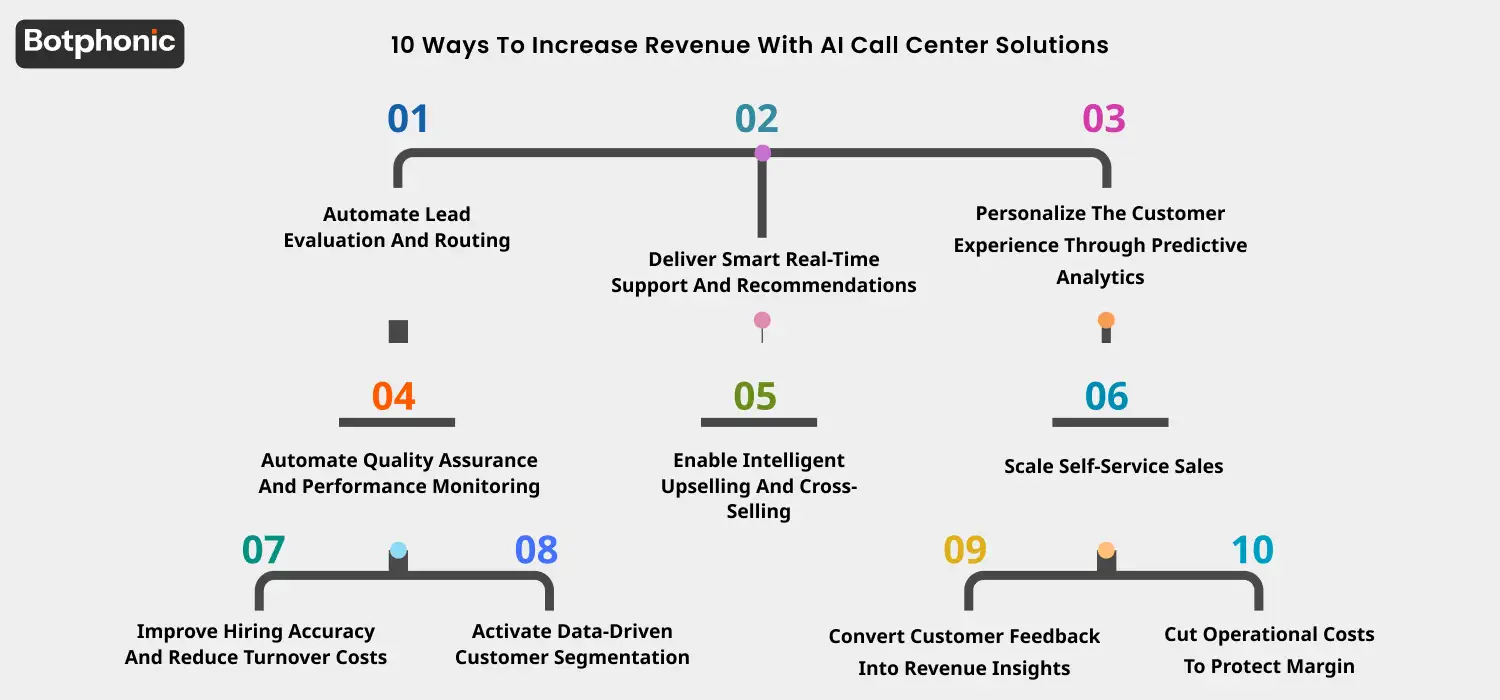
1. Automate Lead Evaluation and Routing
What it does: AI call center solutions use CRM data. Including, call history and behavioral signals to rank inbound leads prior to a human agent picking up. It redirect each call to the agent most likely to turn it into a conversion.
Smart routing eradicates the delay between agent response and lead intent. The system uses matching of high-intent callers with the top-performing agents and marks upsell candidates prior to the call. The industry standards indicate intelligent routing typically increases the first-contact resolution. It increase FCR by 15 percent in mid-market applications. That is, fewer calls and reduced hold time, and increased capacity to conduct revenue-generating conversations.
The use of AI call assistant software also identifies patterns of agent performance throughout time. While, optimizing the routing rules in real-time. The outcome: agents get more focused on the calls, with which they can generate the most value. As opposed to accepting every call that comes in without assessing its suitability.
2. Deliver Smart Real-Time Support and Recommendations
What it does: AI follows sentiment, finds signs of escalation, and provides the agent with the appropriate product information, objection responses, or compliance reminders on their screen during live calls, in real-time.
This is the pattern of agent assist, and ROI can be calculated on a call basis. Call summarization has an average saving of 26 seconds per call in the post-call wrap-up time, which is worth about $20M a year in terms of contact center operation by a 2,000 agent telecom deployment, according to telecom deployment data cited by Observe.ai.
In addition to speed, real-time suggestions enhance regularity. With AI call center solutions, a customized script is ready and the appropriate offer is surfaced at the appropriate time, so the agent can concentrate on the conversation, not navigating the knowledge bases. AI voice agents are more involved in active listening and relationship-building. A supervisor alert is automatically activated when a call displays indications of escalation – churning is prevented prior to its occurrence.
3. Personalize the Customer Experience Through Predictive Analytics
What it does: Predictive analytics models are used to analyze purchase history, interaction data, and behavioral trends across touchpoints to predict what a customer requires before they request it.
Lifetime value is improved through personalization on a scale. According to the data on the implementation of contact centers of e-commerce, customers receiving relevant recommendations during service contacts increase average order value by 10-15 percent in comparison with customers receiving generic responses. The influence adds up – every individualized contact raises the chances of a repeat purchase.
The contact center platforms of the present-day AI unite such data on multiple channels – WhatsApp, Facebook Messenger, Telegram, email, and voice – such that the same customer profile informs all interactions, no matter the channel. Thanks to contact analytics, it is now possible to determine the customers who will most likely upgrade, churn, or expand and direct them.
4. Automate Quality Assurance and Performance Monitoring
What it does: AI compares 100% of calls to predefined quality standards – compliance checklists, sentiment benchmarks, resolution standards – instead of the traditional 2–5% sample.
This is the “silent supervisor” pattern. Conventional QA sampling implies that 95-98 percent of calls are not reviewed and that systematic issues remain unseen until they appear in churn data. QA powered by AI bridges that gap completely.
Examples of such systems include Observe.ai, which is an analysis of all customer-interaction touchpoints and alerts to compliance breaches, unrecognized upsell opportunities, and coaching moments. The revenue implication is straightforward: the sooner the poor patterns are spotted, the sooner they can be corrected, and the behavioral correction will lead to an increase in conversion rate within weeks, not quarters.
Managers move out of reactive complaint review towards proactive performance coaching – a structural change that builds up over time.
5. Enable Intelligent Upselling and Cross-Selling
What it does: AI listens to the content of calls to identify buying indicators – a customer requesting the features of a higher-tier plan, being frustrated with the current constraints, or having competitor-related concerns – and provides the agent with an offer that is appropriate and at the best time possible.
This is the top-earning lever on the stack. A study of generative AI in customer care by McKinsey revealed that upsell detection contact analytics can boost topline revenue by 10-20 percent – a figure that captures both an increase in conversion rate and increase in average order value.
The process is simple: the majority of upsell opportunities are not used due to the lack of knowledge about the products of the agent but because of the lack of the moment, the appropriate signal in the conversation that they should introduce an offer. AI bridges this divide by taking speech in real-time and bringing the offer to the foreground before the window closes. One of the quickest avenues to quantifiable revenue increase in a contact center is to tie AI sales assistant capabilities to inbound service processes.
 PRO TIP
6. Scale Self-Service Sales
What it does: AI voice agents and chatbots process daily inbound requests – order status, account change, simple troubleshooting – without human involvement, and identify purchase intent and direct qualified buyers to live agents.
The average rate of self-service deflection of routine calls is usually 40-60 and the human agents are then left to attend to only the complex and revenue generating interactions. The reallocation of capacity itself is a revenue mechanism: the agent headcount increases and can process more high-value calls.
The trick is to qualify the deflection. Checking the balance by a customer is a real deflection. An upgrade request made by a customer is a revenue indicator, which the AI must send to a conversion-trained agent instead of resolving independently. AI call center solutions are well-configured to deal with this distinction.
7. Improve Hiring Accuracy and Reduce Turnover Costs
What it does: Predictive hiring models compare the behavioral and performance profiles of top-performing agents to predict high-fit candidates in the recruiting pipeline, decreasing the turnover and the cost burden.
The average contact center turnover is 30-40% per year – one of the highest in any industry. When considering recruitment, onboarding, and ramp time, the replacement cost per agent is 10,000-25,000. In a 200-agent operation with an annual turnover of 35% the replacement costs will be 700,000-1.75M per year.
This is mitigated by AI-driven hiring in two aspects: enhanced candidate-to-job fit at the time of hiring, and prompt detection of flight-risk signs in the current workforce. Both are directly proportional to cost avoidance, which at contact center scale makes a significant contribution to operating margin.
8. Activate Data-Driven Customer Segmentation
What it does: AI divides customers based on lifetime value, product fit, frequency of engagement, and churn risk – and directs each segment to the most appropriate service and sales strategy based on their profile.
Where Lever 3 is focused on individual conversations, i.e. personalizing them, this lever is on the portfolio level. Revenue potentials do not apply equally to all customers and treating them the same way is a structural inefficiency. Segmentation-based routing assigns high-value accounts to senior agents, initiates active outreach to at-risk customers, and focuses upsell effort on the areas with the best conversion chances.
Organizations that implement segmentation-based engagement programs have 15-25% higher customer retention rates, and compounding impacts on lifetime value. Most CRMs already have the data – interaction analytics makes it actionable.
9. Convert Customer Feedback Into Revenue Insights
What it does: AI processes post-call surveys, NPS responses, and unstructured feedback at scale to reveal patterns that direct product development, pricing, and service design decisions.
The Voice of Customer programs which bridge the gap between feedback and action produce a quantifiable ROI. Forrester Research has discovered that organizations that take action based on VoC data always have retention rates that are 1.4X higher than the rates of the organizations that gather feedback but do not systematically analyze it.
Most organizations have a contact center as the largest source of feedback in volume – thousands of conversations a day, each of which contains objections against the product, requests to add features, references to competitors, and indicators of churn. AI call center solutions automatically extract this signal and convert post-call data, which is a compliance artifact, into a strategic input.
10. Cut Operational Costs to Protect Margin
What it does: AI process summarization of calls, documentation of compliance, optimization of scheduling, and routine processing of transactions – the labor cost per interaction is reduced, and service quality is preserved or even increased.
Field experiences prove the magnitude of effects. One of the regional moving companies that implemented routing and follow-up automation based on AI reported an incremental revenue of $1M. One of the largest telecommunication providers has saved $20M in operating costs by using AI to optimize the workforce and self-service deflection – without lowering the ratings of services.
Cost savings at this scale flow directly to operating margin, creating budget capacity for reinvestment in higher-leverage initiatives. In the organizations where cost minimization serves as the main limitation, Lever 10 and Lever 6 (self-service deflection) generally offer the shortest payback – in most cases, this can be achieved within 3-6 months of implementation.
 NOTE
NOTEThe 5 Revenue Leaks Nobody Measures
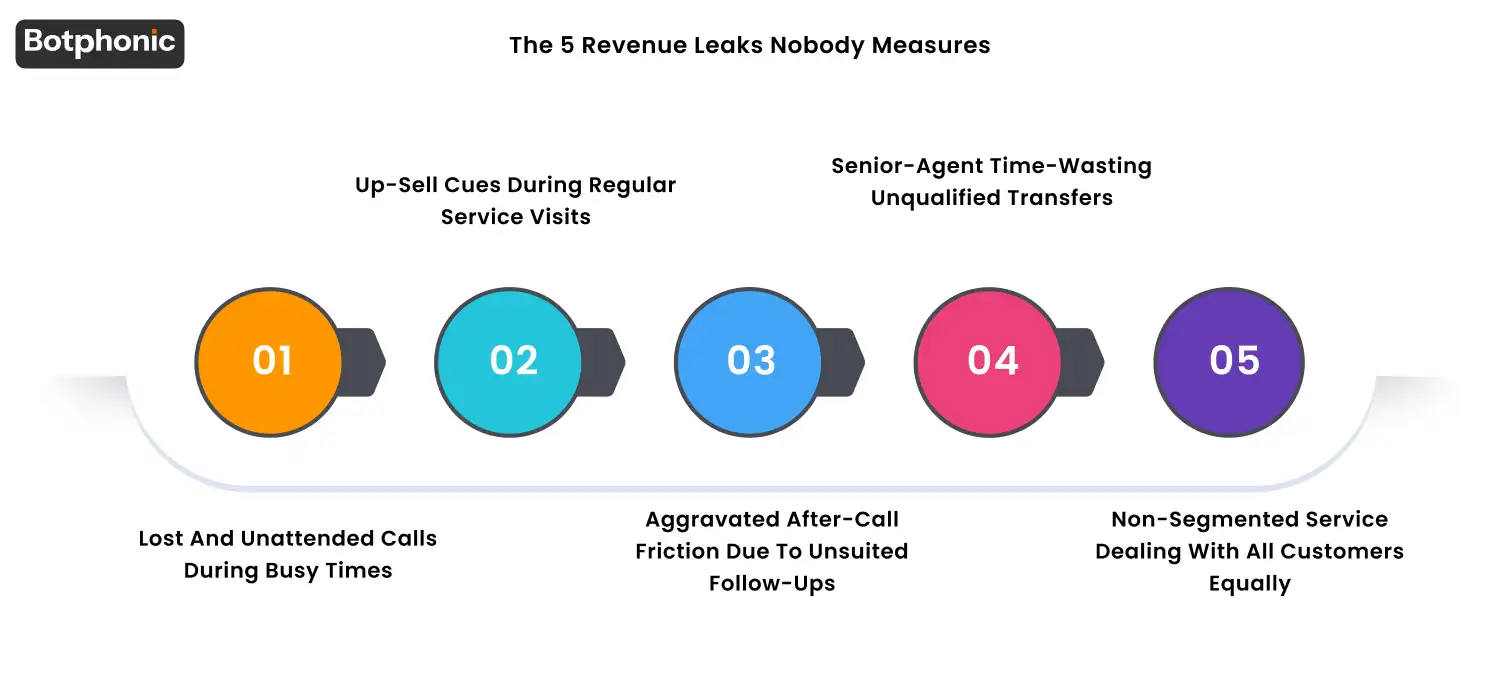
The majority of leaders in contact centers follow the measures of handle time, CSAT, and cost per call. A smaller number traces the revenue that can be achieved with five structural gaps that AI is ideally placed to bridge.
1. Lost and unattended calls during busy times. All the calls that are abandoned in case of a queue overflow are lost conversions. AI-based dynamic routing and virtual queue callbacks salvage part of these contacts – about 20-30% of the volume that had been previously abandoned – and re-route them to agents when there is capacity to do so. (Lever 1 closes this.)
2. Up-sell cues during regular service visits. Someone calling in to change his billing address could have just upgraded his plan to a rival. In the absence of conversation intelligence in real-time, this signal is not detected. The agents cannot do anything with the information that they do not possess. (Lever 5 closes this.)
3. Aggravated after-call friction due to unsuited follow-ups. Calls that terminate without an appropriate follow-up – open cases, un-escalated callbacks, unspecified escalation routes – produce recurring contacts and distrust. This category is eliminated by AI-generated summaries of call and automated follow-up triggers. (Lever 2 closes this.)
4. Senior-agent time-wasting unqualified transfers. When calls that tier-1 agents might resolve – or escalate to senior agents – are transferred by tier-1 agents a hidden cost is created. Layers of AI qualification prior to and during transfer decisions lower the number of unqualified escalations by 30 – 40% in typical deployments. (close this, Levers 1 and 4.)
5. Non-segmented service dealing with all customers equally. A customer with a lifetime value of 500 and a customer with lifetime value of 50,000 get the same queue time, same hold music, and same agent assignment – unless logic of segmentation comes into play. The measurable revenue leak is treating your most valuable customers just like your average customers. (Lever 8 closes this.)
ROI Calculator – Estimate Your Revenue Lift
The financial influence of AI call center investment depends on the size of the operations, the present level of the CSAT, and the leverages deployed initially. The drivers of the model are:
- Calls/day – calculates deflection savings and value of reallocation of the agents and capacity capacity.
- Average ticket value – calculates the upsell and cross-sell upside per converted interaction.
- Existing CSAT score – base of churn reduction modeling.
- The number of agents – defines the value of AHT savings and the extent of QA automation.
The rough estimate of this is: a 500 agent contact center averaging 10,000 calls per day with an average ticket price of $200 can anticipate a 800K-2M increment in annual revenue with the deployment of Levers 1, 2 and 5, and the savings of 1.2M-3M with Levers 4, 6 and 10.
To have a deployment specific estimate, book a 30-minute ROI test booking with Botphonic. Your particular call volume, your current tool stack and what levers are applicable to your operation are discussed during the session.
How to Start: 4 Implementation Tips
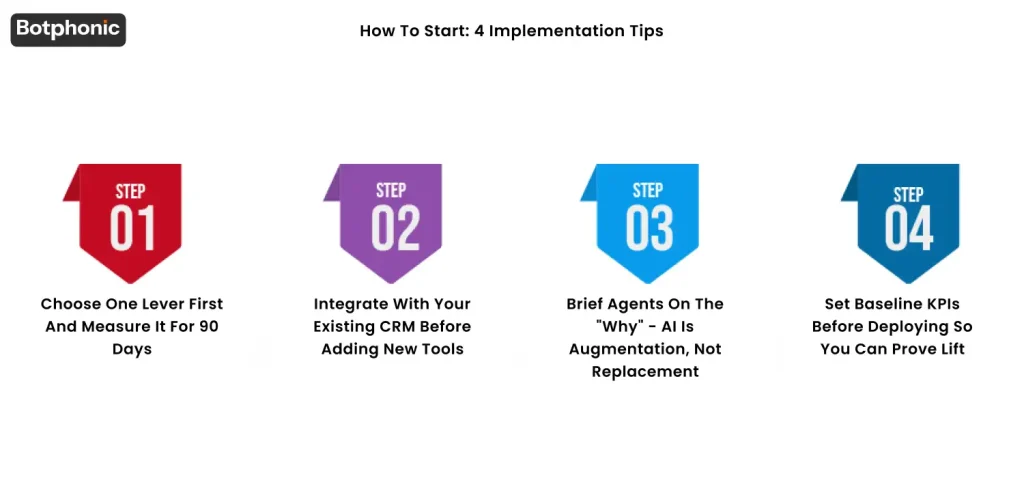
Tip 1: Choose One Lever First and Measure It for 90 Days
The most prevalent implementation error is implementing several AI capabilities at once without a measurement baseline. When all the changes happen simultaneously, the improvement cannot be attributed – and what is not functioning optimally.
Select the lever with the most definite KPI. In case handle time is monitored on a daily basis, the Lever 2 (real-time agent assist and call summarization) is the appropriate place to start. Lever 1 is the most measurable in case inbound routing logging has already been done. Establish pre-deployment baseline, pilot 90 days, and allow the data to dictate expansion priorities.
Tip 2: Integrate with Your Existing CRM Before Adding New Tools
AI call center functions require clean and accessible data on customers. A routing model that is not able to read CRM history will not intelligently route. A personalization engine which is not able to see purchase history will not personalize.
Audit the data connection of your contact center platform and CRM before implementing any of the 10 levers. Majority of integration failures are not technical – they are permission and field-mapping problems that become evident during deployment. This will solve these issues, and all other capabilities down the line will become more productive.
Tip 3: Brief Agents on the “Why” – AI Is Augmentation, Not Replacement
The most common underestimated implementation variable is agent adoption. Agents who recognize that AI does not substitute judgment but only enhances it are quicker to implement and work more efficiently.
Overall, a systematic briefing – of what the system identifies, what it brings to their screen, what it never does (makes decisions, reports to HR) will usually clear up opposition within the first week. The use of real-time assist tools by agents has been proven to be highly effective compared to those who do not use it in the first 60 days.
Tip 4: Set Baseline KPIs Before Deploying So You Can Prove Lift
The most valuable deliverable of any AI call center investment is revenue attribution. Stakeholders that gave their consent to the budget will demand evidence. In the absence of pre-deployment baselines, there can be no proof.
The five KPIs to pre-deployment base: (1) first-contact resolution rate, (2) average handle time, (3) conversion rate on upsell-eligible calls, (4) cost per resolved interaction, (5) agent-assisted NPS. These five measures encompass all the revenue and cost effects of the 10 levers mentioned above, and they may also be directly trended against dates of deployment to isolate the contribution of AI.
Where to Start: A Prioritization Framework
The bottleneck of every organization is not the same. The point of entry will be different depending on the location of the loss of revenue.
- In case cost is the main limiting factor: Begin with Lever 1 (smart routing) and Lever 6 (self-service deflection). These two levers are the quickest to cut the cost per interaction. Normal payback period: 3-6 months.
- When sales performance is the key requirement: Leverage 2 (real-time agent assist) and Leverage 5 (upsell detection). These motivate the most proximate revenue lift. Average revenue increase: 5-15 percent in the initial year of implementation.
- In case quality and consistency are the main limiting factor: Begin with Lever 4 (QA automation). The quality that is consistent is the condition that will make all other levers more efficient. It is also the quickest lever to experience tangible change – usually in 30 days.
As soon as one lever is producing quantifiable outcomes, add a second. The compounding effects better-routed calls with real-time agent assist, QA-calibrated agents with real-time upsell signals – push the top of the McKinsey 10-20% topline range.
Botphonic provides AI voice agent solutions for revenue-generating call center deployments. See pricing and plans or book a 30-minute ROI assessment.