

Summarize Content With:
What You’ll Learn
- Why recruiters lose placements through slow phone screening workflows
- How AI receptionists automate candidate qualification and ATS updates
- The difference between generic answering services and recruiting-specific AI
- How AI reduces duplicate candidate records and after-hours drop-off
- What features matter most when choosing an AI receptionist for recruiting
- How staffing agencies use AI to cut screening time and speed up placements
An AI receptionist for recruiters is an automated voice and messaging agent that screens candidates, syncs data to your ATS, and routes qualified applicants to the right recruiter, without human intervention. It’s built for staffing agencies and recruiting teams drowning in inbound call volume.
Why Are Recruiters Still Spending 2+ Hours a Day on Phone Screening?
Phone screening overload is a volume problem. Recruiting teams handling dozens of applicants weekly have no scalable way to manually answer, qualify, and route every inbound call, so hours disappear into repetitive conversations.
The Repetition Trap Most Agencies Don’t Track
Every recruiter knows the calls: availability checks, shift preferences, location questions, work authorization, the same five questions, repeated fifty times a week.
That repetition adds up fast. Two hours daily per recruiter equals ten hours weekly. Across a team of five recruiters, that’s a full-time employee’s worth of capacity spent on intake calls alone.
Why After-Hours Candidate Loss Compounds the Problem
Candidates don’t job-hunt on a 9-to-5 schedule. A qualified nurse finishing a night shift calls your agency at 7 AM. A warehouse worker applies on Saturday. If no one answers, they move to the next agency on their list.
There’s no recovery from a missed first contact in high-volume hiring. Speed-to-contact determines the placement.
 NOTE
NOTE
What Is an AI Receptionist for Recruiters, and How Is It Different From a Generic Answering Service?
An AI receptionist for recruiters is a purpose-built voice agent that understands hiring workflows, not just call handling. Generic answering services capture a name and number. Recruiting-specific AI qualifies candidates, updates your ATS, and escalates high-intent applicants in real time.
Technical definition: An AI receptionist in recruitment operates via Speech-to-Text (STT) processing, converting live audio to text at a target latency under 600ms, then maps those transcriptions against predetermined ATS applicant qualification schemas. The NLP layer classifies intent, extracts structured data fields (availability, role preference, location, certifications), and triggers conditional logic branches to determine routing. The structured output is then written to the ATS via authenticated API calls, not pasted as unformatted notes.
What Generic Virtual Receptionists Get Wrong in Recruiting
Generic tools weren’t built for staffing logic. They don’t know the difference between an active job-seeker and a passive one, they can’t check your ATS for duplicate profiles. And they don’t even flag urgency.
The result: recruiters manually sort every callback, re-enter notes, and chase candidates who’ve already accepted offers elsewhere.
What a Recruiting-Specific AI Voice Agent Actually Does
A platform like Botphonic’s AI call assistant handles the full intake sequence: it greets the candidate, asks role-specific screening questions, checks availability, and writes structured notes directly into Bullhorn, Greenhouse, or Lever, before a human ever touches the record.
 PRO TIP
How Does AI Receptionist Technology Actually Write Data Into an ATS?
ATS data integration is the process of an AI voice agent reading from and writing structured candidate records to your applicant tracking system via its native API, not copy-pasting call notes into a text field. Here’s what that means for recruiting teams.
Webhooks vs. Unformatted Text; Why the Difference Matters
There are two ways an AI receptionist can “connect” to an ATS. One works. One creates more admin work than it solves.
Unformatted text parsing means the AI drops a block of call notes into a free-text memo field. A human still reads it and updates stages, tags, or custom fields manually. This is common in cheaper integrations and is only marginally better than voicemail.
Webhook-based native integration means the AI sends structured JSON payloads to specific ATS API endpoints after every call. In Bullhorn, for example, that means writing to /entity/Candidate and /entity/CandidateWorkHistory via the Bullhorn REST API, creating or updating discrete data fields like status, availability, desiredLocations, and customText fields mapped to your workflow. During Greenhouse, calls hit the POST /v1/candidates endpoint with properly mapped attributes. In Lever, the POST /v1/opportunities endpoint receives structured opportunity data.
The result: no manual re-entry, no misplaced notes, no data lag.
How AI Prevents Duplicate Candidate Profiles
Candidate identity resolution is how the AI receptionists are pre-screening candidates while recognizing an existing candidate calling from a new phone number, and updating their profile instead of creating a second record.
This is a genuine operational pain point. A candidate who interviewed six months ago calls from a different mobile number. Without resolution logic, the AI creates a duplicate profile. Now your ATS has two records, neither complete.
Platforms like Botphonic handle this with multi-signal matching: the AI cross-references the caller’s stated name, email (collected during the call), and any previously stored phone numbers against existing ATS records. If a match exceeds a confidence threshold, the existing record is updated via a PATCH request, not a new POST. Agencies handling high volumes report this alone eliminates a significant share of weekly ATS cleanup work.
NOTE
How Does Candidate Sentiment Detection Work in Recruiting AI?
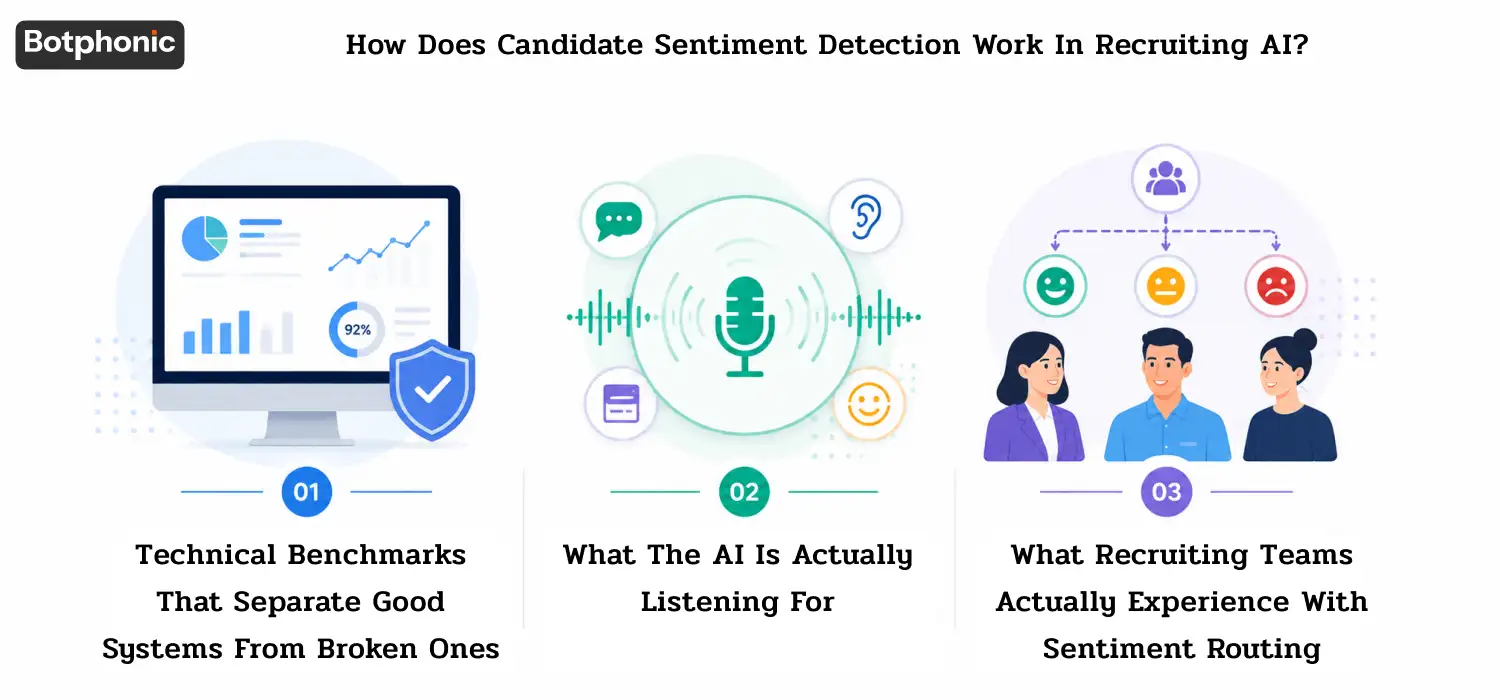
Candidate sentiment detection is the AI’s ability to read tone, urgency, and intent signals during a conversation, not just capture what was said. For recruiters, this is the difference between routing a passive enquiry and escalating a candidate who needs placement today.
Technical Benchmarks That Separate Good Systems From Broken Ones
Response latency is the single most important technical metric in voice AI for recruiting. At above 900ms delay between a candidate speaking and the AI responding, candidates begin perceiving the system as broken or unresponsive, and hang up.
Botphonic’s NLP system targets a response latency under 600ms end-to-end (STT processing + intent classification + response generation). At that latency, measured candidate drop-off during AI-handled intake calls runs below 3%. Systems operating above 1,200ms latency typically see drop-off rates above 12%, meaning more than one in eight candidates abandons the call before qualification completes.
What the AI Is Actually Listening For
Modern NLP engines identify patterns that correlate with hiring urgency: language suggesting immediate availability, frustration signals about a current employer, compensation sensitivity cues, and engagement levels during screening. These signals inform routing, to a priority queue, a live transfer, or a Slack alert to the right recruiter.
What Recruiting Teams Actually Experience With Sentiment Routing
In practice, agencies using sentiment-aware AI answering service report a noticeable shift in recruiter interruptions. Instead of every inbound call landing on a recruiter’s desk, only escalated, high-intent candidates come through. Lower-priority applicants get routed to automated scheduling flows without recruiter involvement.
The recruiter’s phone rings less. But when it rings, it matters more.
Case Study: How MedStaff Rapid Reduced Healthcare Placement Time by 42%
MedStaff Rapid is a mid-sized healthcare staffing agency placing RNs, LPNs, and allied health professionals across three US states. Before implementing Botphonic’s recruitment solution, their five-person recruiting team was spending a combined 9.5 hours daily on inbound phone screening, primarily availability checks, license verification questions, and shift preference collection.
The agency’s core problem wasn’t recruiter quality. It was that 34% of their inbound calls arrived outside business hours, and every missed call represented a candidate actively searching, with competing agencies one Google search away.
After a five-day Botphonic implementation, configured with their license-verification screening script and direct Bullhorn REST API integration, the results over a 90-day period were:
- Inbound call answer rate: 61% → 100% (24/7 coverage)
- Average time-to-first-contact: 4.2 hours → 11 minutes
- Manual screening hours per day (team total): 9.5 → 3.1 hours
- Placement cycle time: reduced by 42% on roles sourced via inbound calls
- Duplicate ATS profiles created per week: 23 → 2 (identity resolution active)
The agency’s lead recruiter noted that the change wasn’t about replacing their process, it was about compressing the lag between a candidate’s first call and a recruiter’s first meaningful conversation.
What Should Recruiters Look for When Choosing an AI Receptionist Platform?
The right AI receptionist for your recruiting team depends on three non-negotiable capabilities: deep ATS integration via native APIs, reliable human handoff logic, and omnichannel candidate engagement. Everything else is secondary.
How Do Different AI Receptionist Approaches Compare for Recruiting Teams?
| Approach | Best For | ATS Integration Method | Sentiment Detection | Handoff Speed | Setup Time | Avg. Response Latency |
| High-volume voice AI (Botphonic) | Staffing agencies, healthcare, warehouse | Native REST API (Bullhorn, Greenhouse, Lever) | Real-time urgency scoring | Instant, SMS, Slack, live transfer | 3–7 days | <600ms |
| Executive search AI | Retained search, legal, technical leadership | Custom CRMs, Salesforce API | Passive intent detection | Structured multi-step scheduling | 4–8 weeks | 800–1,200ms |
| Budget SMS/voice tools | Boutique firms, solo recruiters | Zapier webhooks, mid-market ATS | Keyword tagging only | Automated booking links | Same week | 900–1,500ms |
Here’s how manual versus automated screening costs scale with team size, using conservative agency benchmarks:
The gap between manual screening cost and AI platform cost widens sharply past three recruiters. At ten recruiters, manual screening time represents over $225,000 in annual salary cost,against an estimated $6,000 AI platform fee.
What Changes in Your Recruiting Operation When You Implement AI Call Screening?
Implementation changes where recruiters spend their time, not whether they’re needed. The AI removes repetitive intake work. Recruiters keep the relationship work, the judgment calls, and the placements.
The Before-and-After Workflow Shift
Before AI receptionist software screening, a typical inbound call sequence looks like this: candidate calls, front desk takes a message, recruiter calls back hours later, candidate has already accepted another role, recruiter manually updates the ATS.
After implementation with Botphonic: candidate calls, AI qualifies them in real time, syncs the profile to Bullhorn via REST API, and either books an interview slot or escalates to a recruiter immediately. The lag disappears.
See how Botphonic automates candidate screening, ATS updates, and call routing, so your team can focus on placements.
Book a demoIs an AI Receptionist Compliant With GDPR and CCPA for Candidate Data?
Compliance is not optional for any agency recording and processing candidate voice data. Platforms must address data storage, consent handling, and regional residency requirements, or expose the agency to regulatory liability.
What the Regulations Actually Require
Under GDPR (Article 13, europa.eu), candidates must be informed at the point of data collection what data is being recorded, how it is stored, and their right to erasure. For voice AI, this means the call must include an explicit disclosure before screening begins, not buried in terms of service.
Under CCPA (California Attorney General guidance), California-based candidates have the right to know what personal information is collected during a call and to opt out of its sale or sharing.
For global staffing agencies, verify whether voice recordings are stored in EU-regional data centres (required for GDPR compliance on EU candidate data), encrypted at rest with AES-256 or equivalent, and whether retention periods are configurable to match your data governance policy. A SHRM workforce data governance framework provides additional guidance on candidate data handling practices for HR and recruiting teams.
