

Summarize Content With:
What You’ll Learn
- Why most AI booking software for dealerships adds work instead of removing it
- The real technical hurdle: screen scraping vs. true API integration with CDK, Reynolds & Reynolds, and Tekion
- Why sales and service appointments need separate scheduling logic
- A self-assessment checklist to score your dealership’s scheduling readiness
- What actually changes in no-show rates once integration is done right
Most AI booking tools are glorified calendars that create more work for your BDC, not less. AI booking software for dealerships is scheduling technology for sales and service teams. It only works if it reads and writes live data inside your CRM and DMS, not around it.
What Is AI Booking Software for Dealerships, and Why Do Most Versions Fail?
AI booking software for dealerships is a system that automates scheduling through chat, SMS, voice, and phone, then writes the result directly into dealership systems of record. Most tools on the market stop at the chat layer and never solve the harder problem: getting that appointment into a DMS that was never built to be open.
Modern AI appointment booking platforms don’t simply reserve time slots. They verify customer intent, check live availability, update CRM and DMS records, and trigger confirmations without manual intervention. That workflow eliminates duplicate work for BDC teams while keeping calendars accurate across departments.
How Sales Appointments Differ From Service Appointments
A sales appointment involves a consultant, a test drive, and often a finance conversation. A service appointment depends on technician availability, workshop capacity, and parts. Treating both the same way is the root cause of most scheduling failures.
Sales scheduling is about capturing intent before it cools. Service scheduling is about matching real capacity to real demand. One favors speed. The other favors precision.
Because every dealership operates differently, scheduling rules should reflect the realities of automotive retail rather than generic appointment software. AI solutions designed specifically for car dealerships understand showroom availability, service lane capacity, lead routing, and after-hours customer inquiries far better than standard booking tools.
Why Manual Scheduling Breaks Down at Volume
Manual booking works fine at low call volume. It collapses once a store handles hundreds of monthly inquiries across phone, web, and walk-in. Analysis of nearly 3,000 dealerships found the average hold time runs over three minutes, and 60% of callers hang up after just one minute on hold (useflai, 2026).
From our experience onboarding 100+ stores, the volume problem is rarely the reason a booking tool gets abandoned within six months. The integration problem is.
Why Does AI Booking Software Integration With CDK or Reynolds Actually Fail?
Integration with CDK Global or Reynolds & Reynolds fails when a vendor relies on screen scraping instead of a certified API connection. Screen scraping reads DMS screens like a human would, which breaks the moment the vendor changes a field or a layout.
Screen Scraping vs. True API Integration
Screen scraping was once the default workaround for third-party vendors. Reynolds actively disabled report-preview scraping and dial-in access starting in 2010, forcing vendors onto its certified interface instead (Wikibooks DMS documentation). Any booking tool still leaning on scraped data today is building on a foundation the DMS vendor can shut off without notice.
True API integration means the booking platform exchanges data through a certified, documented interface instead of imitating a login session. Reynolds requires vendors to complete its Reynolds Certified Interface (RCI) program before write access is granted (Reynolds & Reynolds). CDK runs a comparable certified partner program, and per-dealer access fees have run into the hundreds of dollars per month per integration category in court testimony from a related antitrust case (Authenticom v. CDK Global court filing).
 NOTE
NOTE
Why CDK and Reynolds Are Called “Walled Gardens”
CDK and Reynolds are described as walled gardens because both companies have historically restricted third-party access and charged integration fees to control it. Reynolds’ RCI entrance fees have run as high as $80,000 in past vendor accounts (Wikibooks DMS documentation). That cost structure is exactly why so few booking vendors ever reach true write-back integration, and why so many dealerships end up with a scheduling tool that only reads data, not one that updates it.
By contrast, Cox Automotive’s Opentrack framework is generally considered more open, giving third parties DMS access without the same per-transaction fee structure (dmsintegration.ai, 2026). Cloud-native platforms like Tekion are built on modern API architecture from the start, which lowers integration friction compared to legacy systems (dmsintegration.ai, 2026).
Middleware vs. Native API Integration
Middleware is a translation layer that sits between the booking tool and the DMS, converting data formats so the two systems can talk. Native API integration skips that layer and connects the booking platform directly to certified DMS endpoints.
Middleware is faster to deploy and often cheaper upfront. It also adds a second point of failure, if the middleware provider’s connection lapses, your booking tool silently stops syncing even though the DMS itself is fine. Native integration costs more to certify but removes that failure point, because the booking platform maintains the certified relationship itself.
From our experience onboarding 100+ stores, the stores that skip this question during vendor evaluation are the ones calling support six weeks later asking why appointments stopped appearing in the DMS.
Why Do Dealerships Lose Revenue to Missed and No-Show Appointments?
Missed and no-show appointments are a direct revenue leak, not just an inconvenience. They cost technician time, sales floor capacity, and customer trust, and a broken integration makes every one of these numbers worse.
Service departments run a no-show rate of roughly 15% to 25%, with 20% treated as the industry norm (Numa, 2026). At a $450 average repair order and 200 monthly repair orders, that translates to about $18,000 in monthly lost revenue, or $216,000 a year from one store (Numa, 2026). Separately, one industry estimate puts the fully loaded cost of a single missed appointment between $220 and $295 once lost upsells and technician downtime are included (Kimoby, 2025).
The problem is not limited to service. Calls placed between 7 PM and 10 PM, when customers are actually free to book, end in a hang up nearly two out of three times (Numa, 2026).
Pro Tip: Pull your call logs by hour before evaluating any booking platform. If your after-hours hang-up rate looks anything like the industry’s 65%, an always-on voice assistant will show ROI faster than a new CRM module.
Self-Assessment Checklist: Is Your Dealership Ready for AI Booking Software?
Score your dealership honestly against each line below. Every “no” answer is a gap an AI booking vendor should be able to explain, in writing, before you sign anything.
Sales scheduling readiness
- We know our current internet-lead show rate (industry range: 40–50%) (Numa, 2026)
- Our CRM (VinSolutions, DealerSocket, or Elead) already flags duplicate leads automatically
- A booked test drive appears on the consultant’s calendar within minutes, not hours
- We can trace every no-show sales appointment back to a lead source
Service scheduling readiness
- We know our current service no-show rate (industry norm: ~20%) (Numa, 2026)
- Technician capacity is visible in real time, not updated once a shift
- Appointments are confirmed by a real response, not just a one-way reminder text
- Our DMS (CDK, Reynolds, or Tekion) has a documented certified-partner program our vendor is enrolled in
Integration readiness
- Our current or prospective vendor can name their DMS certification (RCI, CDK partner tier, or native API)
- We know whether their connection uses middleware or a native API
- We have asked what happens to bookings if the DMS connection drops for a day
- We track appointment volume and show rate as a monthly KPI, not a launch-week metric
If you checked fewer than eight boxes, integration depth, not chat features, should be the first question in every vendor demo.
What Should Dealers Look for in AI Booking Software?
The right AI booking software is the one that reads and writes data across your existing CRM and DMS, not a bolt-on calendar. Every other feature depends on that connection working correctly.
Omnichannel Booking Channels
Customers now book across web chat, SMS, and phone calls, often switching mid-conversation. AI booking software should hold context across all three. A voice AI system built for test drive booking should hand off cleanly to text confirmation without asking the customer to repeat themselves.
No-Show Prevention Features
No-show prevention depends on confirmation, not just reminders. Confirmed appointments show up at meaningfully higher rates than appointments that only received a generic reminder text (Numa, 2026). Email reminders alone are weak here, automotive open rates hover around 20%, and confirmation is never guaranteed (Numa, 2026).
Look for platforms that also support multi-location scheduling, custom service lane rules, and appointment analytics broken out by advisor and time slot.
| Feature | Why It Matters for Dealerships |
| Native DMS API (not middleware) | Removes a silent single point of failure |
| CRM Integration | Eliminates duplicate customer records |
| AI Confirmation (not just reminders) | Directly reduces no-shows |
| Omnichannel Booking | Captures leads across chat, SMS, and voice |
| Capacity Management | Prevents overbooking a service bay |
| Appointment Analytics | Shows which advisors and slots underperform |
How Does AI Appointment Booking Actually Work Inside a Dealership?
AI appointment booking works by combining a conversational front end with real-time access to your scheduling data. The system asks qualifying questions, checks live availability, and writes the booking directly into your CRM or DMS through a certified connection.
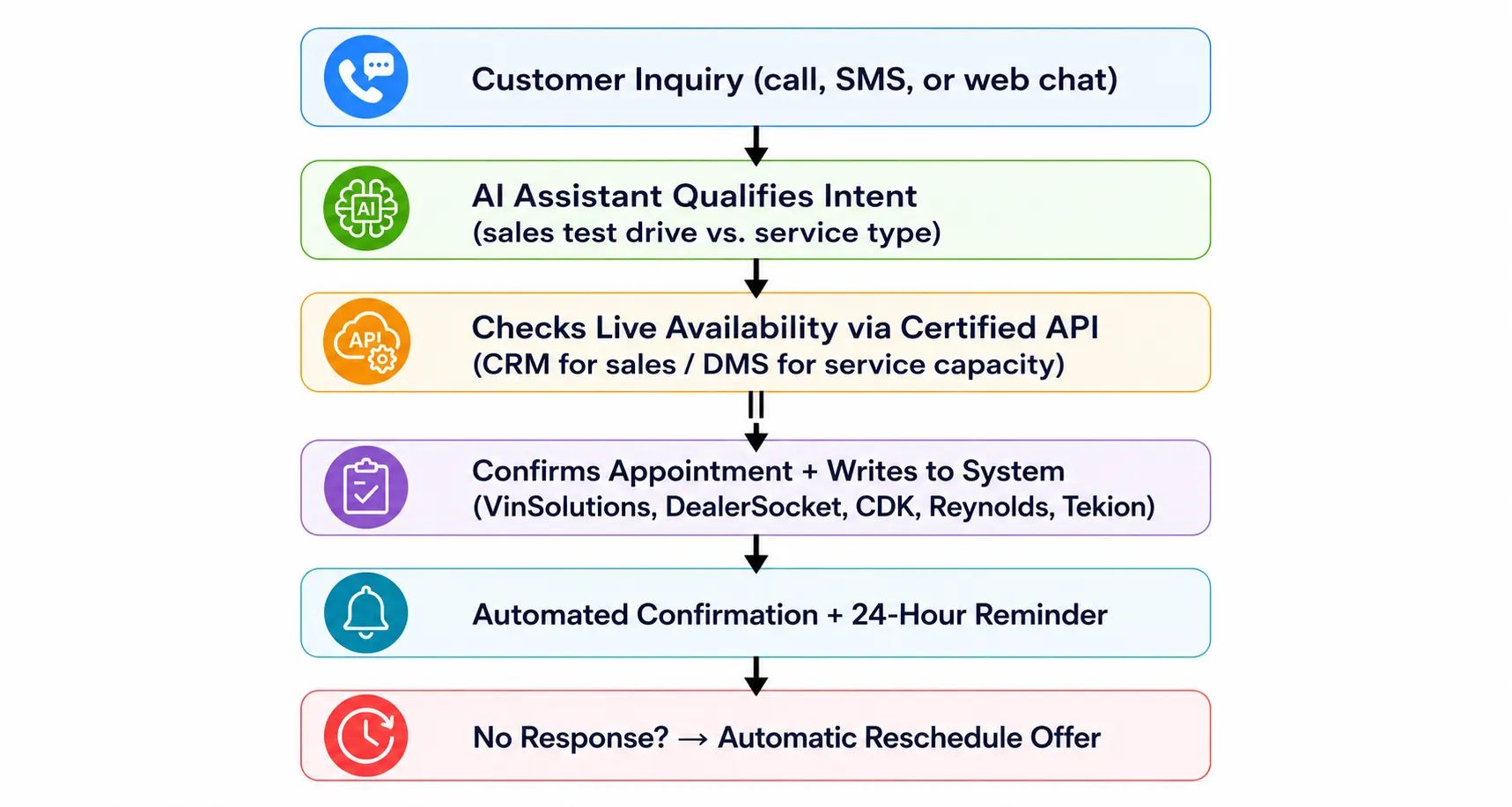
A Ford dealership that deployed AI-handled scheduling captured 23 previously missed appointment leads on its first day and was booked five days out within a week (Numa, 2026). That result depended on the booking writer actually landing in the DMS the first time, not on a retry queue.
What Changes When a Dealership Implements AI Booking Software Correctly?
Once integration is done right, the biggest change is fewer gaps between booking, confirmation, and follow-up. Those gaps are exactly where the industry’s 20% no-show rate lives.
Stores that added a full confirmation and reminder workflow, not just online booking, saw appointment volume climb 10% in the first month and more than 40% after 60 days (Numa, 2026). One CDJR store went from 205 monthly service appointments to 448 in a single month after automating call handling (useflai, 2026). On the sales side, leads contacted within one hour are roughly seven times more likely to qualify than leads contacted after thirty minutes (Harvard Business Review, cited via Botphonic).
In practice, what dealerships actually experience is less dramatic than the case studies suggest at first. The AI does not replace the BDC team. It removes the repetitive booking calls so staff spend more time on complex trade-ins and financing conversations, while the system handles routine confirmations around the clock.
Request a demo with Botphonic and see how AI appointment booking performs against your dealership’s actual call data.
Try Botphonic Today!What Mistakes Should Dealers Avoid When Choosing AI Booking Software?
The most common mistake is picking generic scheduling software with no automotive integrations. A calendar tool that cannot write to your DMS creates more manual work, not less.
Other frequent errors include:
- Accepting “we integrate with CDK” without asking which certification program covers it
- Ignoring the difference between read-only and write-back access
- Overlooking the mobile booking experience most customers now use first
- Choosing based on price alone, without testing confirmation accuracy
- Never measuring appointment performance after go-live
What’s Next for AI Appointment Booking in Automotive Retail?
Predictive scheduling is the clearest near-term shift. Systems are starting to flag service needs from vehicle telematics before the customer even calls. Voice AI is also expanding into full inbound call handling, not just booking, covering pricing questions, financing basics, and parts availability in the same conversation.
Expect more dealerships to pair AI receptionist tools built for car dealership call handling with predictive staffing models that adjust technician schedules based on forecasted demand.
Conclusion
Dealership scheduling is not one problem, it is a sales problem and a service problem running on different clocks, sitting on top of DMS platforms that were never designed to be open. The best AI booking software for dealerships treats the scheduling logic separately while surviving contact with CDK, Reynolds, or Tekion.
If you’re evaluating multiple vendors, don’t compare features alone. Review how each platform handles DMS integrations, omnichannel scheduling, confirmation workflows, and certified write-back capabilities. This comparison of the top AI scheduling platforms can help shortlist solutions before requesting demonstrations.
Before choosing a platform, run the self-assessment checklist above and ask every vendor to name their DMS certification in writing. That single question will tell you more than any feature list.
