Summarize Content With:
Introduction
Logistics businesses operate on speed. Losing a potential deal because of a late delivery, failed attempt to re-plan a delivery, or unanswered phone call in response to a freight quote may result in lost business. And also in broken relationships with a client or slowing down of operations that can trickle down a complete supply chain. However, the tradition of small front-desk teams at many logistics companies cannot be present 24/7, as many companies do.
It is here that an AI receptionist for logistics has begun to be worth the difference. Transforming how companies handle high-volume calls and operational tasks. However, when used in context, the AI receptionist can have different meanings. It is worth clarifying what exactly these systems accomplish within a logistics operation since the response to simple questions is significantly broader than that.
The Challenge of Call Volume in Logistics
Why traditional receptionists struggle
Logistics firms get calls in several directions at the same time, such as:
- Carriers call in
- Customers are monitoring their orders
- Dispatchers are checking their aunts
- Warehouse partners are signaling an exception
- New clients are seeking a quotation
Volume goes high and erratic during peak seasons.
The traditional receptionist staffing can deal with a certain number of calls before the calls go to voicemail. Or callers are sent to long holds. In logistics, none of the outcomes are neutral. A carrier which cannot connect to dispatch to confirm a pickup window can miss the slot altogether and result in a cascade of delays.
When a customer calls to check the status of their shipment and he hears a voicemail. They may be inclined to suspect that the shipment is lost and become uncontrollable.
An AI Receptionist for Logistics can process numerous dialogues simultaneously. Wthout compromising response quality, effectively redesigning the capacity equation of busy operations.
Core Functions of an AI Receptionist in Logistics
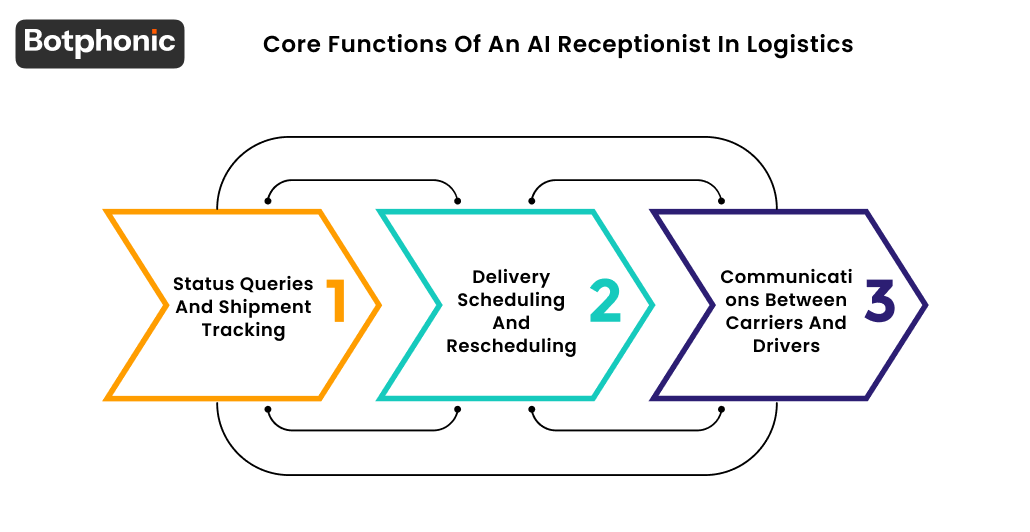
1. Status Queries and Shipment Tracking
A variation of where my shipment is the single most frequent type of call in the logistics. Human agents are time consuming in these calls. Since they need to call up tracking systems, decipher status codes and change jargon used in logistics into plain language. Which makes it understandable by the customer.
This can be automated by an AI call assistant, which is tied to a transportation management system (TMS) or tracking platform of a company.
- The caller identifies themselves or gives a reference number
- The AI retrieves the current status as it stands
- Reports it in a meaningful and understandable manner
- Exceptions are recorded and what is being done in case of delay.
This interaction does not need the assistance of humans in virtually all occurrences and it is capable of occurring at 2am just as well as it can occur at 2pm. This 24/7 availability is operationally important in the case of logistics companies which are serving customers in different time zones.
 PRO TIP
2. Delivery Scheduling and Rescheduling
Another field that AI receptionists have really been of use is scheduling. In case of failed delivery attempt due to the absence of the recipient. Or even a full dock, or a mismatch in address, the follow-up process includes the carrier calling the customer to schedule another window. The customer calling back and making themselves available, and a dispatcher manually clearing the route.
This complete loop can be handled by an AI receptionist for logistics. Such as automating scheduling and rescheduling without human intervention. It calls the customer (or picks up his or her inbound call). Gets his or her desired reschedule window. Then proceeds to verify it against available capacity where it is coupled with scheduling software. Then confirms the new time and records all this without a human dispatcher.
In case of exceptions – a customer requests with a time window that is not available, a freight shipment that needs special attention, etc.- a human may receive the AI with all the pertinent context already recorded.
3. Communications between Carriers and Drivers
Customers are not the only ones who call in. Inbound communication is always going on in the process of logistics between carriers and drivers. They make phone calls to check pick-up schedules, update delays, report truck problems, request dock assignments or gate codes, and check on the load status. These are ordinary calls as individuals. They end up consuming huge quantities of dispatcher and receptionist time cumulatively.
The routine part of these interactions can be managed by an AI receptionist for logistics. Ensuring drivers and carriers receive timely updates and instructions.. By validating appointment windows in the system, relaying instructions and checking in information. In the case when a driver calls about the problem that needs the actual decision-making, the AI forwards the call to the corresponding dispatcher with the context already attached.
Such intelligent routing saves the delay between someone reporting a problem and the appropriate person becoming aware of it, which can easily be the difference between resolving a problem in a clean manner and allowing the problem to propagate into a larger issue.
 NOTE
NOTE
Driving New Business and Managing Exceptions
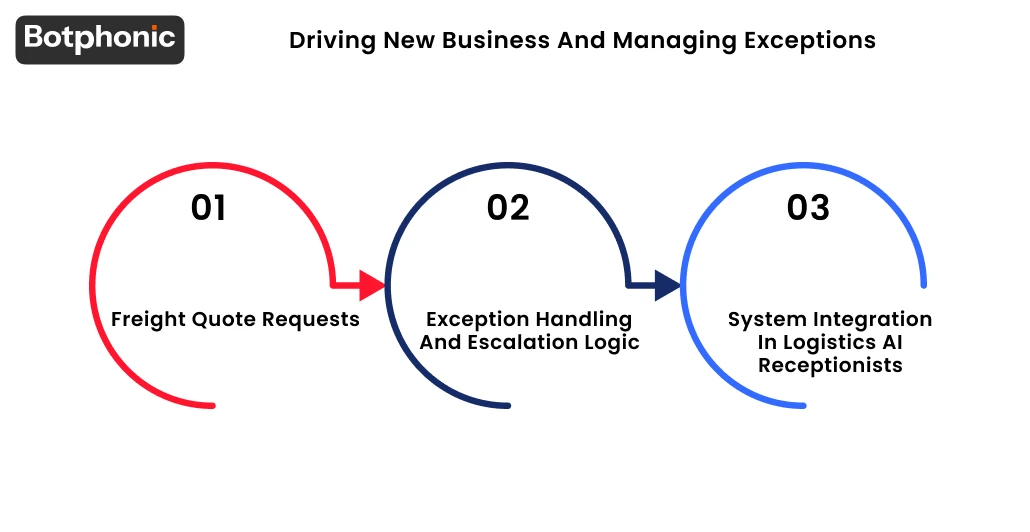
1. Freight Quote Requests
Quote requests are the beginning of new business, and companies that are slow in responding to them lose their opportunity to the faster ones that respond quicker. As an inbound caller, an AI voice agent for logistic is able to:
- Capture the rudimentary details of a freight quote (origin, destination, weight, dimensions, freight class, timeline)
- Automatically put data into the CRM or quoting system
- Ensures to provide a rough estimate in case the rates are in the system
- Can assure a more detailed quote within a particular timeframe
2. Exception Handling and Escalation Logic
The logistics operations are heavy with exceptions. Things go bad, deliveries are late, customs detainments, wrong addresses, weather, way. In the case of exceptions, customers and partners require quick information and, occasionally, quick decisions.
An AI receptionist may be programmed with the logic of escalation which identifies high-priority exceptions. Such as:
- Shipment value
- Client level
- Time sensitivity
Instead of sending all exception calls to the next human that is available, it can give priority to them and forward them to the appropriate individual, the account manager of a major client, a specialized custom department of international freight, or a supervisor of damage claims.
Such an intelligent routing saves the delay between a problem being reported and the appropriate person becoming aware of it, which can easily be the difference between a problem being resolved in a clean manner, and allowing the problem to propagate into a larger problem.
3. System Integration in Logistics AI Receptionists
An AI receptionist for logistics must integrate seamlessly with TMS, CRM, and other platforms to provide actionable, live responses rather than generic answers. Integration is the real business value of the operational value – a TMS platform, CRM system, warehouse management software, and carrier APIs, and scheduling tools.
An example here is Botphonic, which develops its AI receptionist service on the idea of practical integration with the software environment already in use by logistics companies so that the AI is not merely answering calls but actually communicating with live data so as to give the correct and actionable response.
The interaction is considered useful when a caller inquires the status of his or her shipment and the AI is able to retrieve live tracking information directly out of the TMS. When it is unable to, the AI is treated as yet another hurdle to an already exasperated caller.
What Logistics Companies Often Overlook During Implementation
The most typical error that any logistics company can commit when implementing an AI receptionist is to assume that it is a drop-in substitute of human personnel without considering the work processes. The technology is most effective where the implementation team diagrams the types of calls that the company is actually receiving, develops clear escalation procedures in case of exceptions, and the knowledge base of the AI is tailoring towards the specific operations of the company.
An abstract AI logistics automation will not be capable of answering queries concerning freight lanes of a particular company, the price scheme, or the partners that the enterprise has. The AI work needed to ensure it is actually useful is very real and the companies that do not take the time to do the configuration of its systems have ended up with a system that responds only to the most simplistic of queries and can frustrate the caller trying to do anything that requires more than a yes or no answer.
When implemented correctly, the system turns into a true working asset, not only an instrument of call diversion, but a working part of the communication processes that ensure the functioning of a logistics company.
See how AI can streamline your operations
Schedule a demoConclusion
The AI receptionist for logistics is no longer hypothetical, it’s a practical operational tool that streamlines inbound communication, tracking, scheduling, and exception handling. These systems process much of the inbound communication that was formerly done by 24-hour human personnel to track queries and delivery schedules, reschedule carriers, and exception routes. Moreover, as per research, the data states that AI helps reduce maintenance costs by 10-15% for logistics operations.
That is a significant change to logistics companies that are struggling with both increasing customer demands and limited human resources. It is not whether AI receptionists can assist, but whether it is considered carefully enough to bring about the operational value that is actually there.