
Summarize Content With:
What You’ll Learn
- Why manual driver check-calls drain dispatch budgets and introduce costly human error
- How AI phone call software for logistics handles context-aware driver communication and TMS sync
- The role of AI dispatch software in automating detention and dwell-time tracking
- How AI in logistics and supply chain closes the 24/7 coverage gap without hiring more staff
- What changes in your operations, and your bottom line, when you implement voice AI for dispatch
Are You Ready for AI Dispatch? A Decision Matrix
Use this before reading further. If you answer “Yes” to three or more questions, you are operationally ready for AI phone call software today.
| Readiness Question | Yes | No | Not Sure |
| Do you handle 100+ driver check-calls per day? | Strong fit | May be premature | Audit your call volume first |
| Do you run overnight or weekend dispatch with reduced staff? | Strong fit | Lower urgency | Check your after-hours miss rate |
| Are detention disputes costing you unbilled revenue? | Strong fit | Lower urgency | Pull your last 90 days of detention claims |
| Is your TMS accessible via REST API? (McLeod, TMW, Aljex) | Ready to integrate | Resolve first | Confirm with your TMS vendor |
| Do dispatchers spend 2+ hours daily on routine status calls? | Strong fit | Lower urgency | Time-study one dispatcher for a week |
| Have you had a staffing gap cause a service failure in the last 6 months? | Urgent fit | Lower urgency | Track near-misses going forward |
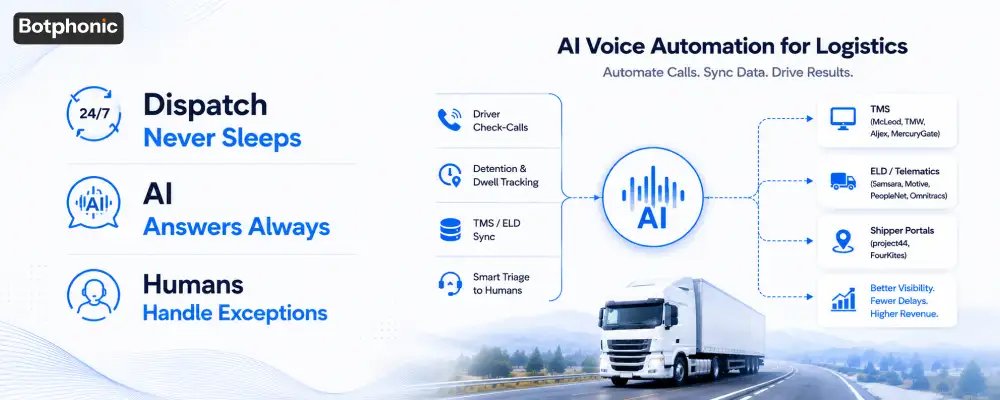
AI phone call software for logistics is an automated, voice-based system that interfaces with the TMS and ELD systems to perform driver check calls, detention management, and dispatching triage around-the-clock without any human intervention.
The cost of a driver check call at 3:00 AM is not only your hourly wage. The cost of this call is sleep deprivation, human error, and delay that it adds to a load which is already behind schedule. This blog post is for those carriers, 3PL providers, and dispatch offices that operate 24/7 but do not have the budget to do it.
Why Is Driver Check Called a Manual Process in 2026?
Check calls are manual because all the workflow procedures were built on telephoning, and no replacement has been made yet. Here is how it works for dispatchers.
ELD shows you where the truck is. TMS platform shows you the status of your load. Neither of them initiates the phone call though. Verbal estimates, dock confirmations, and “I am stuck in traffic” excuses still require human action calling your driver. And it costs money each time.
Fact: A medium-sized carrier operating 200 trips a day uses 16+ dispatcher hours a day on repetitive status calls work with no decision making.
Communication friction is in top-two for pain points in carriers with fewer than 500 trucks according to DAT Freight & Analytics. The manual check call is the friction.
What Is AI Phone Call Software for Logistics and How Does It Deal with Driver Accents?
AI phone call software for logistics is a voice-based automation layer that manages incoming and outgoing calls for your dispatchers. This is what it entails for carriers and 3PLs.
This is not an IVR telling you to “press one for status update.” It is a conversational AI agent understanding everything a driver says including local dialects, CB jargon, partial sentences such as “I am pulling in now” and “the dock is closed they are telling me it will be two hours.”
Contextual Awareness-Based Automation Layer Above Generic IVR
IVR systems fail in logistics because they do not understand the meaning of messy, real-life language. “I am ten minutes out” in background noise has a certain meaning, just as “they got me sitting here since noon.”
Fact: Logistics-specific AI systems include ambient noise reduction, specifically designed on truck cab audio. Engine sounds, CB interference, and road wind are all removed prior to transcription.
“Dropped the trailer” has a different meaning than “dropped the load.” The AI system is trained on freight-specific terminology to be able to recognize the difference.
Instantaneous TMS Integration: Overcoming the Phone-to-Keyboard Gap
While the manual check-calls themselves do not have much room for improvement, the transcription process introduces transcription errors and delays.
Fact: At high volume dispatch centers, even a 10-minute gap between a verbal report and entering data into TMS can result in missing an appointment window.
From the very moment when the driver states “I’m at the dock,” the AI system registers time, location, and status code and inserts it into the TMS database via API. Zero middlemen. Zero keyboard typing. An installation of the system generally involves integration with:
- TMS systems (McLeod Software, TMW Suite, Aljex, MercuryGate) for the purpose of load status and delivery reporting
- ELD/telematics companies (Samsara, Motive, PeopleNet, Omnitracs) for location confirmation and calculation of dwell-time
- Shipper portals (project44, FourKites) for pro-active status push in case AI picks up driver updates
The correct question to ask vendors is not “are you able to integrate into our TMS?” Most will say yes. Instead, ask: “How quickly can you do this integration? And will you run the sandbox validation of integration against our TMS?”
 PRO TIP
How Does AI Dispatch Software Work With Detention and Dwell Times?
Managing detention and dwell times is how AI dispatch software drives direct revenue growth. Below is how it works.
Human dispatchers are unable to catch detention since they cannot watch over all loads at once. Driver waits three hours at a loading dock. They call after the driver calls out frustrated about being late. Poorly documented detention time is hard to bill.
The AI As The Watchful Dispatcher
AI-based dispatch software handles this by leveraging the geo-fencing feature. The instant the driver using an ELD enters the geo-fence around a particular location, the AI places the call. Should the driver remain there past the two-hour window, the AI places another call confirming detention.
No one needs to remember to make that call. No trucking job gets forgotten at 2:00 AM on a Sunday morning.
Fact: AI monitoring companies report that carriers can recoup from $50-$200 per incident where detention has been record but previously undocumente.
This connects directly to AI in logistics and transportation profitability at the per-load level.
Evidence Collection: The AI-Audit Trail That Speaks For Itself
Disputes over detention are frequent. Shippers deny it. Dock logs have disappeared.
AI call software generates a verifiable and timestamped audio record of every confirmation that a load was picked up and/or delivere. The driver says “I’m here, doors are close.” The AI records it. The driver calls in hour three. Again, the AI records it. Together with ELD timestamps, this becomes the document set that prevails in billing disputes.
Side note: Voice-based audit trails are most valid when combined with telematics data. Verify in advance that your platform is capable of importing timestamps from Samsara, Motive, or PeopleNet before implementing AI detention monitoring. That’s how the bill gets paid.
Can Logistics Companies Really Afford 24/7 AI Dispatch Coverage?
This is not a matter of whether logistics companies can afford 24/7 AI dispatch coverage. Rather, it is whether they can afford NOT having 24/7 AI dispatch coverage. Here is what it means for mid-sized carriers and 3PLs.
To cover 24/7 operations you need a minimum of four dispatcher full-time equivalents. On average, dispatcher salary (fully loaded) amounts to $55,000-$75,000 per year (Bureau of Labor Statistics, 2024). This means that mid-sized carriers with 150-500 trucks pay $250,000-$400,000 per year just for their night and weekend staffing – to follow a script.
Experience of Dispatchers With 24×7 AI Coverage
When it comes to experience, dispatch centers utilizing AI software for phone calls share a similar experience: overnight volume of calls disappears off the dispatchers’ plates entirely. Status update calls, ETA confirmation calls, check-in calls are handle by the AI. Escalations are handle by humans.
A regional 3PL company that is moving 300 loads per day decreased the number of dispatchers handling overnight traffic from three FTEs to one without laying off any workers; instead, the firm assigned two of those to handling shipper relations during regular hours.
Triage Dispatch: 95/5 Ratio
95% of incoming dispatch calls can be anticipate: status updates, ETA confirmations, dock arrival times, load number verification. AI takes care of all of that.
The other 5% break downs, load rejections, shipper disputes, drivers’ welfare checks, etc need human intervention. AI recognizes them in 30 seconds and warmly transfers them to a live dispatcher.
Fact: AI dispatch software saves 85% of human dispatcher handling time on check-calls.
This triage model is what makes AI phone call assistants for dispatch centers economically viable. You are not replacing dispatch. You are refocusing it.
AI vs. Manual Dispatch vs. Basic IVR: What’s the Real Difference?
| Capability | Manual Dispatch | Basic IVR | AI Phone Call Software |
| 24/7 availability | Only with overtime/staffing | Yes | Yes |
| Understands driver speech | Yes | No | Yes (trained on freight language) |
| TMS auto-sync | Requires manual entry | No | Yes (via API) |
| Geo-fence detention triggers | Missed frequently | No | Yes (automated) |
| Escalation to human | Always | Never | Intelligent triage (top 5% of calls) |
| Voice audit trail for billing | Inconsistent | No | Timestamped, structured logs |
| Cost per call | $8–$15 (loaded labor) | ~$0.50 (limited value) | $0.10–$0.50 |
| Handles ambient truck noise | Yes | No | Yes (noise filtration trained for cabs) |
Logistics AI Benchmarks: Standards of Excellence
This is how operational AI phone call software in freight and logistics is measured. Use these benchmarks when evaluating vendors and setting internal benchmarks.
- Response latency: Standard for AI dispatch response time is less than 1.5 seconds from driver’s last word to the AI’s response. Over 2.5 seconds drivers turn off the device.
- Speech recognition accuracy (clean environment): At least 95% word-error-rate accuracy in standard English on a clean telephone line.
- Speech recognition accuracy (with cab noise): Acceptable minimum level is 88%+ with engine noise at 70dB. Below that, intent recognition fails, and drivers repeat themselves.
- TMS sync delay: Time from driver voice report to status entry in TMS should be below 8 seconds. Average manual dispatcher time is 6-12 minutes.
- Detention trigger speed: Call for check-in at geo-fenced location should be triggered within 90 seconds after ELD boundary crossing.
- Triage accuracy: AI must correctly recognize calls requiring escalation at 97%+ rate. Missed escalations (e.g., breakdown reported as a status report) is the riskiest failure point.
- First call-resolution rate: 90%+ of regular check-call procedures have to be resolved without any human callback.
- ROI timeline of pilot project: Cost-neutral for most mid-market carriers within 60-90 days at 200+ calls per day.
“Why Are Most Logistic AI Pilot Projects Failing?” An Expert Warning!
There is a high failure rate with respect to pilots of AI in logistics because the reasons are invariably the same. They are as follows:
1. This system was designed for noise-free audio inputs and not for real-world audio that is full of sounds on the highways. The demonstration by the vendor took place in a silent room where the performance was impeccable. Later on, a driver phoned in while driving a Kenworth truck on a highway at 65 mph with rainfall on the windscreen, and the accuracy fell below 70%, causing the pilot project to be terminated.
2. The mapping of the TMS API was never validated. The vendor told us “we integrate with McLeod.” What this really means is “we can send a webhook to McLeod.” The field mappings were incorrect; statuses were being sent to the wrong load IDs; dispatchers took two weeks fixing erroneous data. You must test an integration with your own TMS in the sandbox environment before go-live.
3. There was no dispatcher participation in the pilot program. Configuration was done in the absence of those who would receive escalation calls. The AI was simply sending calls to a general queue. There was no warm-transfer configuration into the proper dispatcher for the particular lane or region. The drivers were confused; the system reverted to manual calls within a week. Without dispatcher buy-in, you will not be successful.
4. There were insufficient calls during the pilot period to yield any usable data. Thirty loads per day for two weeks is not a pilot, but a demo. For a pilot program to provide useful data, there should be at least 500 calls handled by AI to determine accuracy and failure scenarios. Establish this minimum first.
What Gets Screwed Up in the First Two Weeks: A Typical Integration Error
This is a real-life example of an integration issue that occurs when implementing logistics AI solutions. This is not a theoretical case study.
A regional carrier in the Southeast region with 180 trucks and McLeod Software installed launched an AI check call system on Monday morning. By Wednesday, the carrier’s operations manager was calling the vendor.
The issue: Drivers called the system using outdated load number formats that the carrier phased out six months ago. The AI didn’t recognize those formats, so instead of making transfers, it registered failures to look up records. Approximately 22% of calls in the first 48 hours ended in drivers hanging up without resolving anything.
Why did it happen: The implementation team did testing using current load number formats only. Nobody checked actual calls’ logs to find out what kind of formats drivers actually used in practice. The drivers are creatures of habit, and some of them were using print-outs that were months old.
How it was fixed: The vendor provided a parser which could handle both legacy and new formats and verified with the driver prior to logging the information. Total fix time: Three days. Two of those days involved unhappy drivers who didn’t understand why dispatch “wasn’t working”.
The take-away: Prior to go-live, grab 90 days of inbound call recordings and transcribe them by hand. Catalog all variations in how drivers convey load numbers, locations, and status. Use real call behavior not hypothetical call behavior to develop your training data.
Friction like this is to be expected during week one. It does not mean you should give up on your deployment. It means you should consider a structured pilot before a full-blown roll-out.
Does AI for Logistics Create a Measurable Operational Advantage?
By making every handled call a structured data point, AI for logistics changes everything for carriers looking at more than cost savings.
The logging and timestamping of all call-checks reveals patterns. Certain lanes have dwell-time problems at certain facilities. Certain drivers have ETA accuracy patterns predicting late arrivals 90 minutes ahead of time. That log of calls becomes a performance database informing lane plans, carrier selections, and driver schedules made on the basis of dispatch memory before.
Fact: In an environment where annual driver turnover among large truckload carriers exceeds 90% (ATA, 2024), carriers answering all their drivers’ calls immediately, around-the-clock, experience significantly higher driver retention ratings than those leaving voicemail messages after hours.
The average annual cost of managing 1,200 check-calls per week on 300 trucks, where $10 of loaded labor goes into each one, is $624,000 for voice calls. For an automated phone call program costing $0.25-$0.50 per call, it would cost $15,600-$31,200. The equation does not need a CFO’s approval. It needs a pilot.
Want to know how AI dispatch sounds for your particular load volume? Try Botphonic’s AI call assistant for logistics and schedule a live demo of freight-specific scenarios not some generic demo.
Conclusion: Back to the Dispatch Desk
The dispatch desk was never supposed to be a call center. It was supposed to be a decision center.
AI phone call solutions for logistics turn the dispatchers back into that. The repetitive calls, the ETA verification at 3:00 AM, the detention forms all of that gets handled by AI. The dispatcher deals with whatever calls require judgement: the breakdown 40 miles away from delivery, the escalation from the shipper that could jeopardize the entire relationship.
The future of freight is not less people. It is more intelligent dispatchers backed by AI voice technology infrastructure which handles volumes that cannot be covered by any human workforce.
The best AI phone call assistants for logistics companies are already being used by mid-sized carriers and regional 3PLs. What remains to be seen is whether your competition will adopt them first.
