
Summarize Content With:
What You’ll Learn
- What an AI phone agent for dispatch actually does on live calls
- Why manual dispatch intake causes burnout and missed loads
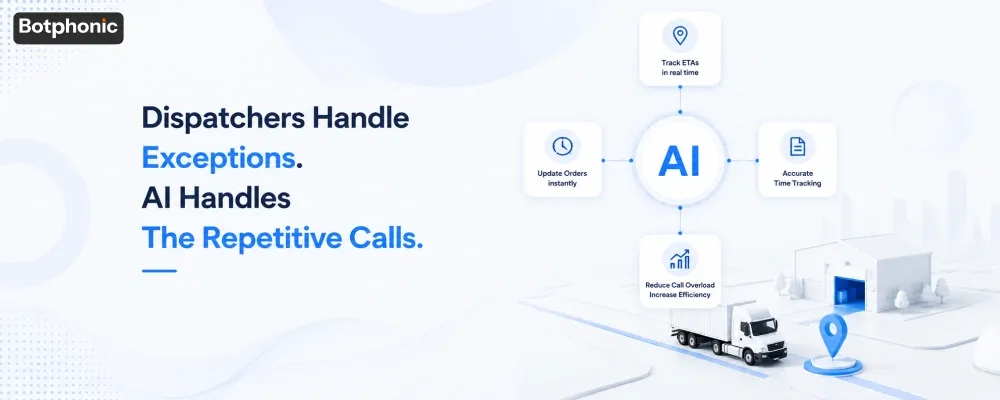
- How AI handles ETA updates, order management, and time tracking
- A side-by-side comparison of IVR, human-only, and AI-assisted dispatch
- What changes operationally after you implement an AI phone agent
An AI phone agent for dispatch is software that answers, understands, and routes fleet calls in real time. It is built for dispatch managers, fleet owners, and operations leads. It matters because manual call intake is now the top driver of dispatcher burnout and missed loads.
What Is an AI Phone Agent for Dispatch?
An AI phone agent for dispatch is a technology-driven conversational system that provides answers to driver/customer calls without human operators involved. How does it work for your dispatch operation? Typical questions are dealt with instantly and only true exceptions come through to people.
As opposed to a voice menu, it recognizes the intent behind natural speech. For example, a driver says “I’m running late on load 4521” rather than selecting options on a menu.
 NOTE
NOTE
Why Do Dispatch Centers Receive Too Many Calls?
The reason why dispatchers receive too many calls is that the majority of the calls coming in are repetitive in nature and not complex. What does it mean for dispatchers? They spend many hours answering the same three questions.
Dispatchers claim to spend 60% to 70% of their time answering brokers’ calls, doing checks, and replying to emails rather than booking productive loads, according to Numeo’s 2026 analysis of the manual dispatch process cost. There is no time left for scheduling or negotiating rates.
The economic consequences arise quickly. Carriers owning 10 to 20 trucks are currently losing between $35,000 and $75,000 each year through the missed night and weekend potential, according to the cost analysis by Virtual Nexgen Solutions. Nobody was available to pick up the calls, even though that could have been done.
Dispatcher turnover exacerbates the situation. Dispatcher turnover among carriers ranges from 25% to 35% each year across the industry, according to the Virtual Nexgen report cited above. With each departure, all the corporate know-how regarding lanes, drivers, and brokers goes away.
What Do Dispatch Managers Face in Reality
In reality, all the dispatch managers face the same picture regardless of fleet size. In case a dispatcher needs to handle driver check-ins, customers’ status calls, and some actual emergency simultaneously, he/she is likely to postpone check-ins. These people make their calls again within a few minutes after that.
The second call is what usually messes up the schedule of the day. The Botphonic AI phone call software solution was designed specifically to catch that particular moment and prevent another call to a dispatcher at all.
How Does an AI Phone Agent Answer Driver & Customer Calls?
The AI phone call solution for dispatch combines natural language processing with direct integration with your fleet data systems. This means that the caller speaks naturally while receiving the answer extracted from your fleet data, not some AI’s best guess.
Here are the key technical layers that make it possible:
Telematics-integrated voice response connects the conversation directly to the GPS and ELD information in your systems, making the answer about estimated time of arrival correspond with the real position of the truck.
NLU (Natural Language Understanding) fine-tuning makes sure that the machine learning model is trained to understand the specific vocabulary of trucking industry, like “load number 4521”, “lane 830” and other terms used by your company.
Latency management takes care of predictive latencies in managing the difference between a driver’s query and a data look-up by the agent, thus ensuring that the agent does not keep a caller hanging while performing the lookup. Moreover, all interactions are logged to carrier compliance logs, recording the hours and status changes for audits should the need arise.
Automated ETA Management
The AI call assistant retrieves the relevant location and schedule information to provide an instant answer to questions like “Where is my driver?” The process is not dependent on any dispatcher looking at a screen. The answer is available within seconds, and the dispatcher does not have to handle the call.
Streamlined Order Management
The agent can collect order details directly from the caller during the intake call. Orders can be updated in the system and flagged if anything human input is required – for example, a rejection of the load or rate disputes. Any changes to orders will be made by the agent automatically.
Time Tracking Accuracy
Shift times and driver hours are tracked automatically by the agent during the intake call, saving an important manual step in many time tracking software implementations requiring dispatchers to enter the information.
 PRO TIP
AI Phone Agent vs Traditional IVR vs Hiring More Dispatchers: Which Is Better?
Fleet managers usually compare three paths when call volume outpaces staff. Each one solves a different part of the problem, and each has real tradeoffs.
| Approach | Handles routine calls | Scales with fleet growth | Cost pattern |
| Traditional IVR (press 1, press 2) | Partially; frustrates callers with real questions | No; menus don’t adapt to new scenarios | Low upfront, high hidden cost in abandoned calls |
| Hiring more dispatchers | Yes, but at full labor cost per call | Slowly; hiring and training take months | High; fully loaded dispatcher pay averages $52,922 per year per Numeo’s 2026 salary data |
| AI phone agent for dispatch | Yes, understands intent and pulls live data | Yes; call volume growth doesn’t require new headcount | Fixed monthly cost, scales with usage not headcount |
Traditional IVR menus route calls but don’t understand them. Hiring solves capacity but adds a slow, expensive layer. An AI phone agent for dispatch handles the routine volume directly, which is why fleet managers increasingly treat it as the first layer, not a replacement for dispatchers.
What Should Fleet Managers Consider When Choosing AI Dispatch Software?
Good AI phone software for logistics companies dispatch software that integrates into your current ecosystem. This is how you should think about evaluation, compatibility must come before all else.
Compatibility With Current Systems
Determine if the agent integrates with your existing fleet management system and business management system without customization. In reality, this translates to verifying that the agent integrates with your telematics systems, fleet management suite (Samsara/Geotab), using a RESTful API for JSON payload exchange for loading, driver status, and location information. If a vendor cannot provide such integration details, this is an indicator of manual integration rather than automated.
For fleets operating in the United States, dispatch workflows should also support compliance with transportation regulations and operational best practices established by the U.S. Department of Transportation (DOT). While an AI phone agent doesn’t replace regulatory obligations, it should help document communications and streamline operational processes alongside existing compliance programs.
Performance Analytics
Evaluate the ability of the software to translate call data into actionable performance analytics. How many status calls does each route produce? What customers make the most calls, and why? All this information must be available to your customer service management platform, not hidden inside call logs.
Escalation Logic You Can Trust
The agent should have clear protocols about when to escalate a conversation to a human. The driver with a problem should never be trapped into a phone tree. Make sure the process for escalation is quick and straightforward before implementing it company-wide.
Botphonic’s guidelines on how to choose AI phone call software for your logistics business explain the criteria above in more detail.
AI-Human Handover Protocol: What Makes the AI Step Aside?
The trickiest part of any AI phone operator is not answering questions but understanding when the call is no longer a simple matter.
The AI does not depend solely on keyword analysis. Instead, it analyzes tonal shifts, pace, and context clues: an increase in urgency, shorter sentences, a driver repeating himself, or safety-related words like “accident,” “hurt,” or “can’t move the truck” all increase the priority level of the call. At the point where the priority level reaches a certain threshold, the AI gives up trying to resolve the issue itself and transfers the call to a live dispatcher, bringing along the context it has already assembled—load number, location, and what the driver said.
There is a reason why this hand-off procedure is necessary. An individual who is in the middle of having their truck break down does not want to negotiate with the same automated system that is trying to verify their estimated time of arrival. The entire hand-off protocol is designed so that, in moments of doubt, the AI automatically defaults to hand-off rather than to help.
How Do You Implement an AI Phone Agent Without Disrupting Dispatch?
Implementation should be done through phasing, and not a one-stop solution. Let’s look at the steps to take: start with narrow coverage, collect the data, and phase in further.
The first phase usually includes only the regular reporting tasks, like asking about ETAs or shift scheduling. The second phase includes collecting the orders and details after the team gets used to the escalation process.
What Changes When You Implement an AI Phone Agent in Fleet Dispatch?
The biggest change in the implementation of the agent would be in reassignment of roles. The dispatchers would cease to function as information relayers and would become exception managers. They would manage any breakdowns, rate disputes, or schedule issues but would no longer spend their time on repeating information.
Data on calls will also become valuable for the first time. Instead of relying on the impressions about the problematic lanes, the management will have recorded reports of all regular communications.
Is an AI Phone Agent Worth It For Fleets?
This Looks Like in Reality
Botphonic isn’t a novice in high-volume call centers. During a case study with a digital marketing agency receiving clients’ requests all day long, implementation of a voice AI agent by Botphonic brought the following result: 82% higher processing of client queries, 40% savings on agents’ pay, 20% productivity increase of the staff, and 5 times faster sales cycle.
The case above isn’t a fleet – it’s another type of high-volume call center. However, the issue is identical to the one faced by dispatchers: too much volume of routine calls competing with calls which need human attention. The technology behind these achievements (routing routine calls to AI and keeping humans for making judgment decisions) was described in detail in this guide. [ Calculate ROI of Your Own Fleet With a Calculator]
It will depend on your current call volumes and number of dispatchers, but it always follows a predictable pattern. Adoption of conversational AI in customer-facing roles is not experimental anymore: 85% of customer service leaders planned to experiment or pilot customer-facing conversational generative AI in 2025, per Gartner’s December 2024 survey.
Gartner also predicts that at least 70% of customers will use a conversational AI interface to start their customer service journey by 2028, per its customer service AI use case research. This trend is particularly relevant to a dispatch role because dispatch is a voice communication-intensive industry.
For most fleets, it’s just a matter of calculation. If your fleet spends more than half of a dispatcher’s working day answering routine phone calls, it makes sense to invest in an AI phone agent to get back some of the lost working hours before headcount growth becomes necessary.
