
Summarize Content With:
Quick Summary
Each day tens of thousands of voices are handled by US logistics teams, as well as tens of thousands of customer ETA alerts, warehouse confirmations, a missed-delivery recovery, appointment scheduling. The majority of such calls are based on the templates which do not require the judgment of a dispatcher. The automation of phone calls based on AI manages 70-90 percent of that routine speech 24/7 at less than a second response time, leaving dispatchers to work on exceptions and high-value relationships.
The figures: 63% of US logistics companies indicate that technology assists them to solve workforce issues. The integration of AI provides up to 85% reduction of planning time and 90% delivery rates on same-day service by operators who have augmented with AI. One of them, called US courier deployment (Illinois, 200-driver fleet), cut delays by 47 percent and had a 3.1-times ROI in 90 days post-Botphonic deployment.
This guide discusses the five reasons why logistics needs AI phone calls now, four detailed use case workflows with mini-script templates, the named courier case study, integrations with TMS/CRM platforms (Zoho, SAP, FreightPOP, Truck Stop, Oracle NetSuite), TCPA + FMCSA compliance specifics, ROI math, and a 7-category vendor selection framework to buyers.
Why Logistics Requires AI Phone Calls at This Time
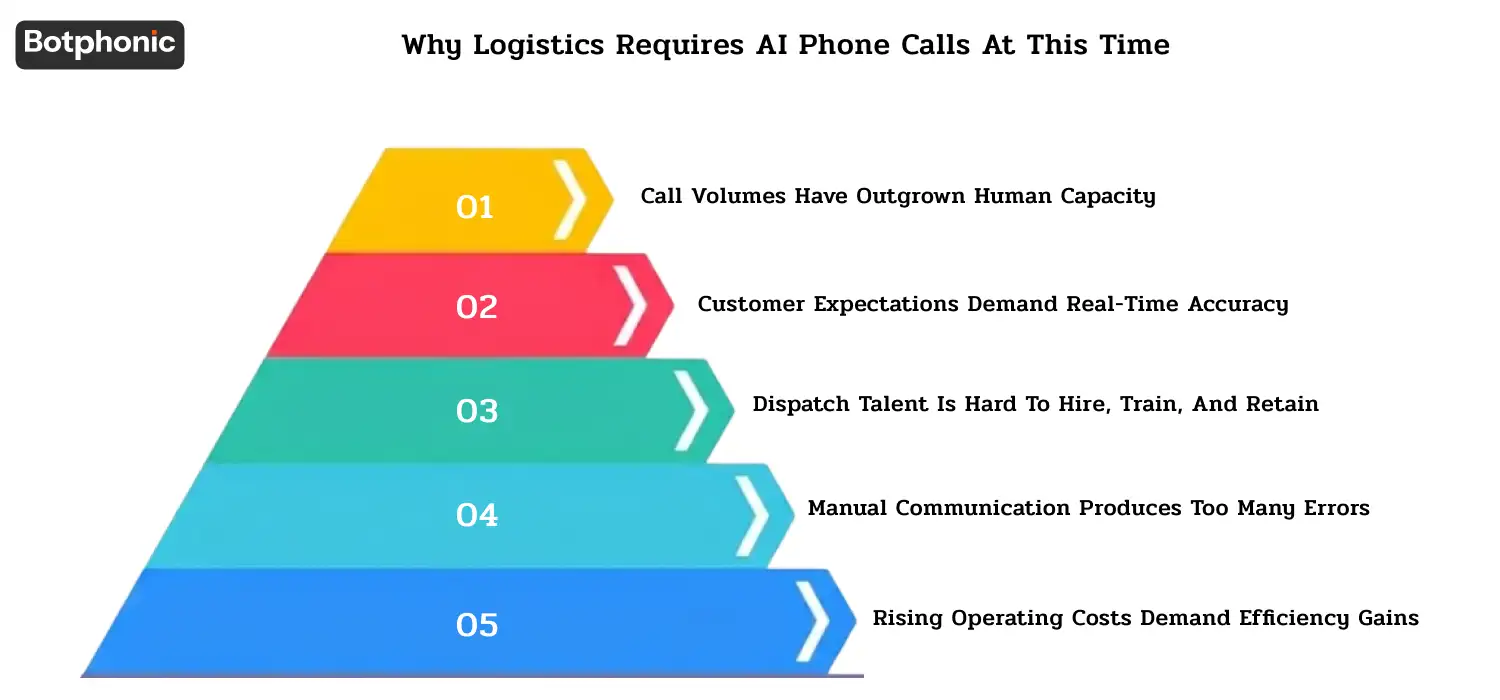
1. Call Volumes Have Outgrown Human Capacity
An average medium sized fleet dispatcher has dozens of parallel requests – pickup instructions, delivery schedules, dock confirmations, route alterations, accessorial orders. The math doesn’t work anymore. Since the number of calls a business receives scales with the business, the response time of the dispatcher degrades, the error rate skyrockets, and burnout can pull senior personnel out of the job faster than they can be replaced.
The statistics in the industry confirm the image: 63% of US logistics companies tell that the adoption of technologies is now a matter of life and death to get through the workforce shortage (and the issue of dispatcher shortage is one of the most burning).
2. Customer Expectations Demand Real-Time Accuracy
Shippers and receivers do not accept any more we will call you back. They desire timely information on delays, route amendments, early arrivals, and accessorials. The penalty of not meeting such expectation is tangible: the lost receiving windows, the overcrowded dock, the production stoppage, the detention charges that grow by the hour. It is the proactive notifications that AI offers so that all of these could never occur.
3. Dispatch Talent Is Hard to Hire, Train, and Retain
Dispatch is a high-stress job that demands quick decision-making, sharp memory and multitasking at all times. There is a shrinking labor pool; high turnover; it takes months to train new dispatchers. AI alters the math by absorbing the repetitive 60-80% of the workload – your remaining dispatchers is focused on problem-solving, relationship management, and exception handling as opposed to being a human routing engine.
4. Manual Communication Produces Too Many Errors
Misaddresses, failing to show up at the appointed time, being given the wrong instructions, the safety incidents – the majority of the operational failures in logistics are caused by manual phone communication. AI standardizes communications, captures accurate data and syncs to the TMS, WMS, CRM and visibility platforms. Errors don’t propagate downstream when the AI captures them correctly the first time.
5. Rising Operating Costs Demand Efficiency Gains
All the costs of fuel, insurance, equipment and compliance costs increased by 10-20 percent during the past 24 months. Margins are at strain. The AI decreases the number of labor hours spent making repetitive calls, time spent conducting manual status checks, and administrative overheads related to entering post-call data. The vast majority of deployments have quantifiable ROI after a few weeks and not a quarter.
Communication Challenges in U.S. Logistics & Delivery
The scale and intricacy make foreseeable bottlenecks:
| Problem | Impact on Business |
| Missed driver updates | Late deliveries, confusion in routes, customer complaints. |
| Customer call overload | Ineffective experience, churn, lost shipper accounts. |
| Manual scheduling | Expensive labor, slow dock turn around, appointment window missed. |
| Limited after-hours response | Missed delivery times, customer dissatisfaction, competitor pickup. |
| Dispatch error compounding | Unsuitable addresses, lost deliveries, accidents, arrest charges. |
The same applies to all five of them: each of them generates downstream costs that would be reflected in the P&L a few weeks later, when no one would trace them back to the original missed call.
Without automation, logistical communication is up to 40% slower, which is directly translated into delayed deliveries, agitated customers, and dispatcher burnout. The biggest single operation lever most fleet operators can use to close that gap is.
 PRO TIP
How Botphonic Automates Logistics Communication
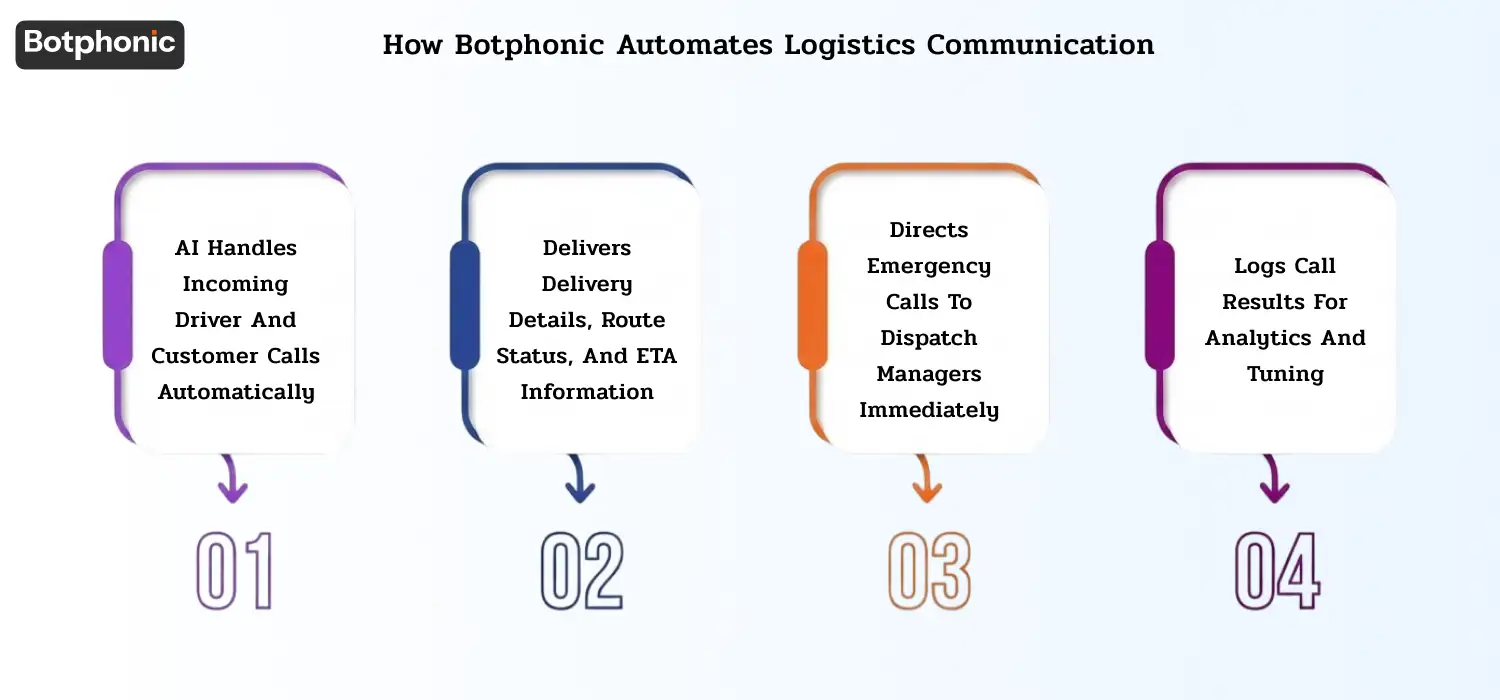
1. AI Handles Incoming Driver and Customer Calls Automatically
All inbound calls are responded to within less than 2 seconds. The AI recognizes whether it is a driver checking in, a customer seeking an ETA update, a warehouse confirming a delivery or a shipper raising an issue, and routes to there.
2. Delivers Delivery Details, Route Status, and ETA Information
Real time queries are answered in real time. The AI retrieves live data off the TMS, GPS tracking, and CRM to provide callers with the correct information rather than letting me check and call you back.
3. Directs Emergency Calls to Dispatch Managers Immediately
Routing logic identifies calls that are urgent (accident report, equipment failure, security incident) and routes it to a live dispatcher with the full context of the conversation. The dispatcher picks up at “minute 2” of the conversation, not “minute 1.”
4. Logs Call Results for Analytics and Tuning
Each call will produce a transcript, sentiment score, intent classification, and structured outcome (resolved / escalated / scheduled / canceled). These are fed back into the model to be constantly improved – and into your operations dashboards to be patterned.
Plus: Three Operational Wins
- Live Time ETA Calls and Customer Notifications. AI automatically alerts customers about early arrivals, late arrivals, traffic delays, weather disruptions, equipment failure, and changed delivery times – without dispatcher intervention.
- Smart Issue Detection and Escalation. AI listens to trigger phrases that indicate urgency: “I’m stuck in traffic,” “my trailer won’t open,” “the dock is backed up.” The system automatically creates internal tickets, alerts the appropriate team and gives a call summary such that escalation is not a game of telephone.
- Automated Appointment Scheduling and Confirmation. AI makes calls to warehouses, confirms that there is availability of docks, books time slots, compares schedules with the availability of drivers, sends confirmations to all stakeholders, and automatically updates the TMS.
Use Case Workflows (With Mini-Script Templates) Logistics
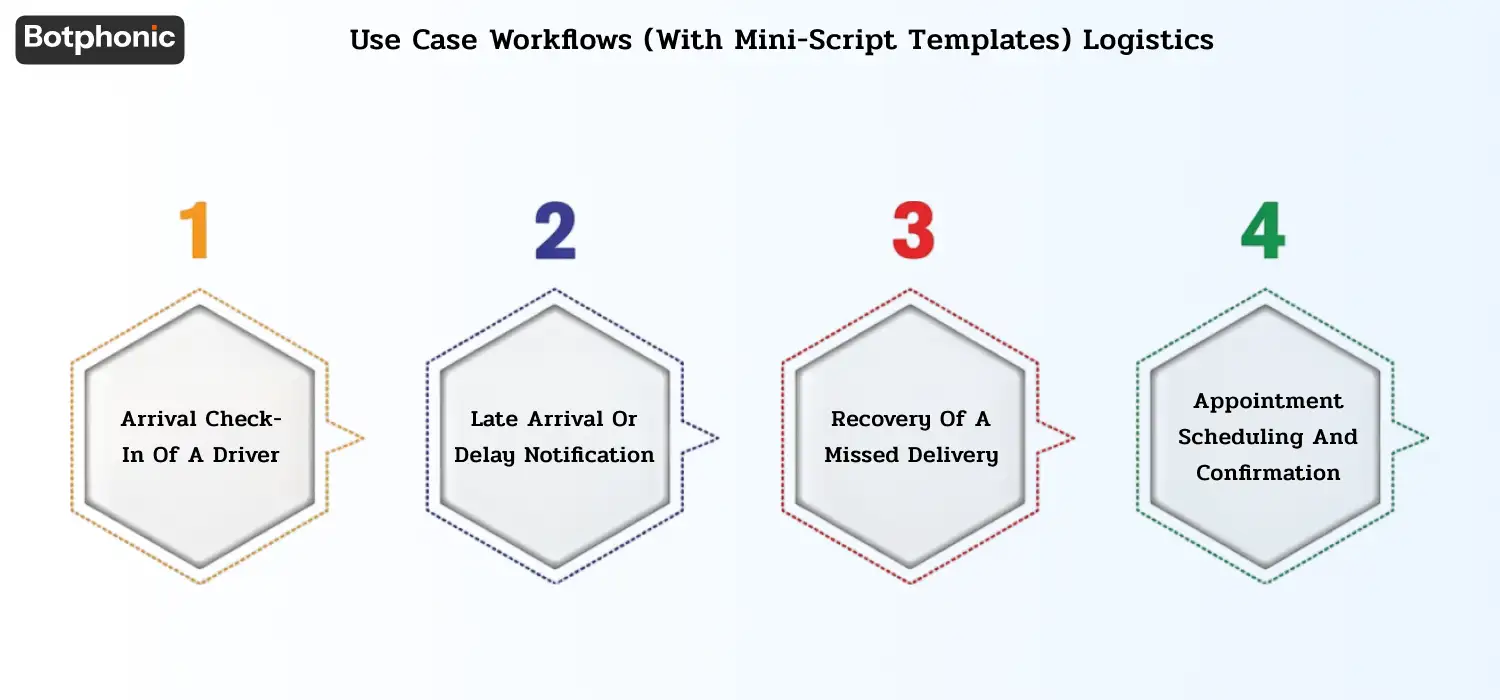
Use Case 1: Arrival Check-In of a driver
Trigger: Geofence activation at the pickup / delivery point, or driver can activate it manually via mobile application.
Workflow:
- Geofence trigger fires → AI makes outbound call to driver
- AI verifies arrival, inquires about dock assignment, records any problems
- Information is sent back to TMS in real time (arrival time, dock number, status)
- Send dashboard updates with organized summary
Mini-script:
Hi [name of driver], this is the dispatch system, I see you have arrived at [location] and have the receiver there assign you a dock yet? Say the dock number, or say whether there is any delay or not.”
Use Case 2: Late Arrival or Delay Notification
Trigger: GPS monitoring notices that the driver is taking over 15+ minutes to travel in accordance with the ETA threshold.
Workflow:
- Breach of GPS threshold identified → AI records the delay
- AI makes a proactive call to the receiver
- AI provides the reschedule option in case there is a big delay
- Response received by the customer; TMS revised with the new ETA
- Dispatch alerted only if customer escalates or rejects new window
Mini-script:
Hello, this is [carrier] calling to deliver [ID] in your existing window or would you prefer to reschedule? I am able to make a new slot at [time] today or [time] tomorrow morning.
Use Case 3: Recovery of a Missed Delivery
Trigger: Driver tries delivery but receiver is not available; TMS indicates failed delivery attempt.
Workflow:
- TMS recognizes unsuccessful delivery
- AI calls consignee
- AI presents three alternatives: re-delivering tomorrow, picking at terminal, redirecting to alternate address
- Consignee selects → TMS modifies with new instructions
- End of day report sent out as dispatch report
Mini-script:
Hi, this is [carrier] calling regarding your delivery, we made an attempt earlier this day but there was no one available to receive the delivery, to get it to you tomorrow, please make a choice: option 1, redelivery to the same address, option 2, pick up at our terminal at [address], or option 3, redirect to a new address. Which works best?”
Use Case 4: Appointment Scheduling and Confirmation
Trigger: New load is coming into TMS in need of delivery appointment booking.
Workflow:
- AI extracts possible delivery windows of TMS
- AI makes a call to receiver with the suggested time slot
- AI takes into account confirmation or alternative request
- TMS increments window that has been confirmed
- Conflict alert in case dispatcher has to intervene
Mini-script:
Hello, the carrier calling to schedule the delivery of load [reference number] can offer [time slot 1] or [time slot 2]. Which your dock, sir?
Use Case Summary
| Use Case | AI Action | Operational Benefit |
| Driver arrival check-in | Geofence call + structured data capture. | Removes manual driver-dispatch one way traffic. |
| Late arrival notification | Active customer proactive outreach and reschedule option. | Minimizes the cost of detention + lost receiving windows. |
| Missed delivery recovery | Outreach Multi-option consignee outreach + automatic TMS update. | Cuts re-delivery cost + churn of customers. |
| Appointment scheduling | TMS-intelligent booking and conflict detection. | Frees dispatcher of calendar coordination. |
Issue Detection: Auto-Escalate Trigger Phrases
The intent recognition of the AI is programmed to understand language that is specific to logistics. Once said to the customer or the driver on a phone call, the AI automatically escalates with all the context:
- I have been stuck in traffic / I have been sitting here an hour.
- My trailer not opening / lift gate broken / equipment problem.
- The dock is backed up/They are not letting me in.
- This is the wrong address/ There is no one here.
- An accident has happened / I should report on the damage.
- This is urgent / I need a manager.
Each trigger generates a structured ticket containing the location of the driver, load reference, and the summary of the conversation. The dispatchers can view the problem with their dashboard even before picking it up.
The Advantages of AI Call Automation to Logistics Teams
| Benefit | Description | Measurable Impact |
| 24/7 Call Support | AI helps drivers and customers 24/7, during the night and on the weekend. | +28% uptime vs. 9-5 staffing |
| Faster Dispatching | Driver routing in real time and proactive customer notifications. | −40% delay rate |
| Reduced Human Error | Automated, regular delivery updates with data that is TMS-synced. | +22% achievement in dispatch records. |
| Cost Efficiency | Reduce the number of manual call handling and staffing costs. | −35% per month expenditure on dispatch labor. |
| Scalable Coverage | Answers thousands of calls daily without being overloaded. | Scalable to 100% during seasonal peaks. |
The trend among deployments: AI takes over the high-volume, low-judgment work (status updates, check-ins, scheduling); dispatchers deal with the complex 20-30% that actually requires a person. Productivity, as well as dispatcher satisfaction, increases within the first 90 days.
Real Results: U.S. Courier Company Reduced Delays by 47%
Company Background
An Illinois-based courier fleet of 200 drivers that conduct local and regional routes – high-volume B2B and B2C deliveries across the Midwest.
The Challenge
- Inbound calls daily (hundreds) with drivers and customers.
- Monotonous status questions of the route status taking over dispatcher time.
- Late communication to customers about ETA change.
- Inadequate CRM integration – the call data that is manually recorded is usually not complete.
- Burnout and turnover of dispatchers that impact service quality.
The Solution
- Implemented Botphonic AI call automation on both inbound and outbound calls.
- Connected with the Zoho CRM in order to receive updated call/delivery note messages in real time.
- Twilio voice infrastructure and number provisioning.
- The 4 use case workflows (check-in, delay notification, missed delivery, scheduling) are configured.
- AI was able to automatically process 80 percent of route-related calls.
The Results (90 Days)
- Reduction in the delivery delays was 47 percent.
- 2x customer satisfaction score improvement.
- 3.1× ROI in 90 days
- Exception management and customer relationship work regained dispatcher capacity.
The mechanism: The AI had removed the large volume routine work that was eating up dispatcher time. The role of dispatchers changed to exception handlers and account managers, which is a more valuable position and better retention.
Integrations Which Drive Smarter U.S. Logistics
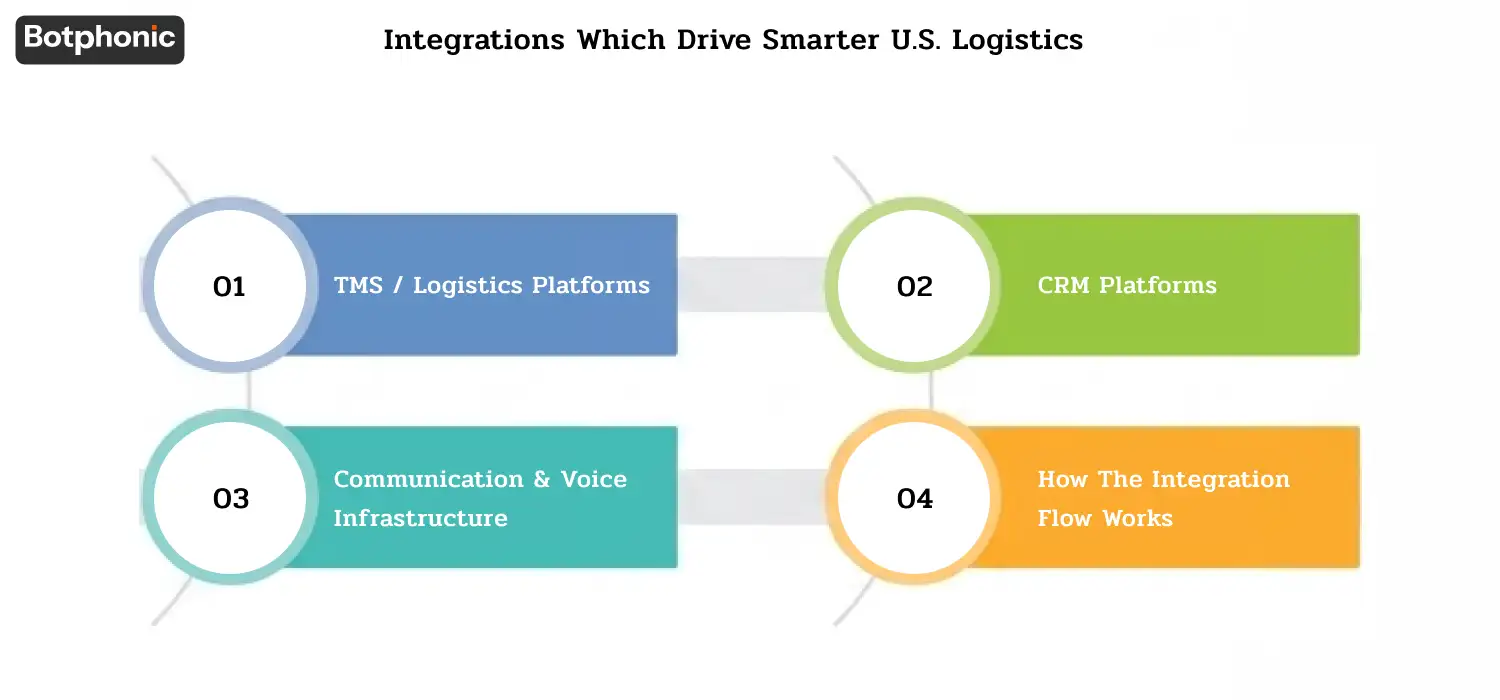
1. TMS / Logistics Platforms
- FreightPOP – visibility of shipment and delivery coordination.
- Truck Stop – carrier and dispatch coordination.
- SAP – logistics of the enterprise type, the shipment and inventory information are synchronized.
2. CRM Platforms
- Zoho CRM – driver/customer call updates, delivery notes, follow-up workflows (primarily integrated in the courier case study)
- HubSpot – an integration of the pipeline in the sale of B2B logistics.
- Salesforce – integration of enterprise CRM.
- Oracle NetSuite – financial, operational, and logistics data integration.
4. How the Integration Flow Works
- Call triggers Inbound or outbound call.
- The identification of driver/customer/load is achieved through CRM + TMS look up.
- AI takes care of the dialogue with situation-sensitive replies.
- Structured data is written back to CRM and TMS in real time.
- Updates to dispatcher dashboard; conflict alerts are fired as needed.
Normal integrations usually take 24-48 hours to complete setup. Proprietary platforms Custom TMS integrations (proprietary platforms) require 1-2 weeks to complete via direct API or Zapier.
 NOTE
NOTE
Compliance: TCPA and FMCSA of Logistics Calls
TCPA – Telephone Consumer Protection Act
Imposed by the FCC Outbound auto calls must have prior express written consent by the recipient. The calls should be placed between 8:00 AM and 9:00 PM in the local time of the receiver (calls beyond that time are considered a violation of TCPA). Mid call, automatic Do Not Call list honoring and opt-out keyword detection are mandatory.
In the case of logistics specifically: driver calls are usually not subjected to TCPA since they are usually B2B operational communications, but calls that are customer facing (delivery notifications, scheduling, recovery) are squarely under TCPA.
FMCSA – Federal Motor Carrier Safety Administration.
The FMCSA oversees the safety of motor carriers, including the hours-of-service regulations that govern drivers and the electronic logging device (ELD) data. An AI calling system that communicates with drivers must respect HOS regulations no automated calls during the time when a driver has to rest unless it is related to an emergency.
The Support of Compliance by Design through Botphonic.
- TCPA-conscientious calling policies are designed in (accurate local-time windows, automatic DNC synchronization, detecting opt-outs)
- Communication scheduling (respects HOS rest periods) FMCSA-conscious driver communication scheduling (respects HOS rest periods)
- Audit trails recorded by encrypting calls.
- Rules that are configurable on a state and workflow basis.
- Datapara DNC database compliance automatic integration.
- Logs (audit ready) which are available to compliance teams.
FDCPA also governs deployments that handle consumer-facing collections (insurance claims, freight payments) – be sure your specific compliance posture is reflected in your vendor before going live.
ROI of AI Call Automation in Logistics
The unit economics tasks are at all levels. Comparison based on the courier case study:
| Metric | Before Botphonic | With Botphonic |
| Avg call volume | 1,200/day | 1,200/day |
| Avg response time | 10 minutes | 40 seconds |
| Delay rate | 19% | 7% |
| Per-call cost | $4-$7 (human-handled) | <$1 (AI-handled) |
| Compliance cost | Manual audit work | Automated audit logs |
| ROI | — | 3.1× in 90 days |
At the economics of the case study, where the fleet handles 1,200 calls/day and the difference in the per call cost produces the difference in the annual savings. Combine the delay-rate gain (reduced detention costs, reduced number of missed receiving windows) and the arithmetic is seldom even.
Industry benchmark: 2.5-3× ROI in the first three months are common to most logistics deployments.
How to Select the correct AI Phone Call Software to use in Logistics: 7-category Framework
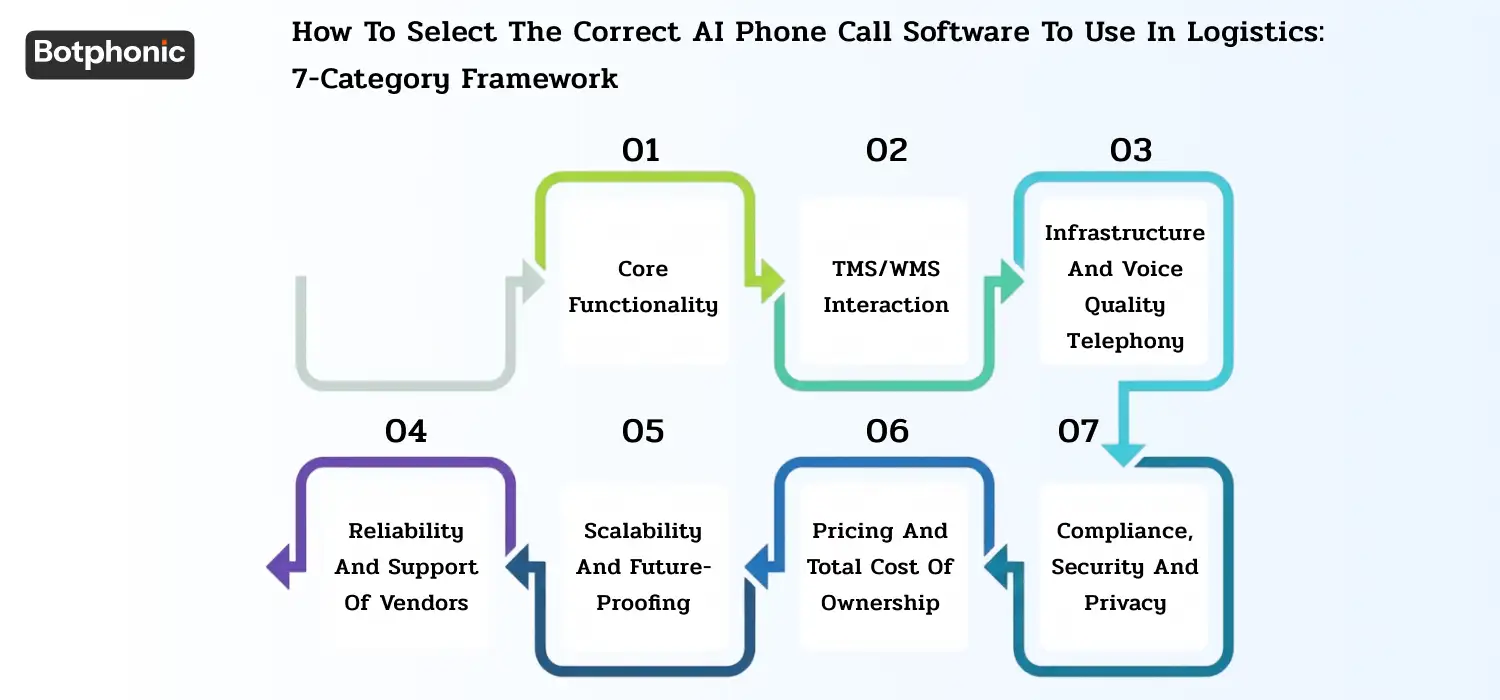
Majority of the teams select a vendor based on his/her demo polish and price. The teams that perform on a large scale have a systematic structure. Seven categories a logistics RFP should address:
1. Core Functionality
- Check-ins and arrival/departure monitoring are automated.
- Real-time notifications of delivery and ETA updates.
- Timetable of appointments and verification of appointments.
- Intelligent escalation and issue detection.
- Multilingual support (Spanish at least to US fleets)
- Carrier outreach and lane sourcing capability: Outbound campaign ability.
2. TMS/WMS Interaction
- Reference number search of loads.
- Data synchronization of driver assignment.
- ETA and routing information fed-back to TMS.
- Slot capture of appointment slots and confirmation write.
- Bidirectional synchronization with top TMS (FreightPOP, Mercurygate, Oracle TMS, custom systems)
3. Infrastructure and Voice Quality Telephony
- VoIP and SIP trunking.
- PSTN fallback due to low connectivity in locations.
- Call failover and redundancy
- High fidelity audio (less than 300ms latency, 16kHz or higher sampling rate)
- Multi-region voice infrastructure of distributed operation.
4. Reliability and Support of Vendors
- SLA uptime ensures (99.95%+ when used in production)
- Customer success manager throughout the onboarding.
- Turnaround time (24-48 hours not weeks) workflow modification turnaround time
- References with similar-sized logistics customers.
- On request performance reports.
5. Scalability and Future-Proofing
- Volume processing at seasonal highs (Black Friday, end of quarter, holiday rush)
- Multi-language expansion path
- More speech recognition and ability to work with noisy backgrounds (truck cabs, warehouses)
- Integration of new workflow with minimal IT intervention.
- Custom builds API access.
6. Pricing and Total Cost of Ownership
- Per-minute use vs. per-call vs. per-agent licensing.
- Enterprise subscriptions in tiers where high-volume operators are concerned.
- Implementation and customization costs (one-time, recurring)
- Undercover charges: voice infrastructure markup, integration fees, upgrade support tiers.
- Total cost in 12 months at anticipated production level.
7. Compliance, Security and Privacy
- Outbound calling rules that are compliant with TCPA.
- FMCSA awareness (HOS respect to the driver)
- Customer data GDPR/CCPA.
- Type II certification of SOC 2 Type II certification.
- End-to-end call encryption
- Call storage with retention that may be configured.
- Role-based access control and audit logs
A vendor that cannot communicate with all of 7 categories when being evaluated is not ready to be deployed at the scale of logistics even with the impressive appearance of the demo.
The Future of AI Voice in U.S. Logistics
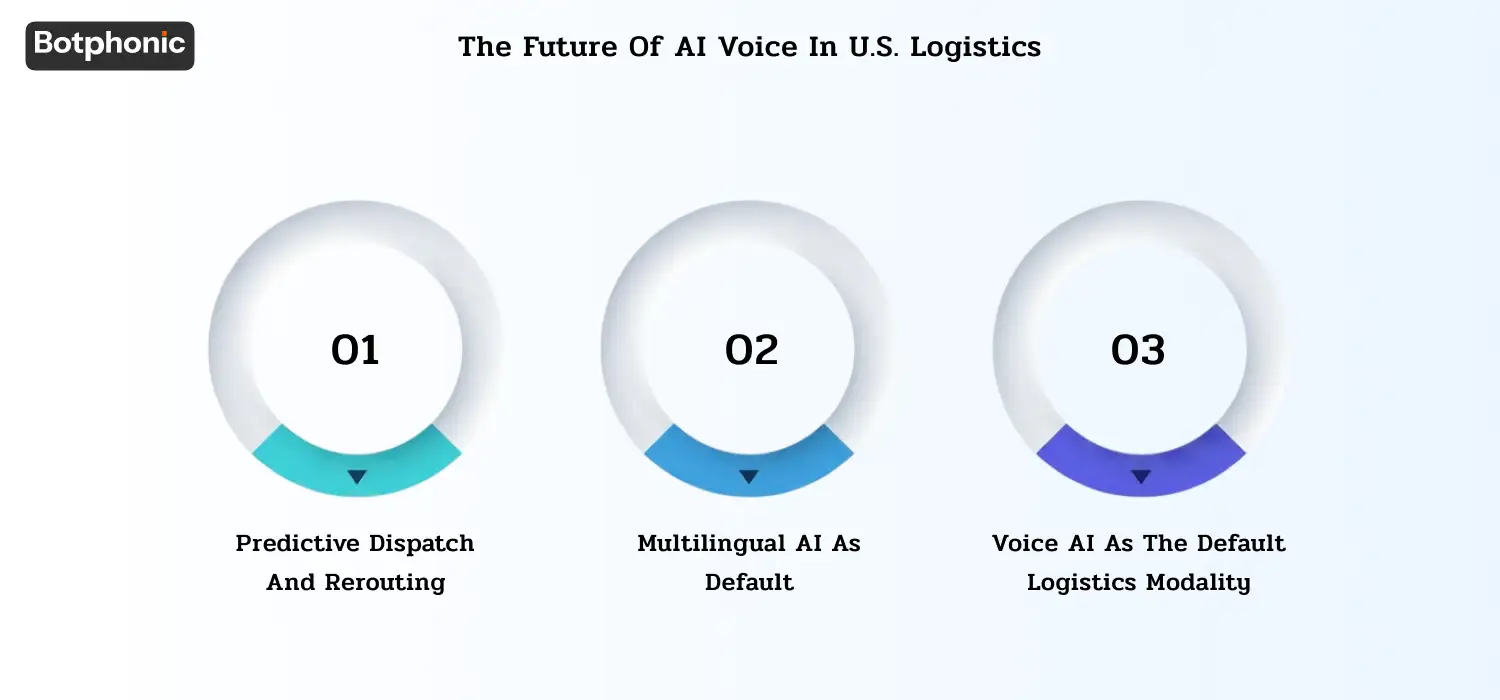
The following 24-36 months will be characterized by three shifts:
1. Predictive Dispatch and Rerouting
AI is not reactive (respond when requested) but proactive (anticipate and forestall). The next-generation AI voice systems will take into account weather data, traffic patterns, and fleet history to predict delays before they occur – and to proactively notify drivers, dispatchers, and customers with updated routing.
2. Multilingual AI as Default
The Spanish speaking drivers constitute a significant portion of the US trucking workforce. The presence of Spanish-speaking customers is even more prevalent in last-mile B2C delivery. By 2027, anticipate multilingual AI voice (English + Spanish minimum, preferably + Portuguese, Mandarin, Vietnamese) to be a default vendor feature, not a premium tier.
3. Voice AI as the Default Logistics Modality
McKinsey anticipates that AI automation will revolutionize shipping and logistics within the coming decade. And voice is the frontrunner, since it is effective in environments where typing is not feasible (driver in a car, dispatcher handling 20 calls in parallel, warehouse employee driving a forklift). Organizations that implement AI voice technology in 2026 can achieve 12-24 months of headstart when compared to their rivals.
Ready to see what AI looks like for your fleet?
Try Botphonic free for 14 daysConclusion
Logistics is an inherently voice-first sector. Phone is the essential tool of the dispatcher; primary contact for the customer for status updates; lifeline for the driver. The innovation for 2026 comes from the fact that voice no longer needs a human on the other end of the line in 70-90% of call volume.
The numbers add up regardless of the organization’s size and scale: small fleets achieve their return-on-investment in weeks, middle-of-the-road players achieve a 3× return-on-investment in just 90 days, large enterprises reduce their compliance costs by more than 60%. The competitive benefit multiplies – organizations implementing the technology in 2026 have 12-24 months head start in terms of processes, information, and culture over organizations implementing it in 2027.
Select a supplier with extensive TMS integration. Begin your pilot project with a single business process (the traditional low-hanging fruit for implementation is driver check-ins – lots of transactions, straightforward rules, quick return on investment). Monitor results for 30 days. Scale from there.