
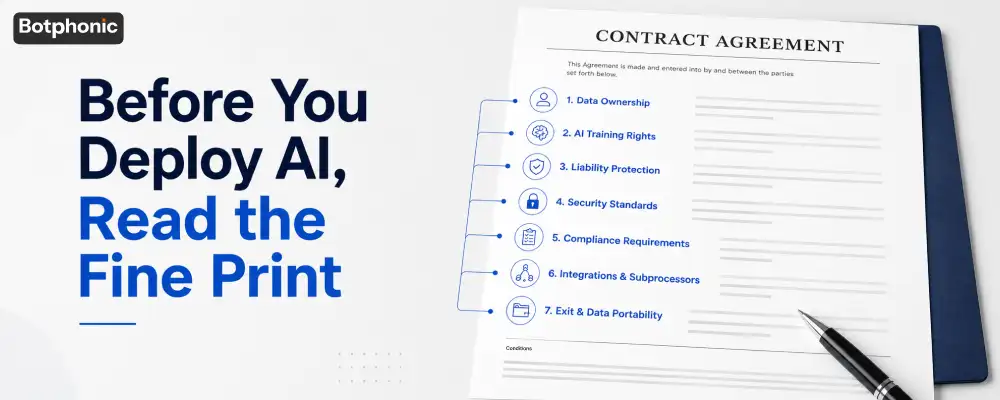
Summarize Content With:
What You’ll Learn:
- Which AI receptionist contract clauses create the most legal and compliance risk
- How data ownership, AI training rights, liability, and exit terms actually work
- What HIPAA, GDPR, and CCPA require from your vendor, and from you
- Which security frameworks to verify before signing
- A side-by-side comparison of weak vs. strong contract language
- Real-world scenarios showing where contracts fail in practice
AI receptionist contracts are the legal documents governing your use of an AI-powered phone answering system. They apply to healthcare practices, law firms, service businesses, and multi-location operations. They determine what happens to your customer data, who bears risk when the system fails, and whether you can leave without losing everything.
Key Terms You Should Know
AI Receptionist Contract: A binding legal agreement between a business and a vendor providing automated call handling, appointment booking, or virtual reception services. It defines data rights, liability, security obligations, and termination terms.
Data Controller: The business (you) that determines the purpose and means of processing personal data. Under GDPR, the controller bears primary legal responsibility for how customer data is used, including by vendors acting on your behalf.
Subprocessor: A third-party vendor your AI receptionist provider uses to deliver part of the service, such as a speech recognition engine, telephony platform, or cloud hosting provider. Your data may pass through multiple subprocessors before a call is completed.
Model Training Rights: A contractual provision granting the vendor permission to use your call recordings, transcripts, or interaction data to train, refine, or improve their AI models. This right is often granted by default and must be explicitly negotiated out.
What Is an AI Receptionist Contract, and Why Do Businesses Get It Wrong?
An AI receptionist contract is a binding agreement that governs every aspect of your relationship with a vendor providing automated call handling. Here’s what that means for your business.
Most businesses evaluate AI reception platforms on voice quality, call flow logic, and pricing. The contract review, if it happens at all, happens after the decision is made.
That’s the wrong sequence.
The demo shows you what the system can do. The contract defines what the vendor is actually obligated to do, what your data rights are, and what happens when things go wrong. Those are different conversations entirely.
If your business uses an AI answering service to handle inbound calls, your contract is the only document that protects you after the sales process ends.
Who Actually Owns Your Call Recordings and Customer Data?
Data ownership is one of the most consequential, and least-read, sections of any AI receptionist contract. Here’s what that means for your business.
Most agreements define three data categories. Each carries different ownership implications.
The Three Data Categories That Cause the Most Disputes
Customer Data includes call recordings, transcripts, and appointment history. Most contracts assign ownership to you here. But ownership does not mean exclusive control, and it does not prevent the vendor from retaining copies.
Usage Data covers how callers interact with the system: call duration, menu selections, hang-up points. Vendors frequently claim broad rights to this category. It is rarely negotiated.
Derived Data is the category most buyers miss. This includes analytics, aggregated behavioral patterns, and insights generated from your customer interactions. Many contracts grant the vendor permanent rights to derived data, even after you cancel.
Note: Ask your vendor to define “derived data” explicitly in the contract. If you see language granting “perpetual, irrevocable rights” to any data category, treat that as a negotiation requirement, not a standard term to accept.
Contract red flags:
- Undefined ownership language across data categories
- Perpetual retention rights that survive contract termination
- Broad rights to “anonymized” data without a clear definition of anonymization
Can the Vendor Use Your Calls to Train Their AI?
AI model training rights are embedded in most standard vendor contracts. Here’s what that means for your business.
Some vendors use real customer interactions to improve their speech recognition, refine automation logic, or develop new product features. This practice is not always disclosed during the sales process.
Why This Clause Has Real Business Consequences
If your business handles legally sensitive calls, medical appointments, legal intake, financial consultations, those interactions contain information your clients expect to stay private.
Beyond privacy, there is a competitive dimension. Industry-specific workflows your team developed over years could contribute to a model that your direct competitors also license.
What to Request Before Signing
- An explicit opt-out from AI model training
- A clause requiring written consent before any training use of your data
- A restriction preventing use of your interactions to improve products sold to competitors in your sector
 PRO TIP
Who Is Liable When the AI Gets It Wrong?
Liability for AI errors is shared, but the contract determines how unevenly. Here’s what that means for your business.
AI reception systems make mistakes. They mishear callers and they route incorrectly.
When that happens, the contract determines whether you have any remedy at all.
Scenario: The 4:00 AM Call Failure
Consider a multi-location urgent care clinic using an AI receptionist to handle after-hours calls. At 4:00 AM, a patient calls reporting chest pain. The AI misclassifies the call as a routine appointment request and routes it to a booking queue instead of the emergency escalation line.
The patient waits. The clinic discovers the failure the next morning during a call log review.
Under a standard contract with a liability cap set at one month’s subscription fee, roughly $200, the clinic has no meaningful recourse. The cap does not reflect the actual risk. It reflects what the vendor was willing to accept when the contract was drafted.
This scenario is not hypothetical in structure. It reflects how liability caps function across most standard agreements.
What to Look For in the Contract
- Warranty clauses: What does the vendor actually guarantee about system accuracy and escalation behavior?
- Liability caps: Is the cap set relative to subscription fees, or does it reflect actual business impact potential?
- Escalation documentation: Is there a documented, contractually required process for escalating failures?
- Service credits: Do SLA violations trigger automatic credits, or do you have to file a formal claim?
What Security Commitments Are Actually Enforceable?
Contractual security obligations are the only ones that matter. Here’s what that means for your business.
A vendor’s website may describe encryption, access controls, and compliance certifications. None of that is legally binding unless it appears in your contract or an attached security schedule.
Website Claims vs. Contract Obligations
| Security Element | Website Claim | Contractual Obligation |
| Encryption at rest | “We encrypt all data” | Specifies AES-256 or equivalent standard |
| Access controls | “Role-based permissions” | Defines who can access data and conditions |
| Incident notification | “We take breaches seriously” | Requires notification within 72 hours |
| Audit reports | “Regular third-party audits” | Commits to sharing SOC 2 Type II on request |
| Data deletion | “We delete data on request” | Specifies timeline and written confirmation |
Security Frameworks Worth Verifying by Name
Do not accept general claims. Ask specifically about:
- SOC 2 Type II: An indep endent audit verifying that security controls are operating effectively over time, not just designed correctly.
- ISO 27001: An internationally recognized certification for information security management systems.
- NIST AI RMF: The National Institute of Standards and Technology AI Risk Management Framework. Relevant when evaluating how the vendor identifies, assesses, and manages risks specific to AI system behavior.
Request the most recent SOC 2 Type II report before signing. If the vendor won’t provide it, that is itself useful information.
How Should Regulatory Compliance Be Handled in the Contract?
Remove subtext below the heading and the top right corner box entirely align the content inside the table equally without changing the context of the image.
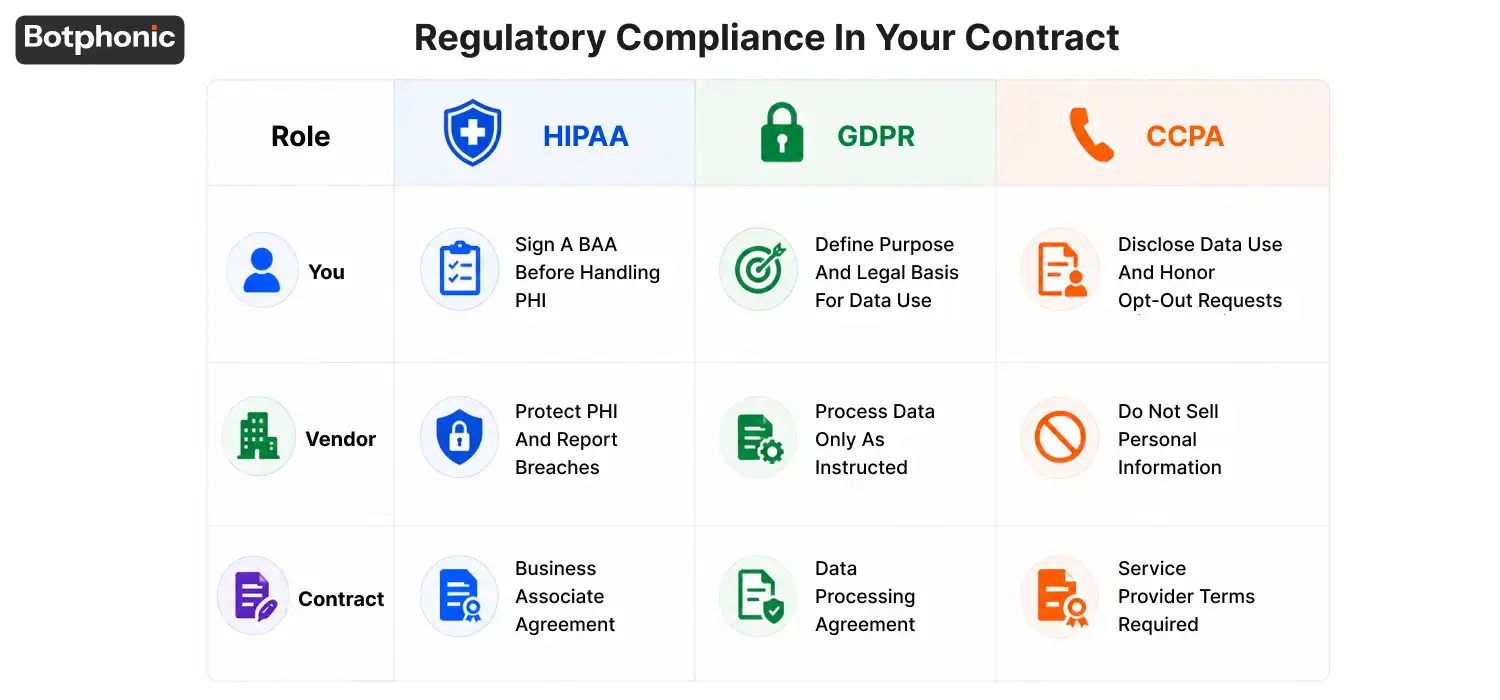
Compliance responsibility is shared between your business and your vendor, but the contract defines the split. Here’s what that means for your business.
Who Is Responsible for What: HIPAA, GDPR, and CCPA
HIPAA (Healthcare)
- You (Data Controller): Ensure a signed Business Associate Agreement (BAA) is in place before the vendor handles any protected health information (PHI). Without a BAA, your practice is out of compliance, regardless of what the vendor tells you.
- Vendor (Business Associate): Must implement safeguards for PHI, report breaches, and handle data only as permitted by the BAA.
- Contract requirement: A signed BAA is legally mandatory, not optional.
GDPR (EU/UK)
- You (Data Controller): Determine the purpose of data processing and ensure a lawful basis exists for collecting caller data.
- Vendor (Data Processor): Process data only on your documented instructions. Must sign a Data Processing Addendum.
- Contract requirement: A signed DPA is legally required before any personal data from EU/UK residents is processed.
CCPA (California)
- You (Business): Disclose data collection practices to California residents and honor deletion/opt-out requests.
- Vendor (Service Provider): Must not sell personal information and must agree contractually to CCPA service provider restrictions.
- Contract requirement: A service provider addendum or equivalent contractual language is required.
Documents That Are Frequently Missing at Signing
- Data Processing Addendum (DPA): Required under GDPR; expected under CCPA. Defines how the vendor processes personal data on your behalf.
- Business Associate Agreement (BAA): Mandatory under HIPAA for any vendor handling PHI.
- Privacy exhibits and security schedules: Detail the technical and organizational measures protecting your data.
An AI receptionist operating in a regulated industry needs explicit contractual coverage, not a verbal assurance from a sales contact.
 NOTE
NOTE
What Third-Party Services Handle Your Data Behind the Scenes?
Subprocessors are the external vendors your AI receptionist provider relies on to deliver the service. Here’s what that means for your business.
A single handled call may pass through a speech recognition engine such as Google Speech-to-Text or AWS Transcribe, a large language model, a telephony platform such as Twilio, and a cloud hosting provider such as AWS or Azure. Each represents a data exposure point your main contract may not address directly.
What to Ask Before Signing
- Request a complete subprocessor list in writing
- Ask how and when you will be notified if a subprocessor is added or replaced
- Confirm that subprocessors are contractually bound to the same data protection standards as the vendor
What Does the Contract Say About CRM and Integration Access?
Integration API rights are a frequently overlooked cost in AI receptionist contracts. Here’s what that means for your business.
Some vendors build proprietary integrations with platforms such as Salesforce, HubSpot, or practice management systems, and then restrict or charge separately for those integrations after the contract is signed.
The Hidden Integration Lock-In Pattern
At signing, the vendor’s platform integrates with your existing CRM. Six months later, the vendor restructured their API tier. Your integration now requires an upgraded plan.
You are not technically locked into the vendor. But rebuilding the integration with a competitor, and migrating the data it contains, costs more than the upgrade. That is functional lock-in.
Rule of Thumb, The API Clause Check: Before signing, confirm in writing: which integrations are included at your contract tier, whether API access can be restricted or repriced during the contract term, and whether integration data (logged call outcomes, appointment records synced to your CRM) is exportable in a standard format.
Contracts with Botphonic should be reviewed against these criteria. Ask directly which integration tiers are contractually guaranteed versus subject to change.
What Service Levels Should You Expect, and How Are They Measured?
SLA commitments define the minimum acceptable performance, not typical performance. Here’s what that means for your business.
Uptime measures whether a system is running. It does not measure whether callers are answered promptly, routed correctly, or escalated when needed. A system at 99.9% uptime can still be failing your callers.
Strong agreements define:
- Call-answer rate: Percentage of calls answered within a defined timeframe
- Response latency: How quickly the AI responds mid-call
- Escalation time: How fast a call transfers to a human when needed
- Support response time: How quickly the vendor responds to reported issues
- Measurement methodology: How each metric is calculated, logged, and reported to you
How Do You Exit Without Losing Your Data?
Exit terms in AI receptionist contracts determine whether switching vendors is practical or painful. Here’s what that means for your business.
Rule of Thumb, The Rule of 30: If you cannot extract your complete data in a standard format within 30 days of cancellation notice, you are locked in. Negotiate this before you sign, not after you have decided to leave.
What to Confirm Before You Sign
- Data export format: Is it CSV or JSON, or a proprietary format no competitor can import?
- Export timeline: How long after cancellation is your data available for download?
- Deletion confirmation: Will the vendor provide written confirmation that all copies have been deleted?
- Transition assistance: Is migration support included or billed separately?
- Post-termination retention: Can the vendor retain any data after termination, and under what justification?
Using a capable AI call assistant only makes business sense if you can take your data with you when you leave.
Botphonic is built to help businesses maintain control of customer communications, integrations, and operational data without unnecessary vendor lock-in.
Book a Botphonic DemoAI Receptionist Contract Review Checklist
Before signing, confirm each of the following:
- Data ownership defined explicitly, including derived data
- AI model training opt-out documented in writing
- Liability caps reviewed and negotiated if needed
- Security obligations in the contract, not just the website
- SOC 2 Type II report requested and reviewed
- ISO 27001 or NIST AI RMF alignment confirmed (where applicable)
- BAA signed if handling PHI (HIPAA)
- DPA signed if processing EU/UK personal data (GDPR)
- CCPA service provider addendum in place (if applicable)
- Subprocessor list reviewed in writing
- Integration API tier and restrictions confirmed
- SLAs define call-answer rate, escalation time, and measurement method
- Data export format and post-cancellation timeline confirmed
- Termination notice period is acceptable for your operation
