
Summarize Content With:
Quick Summary
Solar buyers want to receive a call within minutes. Most installers are unable to deliver – calls come in haphazard bursts, evenings and weekends spike, and human SDRs cost $50K-80K per year and still fail to achieve the after-hours volume. AI phone systems bridge that gap on either side of the funnel: they respond to incoming solar on either side of the funnel with consistent qualifying questions, and they automate outbound sales outreach with a 60-80 percent appointment rate when leads are contacted within 2 minutes of their inquiry.
This guide addresses both directions, i.e., how AI responds to inbound consultation requests (the conventional use case) and how it scales to outbound calling to existing lead lists. Along with the solar-specific qualification framework, handling objections and follow-up workflows that make the difference between a generic AI phone tool and one specifically tuned to the solar industry.
Why Solar Sales Needs an AI Phone Call Assistant
The purchasing process of the sun is different. It is high-cost (15K-40K typical residential install), long payback period (7-12 years), technical questions are real (angle of the roof, number of panels, size of the inverter, net metering), and the financing options are complicated (loans, leases, PPA, tax credits). All of this makes buyers conduct thorough research before speaking to a sales representative – and when they do call, they want to be informed and received with information.
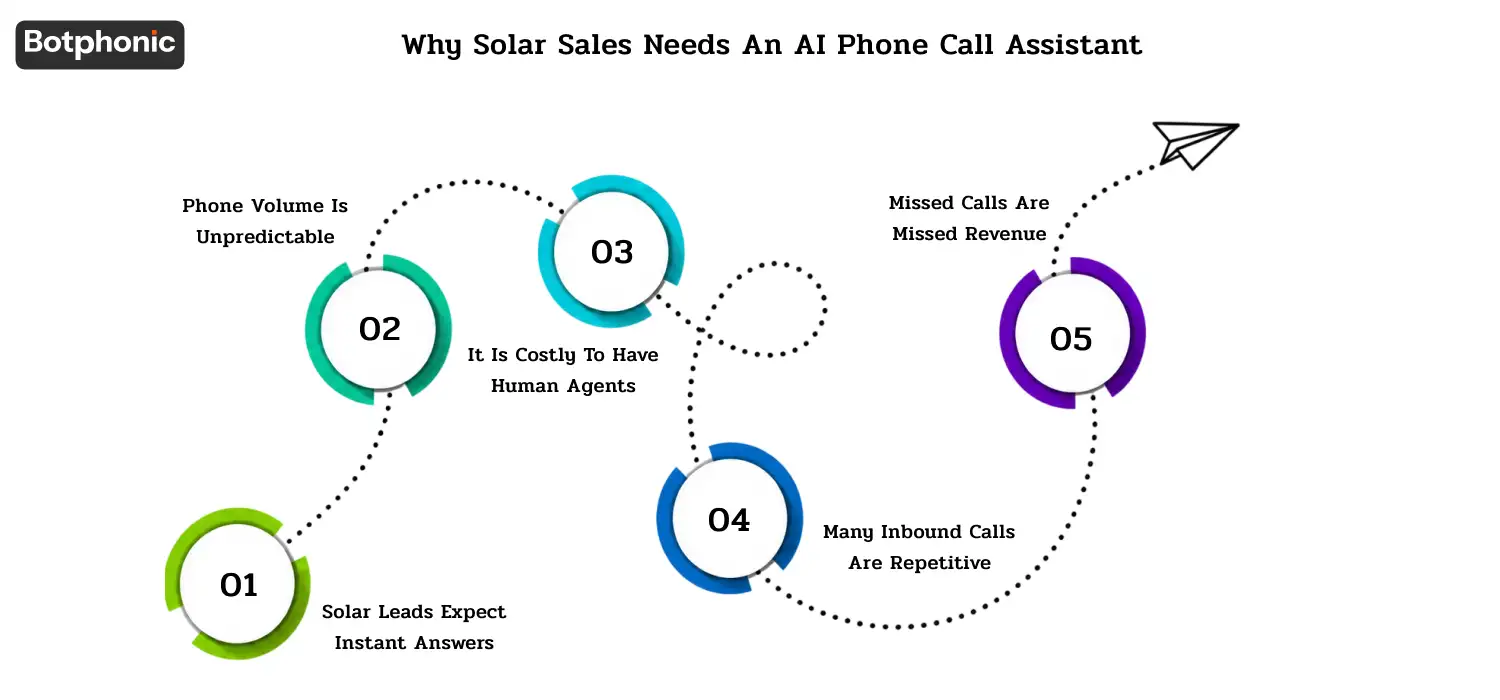
That poses five business challenges to solar installers:
1. Solar Leads Expect Instant Answers
The industry statistics are in line with this: the probability of a lead contacting within 5 minutes to convert is 9 times higher than that of the lead contacting within an hour. Solar customers who do research on financing or site visits do not wait until they are called back, but they go on to the next installer on the first page of Google.
2. Phone Volume Is Unpredictable
Inbound solar calls peak following campaigns on Google Ads, after news of increases in local utility rates has been published, and after seasonal events (post-storm reroofing inquiries, end-of-year tax-credit awareness). Peak staffing implies trough staffing and vice versa, peak revenue is lost when staffed at trough.
3. It Is Costly to have Human Agents
A solar SDR based in the US costs between $50K-80K/year in fully loaded mode. To do the math, consider a mid-sized installer with 2,000 calls each month, and the math indicates that you need 3-4 dedicated reps just to answer the phone -before any commission charge.
4. Many Inbound Calls Are Repetitive
The initial 10-15 minutes of each solar inquiry call discuss the same: Do you own your home? How much do you spend on electric bills? What is the age of your roof? Are you seeking to finance or purchase outright? These are the templated qualifying questions – the very kind of work which consumes the time of the closer.
5. Missed Calls Are Missed Revenue
The ugly arithmetic: when 30 percent of your inbound calls go to voicemail (as is the case with installers who do not have after-hours call coverage), and when your average ticket is worth $25,000 with a 15 percent close rate on contacted leads, every 100 missed calls translates into about $112,500 in lost revenue. This number has never been explicitly run by most installers.
What an AI Phone Call System about Solar Inquiries Actually Does
Contemporary AI phone systems to solar installers deal with the entire intake-to-consultation process:
- In less than a second answer inbound calls using a natural-sounding voice (no press 1 to sales menu)
- Ask the qualifying questions which identify that the prospect is a viable lead (homeowner, suitable roof, decision-maker, budget tier)
- Know the basics of solar (net metering, tax credits, financing, common schedule)
- Check the calendar of the sales rep and make a real-time booking of a consultation
- Record all call information (transcript, sentiment, qualifying answers) in your CRM
- Automatically send confirmation SMS and email
- Work around the clock and time zones
All this is done not by traditional IVR but by the system. Conventional IVR consists of menu driven on-button prompts and pre-recorded prompts. Large language models are used to detect intents, voice quality via neural text-to-speech and context through live CRM integration to sound like an experienced intake coordinator, not a robocall.
Key Benefits: Boost Solar Consultation Bookings With AI Phone Calls
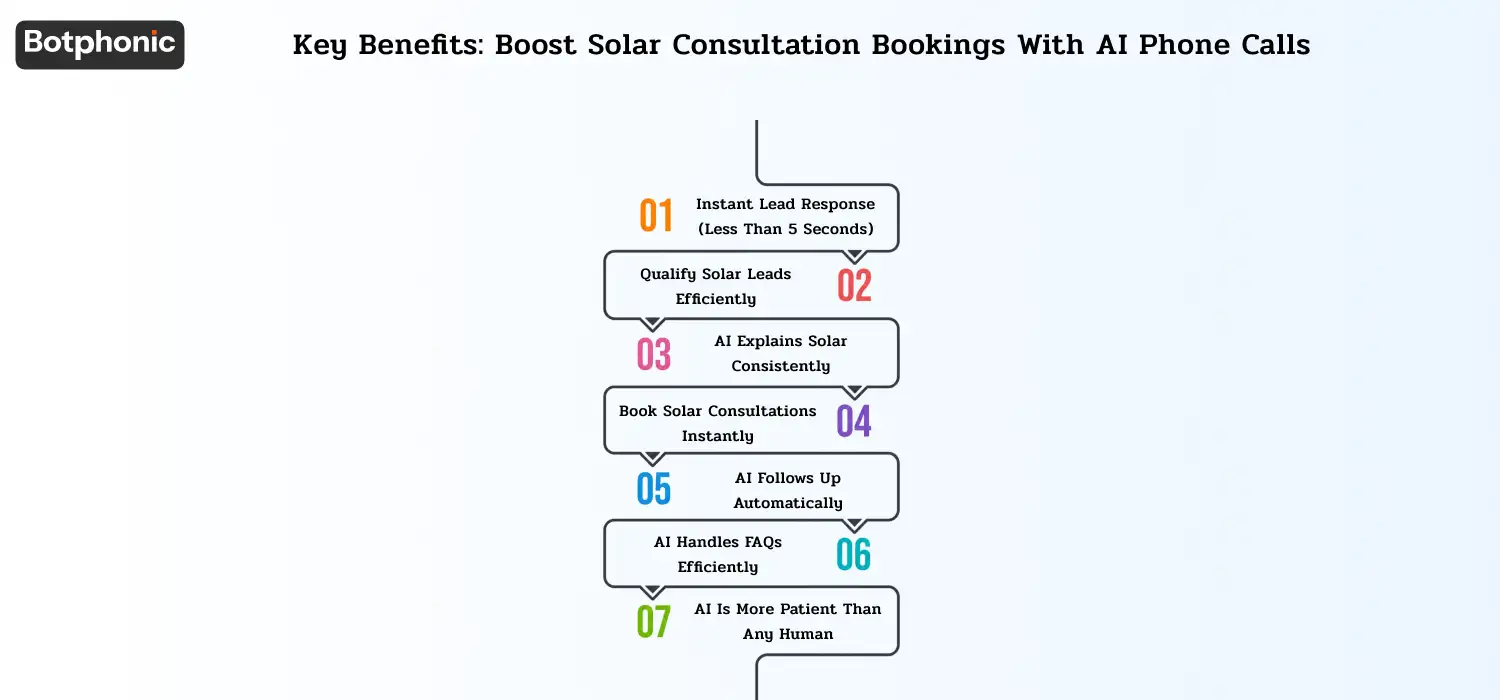
1. Instant Lead Response (Less than 5 Seconds)
The AI refers to all inbound calls within 5 seconds. No line, no holding music, no call dropped. In the case of solar specifically, response speed is the one largest driver of the consultation booking rate – leads that receive an immediate response book at 3-4x the rate of leads that receive a voicemail.
2. Qualify Solar Leads Efficiently
The AI of Botphonic is an optional solar-qualification flow that runs on all incoming calls:
- Ownership of property – “Do you own your home or do you rent?”
- Condition and age of the roof – How old is your roof? Any leaks or planned replacement in the next 5 years?
- Monthly electric bill average — “How much do you pay a month in electric bills?”
- Confirmation of decision-makers – “Do you happen to be the main decision-maker regarding home upgrades?”
- Timeline / urgency – When would you like to install?
- Financing intent – Are you thinking about buying outright, financing or a lease/PPA?
Passing leads are offered a calendar appointment to a consultation. Leads that do not (renters, newly-replaced roofs, single-family homes already at full capacity on net metering) get either a polite hand-off to general info or planned an educational follow-up email – keeping your closers focused on viable opportunities.
3. AI Explains Solar Consistently
All prospects get the same correct response to frequently asked questions: “How does net metering work in my state? “What’s the federal tax credit at right now?” How long is installation normally required to take? “What’s the difference between a loan and a PPA?”
The uniformity is important since solar customers shop around. When your AI provides the same straight answer that would be provided by your closer, you can avoid the trust gap that arises when other reps relay other stories.
4. Book Solar Consultations Instantly
The AI will scan the calendars of your reps in real-time, will consider geographic routing (matching leads to the closest installer territory), and will provide 2-3 time options on the same call. Confirmation SMS and email are automatically sent. The calendar invites get landed in the calendars of the customer and the rep before the call is terminated.
5. AI Follows Up Automatically
Not all calls result in a booking. The AI will follow up automatically depending on the status of the lead:
- Scheduled appointment → 24-hour and 2-hour notification messages
- Interested, but not yet decided –> 48-hour call back in which the answerer offers to provide responses to the questions that have not been answered
- Initial research work → 7-day course of educational emails on financing, tax credits and average payment schedules
- Disqualified (renter, no decision authority) → polite drop off, no additional outreach
This is the most solar installers have a hard time keeping track of by hand, the leads that require 3 contacts before they are ready get lost in the queue.
6. AI Handles FAQs Efficiently
Popular questions about solar systems are answered without them ever having to line up and be served by a human: what is the current rate of the federal tax credit, what is the rebate in this state, what is the typical schedule of installing these panels, what are the warranty terms of these panels, what is the pre-qualification of financing options. The AI processes them with referenced sources and up-to-date numbers (you update the source data once; each time you call it uses the latest numbers).
7. AI Is More Patient Than Any Human
Solar prospects tend to lose patience at hour eight of their shift. Human SDRs may need to explain their concerns to them – “We have been thinking about this all evening but we are concerned about. AI does not. All prospects receive the same treatment of calm and attentive treatment which is given whether they call early or late.
Using AI Phone Calls to Automate Solar Sales Outreach
The conversation flips for outbound sales. Rather than waiting to be called by prospects, you are calling lead lists – purchased lists, web-form leads, lapsed quotes, expired financing offers. Outbound is more difficult (cold calls are less likely to be picked up than inbound) but the reward is greater because you are in control of the timing.
Why Solar Sales Needs Outbound AI
There are three reasons why outbound AI calling can be especially successful with solar:
- Speed of lead is decisive. The industry data indicates that the rates of appointments can increase 60-80 percent when the leads are called within 2 minutes of the form being completed (per syntai.pro). No human-only SDR team is capable of striking 2-minute response on every inbound lead. AI can – and the lift in appointment-rate is real.
- Education of solar leads is necessary prior to booking. Traditionally, cold callers miss out on leads who are not willing to make a commitment now. The patience and consistency of AI leads to the situation where leads that require 3-4 touches actually get them, rather than abandoning them after the initial touch of I’m not ready.
- The price per outbound call has decreased drastically. The outbound handled by human hands costs between $4-7 per dial; the outbound handled by AI costs less than 1. In the case of an installer whose re-engagement campaign cost the installer 10,000 outbound dials per month, with the re-engagement campaign costing the installer 30K to 60K in monthly cost difference, that is.
The AI Phone Call Assistant of Botphonic in Work on Solar Sales (7-Step Outbound Workflow)
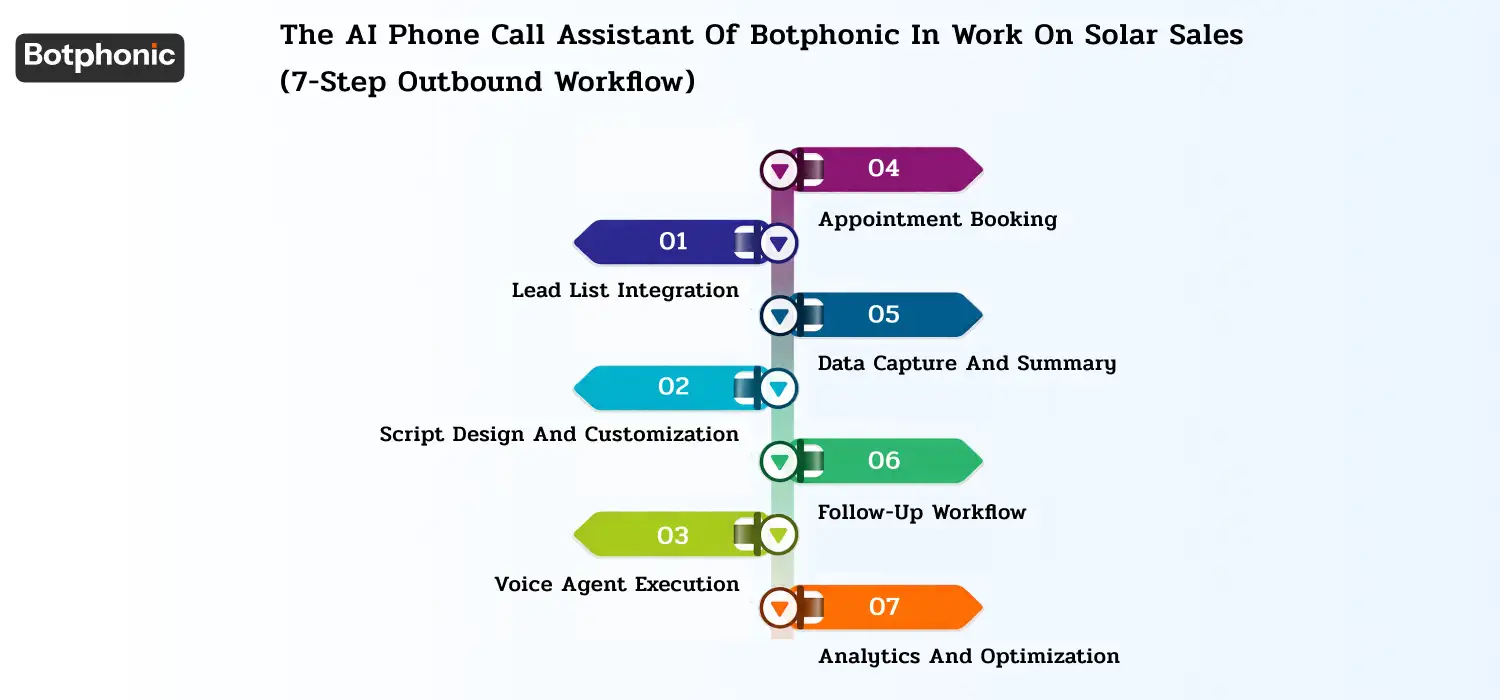
- Lead List Integration – Add a CSV or connect directly with your CRM ( Salesforce, HubSpot, Zoho ). The AI loads the context (source campaign, prior interactions, geography) of each lead, and dials.
- Script Design and Customization – Configure the flow of the conversation, qualifying questions, responding to objections and the voice of the brand. Test in a sandbox and then go live.
- Voice Agent Execution – The AI makes a phone call and opens with a natural introduction, asks qualifying questions, and adjusts in response to answers. When the callers say that they are busy, they are offered a chance to call back at a more appropriate time.
- Appointment Booking – Hot leads will receive a calendar offer immediately (Google Calendar, Outlook, Calendly integration).
- Data Capture and Summary – Each call will produce a structured summary: responses of the lead, the sentiment history, the next-best action, and (where appropriate) a reason why the lead failed to qualify.
- Follow-up Workflow – Leads that indicated not now are tagged as 7-day or 14-day callback. Leads that posed certain questions receive an informative email that contains the answers.
- Analytics and Optimization – Weekly Check-in – intent recognition accuracy, appointment booking rate by lead source, and most common objections. Modify scripts to deal with what is really going on calls.
Solar-Specific Objection Handling
The AI is already programmed to process the counterarguments solar reps are used to hearing every day:
- What about tax credits? – AI mentions the current federal residential clean energy credit rate, common state level incentives, and typical time frames to apply credit.
- “What do I get in terms of ROI? – AI strolls through the ROI computation framework (electric bill × 12 × estimated offset percentage × years to payback) and offers to e-mail a personalized ROI estimate, based on his own bill amount.
- “Is my roof suitable? – AI inquires about age, slope, and shading of the trees, and the recent repairs; flags any obvious disqualifiers and reserves a site visit to marginal cases.
- How long does installation take? – The installation is likely to last the 1-3 days typical install time plus the 4-12 weeks permitting install time (varying by jurisdiction)
- I am only doing some research – I will provide a 7 day educational email program, followed by a follow up call.
The objection handling is not scripted in the strict sense of the word, the AI uses NLP to learn about the underlying issue, and pulls from a configurable knowledge base. New objections which are repeatedly heard are added to the configured set within days.
How AI Phone Calls Change the Solar Sales Funnel
The Old Funnel (Pre-AI)
- Lead fills out web form → routes to email queue
- SDR observes lead in 1-4 hours (depending on staffing)
- SDR calls → goes to voicemail (lead is at work)
- SDR sends message, plans follow-up.
- Lead calls back → reaches different SDR (no context)
- DR re-qualifies, books consultation if lead is still interested
Findings: average lead-to-consultation rate of 15-25%. The majority of leads are killed in the 2-5 steps.
The New Funnel (AI-Enhanced)
- Lead completes web form → AI makes a call within 60 seconds.
- AI is qualified, replies to questions, books consultation in a single call.
- Closer offers a fully qualified lead with conversation summary in CRM.
- Closer is more of a face-to-face consultation with full context (amount of bill, roof issues, purpose to finance it, timeline)
Result: lead-to-consultation rate usually increases 30-50% absolute – partially due to speed, partially to no leads dying within the gap between the lead and the consultation.
The trend that applies to solar specifically: AI takes the first 80% of the funnel; humans take the last 20% (consultation, system design, contract close). The time of human installers is no longer about answering phones and making chase leads but about designing systems and closing deals.
When Are AI Phone Calling Systems Superior to Human SDRs?
| Category | Human SDRs | AI Phone Call System |
| Response time | Minutes to hours | Seconds |
| Call fatigue | Inevitable after 50 calls | Never |
| Consistency of script | Depends on rep, mood, day. | Perfect on each call |
| Work hours | Work schedule | 24/7, including weekends |
| Follow-up persistence | Persistence of follow-up | Continual on all contacts |
| Cost per call | $4–$7 | Under $1 |
| Logging of data accuracy | Varies (written notes) | Exact (full transcript + structured fields) |
| Tone | Depending on the mood. | Optimized for conversions |
| Multilingual coverage | 1 representative per language | Automatic switching in the middle of a conversation |
| Geographic flexibility | Bound to working hours. | None |
The framing which the solar sales teams buy-in: AI does not replace your SDRs. It does the job your SDRs hate (cold dialing, after-hours coverage, repetitive qualification) so your human beings can focus on what they excel at -closing.
Real-World Outcome The Serenity Case Study of Botphonic
A customer-services workflow deployment using the real Botphonic implementation demonstrates what to expect of a tuned solar deployment:
- +25% conversion enhancement on inbound enquiries.
- −50% call handling time
- −20% human errors in scheduling and data entry
- +15% agent satisfaction (because of offloading repetitive work)
- First year ROI of +150%
The same trends often occur in solar deployments – with the added dramatic twist of after-hours capture rates (which is the last thing most installers even know about).
How to Deploy an AI-based Phone Call System to Answer Solar Inquiries (6-Step Rollout)
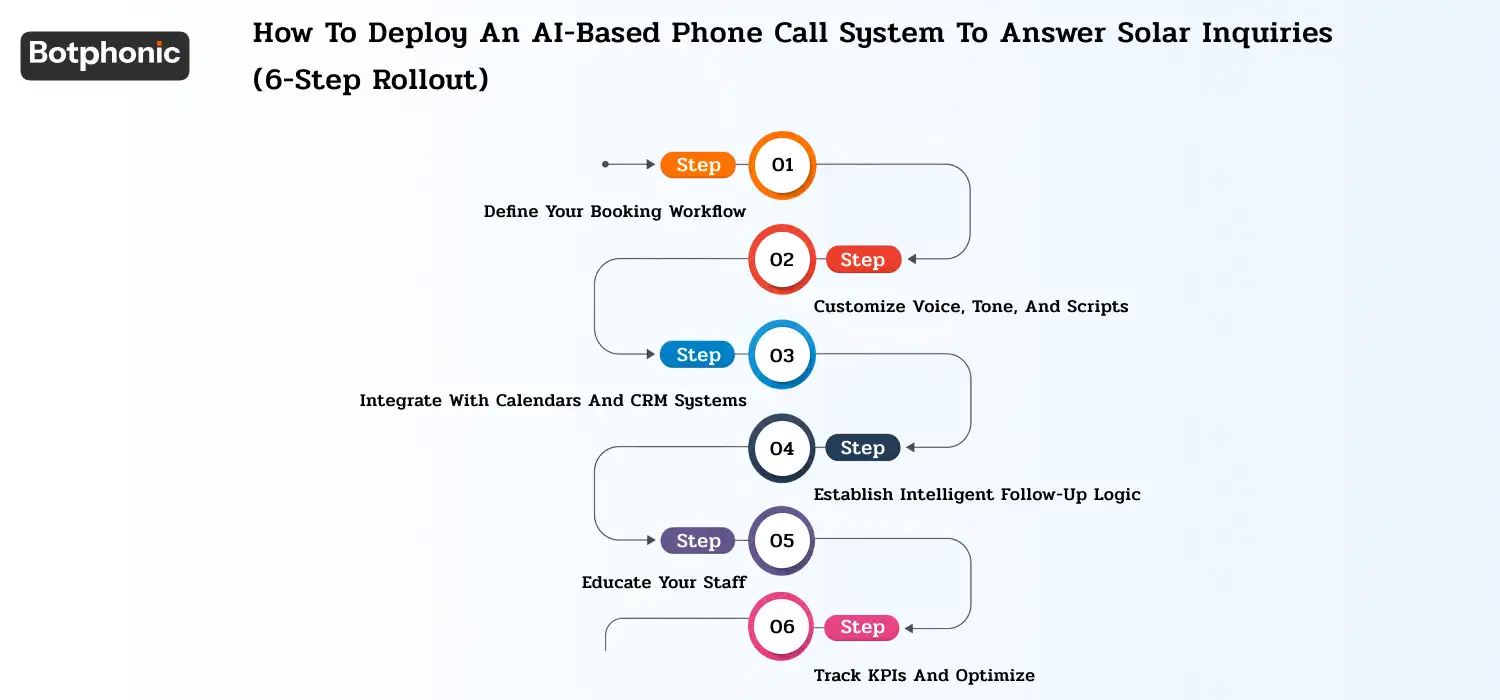
Step 1: Define Your Booking Workflow
Trace out precisely what transpired between inbound call and booked consultation today. Determine the top 5 types of inquiries (general consultation, financing question, site visit request, existing customer support, sales follow-up). The AI must be aware of the route to follow according to the type of inquiry.
Step 2: Customize Voice, Tone, and Scripts
Select a voice character that fits your brand – warm and consultative in residential, professional and direct in commercial. Set up the qualifying questions on a per-inquiry type basis. Sandbox testing with in-house staff prior to production.
Step 3: Integrate With Calendars and CRM Systems
Integrate with Google Calendar, Outlook, or Calendry and book live. Integrate with Salesforce, HubSpot or Zoho to use CRM data flow (Botphonic supports all three as well as 50+ other tools – see the integrations page). Geographic routing rules are used to decide which of the closer gets what lead.
Step 4: Establish Intelligent Follow-Up Logic
Customize the post-call sequence by outcome: booked consultation: reminder sequence; interested but undecided: 48-hour follow up; early research: 7-day educational sequence; disqualified: polite drop-off. All this is automatically done by the AI.
Step 5: Educate Your Staff
Show your closers how to interpret the AI-generated call summaries (sentiment scores, qualifying answers, top objections raised). The work of the closers is no longer to put on all leads that have been pre-qualified but with full context.
Step 6: Track KPIs and Optimize
Measures to monitor weekly: contact rate, qualification rate, booked-consultation rate, cost per booked consultation. Compare against your pre-AI baseline of 30, 60 and 90 days. Add or change qualifying questions and follow-up sequences according to what is really going on on calls.
Conclusion
Solar customers are demanding instant response, proper clarification, and convenient planning. Most installers can provide one of those during the normal working hours; very few can provide all three 24/7 at the cost structure of a small, or mid-sized business establishment. That gap is bridged by AI phone systems.
Those deployments which succeed see AI as a force multiplier of the already existing sales team, rather than a substitute. Inbound: The first call is answered by AI, which qualifies, books the consultation, and sends confirmation – your closer is on his way. Outbound: AI autonomously executes the cold-dial workload at less than -1 a call, books the warm leads, gracefully exits the unfit ones – your reps spend their day in human conversations, not voicemails.
With deployment, most US solar installers can do the math to pay back in the first quarter. The price of not deploying compounds every month: missed after-hours leads, slow callbacks losing to faster callers, closers burning their day on Tier-1 questions that AI can answer in a matter of seconds.
Ready to see what AI looks like for your solar pipeline?
Try Botphonic free for 14 days