
Summarize Content With:
What You’ll Learn
- How the three core AI phone call pricing models work, and which fits your call volume
- What hidden telephony, text speech AI, and LLM inference costs vendors don’t advertise
- How to calculate Total Cost of Ownership (TCO) beyond the quoted subscription price
- A step-by-step framework to evaluate AI phone call pricing models before you sign
- When flat pricing protects your budget, and when per-minute pricing quietly scales against you.
AI phone call pricing models define how businesses pay for automated voice interactions, and they vary widely. This guide is for operations, finance, and technology buyers evaluating voice AI platforms. Choosing the wrong model means budget overruns, not bad AI.
Why Do AI Phone Call Pricing Models Differ So Much Among Vendors?
Pricing models differ among vendors due to different ways in which they bundle their infrastructure stacks. One solution offers “everything in one” price including telephony and speech synthesis. Another does not.
Listed “starting from $X per month” rate rarely corresponds to the amount you’d be paying once your use case goes live. That’s a minimum cost for the lightest usage of the cheapest tier. The difference between the list price and actual cost is where most AI phone implementations fail financially.
 NOTE
NOTE
For a deeper overview of how modern AI phone call solutions are priced and deployed, read our complete AI phone call automation software buyer’s guide.
What Are The Three Main AI Phone Call Pricing Models?
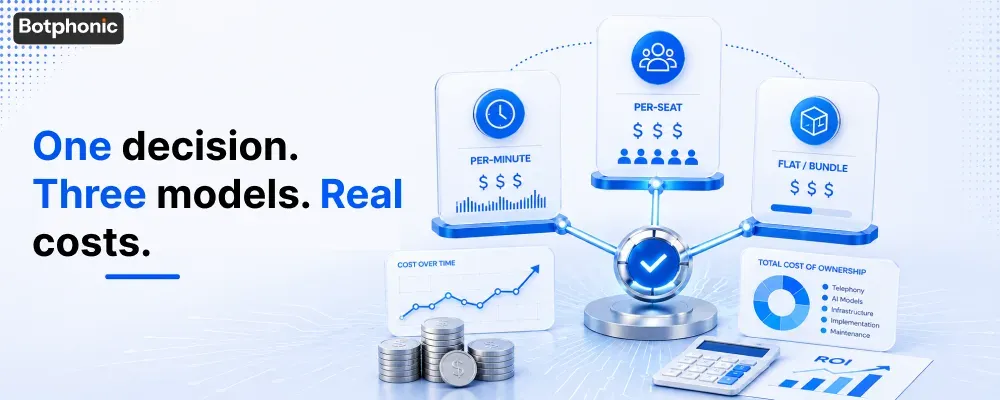
There are three main AI phone call pricing models based on minutes, per-seat model and flat or bundle pricing. They fit different business profiles.
Per-Minute Pricing: How Does Usage-Based Billing Work For Voice AI?
Per-minute billing works based on minutes of speech synthesized and actually used.
How it works: Providers measure usage per call in six-second or one-minute intervals. Costs vary between $0.05 and $0.35 per minute based on the voice quality level, AI/LLM model used, and additional features.
Good for: Businesses experiencing volatile or peak seasonally-driven call volumes such as retail Q4 and tax-related businesses in April.
True danger: A sudden 300% increase in call volume will double or triple your bill unexpectedly. At a price point of $0.15 per minute and 10,000 minutes monthly, you would be paying $1,500. With 30,000 monthly minutes, you’ll be charged $4,500 — same contract, three times the cost.
Per-Seat Pricing: Is the SaaS Seat Pricing Model Suited to AI Voice Agents?
Per-seat pricing means an equal cost is allocated per each deployed “AI agent,” irrespective of call volume.
How it works: You buy a certain number of concurrent AI agents. Seats go for $50-$300 per month depending on the vendor. Any unused seat counts as wasted money in SaaS lingo.
Good for: Contact centers where call volume is consistent and agents operate under full capacity.
True Danger: With 40% of their billing hours sitting idle, you’re paying for capability that offers no value whatsoever. Assess agent utilization before signing.
Flat/Bundle Pricing: Is Flat Monthly Pricing a Way to Control Your AI Costs?
Flat pricing comes with a fixed monthly rate along with an assigned number of calls, beyond which overage rates apply.
Here’s how it works: For instance, a $999 per month plan would have 5,000 minutes of capacity in it. You pay $0.18 for every minute above that cap. The upside is its predictability; the downside? Until you get past your allotted number of calls, of course.
Good fit for: Finance-centric organizations who require accurate forecasting and have an estimated call volume with 20-30% accuracy.
True Danger: Vendors set up overage rates deliberately to make them painful. Check out the terms. That seemingly safe $999 package could very well cost you $1,800 if overage rates of $0.18 per minute start applying beyond 5,000.
Comparison: Which AI Phone Call Pricing Model Fits Your Business?
| Criteria | Per-Minute | Per-Seat | Flat/Bundle |
| Predictability | Low, scales with volume | Medium, fixed per agent | High, until overage |
| Best volume profile | Variable / seasonal | Steady, high-utilization | Predictable, moderate |
| Risk of surprise costs | High at scale | Low if seats are utilized | Medium (overage traps) |
| Entry cost | Low | Medium | Medium–High |
| CFO friendliness | Poor | Good | Best |
| Ideal business type | SMB, seasonal retail | Enterprise contact centers | Mid-market SaaS, finance |
Hidden telephony costs refer to the hidden fees charged by vendors under the subscription line and may be 20-60% of the actual monthly costs.
What Does the Telephony Layer Actually Cost?
The telephony layer refers to such infrastructure elements as PSTN access, number provisioning, and carrier egress. These are actual costs that will come regardless of whether to develop or to purchase platform.
- DIDs for local calls: $1-$3/month per number
- Toll-free numbers: $2-$5/month + inbound minute fees
- Carrier egress (outbound calls): $0.01-$0.04 per minute based on destination country
- PSTN connection costs: some providers charge monthly “telephony access” fee of $50-$200
Twilio and other platforms charge such fees openly. Others, such as some white-label AI voice platforms, include all of them into a single “platform fee.”
How Do Text Speech AI Components Influence the Cost?
The text speech AI means such components as ASR (automatic speech recognition) and TTS (text to speech). They have different tiers and price levels.
- Standard ASR (Google Speech-to-Text): ~$0.006/15 seconds
- Enhanced ASR (better accuracy for accented speech & noise): ~$0.009/15 seconds
- Standard TTS (Amazon Polly): ~$4 per 1 million characters
- Neural/HD TTS (hyperealism): $16-$30 per 1 million characters
The 3-min call will produce approx. 1,500 – 2,500 characters TTS output. At neural pricing rates, this is $0.04 – $0.075 per call for TTS only – hidden within bundled pricing.
What Are LLM Inference Fees in AI Phone Platforms?
LLM inference fees are the cost the vendor pays to run the large language model used to drive the AI’s understanding & responses. You are charged for these whether the vendor shows them or not.
The GPT-4o model charges per token. The average 3-minute AI phone call uses up to 800 – 2,000 input tokens and 300 – 800 output tokens.
- GPT-4o: ~$5/million input tokens; ~$15/million output tokens
- Claude 3.5 Sonnet: ~$3/million input tokens; ~$15/million output tokens
- Smaller/fine-tuned models: $0.50 – $2/million tokens – lower cost, lower accuracy
Vendors using fixed-fee pricing structure bear these costs themselves. Vendors using token-based fee.
 PRO TIP
How Do You Determine The Total True Cost Of Ownership For Ai Phone Software?
Total cost of ownership of AI phone software involves subscription fees, telephony charges, implementation fees, integration time and ongoing governance, not just the quoted price. Many businesses underestimate TCO because they evaluate subscription pricing in isolation instead of measuring the full operational impact of their AI call assistant.
Which Implementation Fees Do Providers Omit from Quotes?
Implementation fees cover set up, CRM integration, prompt engineering, voice personality tuning, testing. These are hardly ever included in the price quote.
This is what dealerships and contact centers really face: For mid-level operations, setting up an AI voice solution for the very first time is expected to require 40-80 hours of configuration. This means $3,000-$6,000 in unbilled implementation fee at $75 per hour IT work rate – before answering the first call.
Integrations with platforms such as Salesforce, HubSpot, VinSolutions, or DealerSocket increase complexity. Webhook configuration, CRM field mapping, and call dispositioning logic will need developer hours or pro services from the vendor and cost you $150-$250/hour.
How Do Overage Charges Cause “AI Bill Shock”?
Overage charges result in unexpected billing increases because of the exceeding call volume – which usually happens precisely when your automation system works perfectly.
One of your campaigns or one of your viral events causes 3x more inbound calls than usual. You have a flat-rate package for 5,000 minutes but got 14,000. Additional charges of $0.18/minute will cost you an additional $1,620 for those 9,000 overages with zero advance notice or approval.
Build the volume scenarios before choosing your package:
- Base scenario: your average call volume
- Double scenario: 2x – a moderate busy season or marketing campaign
- Five-X scenario: 5x – viral moment, outage, or holiday season
Calculate the cost of each scenario based on your shortlisted packages. The cheapest package in terms of base may become the most expensive in terms of five-X.
What Are Ongoing AI Fees For Maintaining And Reviewing Model Quality?
Ongoing fees include model training, prompt tuning, monitoring and quality assurance. These costs are rarely disclosed upfront.
- Human-in-the-loop review: Testing and auditing 3 to 5% of AI calls either costs money for vendor fees or internal QA
- Prompt/Model tuning: When your products, pricing and policies evolve, AI knowledge needs to evolve too
- Monitoring: Industries under regulations (automotive lending, healthcare-related services) require auditing of calls – $200-$500 per month for tools or labor
Botphonic provides an AI-powered virtual receptionist for automotive dealerships that includes ongoing model updating as part of their managed plan, worth checking with any other vendor.
How Should You Assess AI Phone Call Costs Before Committing To The Vendor?
Assess AI phone call costs by running through three volume scenarios, calculating cost-per-resolution and deciding which solution will work best for you depending on your risk level.
Step 1: Assess Your Volume With Three Scenarios – Base, Double, and Five X
Determine your current monthly inbound calls. Price them based on the scenarios for each shortlisted vendor, including telephony costs, overage, and LLM inference for each scenario.
The vendor that dominates at base volume can fail dismally at five-X volume. The vendor you think is expensive at base can keep costs more predictable at scale.
Step 2: Calculate Cost Per Resolution – Not Cost Per Minute
Cost per resolution is the actual key to measuring the price of artificial intelligence technology. You calculate the cost of the artificial intelligence service by dividing its monthly cost by the number of calls it handles independently without human intervention.
An artificial intelligence platform that charges $0.08 per minute but solves 80% of the calls is better than one that charges $0.04 per minute but resolves 40%.
Formula: Monthly AI cost ÷ (Total calls × Resolution rate) = Cost per resolved call
A $2,000 monthly platform solving 1,600 out of 2,000 calls = $1.25/resolved call. A $1,200 monthly platform solving 700 out of 2,000 calls = $1.71/resolved call.
The less expensive option will have higher cost per result.
If you want to quantify business outcomes beyond pricing alone, our guide on measuring AI phone call ROI explains the metrics CFOs and operations teams should track.
Step 3: Decide Between Managed Services and Self-Hosted Infrastructure Keys
Managed service means the vendor controls the ASR, TTS, and LLM API keys and bills you one consolidated fee. Self-hosted means you bring your own Deepgram, ElevenLabs, or OpenAI keys and pay those vendors directly.
| Factor | Managed Service | Self-Hosted Keys |
| Cost at low volume | Higher (vendor margin) | Lower (direct rates) |
| Cost at high volume | Predictable | Negotiable via volume discounts |
| Operational burden | Low | High (you manage API keys, rate limits, billing) |
| Transparency | Low | High |
| Best for | SMB / mid-market | Enterprise with engineering resources |
Before your next vendor call, build a simple spreadsheet: list your monthly call volume, average call duration, current human agent cost per call, and target AI resolution rate. Bring that spreadsheet to the demo. Any vendor worth working with should price your actual scenario on the spot, not hand you a generic deck. Model your AI call costs with Botphonic’s team.
Conclusion: Cheapest Per-Minute Rate Is Not Always the Best
Cheapest per-minute rate seldom guarantees highest ROI. This may be caused by low voice quality, poor LLM models or hidden fees which become apparent only at large volumes.
Pricing model choice should consider three criteria: volume predictability, resolution rate and company’s ability to control its infrastructure. Flat plan with high resolution rate usually will beat a cheap per-minute plan with bad containment.
In the contract negotiation process you should insist on following requirements: tiered reduction of per minute rates at certain volumes, overages limitation/cap or warning when they kick in, service level agreements credits based on AI resolution rate and not availability, quarterly audits of cost per call.
The task is not making AI as cheap as possible. The task is getting maximum value out of each resolved conversation. This change in approach is what separates smart buyers from reactive ones.
