
Summarize Content With:
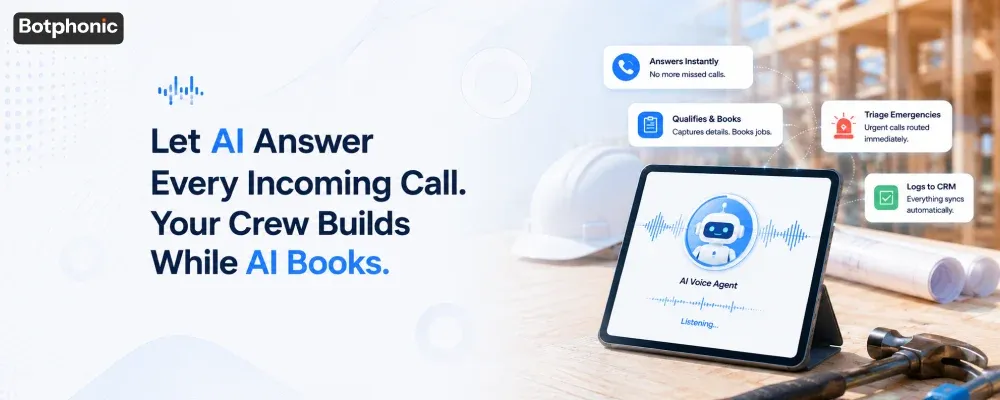
An AI phone agent for contractors is a cloud-based voice bot that acts as a virtual dispatcher. It captures lead details, triages emergencies, and syncs directly to your CRM to prevent lost revenue. It runs 24/7. It never misses a shift. It’s built for solo tradespeople and crews who can’t hold a phone while working.
What You’ll Learn
This guide covers what an AI phone agent for contractors does. It explains why job-site work causes missed calls. It shows how the best AI tools for small business phone answering triage emergencies versus routine quotes. It walks through setup for your own crew.
Why Are Contractors Losing Leads Due to Missed Calls?
Missed calls occur when hands-on work meets high levels of phone activity. The busier you are, the more likely you’ll miss some of these calls.
Job-Site Truths
It is impossible to answer a phone if you’re on the ladder, under the sink, or operating a saw. Plumbing, electrical, heating, ventilation, air conditioning specialists, and general contractors miss between 27% to 62% of incoming calls due to being engaged in physical activity on the job (Aira, 2026). A single missed service call means the loss of $275 to $1,200 of potential income depending on the type of work.
If a contractor misses five to ten phone calls per week, he loses between $45,000 to $120,000 annually. This amount doesn’t appear in the profit and loss statement. You may think that you simply had a bad month.
Why Voicemail Isn’t the Solution
Voicemail wasn’t designed with current customer behavior in mind. AI phone calls are converted into sales 10 to 15 times more often than web forms’ leads (BIA/Kelsey as quoted by Invoca, 2025). High-intent callers disconnect as soon as they hear a recorded message.
P.S. A full voicemail box comes across as unprofessional when a homeowner is comparing three contractors at the same time. This upgrade with your branding and immediate response will cost you almost nothing.
What is an AI Phone Agent for Contractors?
An AI phone agent for contractors is a voicebot that handles all incoming calls, asking qualifying questions, booking, or escalating the job. This technology works no matter if you’re working on-site or not.
How Is It Different from Human-Based Answering Services?
A traditional answering service is only effective if there is someone who works, is trained, and is awake at 2 a.m. An AI-based answering service works all day long, 365 days a year without any breaks.
Under the hood, most platforms use latency-optimized PSTN routing to make calls connect within less than a second. AI-based conversational guardrails prevent the bot from making numbers it was not trained on.
The Importance of Consistency in Your Brand
Every call should get exactly the same accurate pricing model, coverage area, and tone, no matter who or what picks up the phone. Your trained AI will follow your playbook to the letter every single time. Your rota of dispatchers won’t.
What Are the Must-Have Features of the Best AI Call Answering Tools for Small Businesses?
The best AI phone answering tools triage calls correctly, integrate with your CRM, and allow you to step in if required. Let’s take a look at how to distinguish between a useful AI solution and a gimmick.
Accurate Triage Logic
Your agent must know when it’s a quick quote and when it’s an actual emergency such as a pipe bursting or a fire hazard. This is something that your triage logic will have been trained on based on your unique service categories.
Real-Time CRM Integration via API Webhooks
Look for direct integration with the software you already run — ServiceTitan, Jobber, Housecall Pro, or FieldEdge are the most common platforms among field service businesses. The best tools push data through API webhooks the moment a call ends, so caller notes, service type, and address land straight on your dispatch board. No manual data entry.
If you’re comparing vendors, this guide to the best AI phone call software for home service companies explains what integrations, automation features, and emergency routing capabilities to evaluate before making a decision.
Human-in-the-Loop Controls
The strongest platforms let you review call transcripts. You can take over a live call mid-conversation if a situation escalates. This keeps you in control without requiring you to answer every ring yourself.
| Option | Availability | Cost Range | CRM/Data Logging | Best For |
| Voicemail | After-hours only | Free (built into phone) | None, manual playback | Very low call volume |
| Human Answering Service | Business hours, sometimes 24/7 with staffing | $200–$1,000/month (Ainora, 2026) | Manual notes, inconsistent | Complex judgment on every call |
| AI Phone Agent (e.g., Botphonic) | 24/7/365, no staffing gaps | Fraction of a receptionist’s salary | Automatic, syncs to CRM via API webhook | Contractors and field teams who can’t answer live |
 PRO TIP
How Does an AI Phone Agent Triage Emergency vs. Routine Calls?
Triage works in three steps. The AI asks a short set of qualifying questions. It scans for urgency keywords. It routes the call based on what it hears.
Triage Matrix
| Caller Says | Category | Trigger Keywords | Action |
| “My basement is flooding” | Emergency | water, flooding, burst pipe | Immediate alert to on-call tech |
| “I smell gas near my stove” | Emergency | gas smell, gas leak | Immediate alert + advise caller to leave premises |
| “My panel is sparking” | Emergency | sparking, smoke, electrical fire | Immediate alert to on-call tech |
| “I have no heat and it’s freezing” | Urgent — same day | no heat, no AC, extreme temp | Flag for same-day scheduling |
| “I want a quote for a new water heater” | Routine | quote, estimate, install | Collect details, log to CRM |
| “Can you check a small leak under my sink” | Routine | leak, drip, slow | Collect details, log to CRM |
In Action
These aren’t emergencies. They’re quote requests that simply require proper intake. The true benefit doesn’t lie in dealing with that once-in-a-while 2 AM burst pipe. The benefit lies in handling all those other routine calls per week that would have gone to voicemail — now logged and scheduled without having to stop anything you’re doing.
Dynamic Scripting Using Industry Lingo
An efficient agent understands industry lingo like “3-ton unit,” “panel upgrade,” “trip hazard” and can ask for a picture or detail before you even return the call. That one interaction alone saves you from a cycle of phone tag. Learn how AI phone calls help home service businesses capture more leads by responding instantly, qualifying callers, and booking appointments before competitors answer.
How Do You Configure an AI Phone Agent for Your Contracting Company?
Configuration happens in three easy steps. Define your call categories. Train the AI with your playbook. Review transcripts weekly. Most contractors are live in under a week.
Step 1: Define Your Workflow. Make a list of your services. Break down those services into two categories: emergency and routine. This creates your triage flow before writing your first script line.
Step 2: Train the Voice on Your Playbook. Input your pricing, geographical coverage, warranty details, and FAQs. The more detailed your inputs are, the lower the number of calls that will be escalated by mistake.
Step 3: Track & Improve. Go through some transcripts per week. Identify those calls which the voice was not able to solve. Add them to the knowledge base of the platform. Here’s how to compare platforms based on the breakdown of best AI phone call software for home services.
 NOTE
NOTE
Is an AI Phone Agent Worth It for Contractors?
It is if the monthly fee is less than a loss per missed opportunity. Which is true for the vast majority of contractors.
Impact on Revenue
If the cost of a missed call is $275 to $1,200 and the cost of an AI phone agent is just a fraction of a receptionist’s monthly salary, two to three saved jobs per month pay back the investment multiple times over (Aira, 2026). This calculation only becomes better when the average ticket size rises.
Trust from Customers and Reviewing
Fast and professional answering creates the impression that potential customers form about you. An answer received instantly increases chances of a good review compared to voicemail messages left without reaction. Such reputation benefits are even more powerful in a local service area, where referrals play a crucial role.
Freedom of Operation
The greatest change comes mentally. No longer do crews have to check their phones while on a job, as they know that no vital information is lost during calls. Such attention typically results in fewer errors and faster job completion.
Investing in operational efficiency tools aligns with the broader digital transformation initiatives encouraged for small businesses by the U.S. Small Business Administration.
Ready to turn missed calls into booked jobs? Explore how Botphonic helps contractors automate phone answering 24/7.
Try Demo Now!!!