
Summarize Content With:
What You’ll Learn
- How an AI phone agent answers, qualifies, and books calls in real time
- The latency, WebSocket, and LLM fine-tuning basics behind a natural-sounding call
- Why so many business calls go unanswered, backed by verified industry data
- What to compare when choosing an AI phone answering system, including HIPAA needs
- Industry use cases for Healthcare, Dental, Legal, Real Estate, and Insurance
- Whether an AI phone agent is worth it for your business
An AI phone agent is software that answers business calls, understands the caller’s request, and books or routes them. It matters for any business, dental offices, law firms, real estate teams, clinics, insurance agencies, that loses revenue when calls go unanswered.
Quick Definitions
AI Phone Agent: A conversational AI platform that answers a business phone number, holds a real conversation, and completes a task like booking or routing, instead of just recording a message.
Conversational AI: The broader category of systems that understand and generate human language in a back-and-forth exchange, spanning both chat and voice.
Natural Language Processing (NLP): The technique that lets the system parse spoken words into structured meaning, such as identifying a date, a service type, or an urgency level.
Latent Semantic Indexing (LSI): A method for mapping words to underlying concepts rather than exact matches, so “my tooth hurts” and “dental emergency” route to the same intent.
What Problems Does an AI Phone Agent Actually Solve?
The table below maps common front-desk pain points to the manual fix most businesses try first, against what an AI phone call agent does instead.
| Pain Point | Manual Solution | AI Phone Agent Solution |
| Calls ring out during lunch or after hours | Rotate staff breaks, hire evening coverage | Answers every call 24/7, no schedule gaps |
| Callers hang up on voicemail | Ask staff to check messages more often | Live conversation on the first ring, no voicemail step |
| Front desk can’t qualify leads consistently | Train every new hire on the same script | Runs the same qualifying questions on every call |
| Appointments booked incorrectly or double-booked | Manual calendar cross-checks | Direct calendar sync at the moment of booking |
| No record of what was discussed on a call | Staff notes, often incomplete | Automatic call log synced to the CRM |
| Call volume spikes overwhelm the team | Temp staff or overtime | Handles unlimited concurrent calls |
According to research from the speed to lead collective, businesses are about 100 times more likely to contact someone lead if they respond within five minutes compared to 30 minutes (Harvard Business Review / Oldroyd study, cited in Aira, 2026). That is why it is important to measure answer speed, rather than answer rate.
This Data was Evaluated:
All statistics in this guide are cited and sourced from published industry research and are dated and sourced at the time they are cited. If there is variation in numbers across different sources, we report the number and source for missed-calls instead of combining the claims together, as a single example. If this guide refers to Botphonic’s own call-handling actions, the actions could be what the platform is designed to do, not a third-party audit.
Why Do So Many Business Calls Go Unanswered?
Missed calls are not a marketing deficiency, but a staffing and timing deficiency. That means that the calls are coming in, but they’re not being answered for those paying to get phone leads.
Only 37.8% of small business calls are answered by a live person across industries, according to 85 businesses studied (411 Locals, 2023). 85% of people call voicemail, and do not call back, when they reach it.
The pattern occurs in each of the industries covered in this article. According to a study (Peerlogic, 2026) that monitored 4280 calls over 26 practices, between 32% and 38% of incoming calls are missed during business hours in dental practices. In 2024, law firm call answer rates recorded a significant decline, falling from 56% in 2019 to 40% (Clio Legal Trends Report, cited in Oklahoma Bar Association, 2024).
In reality, what a dealership, clinic and company actually get is a walk-in, an incoming call, and an insurance question all in one. That phone loses it almost every time, particularly at lunch time and the first hour after the opening.
 PRO TIP
How Does an AI Phone Agent Answer, Qualify, and Route Calls?
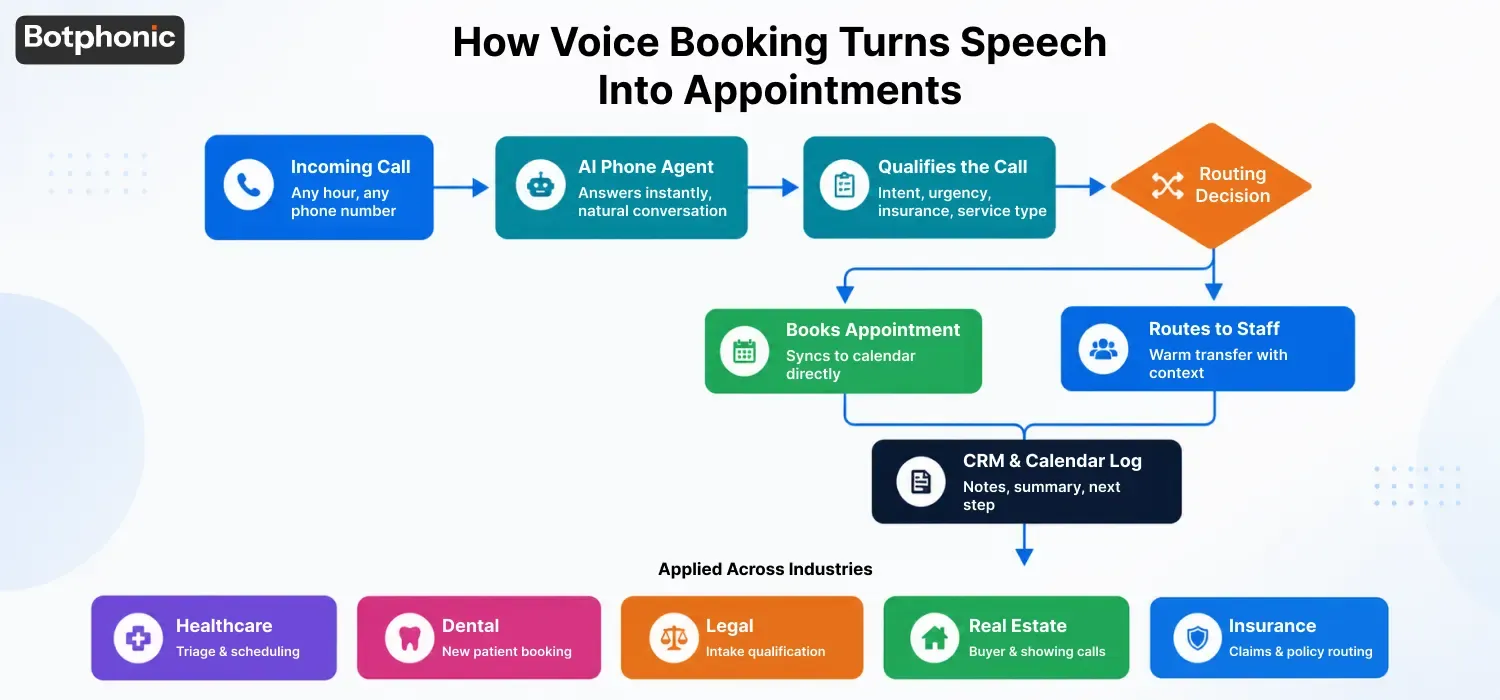
An AI phone agent’s workflow is a set sequence: answer, qualify, route or book, and log. Here’s what that means in live call, step by step, even the most technical of the layer that most vendors don’t tell.
First, the system answers on the first ring using the business’s phone number (or a dedicated tracking number). Calls are typically handled over a WebSocket connection, which supports the persistent, two-way audio stream needed for real-time conversations, unlike REST APIs, which are better suited for post-call tasks like CRM updates.
Most callers believe that AI call assistants are natural when they take less than approximately 800 milliseconds (ms), which is the natural turn-taking time for human conversation. (Famulor, 2026) Callers are able to hear the delay above 1,500 milliseconds and begin to tune out.
Second, the agent uses NLP and a fine-tuned large language model (LLM) to confirm it’s speaking with the right person, assess urgency, and determine whether the caller is new or returning. Training on domain-specific call transcripts, such as dental scheduling or legal intake, helps the model ask relevant follow-up questions.
Third, it makes routing decisions. Routine requests are directly scheduled in the calendar, while sensitive/complex ones are warmly transferred to a human, sharing the context of the call rather than the caller repeating itself.
Fourth, all calls are automatically recorded. There’s no need to remember to write it down as that log can be synced with a CRM like Salesforce or HubSpot, or with software developed by the firm or the practice.
 NOTE
NOTE
What Should You Look for in an AI Phone Answering System?
The selection of a system is a comparison of the coverage, the level of accuracy and the extent of integration. Let’s say you’re shopping for vendors, rather than reading feature lists, what does this imply?
Voicemail is virtually free, yet it doesn’t convert to many. Most people hang up before they leave a message. The classic answering service comes with a human answer phone, but will generally not be able to directly update your calendar or make appointments. An AI phone agent falls between the two: always on call, and capable of accomplishing the task, rather than just taking a message.
| Feature | Voicemail | Traditional Answering Service | AI Phone Agent (Botphonic) |
| Availability | 24/7, but callers rarely use it | Business hours, sometimes extended | 24/7, every call |
| Books appointments | No | Rarely, depends on provider | Yes, direct calendar sync |
| Typical response latency | N/A | 2–4 rings before pickup | Sub-second, first ring |
| Cost structure | Included in phone system | Per-minute or per-agent fees | Flat monthly, scales with call volume |
| CRM / calendar integration | None | Manual, staff re-enters data | Automatic sync |
| HIPAA-eligible for healthcare use | N/A | Depends on staff training | Requires a signed BAA and encrypted call data |
| Scales during call spikes | N/A | Limited by staffing | Unlimited concurrent calls |
Some companies even test new companies such as Openclaw AI against the old companies. What is important is the ability to actually call back to confirm a booking or not just receive a phone call.
NOTE
How Do Different Industries Use AI Phone Agents?
The use cases vary primarily because of the definitions of “qualify” and “compliance” in the industry’s context and in healthcare. Here are 5 industries that have a lot of calls and use the same workflow, but in their own unique way.
Healthcare Practices Use AI Phone Agents to Triage and Schedule Patients
An AI receptionist for healthcare is used by the clinics to classify routine calls from those that require a transfer to the nurse line. As calls can contain PHI, the platform should not be a general purpose conversational AI platform – it must be signed BAA compliant and securely stored.
Dental Offices Use AI Phone Agents to Capture Every New Patient Call
Typically, only 14% of missed calls will leave a voice message, so dental practices rely on AI phone answering to ensure they are the first to hear new patients as soon as they call (Resonate AI, cited in Dentina, 2026). Agent will keep track of open chair time and book directly, even when there is gap in lunch coverage.
Law Firms Use AI Phone Agents to Qualify Leads Before Intake
Before a call ever reaches an attorney, firms use the agent to query case-relevant information (practice area, incident date, etc.) of which they were not already aware. This means that the intake staff only communicate with qualified individuals that call them.
Real Estate Teams Use AI Phone Agents to Answer Buyer Calls Instantly
Agents lose out on significant portion of inbound buyer calls when showing property, as they are not able to answer the phone during the showing (industry data cited in Aira, 2026). An AI phone agent for real estate answers, records the property’s address of interest and arranges a showing.
Insurance Agencies Use AI Phone Agents to Handle Policy Questions and Claims Routing
The AI phone agent for insurance agencies are used to differentiate between routine policy inquiries and active claims which require quick routing. Things such as confirming coverage or asking about payment get answered on the same call.
PRO TIP
What Changes When a Business Implements an AI Phone Agent?
Implementation changes will affect who answers first, not how they handle complex calls. Day-to-day: Staff do not continue to queue all rings and begin processing only the ones that require a person’s attention.
Dealerships and clinics WILL NOT have a front desk team replaced, but what they will get is fewer interruptions during the face-to-face service. The phone system will send normal calls to the AI phone agent, and only pass calls to staff when they are flagged as urgent and high-value.
Call logs too update. Rather than a pile of missed calls, employees receive a daily report of scheduled appointments, qualified leads and missed calls that require a callback.
NOTE
Is an AI Phone Agent Worth the Investment?
The answer, of course, depends on one comparison: the cost per month versus the value of the calls that are recovered. Let’s say that for the average small to medium sized business.
The one recovered dental patient brings $850 or more in first-year revenue (according to data from DenteMax, Peerlogic and Resonate AI, cited in Aria, 2026). Depending on practice area, a legal client from a single recovery can cost thousands more than they have recovered. On the other hand, having a flat monthly AI phone agent fee is a fraction of one recovered call.
Worth it starts to become evident in businesses with high numbers of calls and high value per customer: healthcare, dental, legal, real estate and insurance are all examples. Businesses with low call volume and low per-customer value may see a smaller, but still positive, return.
Real-World Results: What One Botphonic Deployment Actually Achieved
Third-party industry stats make the case for automation in general. First-party results make the case for a specific platform. Serenity AI, an e-commerce cashback and loyalty platform, deployed Botphonic’s white-labeled AI voice agent to call customers after checkout, activate cashback rewards, and recommend cross-sell products in the customer’s own language.
Serenity’s own AI build would have taken 18–20 months and a dedicated development team, with no guarantee of a better outcome than an existing white-label platform (Botphonic, 2026). Serenity’s merchants also had a hard adoption deadline: if results didn’t show within 60–90 days, they canceled, which ruled out a slow in-house build.
| Metric | Result After 6 Months | What Changed |
| Operational time saved | 12+ months saved | Automated repetitive outreach and client engagement duties |
| Outreach costs | 80% reduced | AI voice agent replaced manual email and call coordination |
| Cashback reward redemption | 3X increase | AI calls customers post-purchase to explain and activate rewards |
| Cross-sell revenue | +60% boost | AI recommends complementary products at the right purchase moment |
| Overall conversion | 25% boost | Combined effect of faster follow-up and personalized offers |
| Call handling time | 50% reduction | AI handles the full post-purchase call without a human agent |
| Human error rate | 20% decrease | Consistent script execution across every customer call |
| Reported ROI | 150% | Measured across the full white-label deployment |
Context: This case study covers outbound, post-purchase voice calls for e-commerce, not the inbound scheduling calls covered elsewhere in this guide. It’s included as evidence of what the same underlying AI phone agent infrastructure, real-time conversation, CRM sync, multilingual support, delivers when applied to a different call type. Healthcare, dental, legal, real estate, and insurance results will vary by call volume, script complexity, and average customer value.
Botphonic’s pricing and plans page details pricing by call volume, a number to be considered before relying solely on price for your vendor.
