
Summarize Content With:
Introduction
The sales floor which used to be filled with reps dialing down leads lists is growing quieter not because business is getting slower but because something smarter has taken the headset.
You may have felt the change in the last few years, since you worked in or near the financial services. Teams of compliance are overworked. The future is more difficult to access. And the expense of a living agent waiting on hold until a call back comes, never, is becoming unjustifiable.
What is being used instead of the old cold call pipeline is not a new script or an improved dialer. It is an AI call assistant for finance firms, voice-based AI representatives, and also capable of screening qualifications. Moreover, answering product calls, bookings with an advisor, and follow-ups 24-hours a day, without having a human voice on the phone.
It is not an outward experiment any longer. The silent flight is happening in the wealth management companies, insurance firms, mortgage lenders, and even at the fintech companies. This is why it is occurring, what the statistics tell, and what progressive companies are getting correct.
Why Cold Calling Is Quietly Dying in Financial Services
Cold calling in finance has never been very efficient, it was merely the best option over the decades. These figures have been dismal:
- B2B financial services have an average cold call connect ratio of about 2, as reported by Keller Research Center.
- According to a study on sales productivity by HubSpot, inside sales reps spend up to 40 percent of their time on voicemails, unanswered calls, and manual CRM updates.
- Eighty two percent of purchasers report that they have taken an appointment with a sales representative who contacted them over a medium they favored, and which is not necessarily a cold call anymore (LinkedIn State of Sales Report, 2023).
- Even salesforce have stated that 54% of consumers have stated they trust in use of AI but when it’s about complete trust only 10% have agreed.
Over and above raw conversion figures, there is the compliance angle. In financial services, all calls have to be recorded, all disclosure has to be made, all opt-out should be honored. A human rep that forgets to disclose a necessary disclosure exposes the regulatory risk activity. That is not a speculative risk that SEC and FINRA have fined companies specifically because of poor call documentation.
The outcome: Sales teams are high, compliance costs are high, and the ROI (return on cold outreach) has been decreasing annually.
What AI Call Assistants Actually Do (And Don’t Do)
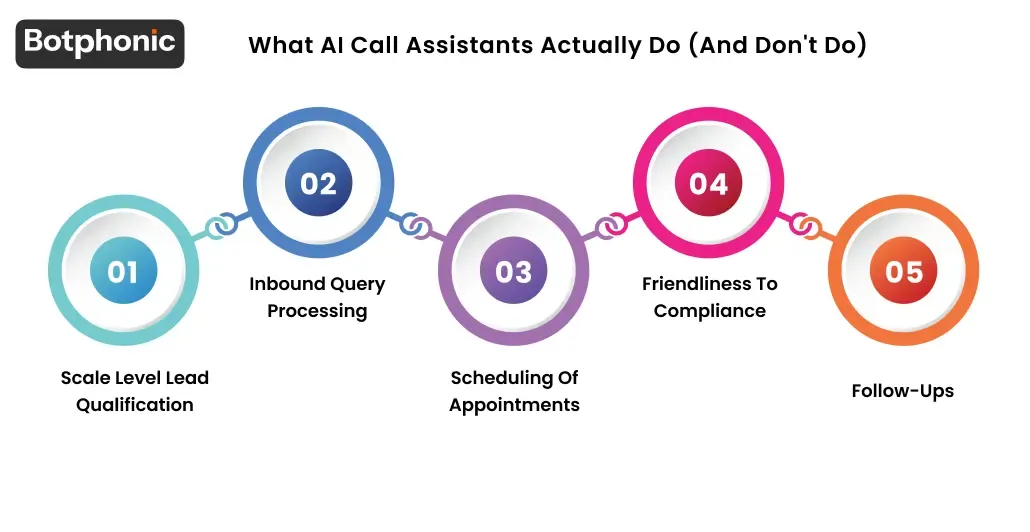
AI in financial services has much hype surrounding it. And it is worth being clear about what AI receptionist are designed to do in financial firms, and what they are not.
- Scale Level Lead Qualification: A human rep would take 20 calls to dial 500 prospects, whereas an AI call assistant would take 500 calls to dial 500 prospects. It recognizes intent signals, poses qualifying questions, and directs warm leads to advisors without using human bandwidth to screen tire-kickers.
- Inbound Query Processing: When a potential customer calls in inquiring about prices, account requirements, or loan approval requirements, an artificial intelligence can manage such interactions correctly and in real-time at 2 AM in case of need.
- Scheduling Of Appointments: The system eliminates no-shows as advisors can be linked to their booking calendars using AI assistants, so there is no need to travel in both directions to find the time, and bookings are confirmed automatically.
- Friendliness To Compliance: All AI calls are recorded, transcribed automatically, and stored. Disclosures may be typed into the flow of conversation and the likelihood of a rep missing needed language due to pressure is minimized.
- Follow-Ups: AI can be used to make follow-ups after a meeting, remind of document requests and renewals, and free up the advisors to do real advisory work.
What AI Call Assistants Are Not
They are not a replacement to complex advisory dialogues, managing client relationships in sensitive ways, or being in a circumstance where it involves actual emotional judgment. The most effective applications view AI as the top-of-funnel driver. And human advisors as making an intervention after actual interest is determined.
Quick Glance
| AI Call Assistants Handle | AI Call Assistants Do NOT Replace |
| Lead qualification | Complex financial planning |
| Appointment scheduling | Emotional client conversations |
| Disclosure delivery | High-net-worth relationship management |
| 24/7 inbound support | Crisis advisory discussions |
| Automated follow-ups | Strategic portfolio decisions |
| CRM logging & documentation | Long-term trust-building |
The Numbers Behind the Shift
The conversational AI for finance business cases is not theoretical. The figures are beginning to be gleaned:
- According to the 2023 Financial Services AI Adoption Report by McKinsey, firms that use AI-based voice agents experience an increase in the number of qualified leads 3-5x without an equal rise in headcount.
- The global AI in fintech market is estimated to be worth 42.83 billion in 2023 and is expected to investigate at a CAGR of 16.5 per cent up to 2032 (Grand View Research).
- In a 2024 Salesforce financial services report, 67 percent of teams that were high performing in financial services had already implemented or were piloting AI-assisted outreach tools.
- When initial qualification is managed by AI and compared to the fully human SDR model, the average cost per qualified lead reduces by 40-60 percent (Drift Conversational Sales Benchmark, 2023).
They are not the figures of the start-ups that do experiments. But those of companies which handle billions of AUM and have hundreds of thousands of customers. The ROI is actual, and serious institutions are listening to decision-makers.
Compliance: The Change Everything Factor to Finance
The adoption of AI in most industries is mostly a talk of productivity. In the financial sector, AI receptionist for financial advisors are also a compliance conversation as well,. But that is where in fact the AI call assistants to financial companies have a structural edge over teams where only people work.
An example of compliance requirements embedded in financial sales outreach: Do-Not-Call registry compliance. The mandatory disclosure of the product at certain points of the dialogue. Proper documentation and storage of communication with clients. FINRA Rule 3110, Supervision requirements.
This is all programmed into a properly set AI call assistant. All the calls are recorded and stored in a format that can be accessed. Upstream Do-Not-Call list scrubbing is automatable.
This does not imply that AI eliminates compliance risks, bad-configured systems or bad-designed conversation streams can generate their own issues. However, when applied in the right way, AI call assistants produce a more auditable result. More consistent outreach process than most human teams can practically execute on the scale.
What the Transition Really Looks Like
Financial companies that are successfully shifting are not doing it at once or in a single day. The trend that is forming resembles the following:
Phase 1: Inbound first: Implement AI to process inbound queries and direct them in an intelligent manner. Reduced risk, instant ROI, and prepares the team with the AI-assisted workflows.
Phase 2: Outbound qualification: Add AI to the outbound lead qualification. Only warm leads are passed to human advisors by AI which makes first contact, qualifies intent and hands off.
Phase 3: Full-funnel: AI manages the entire trip to first contact up to booked meeting, and end-to-end systems of CRM, calendar, and compliance are integrated.
Companies who attempt to bypass Phase 1 and go directly to Phase 3 usually have to face opposition, both when advisors distrust the quality of the handoff and when compliance departments feel anxious about a system that they are not familiar with. The dramatized strategy creates inner trust and technology.
 PRO TIP
Tools Building this Infrastructure
There are a number of platforms that are fighting to be the infrastructure that AI-assisted financial sales use. The space also has existing CRM vendors with added voice AI and dedicated voice AI platforms. Also with newer entrants with a purpose-built to regulated industry.
Botphonic provides AI call assistants capable of managing compliant voice conversations at scale, should be mentioned. The strategy of Botphonic involves the construction of a configurable dialogue. In which disclosures, qualification logic and handoff triggers can be specified by the firm and not using an AI with the generic algorithm that may not follow the scripts required. In the case of companies dealing with wealth management, insurance, and lending. Such configurability is of great importance compared to other sectors, such as e-commerce.
The difference between tools in this space is slowly reduced to: compliance configurability, depth of integration with the current CRM and telephony infrastructure, quality of voice experience and the presence of human-in-the-loop escalation paths.
Human Advisor Is Not Getting Replaced, But Their Role Will Change
Among the more predictable results of companies that managed to implement AI call assistants is that the advisors do not feel as replaced, but relieved.
Cold outreach grind is the least satisfying aspect of the job that most seasoned financial advisors find to be unfulfilling: calling unqualified leads who hardly recall their signup to a whitepaper, leaving voicemails that go unreturned, and data entry, which ought to be automated, on a Friday afternoon.
When AI takes on that layer, the advisor will spend more of the day doing what they are actually trained to do: to have substantive conversations with already qualified clients who are already interested. The rate of conversions on those conversations is also much higher, employee satisfaction is elevated and retention of advisors, which has been a constant challenge with most wealth management firms, becomes manageable.
 NOTE
NOTE
Stereotypical Arguments, And What the Statistics Say
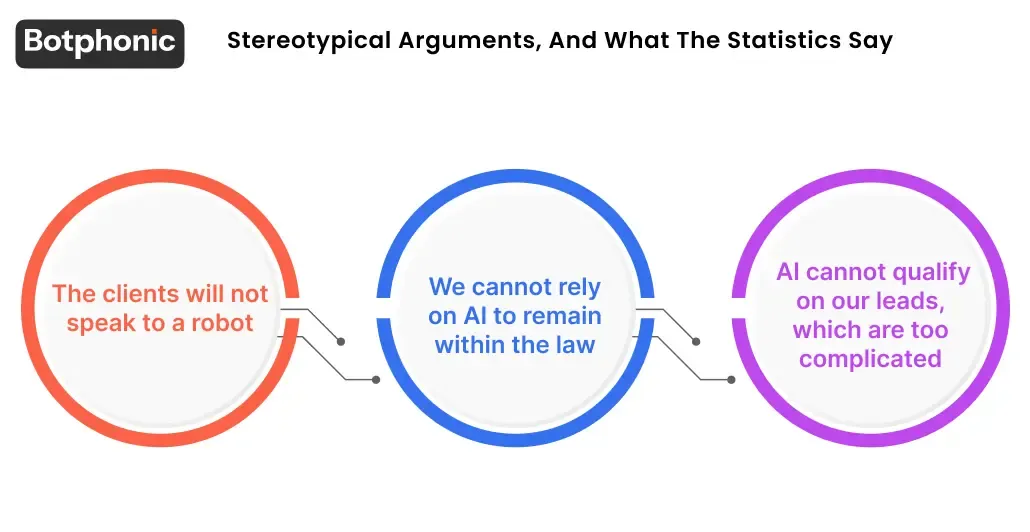
- The clients will not speak to a robot. This is the most frequent complaint, and it is increasingly becoming unjustifiable as voice AI quality increases. A study conducted by PwC revealed that half of all consumers feel comfortable with AI when they want to receive initial service (when the interaction is easy and they can contact a human being when necessary). The important one is that the initial clients do not necessarily require that first contact to be human. They require the human to be present at the right time.
- We cannot rely on AI to remain within the law. This is a valid concern that can be controlled. The solution is not to use AI but to choose platforms that include compliance configuration features and to engage your compliance team in the design of the deployment process at the very beginning.
- AI cannot qualify on our leads, which are too complicated. That might be so with extremely complicated circumstances. But those 80 percent of leads which are standard inquiries, comparison of rates, and meeting scheduling? To a large extent, AI manages those compared to the majority of junior reps.
What Makes the Difference to the Firms that do this Right
The finance companies that achieve the most gains with the implementation of AI call assistants have some common features:
- They had already set success metrics, rather than after. The velocity of the pipeline, the time of advisor to qualified-conversation, the lead response time, and the compliance incident rates, can be measured.
- They did not think of AI as a campaign: they thought of AI as infrastructure. Experiments that are point-in time seldom justify themselves. The firm gains multiple returns as it incorporates AI into the major workflow.
- They built for the handoff. The point where AI is handing a conversation to a human is the point of maximum stakes in the process. The optimal implementation architecture considers handoff with the same care as the AI conversation.
- They maintained conformity in the room. Not as a secondary effort or even a conclusion, but as a participant in the design decision-making process.
Conclusion
The companies that have been substituting cold calls with AI call assistants to finance companies are not doing it simply because it is trendy. They are doing it because the math has changed. Cold outreach at scale led by humans is both costly and compliance-risky, and yields declining returns. The outreach aided by AI can be scaled, it can be documented, and its ability to cope with the upper part of the sales funnel is as good as that of a human team and in terms of consistency is often even better.
These companies that lead on this do not always have to be the largest players in the field. They are the ones who took compliance conscious experimentation seriously a few years ago, invested internal confidence in pre-emptive rollouts, and now are running sales processes which their competitors are yet to comprehend.
The transition isn’t coming. It already has already happened to a significant segment of the financial services industry. Now comes the question how far round the block everybody would like to play before they also can strike.
Discover the platform of a compliant, customizable voice AI at Botphonic
Schedule A Demo!