

Summarize Content With:
A walk-through P&L with their lender was done by a 65-person performance agency last quarter. Revenue was up. Gross margin slipped 14 points lower compared to 2020. The question that every agency owner is asking in some form these days is, “Where did the margin go?
In this order, three places. Onshore SDR team wages increased at a higher rate than retainer prices in the US. The agency’s Manila unit doubled its prices in 18 months. And the agency’s two biggest clients began using in-house AI tools for cold outreach at about the price of a light bulb.
In 2026, marketing agencies will be the call centres. As in the case of enterprise call centres 10 years ago, the companies that emerged in the 2010-2020 offshore labour arbitrage space are now facing the same margin squeeze. The change is happening because the same forces that pushed enterprise contact centres into automation are now shrinking the agencies on the same path, only with a more compressed timeline.
This is an economic case. It’s not about the features. It’s the P&L discussion an agency owner, COO, account director, VP sales or BDR manager is (or isn’t) having at this moment. It defines what agentic AI is, what you’re really shrinking down your margins, why the biggest clients are quietly developing their own in-house, and the buy / build / sell trilemma that every agency owner will face in the next 24 months, whether they like it or not.
What Agentic AI Actually Is (and Isn’t)
Agentic AI is a more advanced step in architecture than the chatbots and co-pilots the majority of agencies are already using. The difference is important because the cost curve is different.
A chatbot or copilot answers questions. Follows your commands. Helpful in writing, summarizing, suggesting.
An agentic AI system establishes a target, carries out a series of actions to achieve it, and reports the results. In sales-ops, that means: pick up the phone, navigate the conversation, qualify the prospect using BANT or MEDDIC, and manage the 3-4 branches of objections, book in the calendar, surface to a human when the confidence level is below the threshold, and create the CRM record.
Technically, agentic AI is typically a collection of specialized models working in unison and each performing a part function, as opposed to a single LLM attempting every facet. A conversation model, a qualification scorer, a calendar integration, a CRM writer, a confidence monitor . . . each performs a single function.
Here are some of the strengths of agentic AI for agencies in 2026:
- Cold and warm automated outbound calling, follow-up conversation, at scale.
- Inbound routing/qualification
- Support for booking meetings on top of complicated calendars.
- CRM hygiene and pipeline updates.
- Multilingual outreach where the agency did not believe they could afford the staff.
What it doesn’t do so good:
- Engaging in strategic discussions with Key Leaders (C-level)
- Negotiations with multiple parties in context.
- Anything that necessitates true relational capital
- A complex deal architecture including pricing, structuring, and multi-stakeholder agreement.
The last one is the agency’s safeguard. Agencies who move first, shift their position around what AI can’t do and eradicate the cost of what AI can do with agentic AI.
The Margin Math, What Happened to Agency Gross Profit Between 2020 and 2026
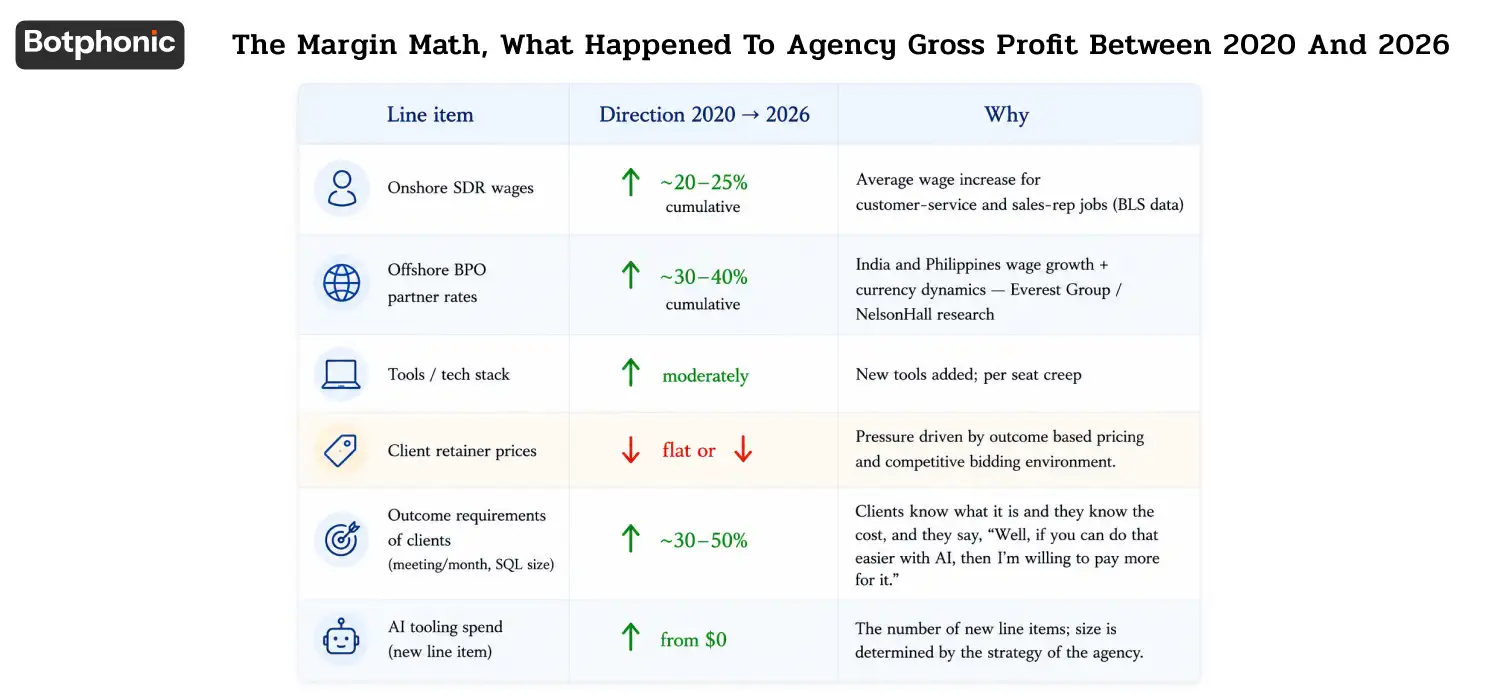
There are 6 large lines on the typical performance agency P&L.
| Line item | Direction 2020 → 2026 | Why |
| Onshore SDR wages | ↑ ~20-25% cumulative | Average wage increase for customer-service and sales-rep jobs (BLS data) |
| Offshore BPO partner rates | ↑ ~30-40% cumulative | India and Philippines wage growth + currency dynamics — Everest Group / NelsonHall research |
| Tools / tech stack | ↑ moderately | New tools added; per seat creep |
| Client retainer prices | flat or ↓ | Pressure driven by outcome based pricing and competitive bidding environment. |
| Outcome requirements of clients (meeting/month, SQL size) | ↑ ~30-50% | Clients know what it is and they know the cost, and they say, “Well, if you can do that easier with AI, then I’m willing to pay more for it. |
| AI tooling spend (new line item) | ↑ from $0 | The number of new line items; size is determined by the strategy of the agency. |
The bottom line: A blended BDR/lead-gen agency with a 45% to 55% gross margin in 2020 will probably have a 25% to 35% gross margin in 2026. There are some shops that are worse! Some, only the ones that got on the early radar of AI and adjusted their delivery style, are higher.
Not all agencies will be this. The P&L dynamics of strategy, creative and vertical-expertise shops differ. That service, however, is the one that agentic AI is most likely to disrupt: But the agencies whose service was “we sell calls at scale.
The Three Forces Compressing Agency Margins
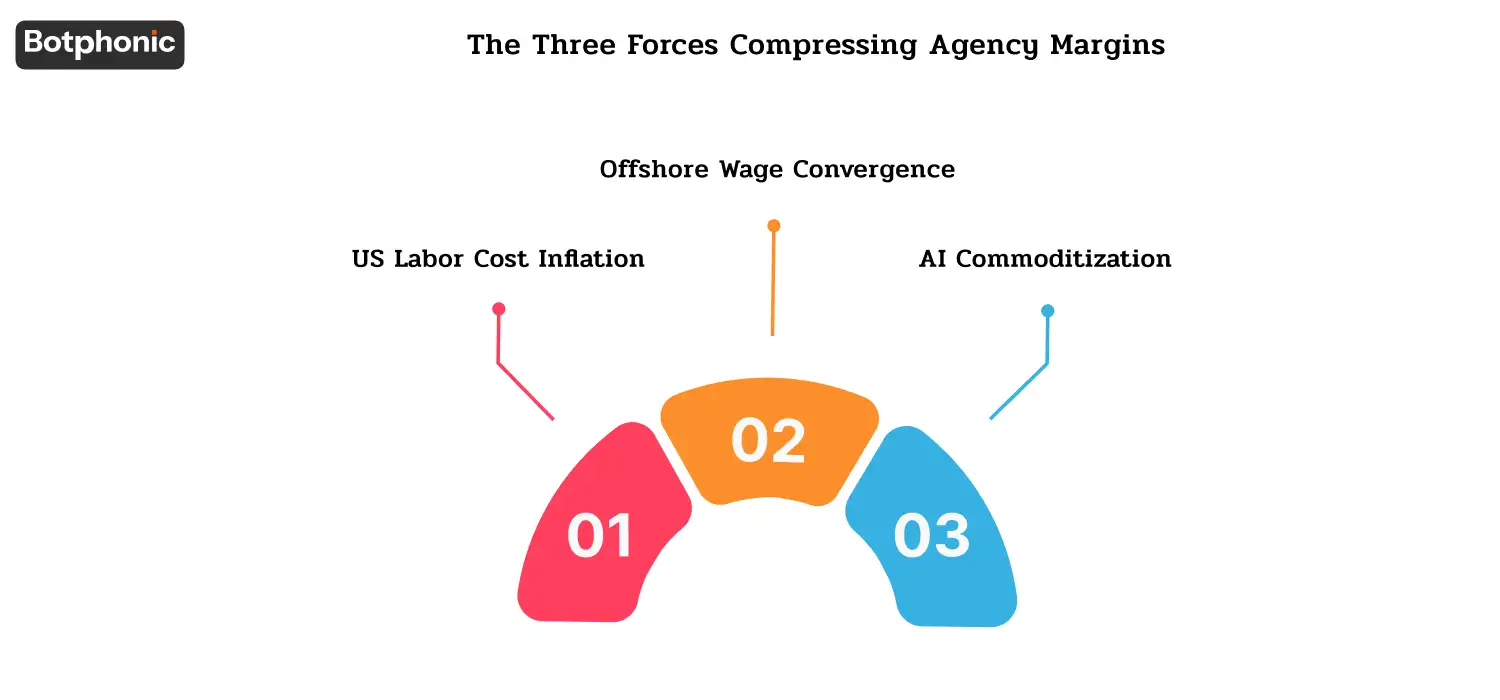
Force 1: US labor cost inflation
The Bureau of Labor Statistics reports on the growth in wages for the “Customer Service Representatives” and “Sales Representatives, Services” occupation groups. In both, growth has exceeded the level of the long-term trend over 2021-2025. In addition to hiring competition, ramp up time and turnover costs, the fully-loaded cost of an onshore SDR has risen from about $55-70K in 2020 to about $75-95K in 2026, depending on geography.
Your margin would have been okay if your pricing for retainers kept pace with wages. If it didn’t then most didn’t and that difference was filled from gross profit.
Force 2: Offshore wage convergence
The performance-agency model of 2010-2020 was based on a $80K onshore SDR being replaced by a $12-18K equivalent in Manila or Bangalore for a $40-50K all-in cost to the agency with a margin spread.
That is an arbitrage that’s closing. Since 2022, Everest Group, NelsonHall, and other BPO market researchers have been monitoring double-digit annual wage increases in key offshore SDR/BDR hubs. The spread has tightened significantly, alongside the US wage growth being slightly weaker. The all in cost is now in the $40-50K range and is closer to $55-70K for the same quality. The math that created the model is now the math which is cracking the model.
Force 3: AI commoditization
The four activities most people do on a BDR agency floor – cold outreach, qualification, scheduling and follow-up – are the very activities AI does cost-effectively in 2026. The cost of agentic AI deployments have dropped from high costs and experimental in 2023 to single-digit dollars per conversation for many workloads and quality bands that are on par or better than average human-SDR output on the repetitive parts of the job in 2026.
In the agency procurement question “should we adopt” the answers are not “should we adopt” but “should we NOT adopt? It’s about “how fast can we adopt without losing the trust of the team and trust of the client.
 PRO TIP
The Buyer-Build Threat, When Clients Stop Hiring Agencies
The fourth force that doesn’t appear on the charts, but is now a top strategic threat for many agencies. It’s the moment where a client’s CFO calculates the numbers and realizes that they will save money by building their own in-house SDR motion for their agency with AI tools than they would by paying a retainer fee to the agency itself.
That was a high bar in 2020. Despite low offshore cost of labour, an in-house BDR team needed to be hired, trained, managed, churned out and also needed to have a sales-ops layer. The agency’s bundled service was typically less expensive than developing it in-house.
The threshold has been lowered in 2026. A mid-market client (Series B / C / D, 20M-$100M ARR) can use agentic AI tools on their own, costing them one to two onshore SDR salaries. Economic considerations for outsourcing thinning.
What are the most exposed agency services:
- Pure cold outbound
- The initial stage of inbound is inbound qualification, which is taking place at the top of the funnel.
- Actor scheduling and booking as a service.Actors booking and scheduling as a standalone service.
- Content syndication / nurturing is a generic approach.
Which agency services are the least impacted:
- Industries / categories (regulated industries, niche verticals).
- Strategic positioning, messages and competitive intelligence.
- Executive-level relationship work
- Creative production with the human eye still in charge.
- Services with outcomes as opposed to services based on the number of activities provided.
The agency response form is simple: be the agentic AI or even a conversational AI that the client can’t (or doesn’t want to) run. Offer the system, the optimization, the vertical specificity, the integration work. The agencies that make it through 2026-2028 are going to be more AI-managed, less SDR factories, in nature.
What Agentic AI Does to an Agency P&L
This is the math that is communicated in the conference room.
Worked example, a 30-person agency
Assume the numbers (illustrative; replace numbers with actual numbers):
- Conference calls at all clients, 5,000 per month.
- These are pre-AI onshore SDRs and pre-AI offshore SDRs.
- Typical, fully-loaded cost-per-meeting: ~$185 blended
- The total delivery costs are approximately $925K per month.
- Average staff salary: ~$600K
- Pre-AI gross margin: ~29%
Post-agentic AI (year 1, partial rollout):
- Booked meetings with agentic AI at the rate of ~$25 per meeting were 50% of the meetings.
- 50% continue to be blended human delivery at ~$185 / meeting
- The total monthly delivery cost is ~$525K.
- Same revenue retainers: ~$1.3M
- Post-AI year-1 gross margin: ~60%.
In Year 2, all the work is routine:
- 75% AI / 25% human (strategic accounts, complex verticals)
- Monthly delivery is ~$340K per month.Monthly delivery = ~$340K/month.
- These have some compression as clients learn cost basis: revenue ~$1.1M
- Year-2 gross margin: ~69%
This is illustrative, not a forecast. Point is, it’s not an agency margin boost, it’s a structural reimagining of agency margins — if they actually rebuild their pricing and delivery model around it instead of installing it as an add-on cost.
Cost per outcome by delivery model
| Delivery model | Cost per meeting booked | Cost per SQL | Quality band | Best fit |
| Onshore human SDR | $300-500 | $600-1,000 | High | Strategic / complex / regulated |
| Offshore human SDR | $80-150 | $160-300 | Moderate-High | High-volume routine outbound |
| Agentic AI (full) | $5-25 | $25-100 | Moderate (rising) | Highest volume routine, qualification, scheduling. |
| Hybrid (AI + human review) | $30-80 | $80-200 | High | In 2026, most production work will be done at agencies. |
The numbers above are examples based on industry benchmarks, but your numbers may differ depending on the vertical, quality of the list and the AI configuration.
Persona Playbooks, How Each Agency Role Should Read This
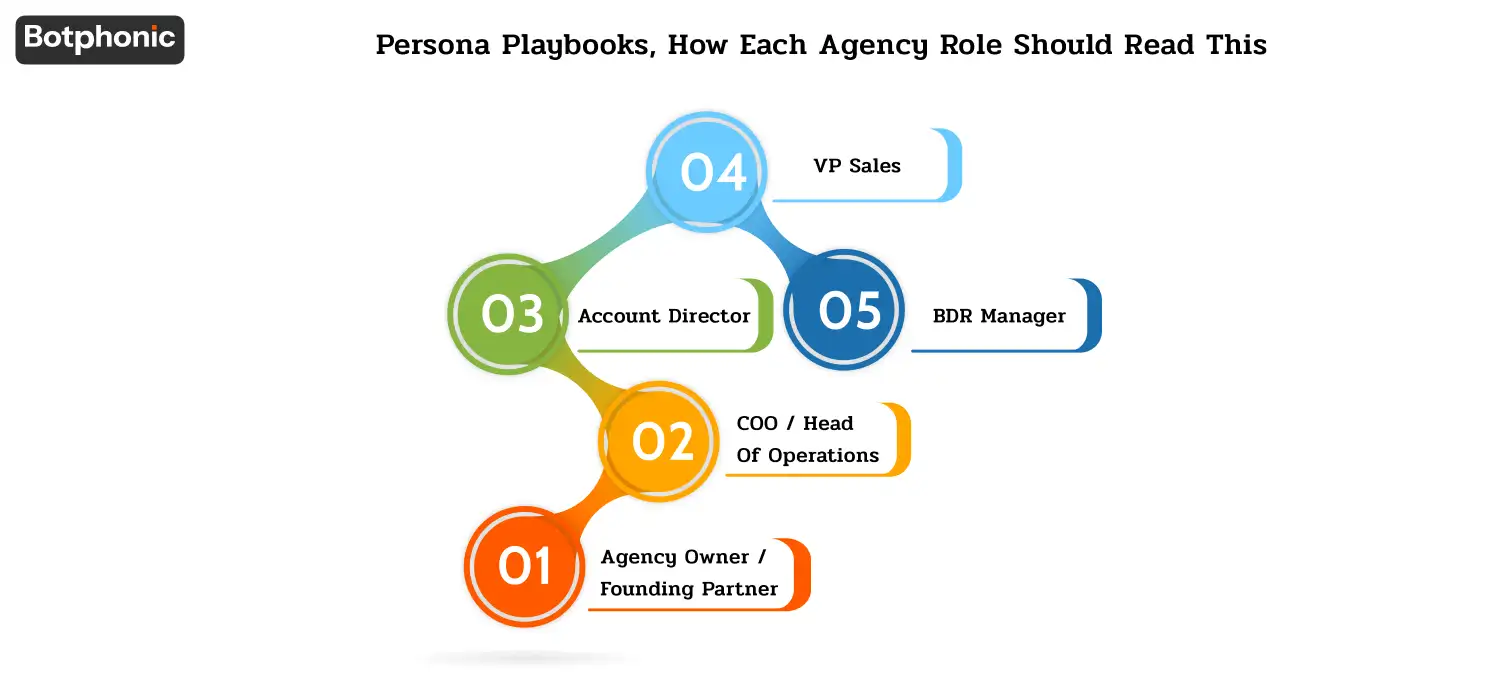
Agency Owner / Founding Partner
You’re in charge of resolving the buy / build / sell trilemma. Your decision frame:
- Purchase if you have a vertical expertise or have been creative and strategic, and/or your agency’s value rises when your SDR cost decreases.
- Only if you have engineering DNA and capital, and you’ve crunched the numbers to see if the economics make sense, should you build; most agencies are too naive in the engineering cost component when choosing to license a vendor.
- If your service stack is primarily the SDR commodity layer, it doesn’t have a viable upmarket-strategy path, and your biggest accounts are within 18 months of in-house construction, then sell.
The trilema is not theoretical. Many agencies will be making this choice implicitly by end of 2027.
COO / Head of Operations
The transition to delivery is yours. It is your responsibility to maintain production while restructuring the floor. Two priorities:
- Introduce the AI gradually, service-by-service, lowest margin first, to avoid any downturn in the quality of your services for your top margin clients.
- Keep the SDR team on board in transition, but within the first 90-180 days, AI implementation relies on human oversight, and panic dismissals disrupt the implementation process.
Account Director
You are the one that handles the face of the transition. Your clients will discover two facts, whether you tell them or not:
- The cost basis of meetings has dropped
- You must be or should be using AI somewhere in the delivery.You should be or are using AI somewhere in delivery.
Lead with transparency. Shift the discussion from ‘we book meetings’ to ‘we deliver outcomes on top of AI-augmented delivery’. In the end the clients pay for results and vertical fit and not SDR seats.
VP Sales
There are two tasks to accomplish in 2026. Walk the walk up to an external sale, and do the talk by selling the transition of the AI within the agency. The in-house sale won’t be easy. For the SDR team, it is, “AI is coming,” or “you’re going to be fired. Your message: “AI is going to take over all of your disliked parts of your job and you are going to be the strategic layer that an AI sales assistant can’t be.
It’s also where the in-house BDR threat is addressed. Create a strategic-account model which is too specific to be replicated by clients.
BDR Manager
Your team is no longer in production mode but now in supervisory. The SDRs who will be successful in 2026 are those who:
- Review AI conversations and improve the prompts/objection libraries
- Make sense of high dollar exchanges that pass through the AI.
- Build up the knowledge the AI does not have – vertical expertise.
- Go for AE or SDR-lead positions, not ‘more dials per day’ positions
There is a need to update the comp-plan. The number of calls per day is irrelevant. It is being replaced by the metric “AI quality score + AE-qualified meetings per week.
In 2026, most performance agencies will select Buy. Most fall into the Build path. There are a number of people who think the Sell path makes sense at this point—mid-market agency holding cos and PE roll-ups are buying and holding the space for a reason, they are looking for the margin reset and they want to be the ones to be owning the labor savings.
 NOTE
NOTE
How to Roll Out Agentic AI in an Agency Without Killing the P&L
Step 1: Pilot the lowest margin service line. The 15% gross margin service is the most obvious and likely place to see a big difference in performance with an AI implementation, while the risk of quality going down is minimal.
Step 2: Maintain staffing levels throughout the 90-day proof. Make an internal announcement that the pilot is not a jobs cut and is about a restructure of delivery. The SDR team should be involved in training the AI, feedback on calls, and creating the objection libraries. If they don’t participate, the pilot fails.
Step 3: Rebuild the pricing model on an outcome, not an hour. Agencies that charge an hourly rate are unable to realize AI margin gains because clients will notice the math and renegotiate. Outcome priced agencies (per qualified meeting, per SQL, per opportunity) will take the margin restoration.
Step 4: Add the AI-savings to client wins, not margin. When the AI-cost-reduction is communicated to clients, it keeps them around longer. If clients feel that they’re paying 2020 costs on 2026, they churn. Select which of the clients receive the discount and which clients receive the strategy overlay.
Step 5: Allocate available labor to the more profitable jobs. The agencies that don’t do well in 2026 will be the ones that bank the AI savings and reduce the staffing. The agencies that do well, move the money to vertical specialists, strategic AEs and creative – the things that AI can’t do.
5 Margin Traps That Make Agency AI Adoption Fail
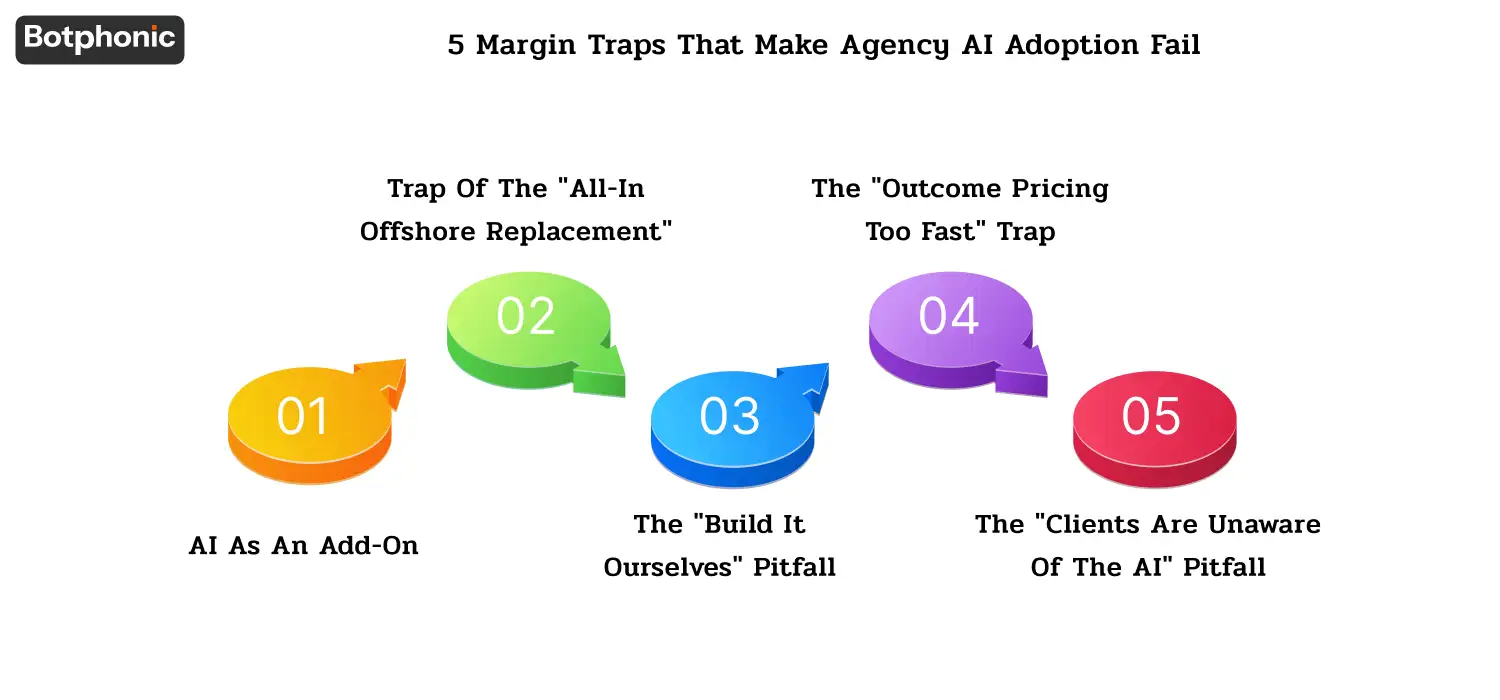
- AI as an add-on. Adding an AI line item in the cost stack and without taking anything away or repricing. It’s not about making the margins higher, it’s about making them lower.
- Trap of the “all-in offshore replacement”. Converting all calls to AI during week one. Clients start to notice the decrease in quality after 30-60 days. Margin is less expensive than trust.
- The “build it ourselves” pitfall. Allowing internal engineering builds to be “owned. The majority of agency teams underestimate the platform cost by 3-5X and the time by 2X. Agencies get licensing victories of >90%.
- The “outcome pricing too fast” trap. The per-meeting or per-SQL pricing model, before the quality of the AI is more stable, makes it hard to maintain stable margins, which in turn puts the agency’s cash flow at risk.
- The “clients are unaware of the AI” pitfall. Simulating calls as human when AI is responsible for the majority. The client discovers (escalated, tone changed, CRM artifact). Trust collapses. Retention dies.
What to Ask a Vendor Before You Sign (10 Agency-Specific Questions)
- Give me three agency customers in our service line and let me speak with them.
- At the volume of which you would be booking, what would your cost per meeting be?
- What is SSNR (meeting-show-rate) / SQL acceptance vs SDR baseline (human)?
- Does your platform support multi-client tenancy and data isolation?
- How deep is your CRM integration with Salesforce, HubSpot, Outreach, Salesloft, Apollo, and ZoomInfo?
- So, what’s your TCPA / DNC compliance posture for outbound on behalf of our clients?
- What is your pricing model? (Flat, Per Seats, Per Call, Per Outcome, etc.)
- How long does it take you to onboard and meet with your first customers?
- How long is your contract, what’s the exit, and the data portability?
- Demonstrate to me an actual recording of a call with a current agency customer that is comparable to what we do.
The Decision
Marketing agencies will be the contact centers of the future. Just as the economics of automation squeezed enterprise contact centers in the last decade, those same economics are now squeezing performance agencies, but faster.
Agentic AI is the strategy for business restructuring. Done properly, it gets an agency’s gross margin back to pre-2020 levels or even beyond, redefines the service stack based on things AI can’t do, and safeguards the agency from in-house builds by the client. Done poorly as an extra cost center, as a quality compromise, or as a black box kept away from the client it speeds up the journey to consolidation or closure.
If you would like us to run a 30-minute margin audit on your agency financials and estimate your cost per meeting, your AI-supported cost per meeting, and your gross margin recovery opportunity, schedule a meeting below. Bring your COO and your VP Sales along, we’ll bring our model.
Most agencies are shocked when they see the real math.
Try Botphonic