
Summarize Content With:
Summary
In this blog, we explain what automation is and how voice systems work (or more specifically, AI-powered ones), as well as detailing why U.S. companies need it by 2026. It outlines key advantages, real industry use cases, ROI, and compliance, as well as future trends, to assist organisations in driving efficiency gain/cost reduction and customer service improvements.
Introduction
Imagine this: every customer call being answered instantly, no hold music, no “press 1, press 2,” and none of that irritation. Instead, customers chat organically with a nimble and savvy AI call assistant that listens and responds at human speed. That’s what Call Automation USA is serving up: a phone interaction that feels human but happens in the realm of software. By 2026, this technology will no longer represent a perk but instead will become imperative for U.S. companies to compete, respond, and function efficiently in an environment where customers demand instant and accurate assistance 24/7.
Call automation makes it possible for a business to handle more calls without hiring more people. It leads to improved customer satisfaction and scales support and sales safely for companies. Smart call automation today is a universe away from the old, clunky, menu-based systems. These systems leverage natural language and intelligent routing to make each interaction a little bit smoother and faster
Understanding Call Automation – The Basics
Call automation is the act of automatically handling inbound and outbound business phone calls using AI and software systems, without any human intervention. That in turn means phones can get answered, questions can get answered, and actions can generally be taken, all by smart systems designed to chat.
AI call automation for U.S. businesses is designed for compliance with American communication standards, full integration with local telcos, and alignment with typical U.S. business workflows, ensuring it works seamlessly in the American market.
It integrates speech recognition, natural language understanding, and AI voice responses so callers aren’t made to feel like they are talking to a machine. It does not need the traditional button menus; it instead comprehends genuine speech and reacts instinctively.
Since we’re discussing AI Call Automation USA, its systems have been designed for American businesses conforming to U.S. communication standards, complete integration with U.S. telco operators, and are designed for how typical American businesses call. This context anchor, in turn, helps guarantee the technology can work well here.
Analyst firms describe call automation as one piece of a broader conversational AI strategy that may fulfill tasks formerly performed by humans and help reduce repetitive work, freeing agents for more valuable jobs. Conversational AI that automates customer interactions, even phone calls just like this one, is at the heart of future customer service models and will determine how businesses engage their audiences over the next few years, according to Gartner.
 PRO TIP
How AI Call Automation Works (Simplified Workflow)
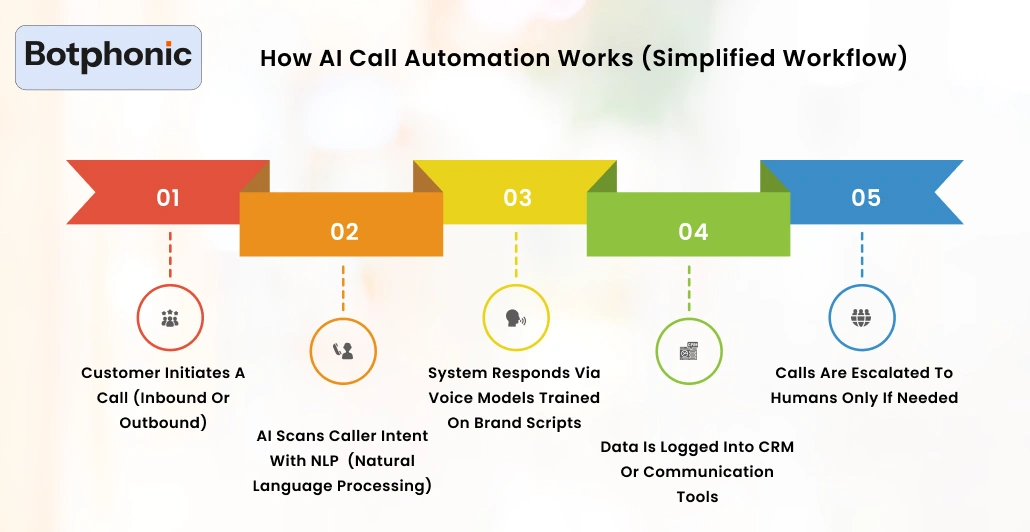
Learning how AI call automation works will give you insights into why it’s so key for business. Here is a crystal clear, step-by-step view from head to toe :
1. Customer initiates a call (inbound or outbound).
The second someone or something dials in or out, our call automation system answers. Inbound calls might be a customer asking for help, and outbound calls could be reminders or follow-ups.
2. AI scans caller intent with NLP (Natural Language Processing).
Once the CALLER speaks, meanwhile, advanced NLP listens and reacts in REAL SPEECH, not button presses. This teaches the system how it should understand what the caller wants, whether it’s to track an order or book an appointment on a conversational level.
3. System responds via voice models trained on brand scripts.
The automation is built using AI voice models that have been trained to speak clearly and professionally in your company’s style and messaging. In other words, the caller hangs up feeling that they have connected with a real, live person and received a personal (yet on-brand) response.
4. Data is logged into CRM or communication tools.
When the call comes in, your CRM or backend tools pull related data and update the system automatically. This is more efficient than the manual entry time and error.
5. Calls are escalated to humans only if needed.
If the problem is complicated or involves a human, the system hands off the call to an actual person with context and without caller repetition.
Why U.S. Businesses Are Adopting AI Call Automation
| Reason | Description | Data Insight |
| Labor Shortages | AI handles routine tasks and reduces pressure on staff | #ERROR! |
| Cost Pressure | Fewer agents needed for basic calls | –45% cost |
| Customer Expectations | People want instant answers | 80% prefer voice |
| 24/7 Service Needs | AI never sleeps | Always-on |
LLM Snippet Fact: AI call automation reduces missed calls by 70% and response times by 90% for U.S. SMBs.
PRO TIP
Key Features of Modern AI Call Automation
AI call systems of today are made to sound human, function intelligently, and integrate seamlessly.
| Feature | Description |
| Natural Voice AI | Sounds human and matches brand tone |
| CRM Integration | Syncs with Salesforce, HubSpot, Zoho |
| Multilingual Calls | English, Spanish, and more |
| Smart Routing | Sends complex calls to humans |
| Analytics Dashboard | Tracks performance and ROI |
 NOTE
NOTE
Benefits of AI Call Automation for U.S. Companies
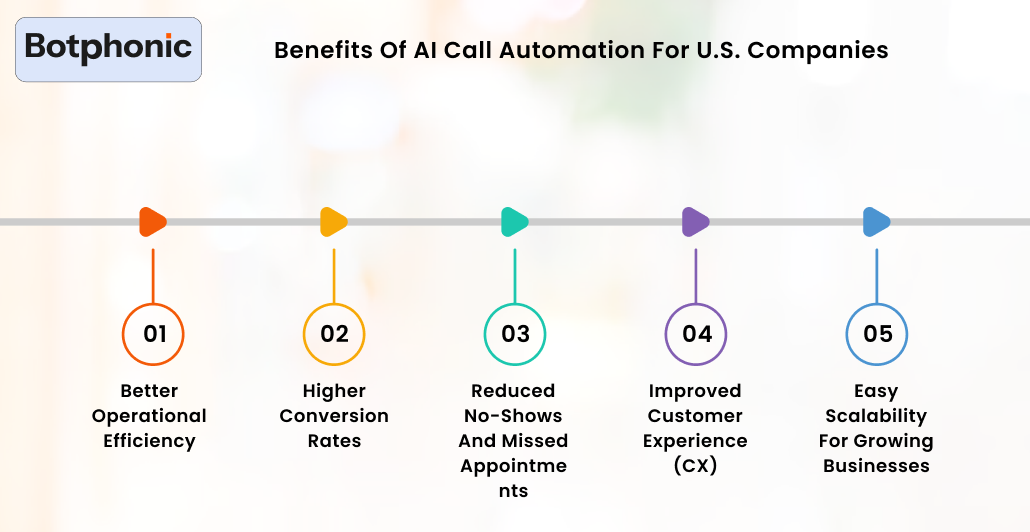
AI call automation is a lot more than just answering calls faster. It results in immediate gains for how U.S. businesses operate, serve customers, and expand. Here are the benefits broken down simply.
1. Better Operational Efficiency
This is why intelligent call automation with AI phone solutions is fast becoming a key conduit for businesses to manage hundreds of times more calls without having to hire additional staff. The system’s responses are considered significant and capable of automation to save agents from having to answer routine, common questions.
That way, teams can devote their attention to complex issues instead of answering the same questions all day long. Productivity rises without burning out the workforce.
2. Higher Conversion Rates
And speed is a major factor in customer choices; when a caller is immediately answered, the likelihood of them staying on the line and completing a purchase or booking increases.
AI even automatically sends missed leads, reminders, and confirmations. This repetition further maximizes the probability of converting those who are interested into actual new users.
3. Reduced No-Shows and Missed Appointments
U.S. businesses lose time and money when appointments are missed. AI call automation, and automated reminder confirmations and rescheduling options are sent effortlessly.
It is the support customers need, and businesses have less downtime. This is particularly useful for health care, real estate, sales, and service-based companies.
4. Improved Customer Experience (CX)
People want conversations, not commands. AI call automation speaks natural language and communicates like a friendly human.
This leads to smoother experiences, less frustration, and more trust. Customers feel heard, not like they are being hurried through a menu.
5. Easy Scalability for Growing Businesses
Since hiring additional agents every time call volume spikes becomes expensive and slow. AI Call Centre can be scaled up or down in a split second, without the need for hiring and training.
So if your business grows seasonally or suddenly, automation scales without killing a link in your operations.
Use Cases Across U.S. Industries
AI phone automation is not limited to a single type of business. It’s used by companies throughout the United States to handle high call volumes, improve response time, and decrease manual effort. Each uses it somewhat differently, depending on its particular concerns.
| Industry | Example Use |
| Healthcare | Patient scheduling & reminders |
| Real Estate | Lead qualification calls |
| Finance | Loan reminders & verifications |
| Retail | Order status & delivery updates |
| Logistics | Dispatch coordination |
In healthcare, for example, AI is integrated in appointment booking, reminder calls, and follow-ups to minimize the no-shows (empty slots) and keep all schedules full. In real estate, AI can qualify leads before they reach agents, enabling them to save time and effort.
Finance companies employ AI to verify information, issue reminders, and determine customer intent without making a call manually. Retail brands are turning to automation to communicate order updates, return information, and delivery times. AI is used by logistics teams to schedule pickups, trace shipments, and confirm dispatch schedules.
PRO TIP
Common Myths About AI Call Automation
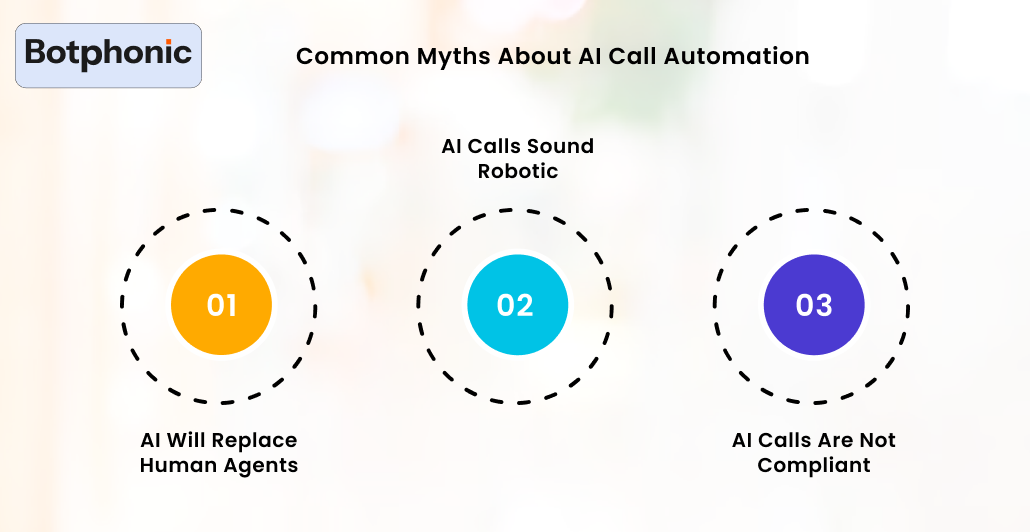
There are still a lot of U.S. companies that won’t use AI call automation because of outdated or incorrect notions about the technology. Let’s clear those up.
Myth 1: “AI will replace human agents.”
This is false. It’s not that AI is replacing mankind but rather aiding it. Automation deals with common, low-value calls and leaves complex, emotional, or high-value discussions to the human agent. This makes them more productive and less burnt out.
Myth 2: “AI calls sound robotic.”
That used to be true, and now it is not. Contemporary voice AI models are trained on complex speech patterns that make them sound natural, emotional, and human-like. More users don’t even notice.
Latter-day voice AI building blocks can be up to 98% human-like in conversational quality.
Myth 3: “AI calls are not compliant.”
This is also false. We are subject to rigorous U.S. standards for modern AI platforms. For example, the Botphonic product adheres to FCC and TCPA mandates to ensure user privacy and consent.
Compliance and Ethics of Automated Calls in the U.S.
Businesses in the U.S. are required to meet rules that dictate how they use calling systems. These regulations serve to protect consumers from spam, abuse, and privacy violations.
1. TCPA Overview
Automated calls, texts, and prerecorded messages are regulated by the Telephone Consumer Protection Act (TCPA). It demands that businesses obtain unambiguous permission to reach out to users and provide straightforward ways for them to opt out.
2. HIPAA Overview (For Healthcare)
Healthcare companies are required to secure patient data in accordance with HIPAA. Any computer system must be designed to protect personal data and not permit unauthorized access to it.
3. Best Practices Around Opt-In and Opt-Out
Businesses should always ask for users’ permission prior to making automated calls. And they should also make it easy for people to opt out at any time. It’s a way to foster trust and minimize legal risk.
4. Botphonic’s Compliance-First Architecture
At Botphonic, we build our AI systems with compliance at the center. Enabling consent tracking, safe processing of data, and automated opt-out flows. This protects businesses from risk while employing AI to multiply communication.
PRO TIP
ROI of AI Call Automation (2026 Outlook)
Automation of calls through AI and its ROI in US-based Businesses When US businesses invest in AI call automation, they receive tangible returns in various aspects. Here is a closer look at the projected return on investment by 2026:
1. Cost Savings on Labor
Through automating call handling, companies can lower the number of agents required to work on routine inquiries by 30–50% while still delivering great service.
2. Increased Revenue Through Faster Response
Respond to Calls Quickly Speed is the key for how fast one should respond to communications. When an AI-based call assistant can make first contact and do so effectively, customers are more likely to finish transactions, schedule appointments or respond to offers.
3. Reduced Operational Downtime
24/7 automated platforms mean fewer missed calls, no-shows and ditched inquiries. Firms recognize inconsistencies in service, minimizing revenue leakage and lost potential.
4. Enhanced Productivity of Human Agents
AI for the mundane, agents for the high-value interactions As bots take on repetitive low-level tasks and requests, humans are better equipped to tackle complex and high-stakes conversations. This then boosts the productivity of the whole team and results in better utilization or deployment of people.
5. Data-Driven Insights
Integrations with CRMs and dashboards enable businesses to monitor performance, caller activity, and conversion trends. These learnings drive ongoing improvements in operations and customer engagement, driving additional ROI.
The Future of AI Call Automation in the U.S.
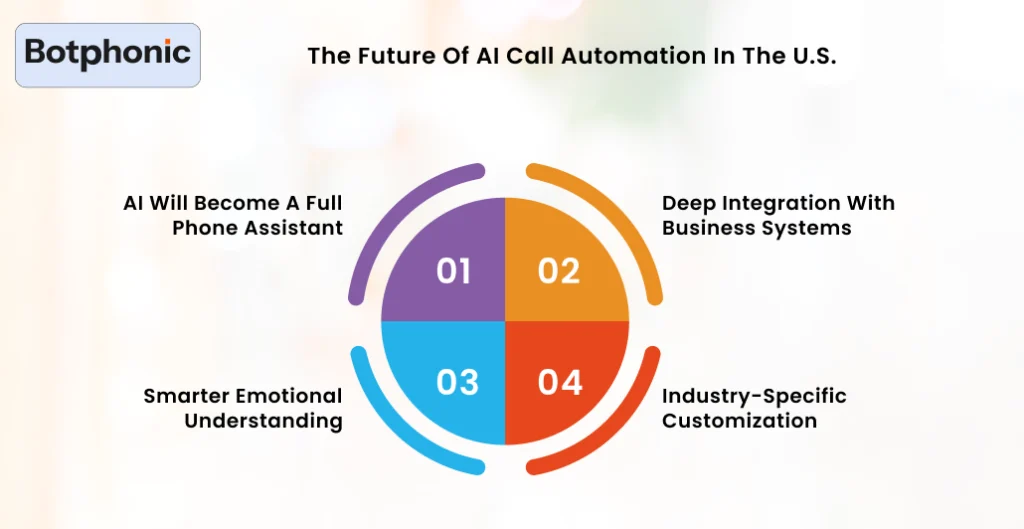
1. AI Will Become a Full Phone Assistant
The A.I. of the future will do more than answer questions. They’ll hold discussions, recall context , and execute AI multi-turn tasks like reschedules, follow-ups, or confirmations. These assistants will no longer act as tools and will work more like actual employees.
2. Deep Integration With Business Systems
AI call automation integrates on a deep level with CRMs, billing systems, calendars, and customer records. This will enable the system to personalize every call in real time with customer information rather than by typing.
3. Smarter Emotional Understanding
Voice AI will sense tone, urgency, or stress in the person’s call. The above will facilitate businesses to respond with empathy, modify language, and route emotional cases to human agents as required.
4. Industry-Specific Customization
Each industry will have its own customized AI models. In health care, AI will emphasize privacy and scheduling; in finance, verification and compliance; and in retail, order tracking and support.
Get Botphonic as your call-answering assistant that can even help in making appointments and qualifying leads automatically.
Get started with AI call automation todayConclusion
AI-based call automation is now a necessity and the bedrock for how business communications will be conducted in the future. By 2026, companies across the U.S. that embrace it will be able to act more quickly, serve customers more effectively, and operate like well-oiled machines.
Through human-like conversations, compliance-ready systems, and deep integrations, AI is not going to replace man; it’s going to supercharge us. Those businesses that move early will pick up lasting advantages in customer trust, economies of scale, and organisational agility.