Summarize Content With:
Quick Summary
Within this analysis, a sincere and detailed consideration of the five vendors currently deemed most worthy of attention will be provided. This evaluation will include a breakdown of their primary target audiences, projected pricing structures, and the specific areas where each platform is falling short of expectations. Furthermore, additional insights into the 2026 pricing landscape for AI call center software and the real-world performance metrics of customer service automation platforms will be incorporated to ensure a comprehensive overview.
Introduction
Interview a few operations managers managing call centers and you will hear the same thing.
- They did a vendor demo, all appeared well.
- The bot did the test calls flawlessly.
- Six months into the contract the containment rate was half of the amount asserted.
The team was still fighting with the implementation team of the vendor regarding a Salesforce connector, especially in cloud contact center as a service (CaaS) environments.
The difference between demo performance and production reality is precisely why the selection of a vendor in 2026 needs more than reading the tables with features comparisons. This is not a market where all the players are virtually identical. Architectural choices made five years ago dictate each platform’s current capabilities and limitations.
The market in itself is expanding so quickly that the stress to make a choice is tangible. According to Mordor Intelligence, the market of worldwide AI call center is projected to be 4.2 billion dollars in 2025, and it is set to reach 11.8 billion dollars in 2030. Gartner has estimated that the AI adoption will save 80 billion in labor costs in the call center by 2026. Such figures drag procurement decisions along. However, rushing and selecting the wrong platform is not as good as going slowly.
What Separates a Real AI Vendor from a Rebranded IVR
Architecture is the line of 2026. Some of the old suppliers simply repacked their interactive voice Response systems, plastered a natural language interface over the top and positioned it as conversational AI for business. The underlying principle remains identical to rule-based systems; the sole distinction is that the input is provided via speech rather than being entered through a keypad.
These platforms appear strong in demos but fail in production, especially when handling real-world omnichannel AI routing integration scenarios.
The Difference Comes Down to Architecture
| Legacy IVR (Rebranded) | True AI Platform |
| Rule-based flows | Conversational intelligence |
| Breaks on edge cases | Handles unscripted intent |
| Script-dependent | Context-aware |
| Weak escalation | Seamless human handoff |
Conversational AI-native platforms, or those redesigned to support it, were the only ones worth considering.
The tells include:
- How the system responds to unscripted intent (system failure or does it loop?),
- How well the system passes context to a human agent,
- If the AI capabilities of AI call assistant native or are they a license and glued on by a third party.
 NOTE
NOTE
The Five Vendors Worth Your Time
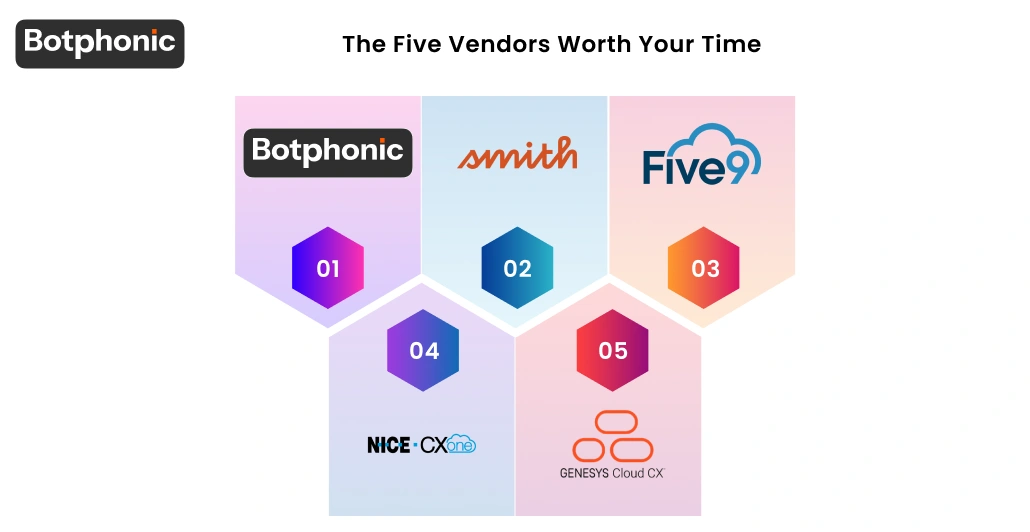
1. Botphonic AI
Best Overall: Most suitable with SMBs and mid-market teams that require rapid installation within modern customer service automation platforms.
Salient Features:
- Speed and architectural honesty is the bone case of Botphonic.
- It was built as an AI-first voice platform, which implies no underlying IVR layer.
- The same intelligence layer is used to handle inbound calls.
- Makes appointments, answers frequently asked questions, and escalation logic.
For businesses employing between five and two hundred agents, deployment is measured in days rather than weeks. Because CRM integrations for HubSpot and Salesforce are native rather than middleware-based, the technical overhead is minimal. Furthermore, the usage-based pricing model—featuring a low base rate—ensures that growing teams avoid heavy seat commitments before their actual usage patterns are fully understood.
Drawbacks:
- Early-stage compliance
Verdict: The most obvious AI receptionist option in the teams that are too poor to roll out over a six month period. The design is good and the plainness is an actual attribute, as opposed to a pretense of it.
2. Smith.ai
Hybrid Model: Best when legal, medical and service companies require reliability alongside conversational AI for business.
Smith.human intelligence is in a certain and justified niche: human receptionists with the help of AI, rather than the AI itself. The site operates an artificial intelligence layer of first contact, overload, and after-hours, although there is a human agent at any rate where judgement is necessary. In law firms and medical practices, where a case of an inadequately handled intake conversation has professional impact, the model will be reasonable, unlike pure-AI alternatives, in that respect.
Strengths
- Human fallback where judgment matters
- Strong context transfer during escalation
- Reliable quality floor
The price indicates the model – plans begin at approximately $285/month and increase with the number of calls. You are paying higher per interaction than pure-AI options, however, you are also purchasing a quality floor which pure AI cannot consistently offer in 2026. The volume limits and per-call rates may shock any team that grows at a rapid pace, thus, math must be modeled early.
Limitations:
- Higher cost per interaction
- Volume scaling gets expensive fast
Verdict: It is not the most affordable in the set, but in any company, where a mismanaged call poses professional, legal, and medical liability, it is the most justifiable option in this comparison.
3. Five9
Sales & Outbound: Best for outbound sales teams with 50+ agents operating within cloud contact center as a service (CCaaS) frameworks.
The dialer technology is evidence of that head start because Five9 has been cloud-native since that is a selling point. Predictive, progressive and power dialing modes are very real mature features and are not on the list to tick a box. Outbound-heavy operations sales teams have campaigns, collections, appointment reminders – the fundamental platform gets the job done.
Strengths:
- Mature dialer tech (predictive, progressive, power)
- Built for high-volume outbound
- Includes 3,000 AI minutes/seat
In comparison with Nextiva, the 2026 version of Nextiva points out that Five9 has 3,000 AI minutes per seat per month, included by all the plan options, which is a great addition to the Core price of 159/seat.
Limitations
- 50-seat minimum
- Named-user pricing (pay even when idle)
- Reported stability issues
The problems of stability and what they refer to as frequent outages are also frequently noted by users on G2 and Gartner Peer Insights. It disqualifies most operations, but is worth pressure-testing in reference calls.
Verdict: Outbound dialer with the strongest force in this contest. The 50-seat floor is an actual limitation, and the stability issues should be investigated honestly before decision-making, however, in the high sales volume cases, core is worth the price.
4. NICE CXone
Enterprise WFM: Best for regulated industries requiring compliance-certified AI call centers and strong governance.
NICE CXone’s Enlighten AI is the only platform where the scale of 100% of call interactions is automatically scored, not a fractional percentage as is the case with other platforms in this comparison.
Strengths:
- 100% interaction QA scoring
- Deep workforce management (WFM)
- Strong compliance tooling
Limitations
- Complex interface
- Steep learning curve
- AI features often cost extra
In the case of contact centers that have staffing requirements that are shift-based and regulatory reporting, such depth is hard to achieve with a collection of tools that can be stitched together.
Verdict: The right option to regulated industries of 100 or more agents and having a real compliance reporting requirement. Beyond that particular scenario, you will be paying a price in depth that you will not exhaust.
5. Genesys Cloud CX
Complex Enterprise: Best for global enterprises requiring omnichannel AI routing integration and hybrid infrastructure.
Strengths:
- Handles hybrid infrastructure
- Advanced routing logic
- Scales across regions and channels
Genesys has a 4.6-star rating on Gartner Peer Insights based on 911 reviews that have been verified, whereas Five9 has a 4.5-star rating based on 800 verified reviews. The most enthusiastic of the reviewers of it are habitually describing an environment that has genuinely strange requirements.
Weaknesses:
- Requires serious planning/governance
- Historical reporting gaps
- High implementation overhead
The complaining ones tend to be those companies that purchased the power of the platform and failed to develop the governance framework that the platform requires to operate.
Verdict: No other competitor manages the real complexity of an enterprise so well. But, power and rightfulness to us are not the same. Unless you have a complicated routing or infrastructure issue, then the depth of this platform is against you.
The Real Wording of the Benchmarks
Some translation should be done on the numbers that are mostly repeated in the AI call center vendor material and often used in AI contact center ROI calculator projections.
A 80 percent rate of deflection is transformational until you realize that it is usually due to an e-commerce implementation that has a small and tightly focused intent library.
The Alhena AI study estimates advanced implementations to be 80-90 percent deflection though the average of the actual enterprise across the fields is 40-70%. That is still a substantial cut in the volume that a human being is dealing with, but it is worth establishing the right expectations before entering a board presentation.
The numbers of average handling time reduction are also variable. Industry research from Desk365 and Dialzara highlights 2025 case studies showing a 45% reduction in AHT
The more controlled trial evidence of McKinsey indicates an improvement of 9% that is real, but not the headline version. The variation normally boils down to what is classified under handling time. In case post-call work (CRM updates, summaries, making follow-up tasks) is incorporated, AI is a game changer. In the case of the measure being talk time only, the benefits are less dramatic.
Three-six months ROI plans are not automatic but possible. Pylon’s analysis of B2B SaaS companies using AI-first support reveals that businesses can achieve a three-month payback by implementing a plan rather than a simple plug-in, while also prioritizing integration and agent training for seamless escalations.
It can be both the case that a 45% reduction in handling time and 9% reduction in handling time are true. It all is a matter of what you are doing, and what you began with.
Learn more: Best AI Call Center Automation Software in 2026
The Honest Pros and Cons
What Works in 2026
The most useful question isn’t which vendor you should choose, but which one has architected its platform specifically for the problem you want to solve. A 20-30 person legal practice, neither should be evaluating the same problem. For teams under 50 seats that
- 24/7 inbound coverage: Answers each client with zero staffing overhead, the economics of the unit are truly strong at scale.
- Post-call automation: All mature platforms are dependable in updating, summarizing, and following up tasks in CRM.
- Consistency: AI agents do not have bad days and average performance is not as important as the floor.
- Peak volume absorption: No call volume ramp-up cost or call volume training required when the call volume peaks.
- Live agent coaching: Allows agent transcription in real-time – coaching and in real time significantly shortens the time of a new agent ramp.
These are now standard capabilities across advanced AI contact center solutions. In 2025, National Association of State Chief Information Officers (NASCIO) Annual conference, Mississippi CIO Craig Orgeron stated how AI is evolving the workforce and not actually in a negative way.
What Still Fails
- Poor emotional sensitivity: Frustrated callers tend to receive inferior AI experiences than they would receive with an actual human.
- Lapses in accent:Companies often underreport dialect processing issues, which directly impact equity for callers.
- Complexity in integration: Enterprises continue to underestimate integration complexity, as 47% of them cite it as their major challenge.
- Containment rate: Vendor containment rate claims are often best-case numbers of narrow-intended deployments.
- Hidden costs in AI call center software pricing: Set-up charges, connector license, AI compute overcharges routinely increase reported per-seat prices.
What You’ll Actually Pay
AI call center software pricing might include base pricing plus hidden costs like API usage, integrations, and sometimes reliance on open-source AI call center APIs.
| Vendor | Model | Initial price | Minimum seats per seat | Key hidden cost |
| Botphonic AI | Usage-based + base | ~$50-200/mo | None | Scale API usage |
| Smith.ai | Per call / per minute | ~$285/mo (Starter) | None | Volume limit overages |
| Five9 | Named-user seat | $159/seat (Core) | 50 seats | AI compute overages above 3,000 min/seat |
| NICE CXone | Named-user seat (tiered) | ~$110/seat (Core) | 100 seats | at upper levels only Enlighten AI capabilities |
| Genesys Cloud CX | Named-user seat (tiered) | ~$115/seat (CX 2) | ~100 seats | Professional services architecture and migration |
One factor that any buyer must be able to model on his own: the difference in named-user versus concurrent-user licensing. Five9, NICE, and Genesys all use a named-user model, charging you per seat regardless of simultaneous agent activity.
In call centers using a mix of smaller, shorter shifts where there is a high concentration of contact centers, concurrent licensing (where you only pay when connections are at their peak) can be much less expensive. One might question all enterprise vendors directly on the subject of concurrent options.
The other standard surprise is setup fees. All three comparison enterprise platforms charge professional service and/or onboarding- the figures being between $5,000 in the low-end and 50,000 or above in complex migrations. These expenses do not reflect in the per-seat figures and they do not normally emerge until late in the sales process. Construct them into your initial year-one TCO, which you discussed.
 PRO TIP
How to Actually Pick One
The frame that is most helpful is not the one that questions the vendor with most features. It is “which vendor was designed for my real problem.
A legal practice of 20 people struggling with missed calls requires something radically different than a 500-agent financial services contact center facing regulatory reporting issues. Although both need AI, neither should judge the same platforms by the same criteria.
Simple Decision Framework
| Scenario | Best Fit |
| <50 agents, fast deployment | Botphonic AI / Smith.ai |
| High-stakes calls | Smith.ai |
| Outbound-heavy (50+) | Five9 |
| Compliance-heavy enterprise | NICE CXone |
| Complex global operations | Genesys |
All these vendors are not flawless. They all have customer reviews relating the difference between what they had shown and what they had provided. The organizations that bridge that gap are the ones that set clear success metrics prior to signing, requested reference customers in their particular vertical, and considered implementation a product project not an IT one.
Before you commit get a free trial with Botphonic
Schedule a demoConclusion
The choice of an AI call center vendor in 2026 is no longer based on how impressive the demo is or how long the feature list is, but how well it maps to your actual needs. The disconnect between sales hype and actual usability in production is quite large, and this is where most people go wrong: they ignore this fact.
The right vendor for you will depend entirely on your needs. For small teams, speed and simplicity are key, while for critical applications, human fallbacks and reliability are more important. For large enterprises, it’s all about the depth in compliance, scalability, and control. There’s no such thing as the ‘best’ platform out there, just one that’s best for your particular needs. And to know about it actually you should go through AI call center free trial that many organizations do offer and give you idea of how they perform.
The key to success is execution, and this means that defining success metrics, validating vendor claims, and considering total cost, including pricing, will determine whether you achieve ROI or not. The fact is, AI in call centers is inevitable, but success is not. The choice is in being wise in our choice and executing with purpose.