
Summarize Content With:
An AI call center is type of contact center where conversational AI voice is responsible for handling inbound and outbound calls. It also helps with automating billing inquiries, appointment scheduling, order status checks, and also leads qualification. The system actively operates by routing complex or sensitive interactions to human agents with full context already transferred. Below we have added five real production deployments, what they do well, what they cost in practice, and a practical decision framework that helps you choose between them.
Key Takeaways
- The greatest ROI is achieved with AI call centers scoped to high-volume, low-ambiguity work: billing, scheduling, order status, lead qualification.
- Enterprise solutions (Amazon connect, Google CCAI, Genesys, Salesforce) and lean solutions ( Botphonic) have very different applications.
- Practical deployments demonstrate 20-40% AHT, 60-83% first contact resolution and costs of 0.05-0.15 per call compared to 1-3 of human agents.
- The most effective model is always hybrid: AI is used to predict the predictable; human against the complex.
Rule-based IVR vs. True AI: What Are You Actually Buying
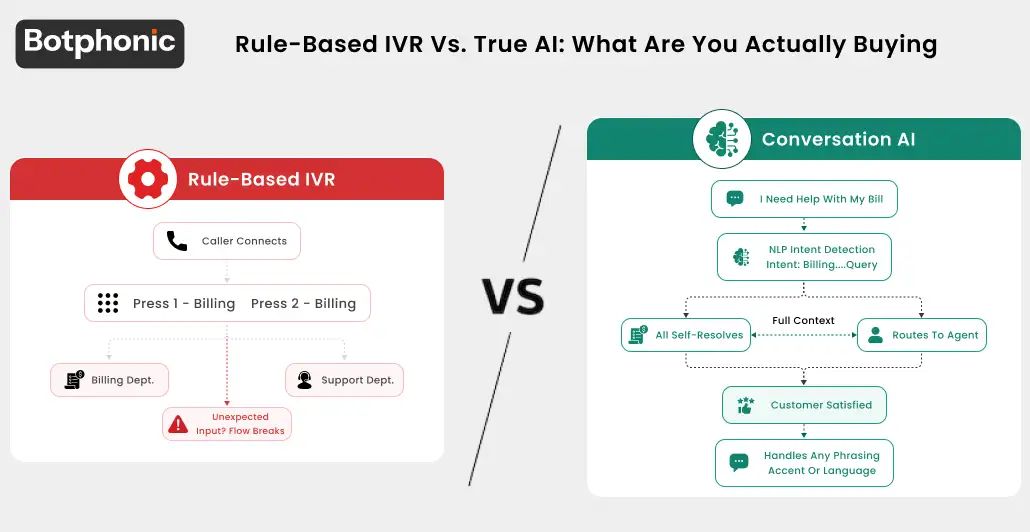
It is essential to know the type of AI that you are dealing with before making any decision regarding the adoption of a specific platform. Despite the similarity in demos offered by vendors, there is a vast difference in how these technologies are built under the hood.
Key question to pose to each vendor
Rule-based IVR follows a very strict structure: press one to speak to billing, press two to speak to support. It does not tolerate any deviation and breaks down on encountering something other than an option in its menu. On the contrary, true conversational AI employs NLP and, recently, LLMs to understand the user’s intent from the voice, handle any digression, maintain context during conversations, and provide customized response. Typically, modern-day enterprise solutions combine the best of both worlds: AI handles the detection of the intent and routing, while the logic of communication follows a scripted procedure where necessary.
What Are AI Call Center Examples (And Why They Matter in 2026)
The transition of AI call centers is to operational backbone more quickly than nearly any other enterprise technology. What was initially a simple IVR automation has now turned into an all-out voice AI that can interpret intent, maintain the context of a conversation, and solve customer problems, without the involvement of a human agent.
But the scope of AI call center is broad. An AI call center is technically a startup that uses an AI call assistant to receive after-hours appointment calls. Yes is a global logistics firm operating Amazon Connect on 50 000 daily interactions. There is a significant difference between the use cases, deployment models and ROI timelines.
This guide decomposes seven actual AI call center applications, both lean applications to support small and growing businesses and large-scale enterprise contact center solutions, to understand the specifics of how AI is being implemented into practice, what outcomes real organizations are achieving, and where the technology is actually paying off.
How AI Call Centers Fit Into Traditional Operations
Prior to the examples: AI functions optimally in the context of structure. At the call centers that are well managed, the escalation routes and scripts along with the quality control and key performance indicators are already set. AI applies such structures in a way that humans are unable to do on large-scale.
Organizations that are benefiting most with AI do not consider it as a last-mile operator but a starting point. Monotony of repetitive requests is dealt with independently. Complex, emotional or high value interactions are routed to experienced agents, where context is already represented by AI, so the agent does not have to work with a blank slate.
This combined design lessens burnout, decreases the cost per touch, and maintains the institutional knowledge that is lost with solely automated systems.
Where AI Call Centers Deliver the Highest ROI
Not all calls are equal. AI provides the quickest ROI on uniform, minimal uncertainty interactions:
- Billing questions and payments.
- Scheduling and reminders of appointments.
- Status of order and delivery information.
- Account verification and password reset.
- Lead qualification and outbound follow-up.
Companies that pursue AI to find edge cases, complicated complaints, delicate negotiations, and emotionally distraught callers, falter. Predictable automation of organizations result in 60%+ cost savings on regular call volumes in 90 days.
AI Voice Agents vs. Human Agents: A Practical Divide
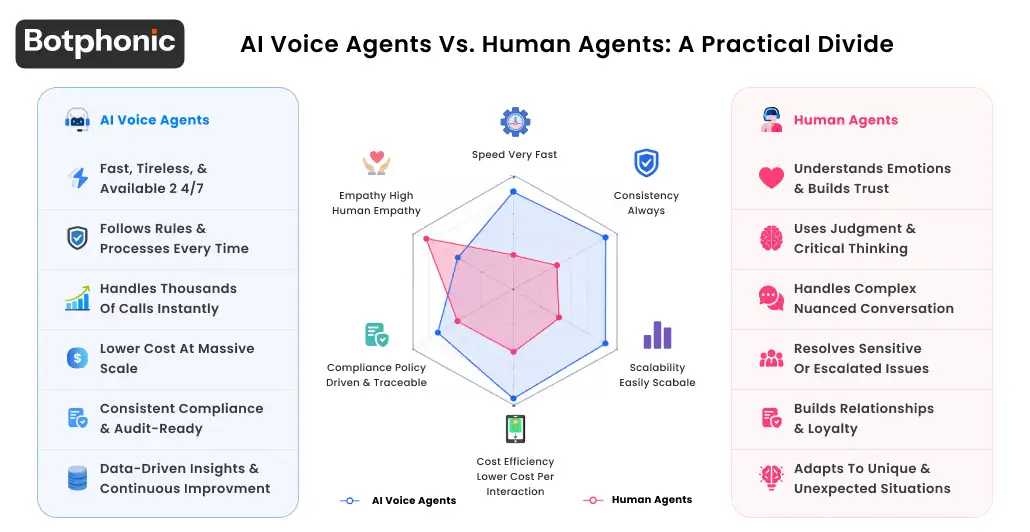
| Aspect | AI Voice Agents | Human Agents |
| Core Strength | Speed, consistency, and automation | Empathy, judgment, and problem-solving |
| Best Use Cases | Billing, scheduling, order status, reminders, lead qualification | Escalations, complaints, negotiations, complex support |
| Availability | 24/7 with zero downtime | Limited by shifts and staffing |
| Cost Structure | $0.05–$0.15 per call | $1–$3 per call (fully loaded) |
| Accuracy | Script-perfect, no deviation | Flexible but variable |
| Scalability | Instantly scalable | Slow and expensive to scale |
| Emotional Intelligence | Limited conversational empathy | High emotional intelligence |
| Compliance Consistency | Enforced scripts and policies | Subject to human error |
| Ideal Role | First-line automation | Final authority in resolution |
Delegation, and not replacement, is the winning formula. AI is concerned with the quantity; humans with the opinion.
5 Real AI Call Center Examples in Production
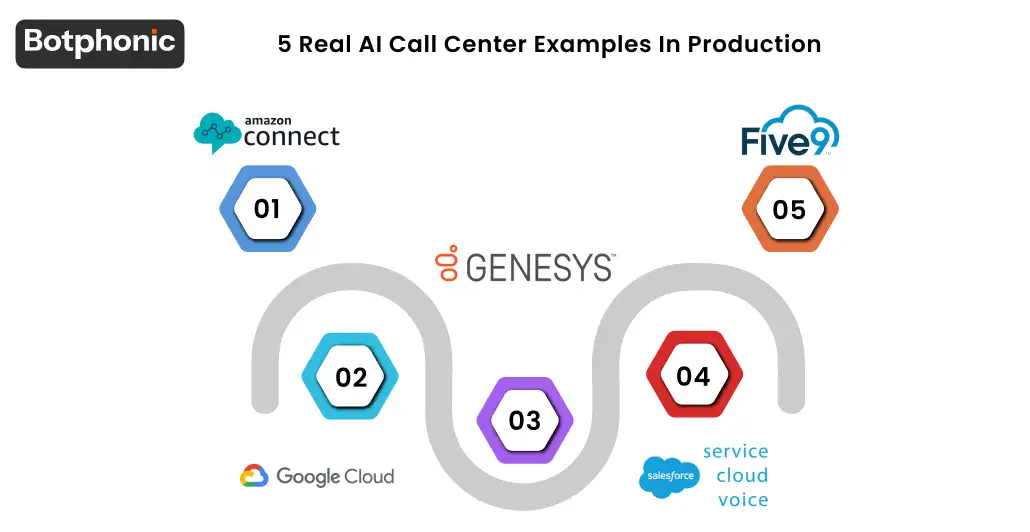
5 real-world AI call center examples: at a glance
| Platform | Best for | Standout feature | Starting model |
| Amazon Connect | E-commerce, logistics, telecom | Deep AWS integration, real-time sentiment | Pay-per-minute usage |
| Google CCAI | Utilities, telecom, public services | Best-in-class NLP, accent & language handling | Enterprise contract |
| Genesys Cloud CX | Banking, insurance, healthcare | Compliance-first AI routing | Per-seat SaaS |
| Salesforce Service Cloud Voice | CRM-heavy orgs on Salesforce | Calls become structured CRM data automatically | Salesforce license add-on |
| Five9 | High-volume outbound sales & collections | Predictive dialing + AI workflow automation | Per-seat SaaS |
1. Amazon Connect: AI at Industrial Scale
Best for: Businesses with high volume which consider customer service to be logistics – e-commerce, telecommunications, financial services.
Amazon Connect is a combination of IVR and speech analytics powered by AI, real-time sentiment detection and intelligent call routing. Practically, it automates the process of answering routine questions (order tracking, refunds, delivery updates) and directs more complex or high-value calls to human representatives with the entire conversation history.
Its real-time analytics identify caller frustration at an early stage, allowing supervisors to intervene before issues escalate. The system also helps streamline Amazon listing services, ensuring consistent and efficient management across large-scale operations.
What makes it work: Discipline. Amazon Connect does not attempt to mimic human judgment, it imposes machine precision in following pre-determined processes. Those organizations using it effectively have already mapped their call flows, escalation paths and QA criteria prior to implementation.
2. Google Contact Center AI: Language Intelligence at Scale
Best for: Utilities, telecom, and public services – industries in which callers describe issues in unpredictable terms.
The benefit of Google Contact Center AI is that it has the natural language understanding that you would expect the company that created Search to have. The platform knows what the callers want to say, and it is not only the keywords typed. It preserves conversation context over turns, minimizes misrouting and manages accents, pauses, and background noise with high accuracy.
Instead of substituting the human judgment, Google CCAI maintains the conversation, minimizes the number of misunderstandings and decreases the number of escalations, leaving agents with the calls that actually demand human attention.
What makes it work: Google is a company whose main competency is language. In businesses that have a wide, unpredictable set of callers, Google CCAI scores significantly higher than rules-based IVR in intent recognition.
Case Study: TELUS Communications
Telecommunications One of the largest telecommunication companies in Canada, TELUS used Google CCAI to manage the large number of natural-language support calls that the company receives each day (17 million customers). Misrouting on inbound support calls was minimized by the system with self-service deflection rates increasing more than 30 percent on the eligible call types. Human agents indicated that they handled calls faster since the AI had already determined the intent and presented the account context of the call before it was handed over.
Source: Google Cloud customer stories.
3. Genesys Cloud CX: AI That Respects Compliance
Best for: You need AI efficiency without regulatory risk: Regulated industries such as banks, insurers, healthcare providers.
Genesys Cloud CX anticipates intent and coordinates customer experiences in voice and chat and online. It constantly tracks interactions to identify compliance risk, identifies potential concerns in real time, and forwards more complicated situations to trained operators with all context intact.
AI works silently: it assists routing choices, uncovers insights, keeps audit logs — but ultimate control remains in human hands. This is the only possible deployment model to comply-heavy industries.
What makes it work: Genesys is aware of institutional reality. It does not dictate human judgment in controlled interactions; the humans involved in such interactions are better informed and there are cleaner audit trails.
Case Study: TD Bank
TD Bank has implemented Genesys Cloud CX to enhance the accuracy of routing and compliance consistency in its contact center activities throughout North America. The AI routing layer minimized the number of misrouted calls by sending customers to the appropriate specialist tier on the first call, which led to a 25% increase in first contact resolution (FCR) of complex banking questions. Compliance scripting – such as necessary disclosures on all qualifying types of calls – had virtually no exceptions in post-call audit reviews.
Source: Genesys customer stories.
4. Salesforce Service Cloud Voice: Turning Calls Into Structured Data
Best for: Organizations using Salesforce CRM as their standard have a record of wanting AI to remove the disconnect between what occurs during calls and what is logged.
Service Cloud Voice is an AI solution that is built into CRM. All the calls are automatically transcribed and summarized. Records of customers are updated in real time. AI displays next-best-action suggestions in calls – it suggests, but does not override, agent discretion. No manual reporting; managers have full visibility.
What makes it work: Salesforce has an ethos of documenting everything — the philosophy of the company is that nothing exists unless it is documented and implemented on a large scale. AI gets rid of the discrepancy between what agents say on calls and what is keyed in on the CRM.
Findings that are usually mentioned: Significant decrease in after-call work (ACW); increased visibility of managers without increasing the number of QA staff.
Case Study: Prada Group
Prada Group implemented Salesforce Service Cloud in its luxury brand business to integrate customer service data and CRM and e-commerce activity. The transcription and summarization were aided by AI, cutting after-call work (ACW) by about 70 percent, allowing more calls to be handled without correspondingly raising headcount. Service managers were able to have a real-time view of the results of calls without having to hire more QA review staff.
5. Five9: Predictive Dialing Meets AI Automation
Best for: Sales and collections teams that have a high volume of outbound sales and collections, and require maximum agent talk time on live connections.
Five9 integrates predictive dialing, which is an AI-driven technology that time outbound calls based on the time of day to connect to an agent to live answer, rather than voicemail, with post-call workflow automation. AI takes care of the mechanics of outbound volume; agents concentrate all their attention on conversations.
What makes it work: In case of high volume outbound operations, the cost of agent idle time (waiting to make a connection) is enormous. Five9 AI does not add such dead time, but it retains humans in charge of the real conversations.
 NOTE
NOTE
Where Botphonic fits: practical AI call center automation for lean teams
Best for: Startups, service business and mid-market companies that require fast deployment, quantifiable ROI, and true automation – without enterprise complexity and cost.
The AI voice agents of Botphonic deal with inbound and outbound calls independently: scheduling appointments, screening leads, sending reminders, following up with the customer, and answering customer questions. They are 24/7, scale on demand, and connect with CRMs, EHR systems, and telephony stacks without the need to have a dedicated implementation team.
In contrast to enterprise platforms which can take months to configure, Botphonic can be deployed within days or weeks. This is the viable entry point into AI call center automation to businesses that are losing money to missed calls, after-hours calls, or the understaffed
reception desk.
- Healthcare: A local clinic automated booking of appointment and prescription refill calls. Hold time decreased to less than 2 minutes, previously it was 15+ minutes. Front-desk employees were no longer involved in phone management, but patient-facing care.
- Financial services: A financial advisory firm used Botphonic to process the volume of inbound inquiries at scale to enable the licensed advisors to concentrate on complex client discussions, instead of routine account inquiries.
- Real estate: A property management company automated calls to inquire about the property and to screen callers by location, budget and schedule showings 24/7 without hiring additional staff.
- Digital marketing: An agency took the place of manual outbound follow-up with multilingual AI voice agents, which enhanced lead conversion throughput by qualification and routing prospects more quickly than before the human-only process.
Examples of AI Call Center by Industry
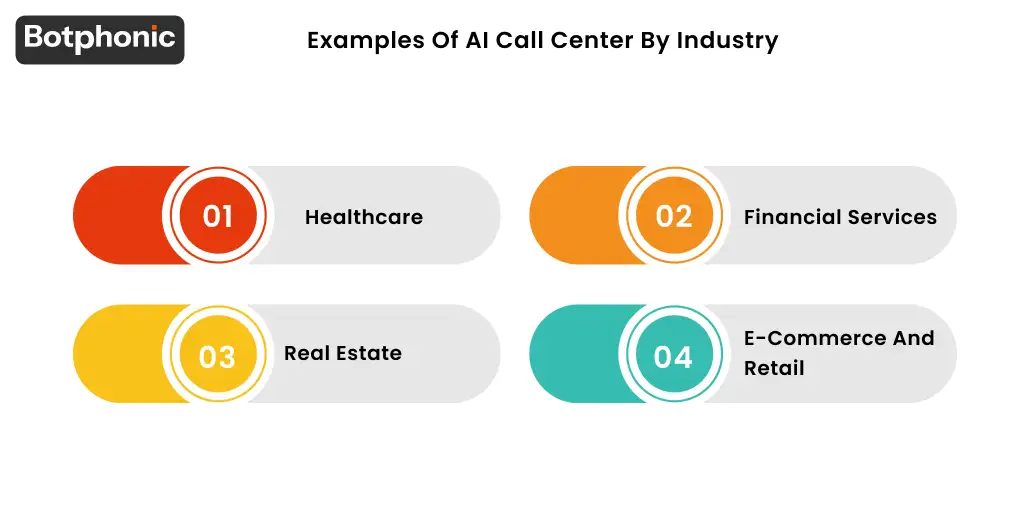
Outside of platform cases, certain industries have some of the most educative AI call center examples. This is how AI is being implemented in four verticals:
- Healthcare
The implementation of AI voice agents in regional clinics and hospital systems is used to schedule appointments, request prescription refills, post-visit follow-ups, and verify insurance. AI handles the volume of calls at the front-desk during the high-traffic time and HIPAA-consistent recording and data processing standards safeguard patient records. The Botphonic healthcare implementation above decreased hold times of 15+ minutes to less than 2 minutes in routine scheduling calls. See how Botphonic works for healthcare.
- Financial services
Account balance, fraud alert follow-up, loan status, and outbound payment reminders are some of the applications of AI by banks and credit unions. Compliance scripting is automatic – all required disclosure is made each and every qualifying call. Both Genesys Cloud CX and Botphonic are operating within this vertical. See Botphonic for financial services.
- Real estate
AI is applied by property management companies and real estate agencies to process inbound inquiry calls, filter leads by location, budget, and timeline, and book showings 24/7. A virtual agent based on AI is able to handle dozens of parallel showings requests on a busy weekend – something that human reception cannot achieve. See Botphonic for real estate.
- E-commerce and retail
Online retailers use AI to scale order status, returns, and product queries, especially during peak times when human call center capacity is too slow to scale effectively. The self-service diversion of regular order requests liberates human agents to upsell and intricate complaints.
AI Contact Center Examples: Enterprise vs. SMB Deployment Patterns
The term call center and contact center are often interchanged, whereas enterprise searchers generally differentiate them:
- Call center: Voice-only or voice-primary. Volume phone interactions (inbound/outbound).
- Contact center: Omnichannel. Chat, voice and email, and messaging all in one platform.
Examples of AI contact centers at enterprise scale Genesys Cloud CX, Salesforce Service Cloud Voice, and Google CCAI are the most popular platforms all of which are designed to support organizations that handle customer interactions across multiple channels at once.
In the case of voice-based automation of AI call centers, which is the most applicable to the case of SMBs, service businesses, and the mid-market companies, purpose-built solutions, such as Botphonic, tend to be deployed much faster, at a fraction of the cost, and with a verifiable ROI in 60-90 days.
AI Call Center Use Cases by Function
Beyond the platform examples, it’s useful to see AI call centers organized by the specific function they automate:
| Use Case | What AI Does | Typical ROI Impact |
| Inbound call handling | Answers, qualifies, routes, or resolves without human | 40–70% reduction in routine call handling cost |
| Appointment scheduling | Checks availability, books, confirms, sends reminders | 2–3x capacity vs. manual booking |
| Lead qualification | Asks qualification questions, scores leads, routes hot leads | 30–50% improvement in qualified lead throughput |
| Outbound reminders | Automated calls for appointments, payments, renewals | 20–40% reduction in no-shows |
| After-hours coverage | 24/7 availability without night-shift staffing | Captures 100% of after-hours inquiries |
| Compliance scripting | Delivers required disclosures on every call | Near-zero compliance exceptions |
| Post-call summarization | Transcribes and summarizes calls for CRM | 70–90% reduction in after-call work |
 PRO TIP
AI Call Center Metrics That Actually Matter
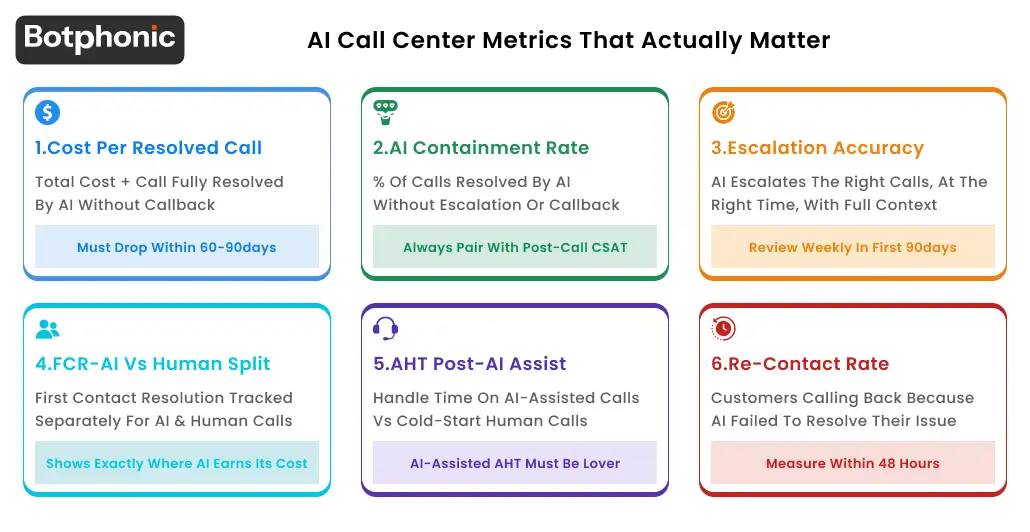
When a metric is not producing visible cost changes or quality, it is ornamental. The following are the KPIs that will give real AI call center ROI:
1. Cost Per Resolved Call (CPRC): The definitive measure of AI performance. Unless CPRC is dropping within 6090 days, it is not the technology that is wrong but the deployment itself.
2. AI Containment Rate (with quality threshold): The percentage of calls that AI resolves and does not escalate or contact customer again, or frustrates customer. Low CSAT and high containment is brand damage at a slow pace.
3. Escalation Accuracy Rate: Does AI escalate hand calls to agents to the right reasons, at the right time, with the right context? Premature build-up = squandered AI expenditure. Last-minute rush = angry customers. This measure is at the cross road of the two.
4. First Contact Resolution (FCR): AI vs. Human Split Track FCR between AI-handled and human-handled calls. This comparison shows where AI is winning its bill and where it must move out of the way.
5. Average Handle Time (AHT) Post AI assist: The idea is not having fewer calls but less time per human interaction. The intent-gathering information that AHT has found post-AI should reduce intentionally vs cold-start human calls.
6. Re-Contact Rate: In case customers are forced to make a call back due to the failure of AI to solve their problem, containment rate is a lie. The integrity test of containment is the re-contact rate.
7. Customer satisfaction score (CSAT): If AI CSAT scores are more than 0.5 points below human CSAT, the AI scripting or escalation logic needs work before containment is expanded.
The 6 Most Effective Strategies To Implement An AI Call Center
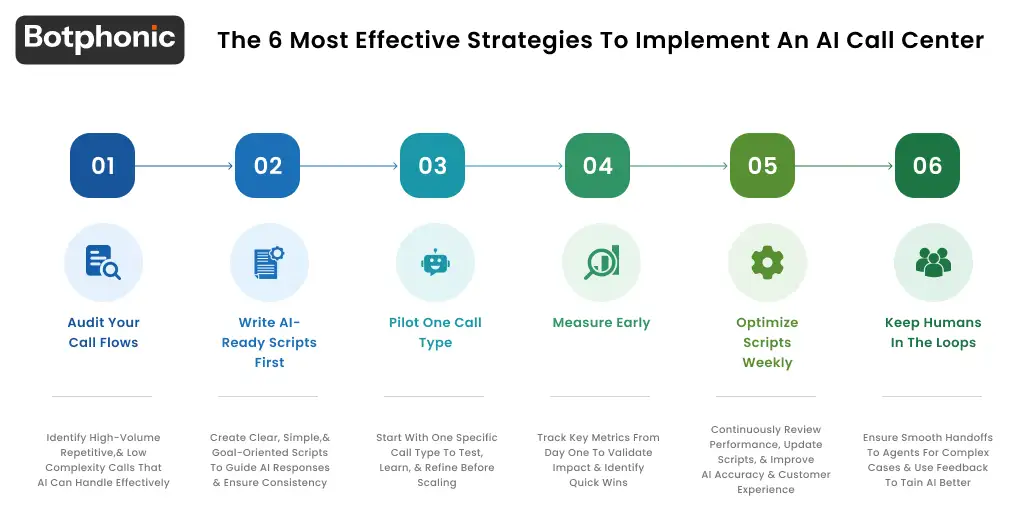
1. Test your call flows first, then configure. Determine the top 3-5 volume/lowest ambiguity types of calls. These are your men-in-the-air. And avoid beginning with edge cases or emotionally charged types of call – start with order status, scheduling or billing.
2. Prewrite scripts and escalation policies. AI do as it is said. In, in, out, out. All escalation routes, all disclosures need, all back-up actions must be describe in a document prior to it being an actual configuration.
3.Pilot only one department at a time. Automate not everything at once. Begin with booking appointments or order status. Measure CPRC rate and containment rate at week two and four and then expand.
4. Measure CPRC and rate of containment on day one. Aim at 90 days benchmark target prior to launch. When CPRC is not declining in week eight, explore configuration – do not extend deployment.
5. Script optimization every week in the first 90 days. The distinction between a good and a great AI call center nearly always lies in the tuning window. Read through all the transcripts of the review and revise the scripts.
6. Human beings should be kept in the loop. Make sure that all AI interactions have a well-documented escalation process. The callers must be aware that they can get a human being anywhere. Transparency will decrease the frustrations by the callers and will develop trust in the automated system.
Which AI Call Center Platform Is Right For Your Situation
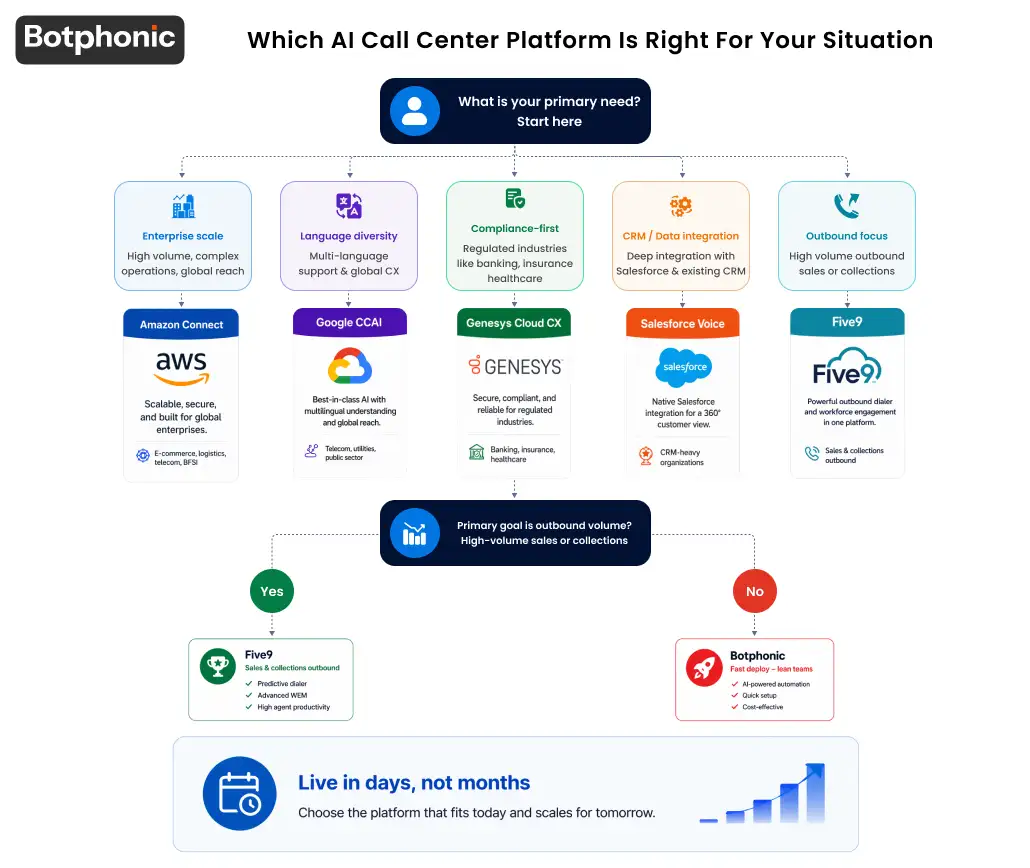
Apply this template instead of resorting to the most familiar brand name.
- Choose Amazon Connect when you require automation on an industrial scale, full integration into the AWS infrastructure, and have the capacity to spend 6 -12 weeks to implement. Most suitable in e-commerce and logistics.
- Choose Google CCAI in case the main challenge you have is natural language diversity – accents, variation in phrasing, multilingual support. Most effective with telecom, utilities and public services.
- Choose Genesys Cloud CX when you are in a regulated business where compliance, audit trail, and human control are a must. Most suitable to banking, insurance and healthcare business.
- Choose Salesforce Service Cloud Voice when your team resides in Salesforce CRM and call unrecordings are eating up your visibility and after-call work hours. Most suitable in SaaS and retail.
- Pick Five9 in case the main objective is outbound volume efficiency and you require both predictive dialing and AI automation. Most suitable with sales and collections teams.
- Pick Botphonic when you require AI voice agents in the production process within days without an enterprise contract and implementation team. Good at lean, expanding companies in the healthcare industry, financial services, and real estate.
See Botphonic’s deployment process, go live in days, not months.
Manage bookings, leads, and customer support 24/7 and turn every call into opportunity
Contact Botphonic!AI Call Center Examples: Key Takeaways for 2026
AI call centers do not entail people replacement, but rather they entail recovery of the operational efficiency that is killed by high volumes of calls. The symptoms include rising costs, agent burnout, and inconsistent service; AI is the structural solution to the predictable part of all call center volumes.
The examples in this guide, whether it be the industrial-level automation of Amazon connect or the Botphonic rapid deployment model of growing business, does prove one thing: AI works where it is scope to its strengths and humans to what it does not excel at.
Any organizations that pursue AI to pursue emotional nuance and edge cases will not succeed. Organizations will experience rapid, compounding returns when automating billing, scheduling, lead qualification, and order status and measuring CPRC, containment rate, and FCR.
Ready to find out how an AI call center can work with your business?
