Summarize Content With:
Quick Summary
This blog is written for agency owners, and team leads who want a clear-eyed account of how AI call center for real estate agencies actually work. Also, where they deliver outsized returns, where they introduce risk if deployed carelessly, and what a properly structured implementation looks like from day one.
Introduction
This is not a product review guide. It does not favour one particular platform above the other.
It is an outline of how to think about the economics, mechanics and risks of AI call center for real estate agencies adoption. Within a real estate setting to be able to compare any platform with criteria that actually matter.
Let’s face it. Most business opportunities are not lost due to a poor marketing campaign. They are lost because no one answers quickly enough. In today’s fast-paced business world, the first agent who answers a lead wins. It’s not the agent who is the most experienced. It is the agent who answers first.
An AI call center for real estate agencies is not a chatbot or a voicemail system. It is a 24/7 system that answers calls instantly and automatically qualifies leads and sets appointments into your CRM system.
The debate is not whether AI Call Centers work. It is whether your existing process is quietly losing business opportunities and how expensive that is.
What Is an AI Call Center for Real Estate, and Why Does It Matter Right Now?
An AI call center for real estate agencies is a software-based system. It can answer calls, qualify leads, book appointments, and synchronize data to your CRM – automatically, 24 /7, without any human participation. It is not a voicemail upgrade or it is not a chatbot widget. And, it also have a complete lead capture system that is trained on listings, on your pricing, on your neighborhoods and on your agency-specific intake process.
Not that AI call assistant is trendy, but this is because it makes sense to do so. It is because the difference between the expectations of the buyers and sellers on reaching out and what most of the agencies provide has become costly enough to quantify.
A buyer who makes a call at 9.45 PM on a Sunday and leaves voicemail does not wait until Monday. The research of NAR 2025 indicates that 78 percent of buyers finally cooperate with the first agent who answers the query. That statistic does not mean the first agent who responds in a business day. It says first full stop.
What Is the ‘Dark Funnel’ in Real Estate and How Does AI Intercept It?
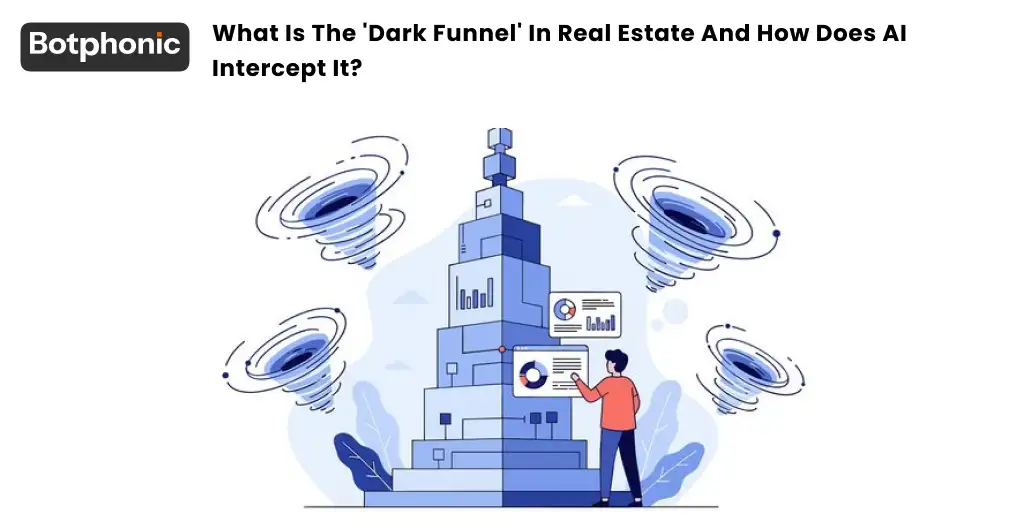
The dark funnel comprises high-intent prospects who explore your listings. It takes a lot of time on your site, and go without filling out a form or calling. The AI call center for real estate agencies fucntions actively. As they never lose leads on your CRM. They are recognised in your analytics as bounce rates unseen revenue walking out the door.
All discussions on the real estate lead capture begin with inbound calls by the buyer who calls the office. Including the seller who calls to request a valuation. These are visible leads. They are stored in a database since somebody performed an action that can be tracked. The much greater and costlier issue is the prospects who took no action. Not entirely because they were indifferent, but because nobody had started speaking to them when they were most interested.
Check For Signs
The behavioral signals that an AI assistant for real estate agencies on a listing site reads on a particular session include how long a visitor has spent on a particular property page, whether they had visited a listing page again on a second visit, whether they had used the mortgage calculator or not. The AI will open a contextual dialogue within a property being looked at when the signals surpass a predetermined threshold.
It is not a generic message of Can I help you today? It is: This three-bedroom has been adjusted twice in terms of price within the last 90 days. Would you like the area to have similar sales information prior to your decision? Such an introduction turns Web browsers into dialogue in a way that passive contact forms will fail to achieve.
 PRO TIP
How Much Revenue Are Agencies Losing from Slow Lead Response
Agencies with a 15-hour average response time on after-hours leads, the industry average according to Inman’s 2025 technology survey, are converting less than 1% of those contacts, compared to a 4%+ conversion rate for leads contacted within five minutes. The revenue difference is not marginal. It is structural.
We shall do the arithmetic of a mid size residential agency. Sixty inbound queries every month. A conversion rate of 4 percent on those that are contacted as soon as possible. An average commission of $14,000. That gives a hypothetical base of monthly revenue of $33,600. This calculation effectively shows the revenue gap that an AI call center for real estate agencies can plug by instantly answering after-hours leads.
What Is the Real Math?
When 40% of such inquiries (after the business hours) come and are not answered promptly (converting to less than 1 percent), the net loss in monthly revenue by after-hours contacts is about $7,800. On an annualised basis, or the value of foregone commission during a response gap which an AI call centre will eradicate during the first day of deployment would be over $93,000.
This calculation is based on the assumption that the quality of lead will be the same in all hours, which is a fair starting point when the agency operates digital advertising all the time. Agencies that get leads solely by referrals or by walking in during the office hours will experience lesser yet significant improvements in the consistency of response and the quality of qualification.
PRO TIP
How Does an AI Call Center Actually Capture and Qualify a Real Estate Lead?
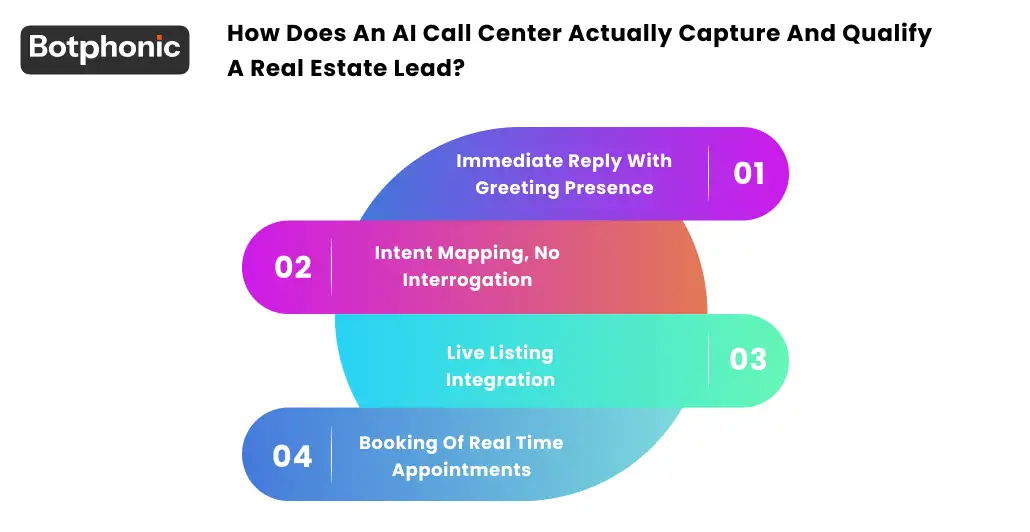
The process undertaken by an AI call center for real estate agencies to capture and qualify a real estate lead using an AI call center consists of six consecutive steps that include instant answer, intent detection, conversational qualification, live data integration, real-time appointment booking, and CRM sync with agent alert. Every part is programmable; it is the quality of configuration that makes the difference between system performance and system operation.
Stage 1: Immediate reply with greeting presence
All calls are responded to in a few seconds, irrespective of the time. The difference between a system that has been implemented well and a glorified voicemail lies in what transpires within the first fifteen seconds. A general greeting that forces the caller to provide his purpose is inflammatory.
The use of a greeting that alludes to the specific listing that the caller is calling about since the AI call center for real estate agencies will have access to the inbound call source information is a good indicator of competence.
Stage 2: Intent mapping, no interrogation
Most agencies under-configure their AI receptionist at the stage of qualification. The poorly developed script presents sequential questions which feel as a mortgage application. The conversational anchoring is applied in a properly designed script – it begins with the particular property that caused the call and then expands in a natural way.
Why are they attracted to that neighbourhood? Are they comparing it with anything that they have watched recently? This methodology of AI call center for real estate agencies collects the same qualification information and develops the relationship that increases a human call back to convert.
Stage 3: Live listing integration
Stand-alone voice agents are not the most effective AI call centers. They relate to the listing database of the agency and then appear as matching properties as the conversation goes on in real time. When a buyer says that he/she needs a home office and a third bedroom, he/she can be informed in the same call that two properties within their budget fit their demands, and the information is provided by the text, before the customer finishes the call.
Stage 4: Booking of real time appointments
The AI call center for real estate agencies examines the live calendar of the involved agent, verifies a showing or consultation appointment and sends a calendar invitation and SMS confirmation to both parties. The next morning the agent opens their CRM and the confirmed appointment, qualification summary, lead score, and transcript are there, but not a missed call notification.
Learn more: AI Call Center Solutions for Property Managers
Three similar listings of the same text, a link to a neighborhood report, or a time when the prospect can receive a call back each form a next step that holds the prospect interested and not leave him/her with nothing to do once the call has been made.
What Compliance Risks Do AI Call Centers Create for Real Estate Agencies?
The AI call center for real estate agencies exposes liabilities on three different compliance frameworks, which include the Telephone Consumer Protection Act (TCPA), the Fair Housing Act, and the laws of recording consent state-specifically.
These are the risks that most agencies failed to map prior to deployment and a number of them are already bearing unpriced liability due to this.
1. TCPA: When does AI outreach require explicit consent?
Outbound AI-generated phone calls and automated SMS follow-ups are supposed to be preceded by a written consent of the recipient. A text message delivered with an AI call center for real estate agencies to a potential person who has already filled out a form on a third-party portal without directly indicating that she wants to receive messages generated by AI is not grey, but it is against federal law. TCPA litigation class action settlements have attained eight figures.
2. Fair Housing Act: Will AI drive buyers unwillingly?
Whenever an agency trains an AI agent with its historical lead data, it instills whatever bias there is in that data. When historical trends indicate steering to or away from particular neighbourhoods based on safeguarded attributes the AI call assistant will reproduce such trends on a massive scale, and make it without any human intervention.
This is actively regulated by the federal authority. Agencies that implement AI without a fair housing review of their conversational outputs have been taking liability that they have not valued.
3. Recording consent: Which states require two-party notification?
The two-party consent jurisdiction is in California, Florida, Illinois, Pennsylvania, Washington and a number of other states. A chat robot listening to people without a clear warning given at the beginning of the call creates recordings that are legally invalid at best and legally actionable on their own at worst.
Compliance Warning
- Do not assess the AI call center platforms based on how many features they have.
- Ask that they record TCPA consent flow design, opt-out automation, fair housing language guardrails, state-specific recording disclosures and audit log access.
- Platforms that invest in compliance infrastructure are more expensive since they are securing the agencies that use them, rather than the reason being that they are less efficient.
Why Does the AI-to-Agent Handoff Have More Lost Leads than the First Missed Call?
Even the best AI call center for real estate agencies can experience losses if human agents are not given proper context, timing, or guidance for callbacks.
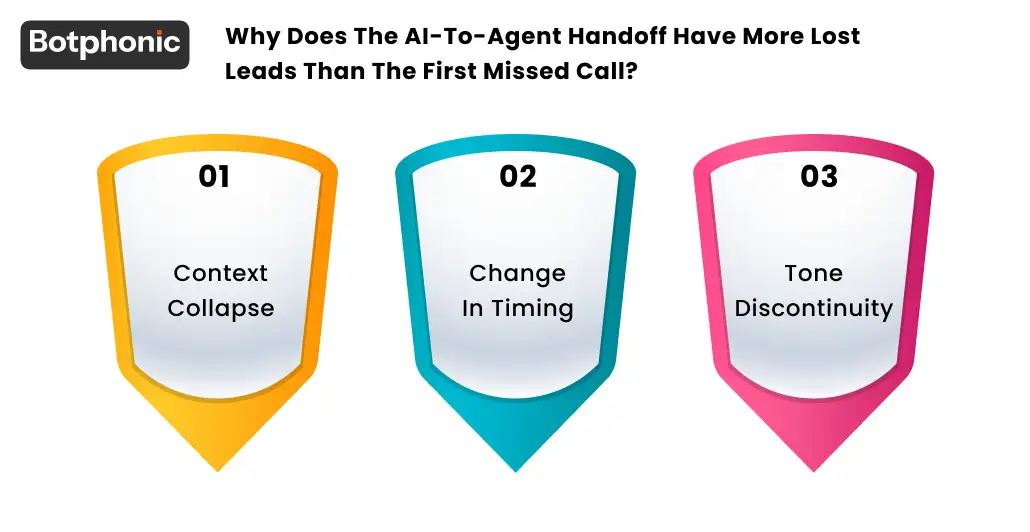
There are AI-to-agent handoff losses in situations where agents are not provided with enough context prior to their call back, where the time taken to escalate is excessive, and where the human interaction is not as good as the AI conversation the prospect just had. These three modes of failure are daily in agencies that have already adopted AI capture without crafting a handoff procedure.
1. Failure mode 1: Context collapse
The agents of AI call center for real estate agencies are notified and given a phone number and a name. They make multiple calls without reading the transcript and re-purpose questions. They might have already been answered by the prospect, and indicate with that repetition that nobody was really taking notes.
A callback within ninety seconds destroyed the rapport that the AI took five minutes to establish, causing the organized and attentive prospect to adopt a generic, transactional attitude toward the agency.
2. Failure mode 2: Change in timing
At 9.45 PM, the AI records a high-intent lead. The assigned agent makes a call back the next morning at 9:00 AM that is eleven hours later. The prospect has possibly talked to two competitors in that window. Whose systems had progressed to human calls in 30 minutes. The AI did its job. The protocol failed.
3. Failure mode 3: Tone discontinuity
The interaction between the agents of AI call center for real estate agencies might be cordial, particular and unhurried. There is a definite lack of clarity in the human callback being able to clearly read abbreviated CRM notes. Agents undermine AI-built trust when they fail to recollect the specific property or the prospect’s pre-approval status. This quality gap makes the interaction feel generic and erases the rapport established by the AI.
Can an AI Call Center Reactivate Old Leads in Your CRM Database?
Yes. An outbound AI voice agent of AI call center for real estate agencies has the ability to methodically go through an inactive CRM database, send personalised re-engagement, figure out who has altered circumstances, and send ready-to-call prospects directly to agent schedules at a price of cents per conversation, as opposed to dollars per tap.
Each of the established real estate agencies has a database of contacts who have requested them, were pursued at a random rate, and stopped responding. This is not a cold list. It is a warm list and has a timing issue. Individuals that had inquired 12-18 months ago did not always lose interest in moving. Various obstacles, including lease obligations, work transfers, and redecoration costs—created a deadlock that depleted their savings and disrupted their schedules. Life circumstances shift. The one that makes the discovery is the first to win the listing.
 NOTE
NOTE
What KPIs Do Real Estate Agencies want to measure to determine the ROI of the AI Call Center?
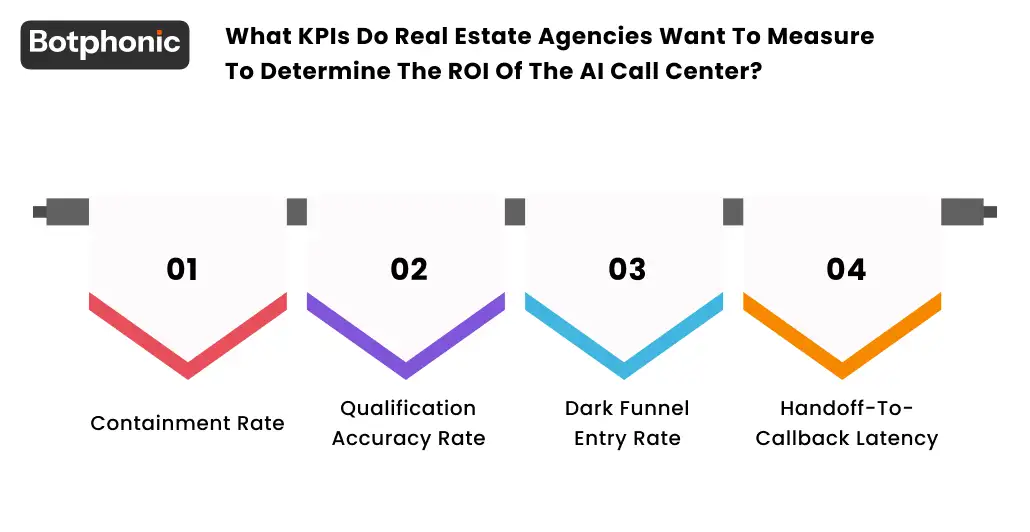
The four metrics used to forecast the AI call center RO. Agencies measuring ROI from an AI call center for real estate agencies focus on containment rate, qualification accuracy, dark funnel entry, and handoff-to-callback latency. Output metrics that ensure activity is confirmed are call volume and appointments booked.
These four process metrics forecast whether activity converts into revenue.
1. Containment rate
What was the rate of completely resolved conversations not escalated by a human to the AI? A containment rate of less than 60 percent is an indication that there is a gap in the knowledge of the training data of the AI or that the qualification script creates uncertainty instead of preventing it. Flip through the records of exacerbated calls once a month, to find the exact queries that the AI was unable to process – and seal those knowledge base loopholes.
2. Qualification accuracy rate
High-intent leads identified by AI typically convert to showings or sales at a rate of 6% to 8% within a three-month window. While this sounds modest, it represents a 20% to 40% increase over traditional manual sorting. Correctly tuned systems yield a 50% increase in conversions from initial contact to physical showings.
3. Dark funnel entry rate
What proportion of AI discussions were proactive on the part of the AI identifying behavioural cues as opposed to reactive based on an inbound contact? This is an assessment of the interception capability of the system with regards to behaviour. The agencies that are tracking reactive conversations only are half measuring what the system is doing.
4. Handoff-to-callback latency
The mean time that an AI call center software takes after making a qualified lead handoff and a human agent making the first contact. This is the measure that most agencies do not have a benchmark on. High-intent lead response intent can be targeted at a 30-minute response. And standard qualified lead response at a 2-hour response. Despite averaging 11 hours of daily operation, the AI programmatically fails to complete its tasks before agents even attempt a call.
PRO TIP
Key Tips and Notes: What to Do Before, During, and After Deployment
Before you deploy
- Run the revenue leak calculation: Perform the calculation of the revenue leak with your own agency data on the basis of the real volume of leads, the conversion rate, and the average commission. Document the number. It can be used to establish an internal ROI benchmark.
- Audit your compliance posture: Before choosing a platform, audit your compliance posture TCPA consent records, fair housing training material and state recording-law requirements.
- Map your lead sources: Trace your lead sources and understand the ones that produce the most after-hours. These dictate on where to attempt the deployment of the AI, and the way to set up the initial qualification script.
- Predefine your triggers of escalation: What responses must be sent to an agent as soon as possible? Who is supposed to book a calendar appointment? What must be born in a nurture progression? The biggest cause of implementation failure is ambiguity.
AI call centers for real estate agencies thrive on process discipline as much as technology.
During deployment
- Train the AI using your real listings: Ensure to follow this and not use a general real estate knowledge base. The more specific the training information of AI call centers for real estate agencies, the more believably there are answers to property-specific questions.
- Start with inbound coverage: Only cover inbound within the initial 30 days. We reactivate outbound leads and intercept proactive behavior during months two and three, once we have streamlined the qualification script.
- Have every agent read five transcripts per week: This introduces them to the handoff format and exposes the gaps in the scripts in a fraction of the time that any management review procedure can accomplish.
After deployment
- Review your four core metrics monthly: Check your four key metrics after every month and communicate them to the entire staff. Containment rate, qualification accuracy, dark funnel entry rate and handoff latency.
- Run a dormant-database reactivation campaign: At month three when the inbound system is stable, run a dormant-database reactivation campaign. Apply a segmented strategy 612 months dormant vs. 1236 months dormant using dissimilar scripts in each case.
- Conduct a fair housing audit: Periodically (i.e., after every six months) perform a fair housing audit of your conversational output shared via system. This is compulsory in a regulatory landscape that is currently actively examining AI-assisted property marketing.
Smartly Scale Your Responsiveness Without Needing Extra StaffSchedule Your AI Demo!
Schedule Your AI Demo!Technology is 20% of the result. The other 80 is process discipline.
Conclusion
The agencies that roll out AI call center for real estate agencies during year one do not lead to capture more leads. They start building superior data consisting of more qualified records, more detailed records of conversations, and improved lead scoring. Such information develops better scripts. Better scripts enhance better qualification. The higher the qualification, the better the rates at which agents are closed. Better lead generation is financed with higher close rates. The flywheel compound, and it compounds over its competitors who later came into the picture.
Real estate has never been unresponsive. The agents and agencies whose reputations were made on returning calls on time. Appearing when insisted on and being contacted where others were not are the ones that stood the test of time. AI call centers for real estate agencies do not alter that principle. They make it both large scale and on a schedule to run all the hours of the day. Regardless of the availability of any single person.
There is no question of whether or not to implement. It is the deliberate nature in which you do it and whether you begin to create the compounding advantage. Or somebody else begins to create it first.