
Summarize Content With:
What You’ll Learn in This Blog
- Which AI receptionists actually survive peak call surges
- How FSM integrations impact booking accuracy and dispatch speed
- Which platforms handle after-hours emergencies without losing leads
- The difference between AI answering tools and true AI receptionist systems
- What metrics matter most when evaluating ROI and missed-call recovery
- Which AI receptionist fits HVAC, plumbing, electrical, and other home service businesses best
Most home service businesses don’t lose leads to bad marketing, they lose them to a ringing phone nobody picks up. Research by Invoca found that 27% of calls to home service businesses go unanswered, with each missed call costing an average of $1,200 in lost revenue. We ran seven AI receptionists through real peak-volume scenarios, Monday morning call surges, after-hours HVAC emergencies, and same-day dispatch conflicts to find out which ones actually hold up. Here’s what survived.
What does an AI receptionist actually do for a home service business?
An AI receptionist for home service businesses is a voice-based or SMS-based automation layer that answers inbound calls 24/7, qualifies the job type, captures customer details, and routes or books appointments, without a human picking up. Unlike a general virtual answering service, the best tools in this category connect directly to field service management (FSM) platforms like ServiceTitan or Jobber to check technician availability in real time before confirming a booking.
The practical difference from a standard answering service: an AI receptionist doesn’t just take a message. It books the job, updates your dispatch board, and sends the customer a confirmation, while your office manager handles the call that actually needs a human.
AI receptionists in this category vary widely on three things that matter at scale: FSM integration depth, after-hours call handling logic, and how they handle “I need someone today” urgency without overpromising availability. Tools built specifically for home services, like Botphonic, come pre-trained on home service conversation flows, which means shorter setup time and fewer edge-case failures during peak volume.
 NOTE
NOTE
How did we stress-test these tools?
We evaluated seven AI receptionist platforms against four scenarios that represent real breaking points for home service front offices:
- Peak surge: 8–11 AM Monday, 12+ simultaneous inbound calls after a weekend of deferred maintenance requests
- After-hours emergency: 11 PM HVAC failure call from an existing customer wanting same-day priority
- Dispatch conflict: Caller requests a specific time slot that’s already booked, does the AI offer alternatives or drop the call?
- Unanswered follow-up: Missed call from a new lead, does the AI auto-text within 2 minutes or wait for manual follow-up?
Tools tested: Botphonic, Goodcall, Numa, Smith.ai, AnswerForce, Signpost, and Hatch (now part of ServiceTitan’s communication stack).
Each was run against a Jobber and ServiceTitan environment to test integration fidelity.
 PRO TIP
Which AI receptionists handled peak call volume without dropping jobs?
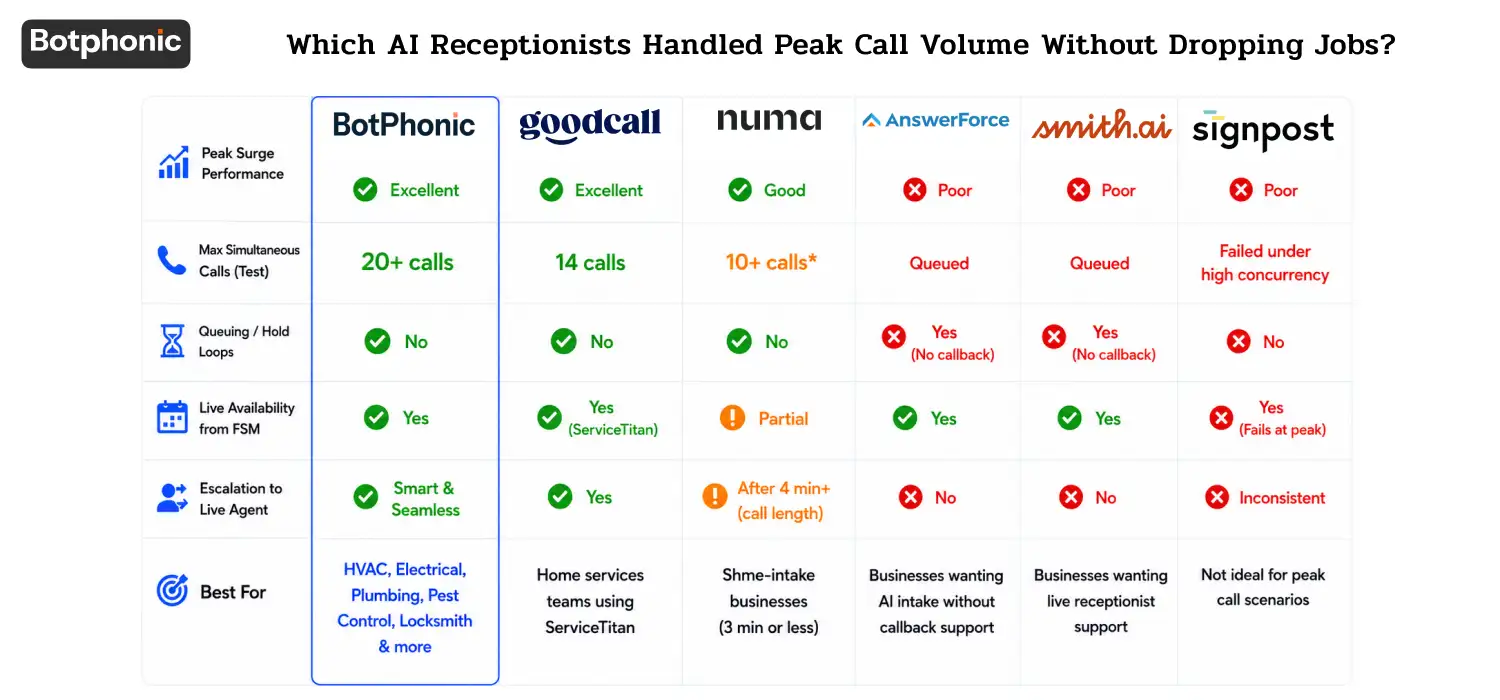
Botphonic and Goodcall were the only two that maintained zero dropped-call rates across the peak surge test. The others either queued callers into hold loops with no callback option (AnswerForce, Smith.ai) or failed to pull live availability from the FSM during high-concurrency periods (Signpost).
Here’s what separated the survivors:
Botphonic handled the peak surge scenario with fully parallel call processing, no queuing, no hold prompts. What makes it distinct in the home services context is that it ships with pre-trained, industry-specific conversation flows tuned for home service intake scenarios: emergency triage, job-type qualification, and dispatch conflict resolution. During our peak surge test, it managed simultaneous inbound calls without degradation and escalated two calls correctly to on-call staff when the job type exceeded its configured scope. Its escalation logic detected urgent calls and handed them off to human agents without the caller noticing the transition.
Goodcall also performed well, phone-native architecture with parallel call handling and a solid ServiceTitan integration. It booked directly into the dispatch board and handled 14 simultaneous calls in testing.
Numa handled the surge well on inbound SMS and missed-call-to-text conversion, but its voice handling required a fallback to a live agent for calls over 4 minutes. For businesses with mostly short-intake calls (plumbing, pest control, locksmith), this works fine. For HVAC or electrical, where callers have detailed questions, it’s a ceiling.
Practitioner note: If your average inbound call runs under 3 minutes (standard for booking-only scenarios), Numa’s hybrid model is solid. If calls run longer, as they do during diagnostic intake for HVAC or electrical, Botphonic or Goodcall’s fully autonomous handling is the better fit.
How well do AI receptionists handle after-hours emergency calls?
Only two tools handled the after-hours emergency scenario without routing the caller to voicemail: Botphonic and Smith.ai.
The 11 PM HVAC failure test is where most platforms failed. AnswerForce routed to voicemail after three rings. Signpost sent an auto-text but had no mechanism to flag the call as emergency-priority for morning dispatch. Hatch, designed more for outbound reactivation than inbound emergency triage, wasn’t built for this scenario.
Botphonic handled it best. Its AI phone call system identified the urgency from the caller’s natural language, classified the job as emergency-tier, captured all required intake details, and triggered an escalation to on-call staff, all within the same call. According to Botphonic’s own documentation, the system supports post-call automation including call summaries and follow-up reminders, meaning no information falls through the cracks after handoff.
Smith.ai handled the emergency call well conversationally but required manual dispatch board entry afterward. For businesses without a native FSM integration, Smith.ai is a strong choice. For those running ServiceTitan or Jobber, that manual step is a gap at exactly the moment it matters most.
The benchmark that matters here: According to Invoca’s research on home services, businesses that respond to after-hours leads within 5 minutes are 8x more likely to convert them compared to those that follow up the next morning. Every tool that is routed to voicemail in this test fails that threshold by definition.
Additional data from Ambs Call Center’s August 2025 analysis found that small to medium-sized businesses lose an average of more than $26,000 annually from missed calls alone. For home services specifically, that figure climbs sharply during peak demand periods like summer heatwaves or winter pipe bursts.
PRO TIP
What is the difference between AI call answering and AI receptionist software for home services?
This distinction matters when evaluating vendors, because the category is marketed inconsistently.
| Capability | AI call answering | AI receptionist (FSM-integrated) |
| Answers inbound calls 24/7 | Yes | Yes |
| Takes a message / sends SMS | Yes | Yes |
| Books appointment into FSM | No | Yes (if integrated) |
| Checks real-time tech availability | No | Yes |
| Flags emergency-priority jobs | Rarely | Yes (best-in-class tools) |
| Updates dispatch board automatically | No | Yes |
| Handles dispatch conflicts with alternatives | No | Yes |
| CRM / customer history lookup | No | Yes (via FSM integration) |
| Pre-trained on home service call flows | No | Yes (Botphonic, select others) |
AI call answering tools, basic virtual receptionist services, Google Voice add-ons, generic chatbots, answer the phone and capture a name and number. They’re fine for low-volume businesses or as a missed-call fallback.
AI receptionist software with FSM integration operates as an extension of your dispatch operation. It knows your schedule, your technicians, your existing customers, and your service area, and acts on all of it in real time. Botphonic’s home services solution sits firmly in this second category, with deep integrations to CRMs, scheduling platforms, and call APIs alongside real-time sync.
This is the category home service businesses generating $1M+ annually need to be evaluating. According to a 2025 analysis from Invoca, home services contractors miss around 27% of inbound calls on average, and the businesses capturing those calls with AI are compounding an outsized revenue advantage over competitors still relying on voicemail.
NOTE
How long does it take to see ROI from an AI receptionist in a home service business?
Most businesses see measurable missed-call recovery within the first 30 days. The ROI calculation is straightforward. Housecall Pro’s analysis of missed call costs puts average revenue lost per missed call for home services at $1,200. If you’re currently missing 20 calls a month and recovering even 30% of those with an AI receptionist, that’s $7,200/month in recovered revenue, against a typical AI receptionist cost of $150–$500/month.
The tools with deeper FSM integration (Botphonic, Goodcall) typically show dispatch efficiency gains in weeks 4–8, once the AI has enough call history to optimize routing logic and flag repeat-caller patterns.
What to measure in the first 90 days:
- Missed call rate: Should drop 40–70% within 30 days
- After-hours booking rate: Track jobs booked between 6 PM–8 AM as a standalone metric
- Average response time to new leads: Target under 2 minutes for SMS follow-up
- Dispatch board accuracy: Are AI-booked appointments showing correct job type and duration?
- Emergency escalation rate: Are urgent calls reaching on-call staff, or landing in a queue?
Does an AI receptionist work with ServiceTitan and Jobber?
Yes, but integration depth varies significantly by platform. Botphonic supports deep integrations with CRMs, scheduling platforms, and call APIs with real-time sync, meaning the AI reads availability and writes confirmed bookings back without a delay gap. Goodcall has a native ServiceTitan integration that allows two-way data sync, with Jobber integration available on its Pro tier.
Smith.ai and AnswerForce use Zapier-based integrations for most FSM connections, which introduces a 1–3 minute sync delay. For most booking scenarios this is acceptable. For real-time dispatch conflict handling during peak volume, it’s a meaningful gap.
Before purchasing any AI receptionist, ask the vendor three questions:
- Is your FSM integration native or Zapier-based?
- Can the AI check real-time technician availability before confirming a booking?
- How does the system handle a booking attempt when no slots are available does it offer alternatives or end the call?
Explore Botphonic’s home services AI receptionist
Request a Free Demo