
Summarize Content With:
What You’ll Learn
- How AI receptionist transforms agencies beyond call handling
- What changed operationally in the first 90 days at three real agency types
- Why all three agencies updated their sales pitch after implementing AI reception
- How AI-powered front desks become proof of capability, not just a cost cut
- What to ask before replacing a human receptionist at your agency
AI receptionists transform agencies by replacing manual call handling with automated intake, qualification, and scheduling. This article is for agency owners who manage inbound leads and want to understand what actually changes, operationally and strategically, after implementation.
Why Does the First Phone Interaction Shape a Prospect’s Entire Perception?
First contact is a signal. It tells prospects whether your agency operates with intention or improvisation.
Most agencies treat reception as an administrative cost. Prospects treat it as a preview of how that agency will handle their business. A delayed callback, an unanswered call, or an inconsistent experience introduces doubt before the pitch even begins.
Reception isn’t just logistics. It’s the first impression of your operations.
 NOTE
NOTE
What Is an AI Receptionist and How Does It Work for Agencies?
An AI call assistant is a voice-based automation layer that answers inbound calls, collects intake information, qualifies leads, and schedules meetings, without a human picking up. It connects directly to your calendar and CRM.
For agencies, this means a prospect calling at 9 PM on a Friday gets a structured response. Not voicemail.
The system asks pre-set qualification questions, routes complex queries to humans, and logs every conversation automatically. Platforms like Botphonic are built specifically for this use case, handling agency intake at scale without hiring additional staff.
 PRO TIP
The Agency Playbook: Real Results from Implementing AI Reception
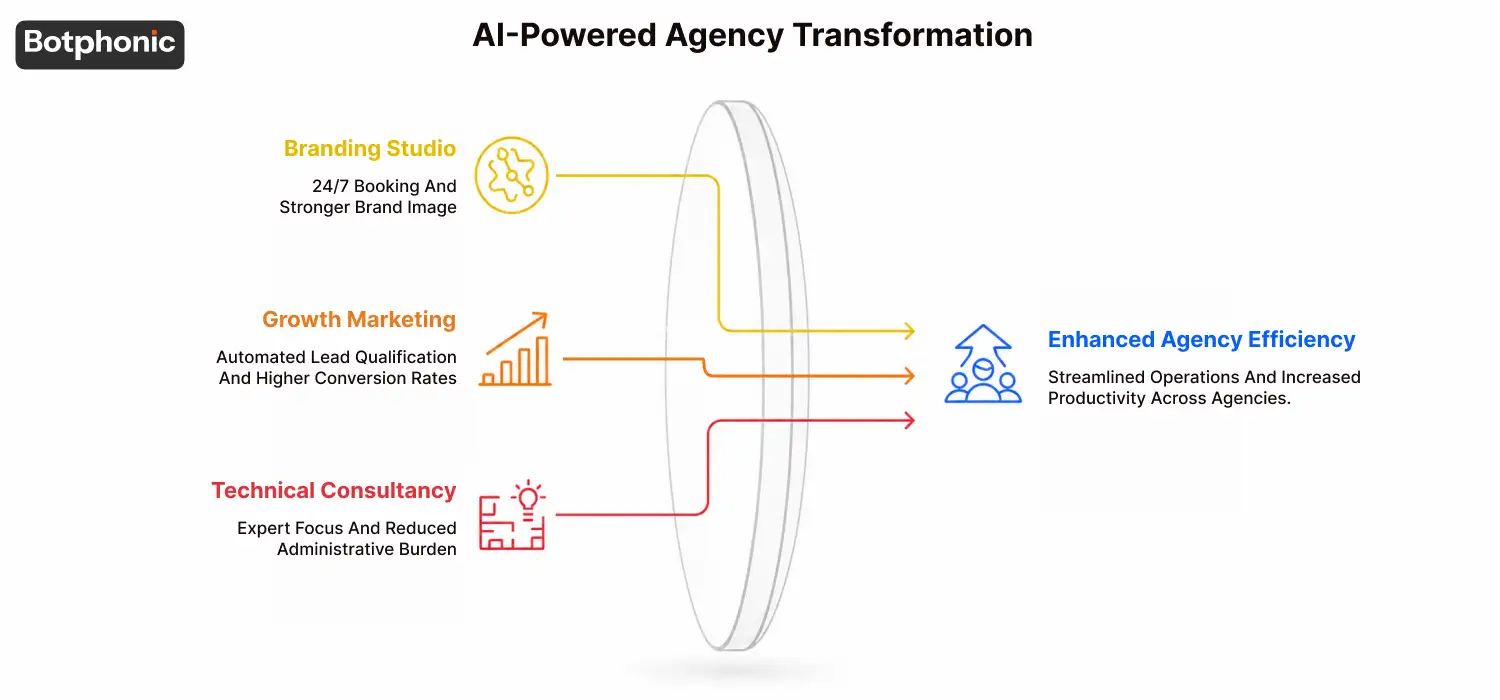
Agency #1: The Branding Studio; Did Availability Alone Change Anything?
Missed After-Hours Calls Were Costing More Than the Team Realized
This small creative studio had a strong local reputation but growing international interest. Prospects in different time zones called during evenings. The team worked 9–5. The gap was invisible in their analytics but visible in their conversion rate.
After implementing an AI customer service layer on inbound calls:
- Calls were answered around the clock
- Prospects could book discovery sessions at the moment of highest intent
- Every caller received the same first-impression experience
In practice: Within 60 days, the studio noticed that roughly 30% of booked consultations had originated from evening or weekend calls, inquiries that previously went unanswered.
How Did This Change the Agency’s Own Brand Pitch?
The branding studio had always positioned itself as a boutique local shop. After implementation, that framing started to feel limiting.
The team realized their front-desk experience now reflected the same modern, scalable operations they recommended to clients. They updated their positioning from “boutique local studio” to “borderless creative partner”, and used the AI-powered intake as evidence.
The receptionist wasn’t just answering calls. It was demonstrating operational credibility to every prospect before the first meeting.
Agency #2: The Growth Marketing Firm; How Do You Fix a Lead Quality Problem?
Why Was the Sales Team Wasting Time on Unqualified Discovery Calls?
This firm generated significant inbound volume through content and paid channels. The problem wasn’t awareness, it was lead quality.
Sales reps spent 30–40% of discovery call time on basic qualifications that could have happened before the meeting. Budget mismatches, service misalignments, and scope misunderstandings consumed hours that should have gone toward closing.
AI receptionist used a qualification filter. Here’s what that means for growth agencies.
The firm built a structured intake sequence into its Botphonic configuration:
- Service interest (SEO, paid media, CRO, full-funnel)
- Monthly budget range
- Current monthly revenue
- Primary growth challenge
Only leads that passed threshold answers got routed to calendar booking.
What Did the Sales Data Look Like After Three Months?
| Metric | Before AI Reception | After AI Reception | Change |
| Avg. discovery call length | 52 minutes | 34 minutes | −35% |
| % of calls resulting in proposal | 28% | 47% | +68% |
| Time spent on unqualified leads/week | ~6 hours | ~1.5 hours | −75% |
| Lead data completeness at handoff | ~40% fields filled | ~90% fields filled | +125% |
How Did This Become a Sales Asset?
The firm realized it had built a live demonstration of conversion optimization, inside its own business.
They updated their capabilities deck to show the intake workflow. During pitches for funnel optimization services, they walked prospects through how their own front-end qualification system worked.
Instead of claiming funnel expertise, they showed it. That distinction changed how prospects responded in sales conversations. See how Botphonic’s agency solution is built specifically for this kind of intake architecture.
Agency #3: The Technical Consultancy; Can AI Reception Handle Complex Inbound Questions?
Why Were Senior Consultants Handling Basic First-Contact Questions?
This consultancy’s senior team regularly fielded calls about pricing, service scope, and technical approach; questions that didn’t require their expertise but consumed their time.
The average senior consultant spent 4–6 hours weekly on intake-adjacent tasks. That’s billable time absorbed by administration.
What Happened When AI Was Connected to Internal Knowledge Resources?
The consultancy connected its Botphonic configuration to a curated internal FAQ and approved knowledge base. Common questions, pricing tiers, engagement models, technology stack compatibility, were answered immediately on the call.
Complex or sensitive questions triggered a human escalation workflow. Specialists were contacted only when their expertise was actually required.
What the consultancy actually experienced: Senior team members reported the change in the first two weeks. Routine intake calls dropped off their calendars. They were pulled into conversations that required genuine judgment, not questions a well-configured intake system could handle.
How Did This Become Their Enterprise Sales Advantage?
During enterprise sales discussions, the consultancy began demonstrating the architecture of its own AI reception system. The conversation shifted from describing technical capabilities to showing a working implementation.
Prospects weren’t evaluating hypothetical expertise. They were looking at a live system the firm had built and operated within its own business.
That’s a different conversation entirely.
What Patterns Appeared Across All Three Agencies?
What Do Agencies Consistently Gain in the First 90 Days?
The operational changes were consistent across all three agency types:
Response speed: Every agency saw faster first-contact times. Prospects weren’t waiting for callbacks or follow-up emails. They received structured responses at the moment they called.
Administrative reduction: Scheduling coordination, basic qualification, and intake data collection shifted to the AI layer. Human teams absorbed that time back into billable and revenue-generating work.
Cleaner lead data: Intake information arrived structured and complete. Sales handoffs improved because the data existed before the discovery call began.
Resource reallocation: Strategy, consulting, relationship development, and complex sales conversations retained human attention. Routine administration did not.
What Is the Positioning Pivot; and Why Does It Matter More Than the Operations?
The positioning pivot is the pattern none of these agencies anticipated. All three eventually stopped talking about AI reception as a cost-saving tool and started using it as evidence of capability.
This matters because agency sales conversations are fundamentally trust conversations. Prospects buy from agencies they believe can deliver. A live demonstration of an AI-powered system inside your own business is more credible than a case study about a client’s business.
The AI receptionist software became a proof point. Not a cost line.
How Does AI Reception Compare to Other Front-Desk Approaches?
| Approach | Availability | Lead Qualification | Setup Cost | Scales With Volume | Acts as Proof of Capability |
| Human receptionist | Business hours only | Inconsistent | High (salary + benefits) | Requires additional hires | No |
| Voicemail + callback | 24/7 capture, delayed response | None | Low | Yes | No |
| Answering service | Extended hours | Basic | Medium | Limited | No |
| AI receptionist (Botphonic) | 24/7 | Structured and configurable | Low-medium | Yes | Yes, demonstrable system |
What Should Agency Owners Ask Before Replacing a Human Receptionist?
Is AI Reception Right for Every Agency?
AI reception is not right for every agency. It depends on call volume, lead type, and operational structure.
Ask these questions before making a decision:
- What percentage of inbound calls currently go unanswered or to voicemail?
- Which conversations genuinely require human judgment from the first moment?
- What intake data should exist before a discovery call begins?
- How will escalations be managed for complex or sensitive inquiries?
- How will you measure success beyond cost savings?
- Can this system become part of how you position your agency to clients?
If your answer to question six is yes, and you sell services that involve automation, AI, or operational efficiency, that question deserves serious attention.
See how an AI receptionist can capture, qualify, and book leads 24/7.
Book a demo with Botphonic today.What Didn’t Change, and Why That Matters
Human expertise remained essential. Strategic consulting, relationship management, complex sales conversations, and high-stakes decision-making stayed in human hands across all three agencies.
AI reception required ongoing oversight. Knowledge bases needed updates. Escalation paths needed refinement. Performance required monitoring.
Technology alone wasn’t the advantage. The competitive edge came from how each agency integrated and applied what they had built, not from adopting the tool alone.
