Summarize Content With:
Introduction
It’s 6:52 PM on a Thursday. One of the owners of a business in Fresno has simply Googled an insurance agency near me, and called. Your office closed at five. The call goes to voicemail. He tries the next result. They answer. Deal gone.
It is not hypothetical, dramatic, but it is Tuesday of most agencies that do not have after-hours coverage. And in markets such as Fresno and Mesa where there are real and actual competition to attract clients and speed of response does count, that one call that was lost can cost you more than you would ever whimper over the technology that would allow its loss.
This work is aimed at owners of agencies who are tired of losing time against the clock.
What an AI Receptionist Does in Reality
Forget the phone trees from 2012. The modern AI receptionist is developed based on the conversational language models, which react to the verbatim words of the callers, but not against the keywords in the scripts.
In simple language, the following is what it does to your agency:
- Responds to all incoming calls in seconds, day, night, weekend, holiday.
- Greets callers by the name and tone of your agency.
- Strolls on your intake queries to qualify the lead.
- Bookings made straight into your diary.
- Automatically enters your contacts and call notes to your CRM.
- Send a summary of the texts or emails you a summary the moment the call ends.
- Answers frequently asked questions, such as hours, services, the fundamentals of pricing, etc., without a person.
- Transfers or Callbacks anything complicated to a live team member through flagging.
The distinction between this and a traditional answering service? The answering service picks up a message and sends it to you at 8 AM. The AI makes the appointment at 6:52 PM, when the prospect remains interested.
The Reason This Is of Concern in Fresno, CA
The agency market in Fresno is truly under-serviced in terms of automation of the front office. The business community is expanding in the Central Valley. And the healthcare, logistics, real estate, and commercial services are part of it,. Moreover, it also incudes agencies that cater to them are faced with a large incoming call volume and limited staffing budgets.
There is also a bilingual aspect that can hardly be overestimated. A large percentage of the Fresno County population does business majorly in the Spanish language. In the case of insurance, legal, real estate and staffing agencies, the fact that a Spanish-speaking caller can be intake-without any hitches, i.e., without the usage of the phrase, let me find someone, is not an option. It is a competitive advantage which has a direct influence on the revenue.
This is done by an AI receptionist that has inbuilt bilingual ability, does not require additional number of people, does not rely on schedules and is not inconsistent. All callers receive equal professional experience irrespective of the language that they dial.
 NOTE
NOTE
The Mesa AZ Angle: Speed-to-Lead Is the Whole Game
Phoenix does not have a quiet neighbor, Mesa. It is the third-largest City in Arizona where the professional services market is growing rapidly in between the premium agencies of Scottsdale and the tech-focused agencies of Tempe and the emerging independent shops of Gilbert. Client competition in this corridor is a reality and whoever is the first one to respond is rewarded.
Research done in the various verticals of professional services has uniformly revealed that the chances of a prospect turning into a client reduces drastically after the fifth minute of the initial call made by the prospect. In a marketplace where your rivals in Scottsdale have invested in infrastructure, a Mesa boutique agency, which picks up the phone within two seconds, at any hour, at any time of the day or night, is truly punching way above its own weight.
The other factor is labor. The talent market in front-office Arizona is also competitive. Identifying, recruiting, and maintaining a competent receptionist able to take professional intake calls regularly is more difficult and costly than it used to be three years ago. AI call assistant does not have that dependency at all, same performance, each time, predictable monthly cost.
What Does It Really Cost and What Are You Forfeiting Without It?
Even research has stated that about 30 to 50% business is accelerated with the help of agentic AI. Below is the math that will make this a no-brainer decision to most of the agency owners.
| Agency Size | Missed Calls / Month | Avg. Client Value | Revenue at Risk |
| Small Agency (Fresno) | ~15 calls | $1,200 | ~$2,700/mo |
| Mid-Size Agency (Mesa) | ~30 calls | $2,500 | ~$11,250/mo |
| Growing Agency (Both) | ~50 calls | $3,000 | ~$22,500/mo |
These estimates have taken into consideration a conservative 15 per cent conversion rate of first-call contacts. This is all that the AI receptionist will stop? Normally 99-499 Americana currency per month based on the quantity of calls made and also functions.
You recoil on the lead you recover first. Anything beyond that is fringe.
| Cost Element | AI Receptionist | Full-Time Human Receptionist |
| Monthly Cost | $99–$499 | $3,200–$4,800 |
| After-Hours Covers | Included | Overtime or separate hire. |
| Bilingual Support | Included in a package | Needs to be hired separately. |
| Sick Days / No-Shows | Never | Guaranteed eventually. |
| CRM Integration | Automatic | Manual data entry. |
| Scale-based on Calls | Infinite simultaneous calls | Single call at a time. |
Learn more: Top AI Phone Call Software for Agencies in 2026
The 6 Largest Concerns That Agency Owners Have (Answered Directly)
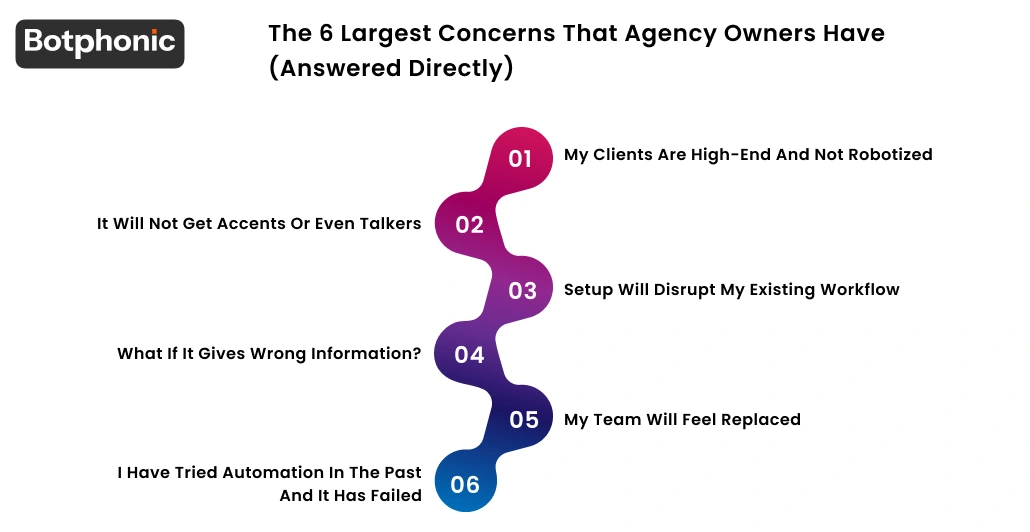
1. “My clients are high-end and not robotized.”
This complaint is often expressed by the owners of agencies who attempted to use an IVR system earlier. The AI-powered assistant for agencies is the same as that of popular consumer software AI receptionists with every one. Your clients are calling to get a response. Quick, precise, professional reactions do not seem mechanical. They feel reliable.
2. “It will not get accents or even talkers.”
The quality of speech recognition has gone up by a substantial margin. The most popular AI receptionists have been trained on various data on accents, and they process rapid and informal speech models with high accuracy. In the case of Fresno agencies, in particular, the platforms that have been trained on Spanish-English bilingual interaction are prevalent. That notwithstanding, you should validate your platform using real life voice situations prior to going live, any decent vendor will allow you to make test calls during the setup.
3. “Setup will disrupt my existing workflow.”
Three things are set up; your call script, your CRM credentials, and your calendar access. That’s it. Your existing phone number is retained, the AI works by forwarding rule or direct number based on the platform. The existing tools don’t change and your team’s workflow isn’t affected. You just stop missing calls.
4. “What if it gives wrong information?”
High-end AI receptionists do not make things up. They just repeat whatever you have specifically asked them to repeat. Anything beyond that will cause an escalation or I will have a specialist follow up with you on that. The answers of the AI are entirely determined by your knowledge base. Get AI on your side, get it updated, in a moment, on all calls.
5. “My team will feel replaced.”
The latter they will not do since the job that the AI is working on is not the one that your team would prefer. Forty times a week is not the kind of thing that your best people join the company to answer the same basic intake questions. Giving them warm qualified leads with notes already in the CRM? That’s a better job. The difference is getting appreciated with several industries.
6. “I have tried automation in the past and it has failed.”
The first wave of automation tools used in the agency services, rudimentary chatbots, inflexible phone trees, call center scripts, did fail. They were unsuccessful as they could not adjust to practical talks. The current AI receptionists are able to use natural language processing which is responsive to what the caller really says and not what you thought that they might have said. That is what makes the difference between a script and a thinking system.
The Importance of Choosing the Right Platform to Your Agency
AI receptionist platform aren’t only developed for agencies. There are those that are medical practice and others that are high volume call centers. The following are questions to ask when making choices:
- Does it not natively connect with your CRM, not by a third-party connector?
- Are you able to write your own intake script, or are you stuck with their template?
- Does it come with a base price of bilingual assistance or as an addition?
- How is billing done: flat rate or per-minute? Per-minute may spike out of the blue.
- So what is the escalation process when a caller poses a question that the AI cannot respond to?
- Is there a trial period? At least two weeks is offered by any reputable vendor.
 PRO TIP
In the case of California based agencies, attest to CCPA data handling compliance prior to signing. In a system where a certain agency follows ups using automated SMS, TCPA opt-in configuration should be an in-built part of the booking flow, and therefore is not something that you must setup yourself.
Short Cuts to the Answers to the Questions We Are Asked Most
- Is it allowed to use the actual name of my agency? Yes. It is completely your greeting, name, tone, language, all.
- Is it necessary to change my phone number? No. You send calls to the number of the AI, or it serves as a primary line with the escalation routing. Your existing number stays.
- What about it not knowing the answer to a question? It doesn’t guess. It reassures the caller that a specialist would be following up, gathers his or her information, and classifies the call under your team. Clean handoff.
- How fast is setup? The average of the agencies also takes three to five business days. Multi-location complex multi-location implementations requiring a custom routing installation may require up to two weeks.
- Is it able to support texts and web chatting? Many platforms do. When your agency services leads off of website chat or SMS, seek out an omnichannel option that would operate all of these off a single dashboard.
Zero to AI-Powered Front Desk: 5 Days to Launch an Agency in Fresno and Mesa
The perception that implementation of AI receptionists for insurance agencies will be complex is the biggest reason agencies keep dragging their feet in implementing this technology. It isn’t. This is what you can do to achieve zero to live within one business week.
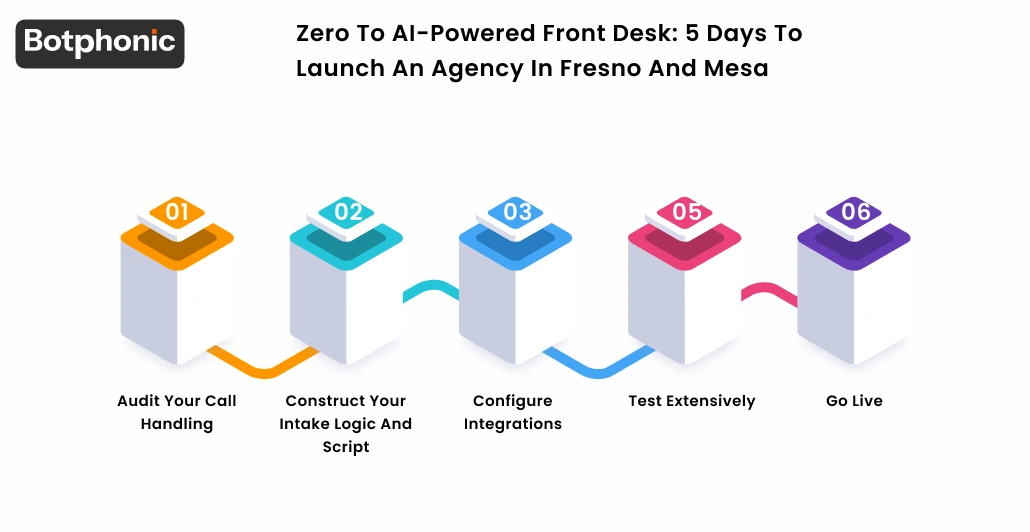
Day 1: Audit Your Call Handling
You have to know what you are replacing before you construct anything. During a week (or even three days) record all your agency received calls. Record the time, request of the caller, length of call and its result. You will soon recognize trends. And know when calls tend to be busiest, the most frequently asked questions, also the current sources of frustrations in calls that are not being properly attended to.
This audit is the basis of your AI intake script. Don’t skip it.
Day 2: Construct Your Intake Logic and Script
Write your greeting, your qualifying questions, your frequently asked questions and your trigger points of escalation. Make the welcome brief and cordial. Reduce and narrow down qualifying questions to those three or four that are really relevant to your agency, do not create a 12-question interview that exasperates callers.
Identify clear terms of escalation: what cases should be transferred live immediately, what should receive a same-day follow-up, and what can be responded to the next morning.
Day 3: Configure Integrations
Integrate your AI platform with the CRM and calendar. The majority of the platforms provide stepwise instructions on major CRMs. Allow between two and four hours between this step. Check all integrations by calling one another with a simulated call. Ensure that contacts are formed properly and appointments are shown in the appropriate calendar. Meanwhile, messages are sent to the appropriate individual.
Day 4: Test Extensively
Carry out at least 20 test calls prior to being live. Include typical cases, edge cases, bilingual communication where applicable, and deliberately stilted calls, e.g. one that changes their mind in the middle of the call, provides imprecise information, or a question that falls out of the FAQ. See how the system treats each of them. Make changes where necessary.
Test the system without coaching with a person who is unfamiliar with it. Their exposure will show you lapses you have blinded your eyes on.
Day 5: Go Live
Activate the AI receptionist and monitor the first 48 hours closely. Review call recordings or transcripts (most platforms provide them) and look for patterns. Are callers getting confused at a specific question? Is the escalation triggering too often or not enough? Make small adjustments in real time.
Keep one human in the loop for the first two weeks, not to answer calls. But to review daily call logs and flag anything unusual. After that, most agencies find the system runs on its own with monthly check-ins.
AI handles repetition and your human teams focus on driving your revenue.
Request a Free DemoConclusion
This can always have no neutral version of waiting anyway. All the weeks that do not have 24/7 coverage are a pile of missed calls, which went somewhere. There is another agency that responded in Fresno. This is in operation in Mesa by its competitor.
The irony lies in the fact that it is the agencies that are most opposed to this change, which tend to be losing most to it. Missed calls do not even exist, you do not hear the voices of the prospects that you have not grabbed.
You did not open your agency to pick up the telephone at 6.52 PM. But someone needs to. An AI receptionist is equivalent to having someone around always, no pay, no sick leaves, and no bad day.