
Summarize Content With:
What You’ll Learn:
- Why traditional school-to-parent calls fail, and what AI phone calls for parent communication fix
- How automated attendance alerts and multilingual outreach work in practice
- How AI calling connects with your student information system, learning management system, and school management software
- What API vs. CSV sync means for your IT team, and which one to choose
- A real-world result from Botphonic’s platform showing what AI call automation delivers at scale
- A practical checklist before your school adopts AI calling
- How to build parent trust while staying FERPA and COPPA compliant
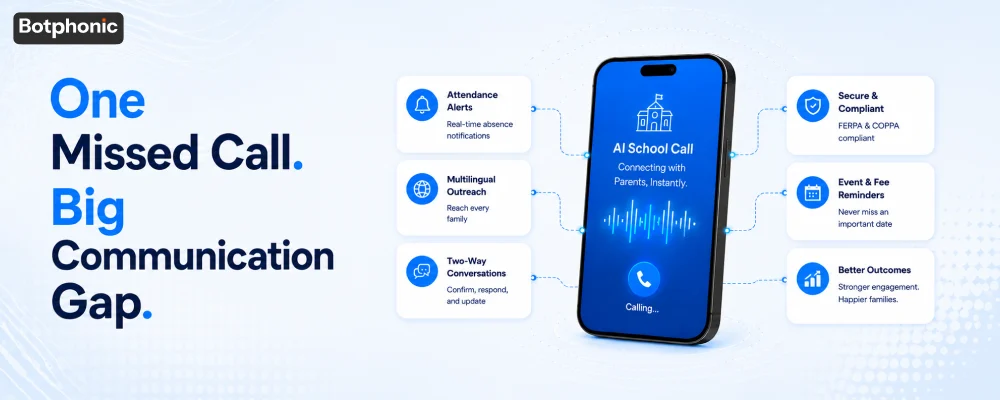
AI phone calls for parent communication are automated, two-way voice conversations that schools use to reach families about attendance, emergencies, and events. They are built for school administrators and district communication teams. When families miss critical messages, student safety and engagement suffer.
Why Is Communication Between Teachers and Parents So Hard?
The current system isn’t working since time is limited on one side but not on the other. A school with 600 students cannot reach out to each family when anything occurs, and parents can’t always be available when called at work.
Pew Research Center (2024): Over 97% of the population own a mobile phone in America today, but the percentage of call answering for unknown numbers has decreased dramatically. There is no point in reaching out to parents; they just don’t answer.
Parents Work During School Time
Parents get calls from schools during their working hours, which fall between 8 AM and 3 PM. No one ever answers calls from an unrecognized phone number during a workday. The message goes into voicemail, no confirmation of absence is given.
Administrators Are Also Overburdened
It takes a lot of effort for the school office employees to check attendance and visitors at once. Calling 30 parents manually about unconfirmed absences isn’t an approach; it’s just a waste of time.
Email and SMS Have Their Limitations as Well
The average email open rate in educational institutions is about 28% (Mailchimp Industry Benchmarks). SMS is read but does not allow verifying a response or taking it into account, adjusting to a different language, and transferring the call to the person if necessary. None of these methods can replace the conversation.
What Is an AI Phone Call for Parents’ Communication and How Does It Work?
An AI phone call for parents’ communication is an automated voice call through natural language processing technology initiated, responded to, and recorded without human involvement in calling. This is how it works for schools.
An AI makes a phone call, sends a personalized message including the student’s name, grade, and the particular situation and waits for the spoken reply of the parent. If the parent confirms the absence, the information is logged in. If he or she asks any questions, the AI gives an answer. In case it requires human intervention, it is escalated.
From One-Way Messages to Two-Way Conversations
Standard robocalls deliver their message and then hang up. AI voice calls, such as calls using Botphonic’s school communication platform, allow for two-way communication. The parent says “she’s sick today, she’ll be back tomorrow,” and that response gets logged into your attendance management software.
The Human Element Is Protected By The AI
The system does the heavy lifting and the repetitive tasks, but a human deals with the nuances. Behavioral issues, custody battles, and mental health discussions must never be handled by AI. That’s where the system identifies these situations and brings them to the attention of the correct staff person.
What Are The Actual Results Of AI-Based Phone Calls?
Actual numbers and results always matter more than marketing speak. Here’s what Botphonic’s platform has accomplished in a high-volume, frequent communication setting—and what that can mean for your school outreach program.
What Botphonic’s Platform Accomplished For A High-Volume Communication Program
In a financial services company utilizing the Botphonic’s Voice AI Agent for managing high-volume customer communications, 28 hours of weekly savings were recorded in call handling time, a 30% reduction in customer attrition resulting from lack of follow-up, and a 32% increase in customer satisfaction metrics, all accomplished without any hiring of additional personnel.
The equivalent to the school environment is clear. The school office staff deal with the very same constraint: the big contact list, the short window of opportunity, and the non-scaleable process. The categories of optimization include staff hours saved, reduction of missed contacts, and increased response rate.
For a school of 500 pupils, the impact will be as follows:
- If staff spends 2–3 hours daily on attendance calls, AI automation will recover this lost time back in less than one month.
- Previously unreachable families because of the limitations in call volume will now be included in the contact routine for the first time.
- Higher confirmation rates due to faster call initiation by AI system after recording the pupil’s absence (not many hours later when the parents had moved on).
 PRO TIP
How Does AI Calling Enhance School Operations?
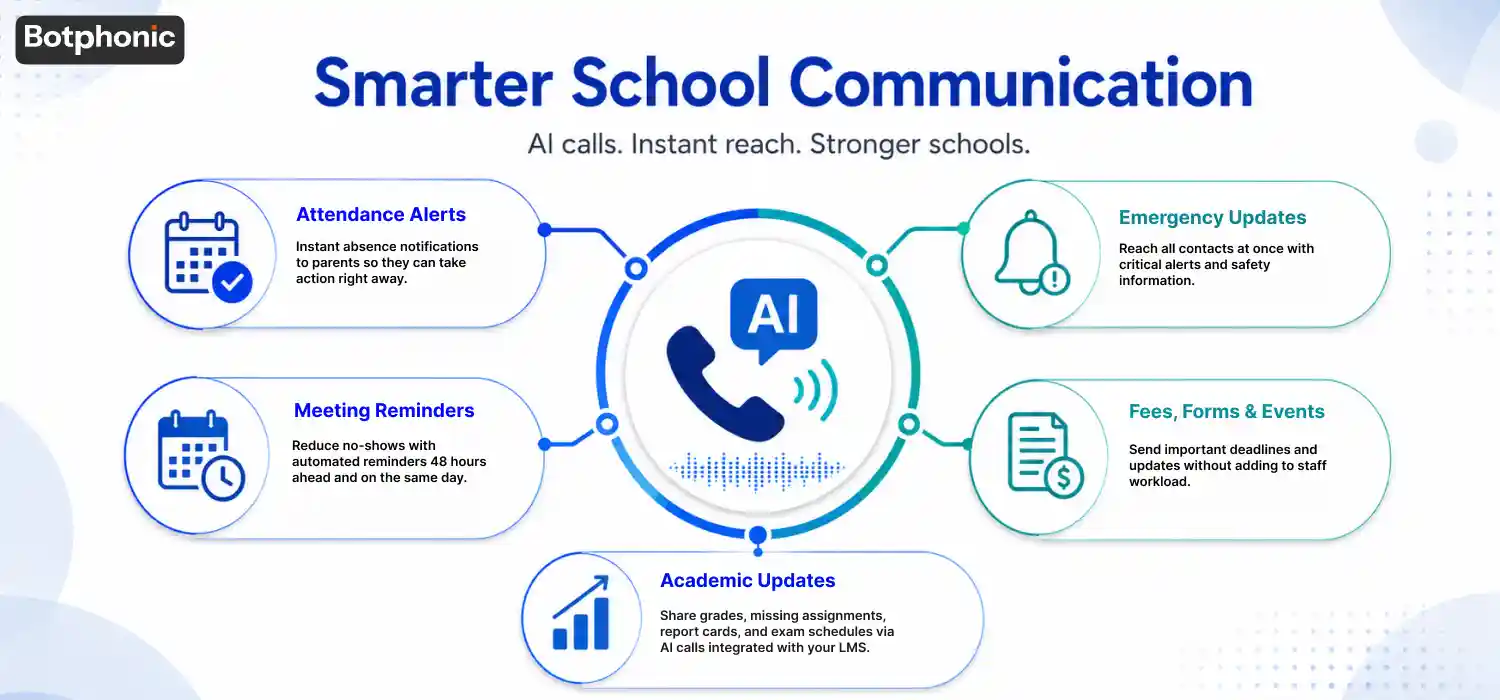
AI calling enhances school operations through the automation of high volume-low complexity communication tasks, whether it’s school admissions or prom queries. This is where the greatest gains will be realized through technology.
Immediate Absence/Attendance Notification
If a student is noted as being absent from class in your attendance management software or student information system, whether PowerSchool, Infinite Campus, or some customized SIS, then the automated phone call can go out immediately. Parents receive the alert and follow up right away, all before the beginning of the second class.
Emergency Closures and Safety Information
Whether it’s a weather related closure or some sort of safety issue, schools need to be able to send out messages rapidly. With the power of AI calling, all contacts are reached at once – not serially. A message that would take two staff three hours to manually dial and deliver takes less than ten minutes.
Reminders for Parent-Teacher Conference
The no-show percentage at parent-teacher meetings can go up to 30-40%. It can be brought down with automated reminders sent 48 hours ahead and on the same day, but it doesn’t consume the time of the employee who needs to make a whole day of phone calls.
Fee, Permission Form, and Events Deadlines
Field trip permission form, lunch money balance, deadline for school events registration are low-priority messages that still have a lot of traffic. They are managed with the help of an AI call assistant with no need to divert the attention of the employees from the students.
Notifications About Academic Performance
Notifications about missing assignments, access to report cards, examination schedule are sent to the parents through AI phone calls linked to your learning management systems for schools, such as Canvas, Schoology, Google Classroom.
How Is AI Calling for Parent Communication Delivered to Families Who Don’t Speak English?
Voice notifications via AI phone call for parent communication in other languages are provided through multilingual voice conversations which detect or preset the language preference at the contact level. It is one of the most obvious instances of equity that AI phone calls provide.
PRO TIP
When schools have a lot of Hispanic, Chinese, Haitian, or Arabic speakers, they tend to have parents who get only English messaging and then disconnect. Botphonic’s multilingual voice AI agents enable schools to send the same attendance call or emergency call in the preferred language of the parent.
AI Calls vs. Email vs. SMS: Which Channel Works Best for Schools?
AI phone calls for parent communication work best for time-sensitive, response-required situations. Each channel has a role. Here is how they compare:
| Communication Method | Best Use Cases | Advantages | Limitations |
| Manual Phone Call | Sensitive or escalated situations | Personal, nuanced | Time-intensive, not scalable |
| AI Voice Call | Attendance, emergencies, reminders | Two-way, scalable, multilingual | Not suited for emotional conversations |
| SMS | Quick alerts, links, confirmations | High open rates, fast | No conversation, language barriers |
| Newsletters, detailed updates | Detailed, archivable | Low open rates, easily ignored |
Schools that perform best use AI calls as the primary outreach for urgent and recurring messages, SMS for follow-up confirmation, and email for documentation and longer updates.
How Does AI Calling Integrate With Current School Software, And What Should IT Directors Consider?
AI calling integrates with current school software by utilizing one of two integration options: Real-time API connection and scheduled CSV data synchronization. This is not only a matter of technical implementation, it defines the speed of your calling process and accuracy of your data.
API Integration VS. CSV Data Synchronization: What Is the Difference?
The integration via API means that Botphonic will get connected to your student information system, school management software or attendance management software through a live data feed. In case a student is marked as absent in PowerSchool or Infinite Campus at 8:14 AM, the call is triggered at 8:15 AM.
CSV data synchronization means that your SIS or school management software exports the data into a file format and sends it to Botphonic according to certain schedule, once per day, for instance. It is easier to implement, as it doesn’t involve API authentication and any software development work on the IT side. However, calls are launched according to the schedule, not in real time.You can also check the best AI call assistant for student admissions to make your decision easier.
Which Integration Should Your School Choose?
| Factor | API Integration | CSV Sync |
| Call trigger speed | Real-time (seconds after event) | Batch (hourly or daily) |
| IT setup complexity | Moderate, requires API credentials | Low, export/import configuration |
| Best for | Attendance alerts, emergencies | Event reminders, newsletters |
| SIS compatibility | PowerSchool, Infinite Campus, Skyward | Any SIS that exports CSV |
| LMS compatibility | Canvas, Schoology, Google Classroom | Same, via export |
| Ongoing maintenance | Low once configured | Minimal |
For attendance and emergency communications, API integration is the right choice. For event reminders and non-urgent academic updates, CSV sync is sufficient and faster to deploy.
Three Things that IT Directors Need to Verify Prior to Integration
Before you integrate Botphonic with your SIS/LMS, there are three questions that your IT department needs to answer prior to the implementation. First, does your SIS vendor support the usage of third-party APIs and what are the terms of the data sharing agreement? Secondly, does the integration send only those fields that are required for communications (name, grade, phone number, preferred language)? Lastly, is the data encrypted during transmission, and does the vendor have an active SOC 2 Type II certification?
Botphonic is certified with SOC 2 Type II, GDPR, and HIPAA standards. To implement the system in schools, make sure that the agreement with the vendor is compliant with FERPA’s school official exception.
How Can Schools Build Parent Trust in AI-Powered Calling?
Schools can build parental trust in AI-based calling through transparency, privacy assurance, and a clear escalation process. Below is how it is done.
Let Parents Know about AI Use
Send a letter home or an email before your first AI call is made. Explain how your school uses AI for attendance and reminder calls, and that there’s a human available too. Parents who know to expect AI calls make them. Parents who don’t know to expect AI calls will be suspicious of them.
Student/Family Data Protection
AI calling services that integrate with your student management system must comply with FERPA. Ensure that your service provider does not collect more than is required of personally identifiable student information. If your district uses any online applications for children under age 13, COPPA applies as well.
When the Human Needs to Take Over
Establish those rules ahead of time. Calls involving any behavioral issues, custody concerns, safeguarding flags or emergencies must go straight through to staff. Where the AI stops, the human takes over.
What Should Schools Audit Before Implementing AI Calling?
- Prior to implementing an AI-based telephony solution, schools should undertake an internal audit of their current communication problems and issues with data quality. Checklist:
- Audit your current communication problems. What communications are being missed? Are you missing out on attendance, events, emergencies?
- Clean up your contact data. Bad numbers in your student information management system will impact delivery right off the bat.
- Determine your priorities in communication. Attendance is priority number one. Emergencies number two. Events and reminders number three.
- Ensure your system is multilingual. Which languages do your families speak? Is your provider multilingual?
- Select your preferred method of integration. API for real-time purposes. CSV synchronization for batch communications.
- Specify your escalation protocol in writing. Whom does the call get escalated to if flagged by AI?
- Educate your office staff. They need to know what AI deals with and what it escalates.
- Notify your families before implementation. One communication in advance saves you a lot of hassle later.
- Monitor engagement at 30 days. Measure answer rates, confirmation rates, time saved by staff.
