Summarize Content With:
Summary
We discussed in this blog how an artificial intelligence (AI) system that makes phone calls can radically change the way the BPO centers communicate with their customers, increase the centers’ productivity, and improve the customer experience. We also covered the benefits, botphonic-centered real-life implementations, challenges, and future perspectives of the technology.
Key Takeaways
- An AI system for making phone calls can bring about a whopping reduction in costs and average handling time in BPO operations.
- Such a system can handle a large number of both inbound and outbound calls, allowing human agents to focus on complex tasks.
- Moreover, these systems improve the quality of interactions between customers and the company’s staff, as well as their consistency and personalization.
- Even though AI call pros in BPOs bring significant benefits, implementing the technology requires the right design, compliance, and worker re-skilling.
Introduction
What if you were to phone a support line and hear a humanlike voice that was kind, patient, and helpful, but it was not a person? It is AI that powers that voice.
A revolution is underway in the BPO (Business Process Outsourcing) sector, where the implementation of AI phone call systems is no longer a thing of the future but has become a standard daily practice. By designing an AI phone call system for BPO centers, companies like Botphonic are at the forefront of this change, enabling voice-first AI not only for customer service but also for sales and beyond.
This blog will explain to you how this transition changes the game, why BPO centers are implementing it, and what cautions you should take when considering intelligent voice automation.
The Rise of AI in BPOs: Why Now?
Changes in the BPO industry have been quite noticeable over the past year or two. The providers of such services need to deal with a demanding customer environment, rising costs, and the challenge of hiring and training large numbers of agents. On the other hand, one cannot overlook the significant progress made by a variety of AI technologies over the last few years, especially in the field of voice AI. These two parts of a story come together perfectly now.
According to available information, AI applications in the BPO sector are estimated to grow at a compound annual growth rate (CAGR) of roughly 25% over the years 2023-2028.
A survey conducted by the BPO industry found that over 65% of BPO companies have already adopted AI for customer-facing tasks to increase both efficiency and client satisfaction.
Voice AI is becoming a breakthrough in the BPO industry because it can handle monotonous or predictable calls, freeing human agents to focus on more complex or emotionally sensitive parts of the call. Moreover, AI-powered devices today offer excellent speech recognition, and the synthesised voice sounds pretty natural. Simultaneously, the discourse became more natural and fluid thanks to real-time intent detection.
 NOTE
NOTE
What Is an AI Call System for BPO Centers?
An AI phone call system for BPO centers is a voice-enabled, intelligent conversational technology that can process and make phone calls, engage in common conversation with humans, perform tasks (like looking up or checking a database), and, when necessary, hand over to humans. In other words, it’s a virtual agent that can be reached over the phone.
An ideal illustration of such a system is Botphonic’s AI call center software. “Aria,” their AI helper, is incredibly flexible both within and outside. It can qualify leads, do payment follow-up, booking, or customer support in any workflow, inbound or outbound, or even a mix of both.
Besides that core technology, the system architecture usually also encompasses:
- Speech Recognition (ASR): Hypothesizes the words that were spoken, and basically converts speech into text
- Natural Language Understanding (NLU): This part of the system deciphers the request of the user
- Dialogue Management: It talks about responding to work
- Text-to-Speech (TTS): It takes AI’s answer and converts it into the most natural way a human voice can be imitated
- Call Actions / Workflows: Pulling together the pieces of a call (callback, escalation, survey)
- Analytics and Reporting: Provides metrics, sentiment, and other KPIs
Learn more: How to Set Up AI Phone Calls in 5 Simple Steps
Key Benefits of AI Phone Call Systems in BPO Communication
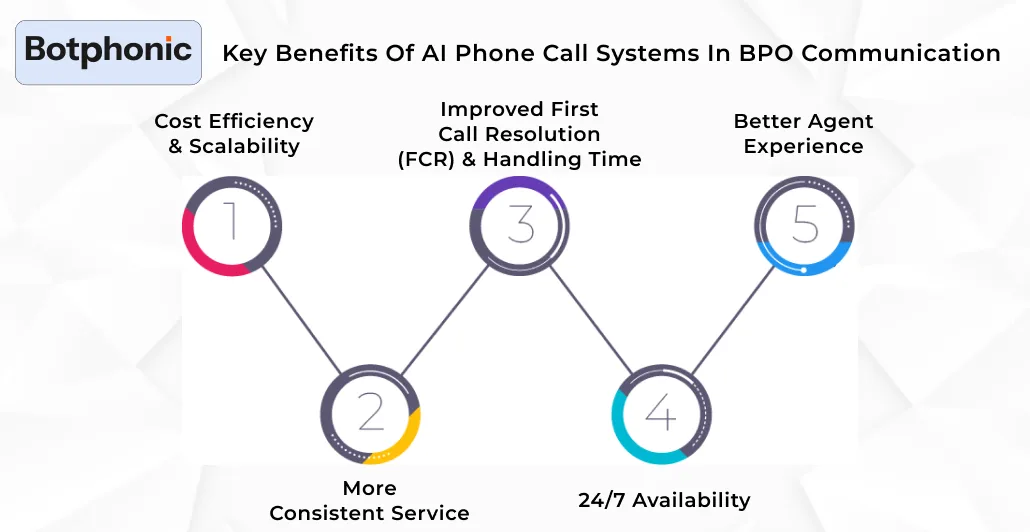
If BPOs install an AI phone call system, they can open up these chief advantages. Most companies, in order to fully enjoy these advantages, decide on the solution of Botphonic’s AI Call Assistant that helps BPOs to voice workflow automation in a fast and large-scale manner.
1. Cost Efficiency & Scalability
AI voice agents are a good way for BPOs to reduce labor costs, especially when many calls are repetitive or low-complexity. Businesses may expand without hiring more employees thanks to AI-driven voice technologies. By automating repetitive processes, Botphonic’s AI call center software can drastically save operating expenses.
2. More Consistent Service
AI agents do not waste time and reduce wait time by responding immediately. They also adhere to the pre-established scripts, so the quality and the content of the communication are always at the same level. Stability is one of the ways companies use to maintain a very high standard of customer service across thousands of calls.
3. Improved First Call Resolution (FCR) & Handling Time
AI-powered solutions can efficiently collect data, help in call routing, or solve straightforward problems. According to voice-AI industry benchmarks, companies that use such systems reduce average handling time by 20–30% and improve first-call resolution by 15–25%.
4. 24/7 Availability
AI voice agents do not require breaks or shifts, so they can operate nonstop. Even at the most inconvenient times, they are available to take over your inbound calls. Therefore, BPOs can now promote themselves as being accessible at any hour of the day, consequently satisfying customers who expect fast responses.
5. Better Agent Experience
AI can perform the most boring, repetitive, and uninteresting jobs. Human agents are freed from the time-consuming tasks of reminders, appointments, and routine follow-ups, allowing them to concentrate on valuable, emotionally rich conversations with customers. The improvement in job satisfaction, accompanied by the reduction of agent burnout, is the outcome of this process. According to Helport, AI copilots evaluate the performance of human agents and coach them by identifying the tone and suggesting improvements.
Introduce real-time AI calling to your BPO. Customer requests were fulfilled at record speed, precision to perfection, and customer delight improved.
Be on with a Botphonic live demo and experience the magic of AI calls!Real-World Applications: How BPOs Use AI Voice Calls
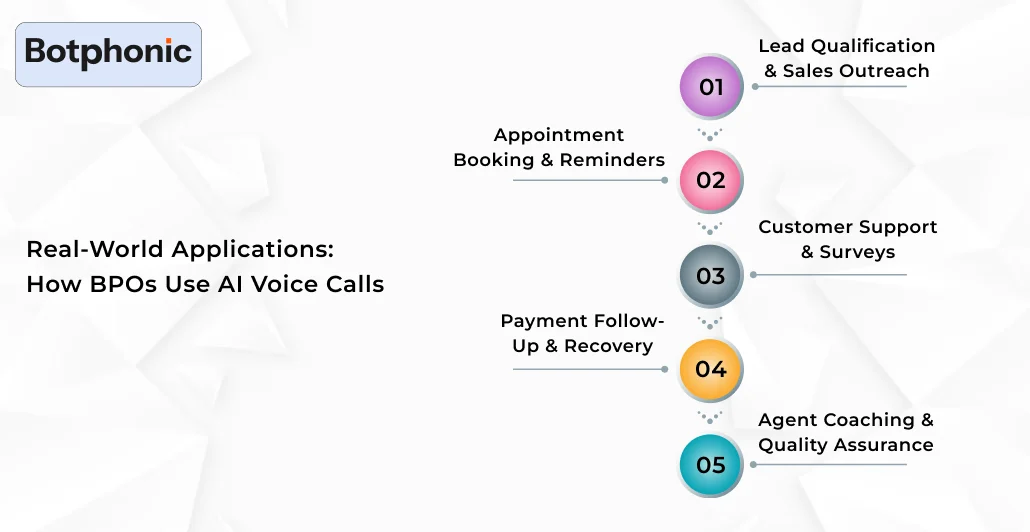
Let’s examine the usage of AI-driven calling systems by BPO centers in real-life situations. The Botphonic AI is highly adaptable, so BPOs may use it for various processes.
1. Lead Qualification & Sales Outreach
The AI voice agent can call leads in outbound campaigns, ask qualifying questions, and determine whether each lead is a good fit. By setting up a meeting with a human agent or directly inserting the lead into the CRM, the lead can be followed up on. The repetitive task of lead qualification is thus automated, allowing BPO teams to save time.
2. Appointment Booking & Reminders
BPOs sometimes handle scheduling for clients: interviews, service appointments, and illness calls. An AI phone call system for BPO centers can definitely call customers, present available slots, confirm bookings, and send automated reminders. The benefits are that it reduces both no-shows and the manual labor involved.
3. Customer Support & Surveys
AI agents can accept inbound calls from customers regarding basic issues and assist with FAQs, billing, and order status. Without a doubt, the AI agents can be proactive in reaching out to customers for feedback or surveys. The voice recording system captures responses, and the data collected is then shared with the client system.
4. Payment Follow-Up & Recovery
Voice AI can perform follow-ups in a polite, automated manner to remind customers about their pending payments. It can remind customers, grant their requests by establishing payment plans, and, if needed, give the option to escalate to a human agent.
5. Agent Coaching & Quality Assurance
Besides handling customer interactions, the AI voice system, such as Botphonic’s, can not only hear agent calls but also analyze them, comprehend emotions, provide suggestions, and coach them. BPOs use it for agent training, to prevent quality decline, and to enhance performance. Helport’s AI coaching model demonstrates the effectiveness of real-time feedback for daily agent development.
Conclusion
As business-process outsourcing companies evolve, a significant number of them are opting for conversational AI phone systems to maintain their automation at a large scale while still being able to interact with customers with a voice that sounds natural and humanlike.
There are problems, for example, ranging from security to customer trust issues, but the potential benefits are huge. If you are running a BPO or managing it, then voice automation should be on your list of priorities to investigate right now. Implement a pilot program, assess the effects, and decide on the next steps. When Botphonic is your call partner, you are not only building a BPO that is ready for the future and is voice-first, but also one that combines efficiency with empathy.
Do you want to revamp your BPO communication style? Don’t wait any longer and give Botphonic a try for free.