Summarize Content With:
Quick Summary
Enterprise call centers are going through a major shift, either structural or generational. AI is no longer considered a simple tool but it has become a necessity for any organization. Organizations who have got this correct are actively improving their customer experience and scaling smoothly. Those who still haven’t got this correct are hiring more agents to solve old problems. And what do you think is the real differentiator, it’s balancing stability with airtight security.
Introduction
Customer service used to be more reactive. For instance just answer the phone, resolve the issue, and move on. But this model has become outdated as per today’s work logic. Customers are looking for quick and accurate responses that are personalized across different channels for them 24/7.
No one calls a contact center. They make calls because something has gone wrong, something does not make sense, or something has to be fixed.
That is what your agents have to work on a daily basis. And this is tougher than ever. Volume is soaring, customers are getting impatient, and in your HR data there is a figure quietly telling you how many agents had left without uttering a word last quarter.
The name enterprise AI call center solution has now been among the most popular phrases in the CX sector – and the most misperceived. There are those vendors who will say that it is a revolution. Others give you a glorified chatbot and refer to it as AI. Both of these descriptions are not very helpful in the situation when you are the one who has to make a decision about the budget and live with it.
Then, take it straight: what is AI actually doing in a call center, why it is important particularly to large organizations, and what you should reasonably expect – both of the technology, the implementation, and the ROI.
Why Is the Traditional Call Center Model Breaking Down for Enterprise Teams?
The current enterprise contact center is glued by the old infrastructure, good intentions in the form of workarounds, and individuals doing their best in the conditions that are genuinely challenging.
The typical agent today juggles six to nine different screens during a single call. They are multitasking, looking up a CRM that has not been updated since the last administration, plumbing through a knowledge base that was developed by someone who dropped out of the company two years ago, attempting to remain emotionally present with a customer who has been waiting in a queue eleven minutes already.
Switching between six to nine screens per call isn’t a performance problem, it’s a systems problem.And it flows down in a single direction: down.
When the agents are unable to locate the answers immediately, the handle times increase. Increase in handle times results in an increase in queue. Customers come in angrier when queues increase. In cases where the customers come in with anger, the calls become difficult. Agents become exhausted when the calls become more challenging. When agents are burnt out at a higher rate, you are paying more on recruitment and training. And the cycle repeats.
A well-implemented enterprise AI call center solution is designed not to replace agents, but to ensure the systems around them stop working against them.
Why This is Important to Enterprise (Not Just SMBS)
Smaller businesses can absorb inefficiency. Enterprise contact centers cannot, the sheer volume of contacts, number of channels, compliance requirements, and geographic spread make every point of friction expensive.
At enterprise scale, a 90-second increase in average handle time can cost millions of dollars per year. That is why the case of ROI of AI sounds so strong in this level.
What Does an Enterprise AI Call Center Solution Do? (Beyond the Buzzwords)
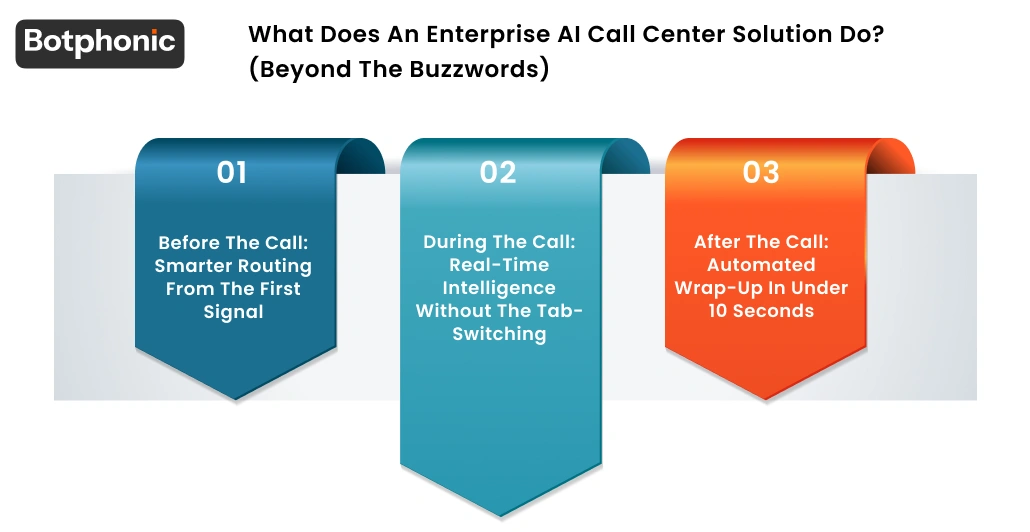
Let’s be precise. A company AI call assistant is not a single-purpose tool, it is a coordinated intelligence layer that will work throughout the entire lifecycle of customer interaction: prior to the call, during the call, and after the call.
1. Before the Call: Smarter Routing from the First Signal
AI examines the incoming signals: caller history, the page they were on when calling, their account status, forecasted intent, and routes the caller to the right agent before anyone picks up not ‘press 1 for billing.’ Intent-driven, contextual routing that has reduced misrouting by up to 40% in early deployments.”
2. During the Call: Real-Time Intelligence Without the Tab-Switching
A live transcription engine feeds a reasoning model that elevates relevant pieces of knowledge articles, proposes next-best actions and silently indicates when the customer sentiment is on the decline, all within the current interface of the agent, and the agent does not need to search anything.
3. After the Call: Automated Wrap-Up in Under 10 Seconds
After a few seconds of the dialogue, AI composes the overall summary, records the reason code, forms the CRM record, and marks the follow-up assignments. Agents review and confirm rather than writing them down anew – reduce a 4-minute wrap-up procedure to 8 seconds.
 PRO TIP
How Does an Enterprise AI Call Center Solution Handle Peak Volume Spikes?
The experience in enterprise CX long enough, you have experienced at least one surge event that has put your infrastructure to the test. A product recall. An administrative system billing mistake that struck 200,000 accounts simultaneously. An overnight weather that caused insurance claims to skyrocket. Or, in retail, any Black Friday.
There are two ways in which traditional infrastructure can deal with these, either it buckles under the load, or you over-provision to meet the peak and spend eleven months a year paying on idle capacity. Neither is good business.
The equation is altered with scalable enterprise AI architecture. Elastic cloud infrastructure is automatically expanded with increased volume and contracted back to normal with decreased volume. The AI receptionist layers, routing, knowledge surfacing, and sentiment detectors do not perform as poorly as human-only systems.
A single enterprise retailer had made 6 million contacts over 18 days of peak season – about 10x their normal volume – with no infrastructure incidents and a CSAT score that remained at 4.6 of 5.
- One of the largest banks in the US has implemented an enterprise AI call center solution on 2.1 million calls per month and has decreased the average handle time by 34 percent without losing any level of compliance with PCI-DSS.
- With AI triage, a healthcare payer reduced after-hours escalations by 58 percent and processed member inquiries concerning benefits and claim status with no PHI disclosure.
To IT leaders comparing platforms, the major inquiry is not: can your system sustain peak load? but: demonstrate your SLA wording in burst load situations, and the contractual fines in case you fail? The latter response is all you need to know.
STAT ENTERPRISE DEPLOYMENT BENCHMARKS
- FCR change: 2834% within 6 months.
- AHT decrease: 30-40% -with no CSAT loss.
- Turnover of the agents: 25-30 percent reduces at the 12-month point.
- Cost per interaction: Falls from $14–18 to $6–9 (fully loaded)
Is an Enterprise AI Call Center Solution Secure Enough for Regulated Industries?
The enterprise contact centers work with some of the most sensitive information within an organization. Payment card numbers. Social Security details. Secured health data. Legal complaints. The compliance requirements are not optional, neither are they one suit fits all.
Any serious enterprise AI call center solution needs to find its way around GDPR, HIPAA, PCI-DSS, SOC 2 Type II, and CCPA as the minimum standard, and industry-specific demands of FINRA, the FCA, or state insurance regulators begin to come into play.
These are some things that you can not compromise on in your security assessment:
- PII redaction not post-call scrubbing. Unredacted storage of card numbers, and SSNs, should never be reached.
- Regulated industries customer managed encryption keys (CMK). You must be the owner of the keys of your own data.
- Unchangeable, cryptographically signed audit records of each AI decision, routing decision and escalation.
- Real multi-tenant isolation of your model and your data should never be leaked into the space of some other enterprise.
- Anomaly detection A flagged behavioral outlier based on AI: exfiltration patterns, agent unusual access, possible account takeovers.
Learn more: AI Call Centers for Inbound Support Teams
Does Enterprise AI Call Center Solution Assist Agents or Replace them?
This is the question that arises in almost every business analysis, and it should be answered straightforwardly: used wisely, AI in a call center enables but does not replace the agents.
The tasks that an AI receptionist relieves an agent will have include the tasks that result in burnout, repetitive requests, cross-system search, post-call report, and the cognitive load of changing tools during a conversation. The work which good agents themselves find significant is what has been left behind, the fine-tuning of solving a problem, the compassion, the decision-making.
Real Agent Empowerment in Practice
- Knowledge surfacing: the correct solution will be introduced into the working process of the agent even before they complete the sentence.
- Sentiment coaching: prompting, live, in the background encouragement to de-escalate, empathize or pivot the conversation without cutting the talk short.
- Post-call automation: AI writes a wrap-up note, the ticket, the follow-up. Agent reviews and confirms.
- Workforce outcomes: 12 months on, enterprises record 42% decline in stress scores on agents and a 31% enhancement in agent NPS.
Only the deployments which continuously perform better are those which do much more than making a decision without involving the agents.
How Does an Enterprise AI Call Center Solution Integrate With Systems You Already Have?
Disruption is one of the most widespread fears of enterprise AI evaluation. When you have Genesys or NICE CXone to do your telephone, Salesforce to do CRM, ServiceNow to do ticketing and a year of institutional knowledge as your stock to draw on and build your own knowledge base; the thought of reaching it is intimidating.
The positive: Current enterprise AI-powered solutions integrate via API into the call center. They supplement your existing stack rather than substituting it. Because these solutions connect directly to key telephony platforms and CRM systems, you can place the AI layer between your current tools and your agents. This layer receives context from every source simultaneously without forcing agents to alter their methods of operation
An actual deployment would resemble:
- The agents retain their existing desktops and telephony applications.
- The system integrates the AI as an intelligence panel within the existing interface.
- Administrators configure routing rules and knowledge sources using a new layer.
- IT coordinates the API links to systems that they already possess.
The straightforward part is normally the integration. Change management is the more difficult task: integrating AI call center software can be set to work just right and still fail to deliver services as it should when agents do not know it, do not trust it, or have never been consulted when it is being designed to present itself in their day.
 NOTE
NOTE
Things to Reconsider When you are considering an Enterprise AI Call Center Solution?
The market environment is saturated, the language has been standardized, and all the presenter decks of vendors sound exactly the same. Some of the questions that make it through the noise:
- Request that you have a live pilot on your live call data. It will only model on artificial data, while this is an indication that the model has not been exposed to actual production variation.
- Burst SLA language is very important. It does not mean much when uptime is referred to as the baseline capacity. Obtain language on peak-load performance on contract.
- Enquire about methodology of bias audit. When the routing choices are correlated with the demographic features, it is a regulatory liability. It is proactively audited by responsible vendors.
- Request the model lineage. On which foundation model is the system driven? Last time it was assessed regarding drift? In case they are not able to respond, this is a compliance and accuracy risk.
- Ask for 12-month cohort data. Neither the optimal deployment nor the worst-case deployment. What does a typical performance of a similar enterprise look like?
Does Your Enterprise Actually Need an AI Call Center Solution?
If your contact center handles more than 50,000 interactions per month, operates across two or more channels, and carries compliance obligations in at least one jurisdiction, the ROI case for enterprise AI is solid. You should check for different AI call center software pricing.
The technology has matured. While the organization has already established compliance structures, the platform itself rarely separates a high-impact deployment from one that stalls at the gate.
Established integration patterns mean that deployment speed rarely depends on the technology itself. Ultimately, human processes determine whether a rollout succeeds or fails. To ensure success, teams must secure agent engagement, maintain a realistic pilot scope, and establish the correct performance metrics from the start.
The contact center doesn’t have to be a place agents dread and customers avoid. With the right AI foundation, it can become a genuine competitive advantage.
Conclusion
The Enterprise AI Call Center Solution is a game-changer for large-scale organizations. It will provide a strategic advantage to the business through streamlined operations, enhanced customer experience, and agent empowerment. With the power of AI, organizations will be able to eliminate inefficiencies. Including decrease operational expenses, and increase customer satisfaction through the power of automation. The capability to integrate with existing infrastructure, organizations will be able to implement the solution. It involves without disruption to their business processes, maximizing the impact of the solution.
With the evolution of technology in the field of AI, the power of improving the overall customer experience and empowering agents is undeniable. For organizations that operate large-scale call centers that deal with large volumes of customers across multiple channels. The need to implement AI is not a choice; it is a necessity for the business to thrive. With the power of AI, your business will be able to achieve efficiency, reduce agent turnover, and provide a quality experience that will bring customers back for more
Tranform Your Call Center Operations With Botphonic
Schedule a Demo