Summarize Content With:
Summary
Conversational AI innovation is revolutionising healthcare call centres by automating the mundane and routine aspects of patient conversation, streamlining call handling. It also assists the healthcare providers in lowering hold durations, lowering costs, while improving patient experience overall.
Introduction
Just imagine a world where each patient call is answered by an intelligent response within seconds no long holds, no repeated transfers and no frustrated callers. This is no longer in some far-off future.
The United States healthcare industry is experiencing historically high call volumes, and patients demand quick, correct and friendly responses. The research reveals that more than 80% of healthcare patients report feeling frustrated when they cannot speak to a human being or receive timely assistance over the phone.
This is where conversational AI for healthcare call centres steps in. It relies on advanced natural language understanding to interact with patients as a trained agent would but 24/7, without hold times.
Understanding Conversational AI for Healthcare
Conversational AI is technology that can understand human language in either written or spoken form and respond in kind. In the world of healthcare, that means processing appointment requests, responding to FAQs, and even deferring traffic calls with high accuracy and speed.
Conversational AI enables machines to be able to process and memorise context, keep track of preferences, and establish multi-turn interactions. It does so via sophisticated algorithms, speech recognition and accessing real-time data from health systems.
How Conversational AI Works in Healthcare Call Centers
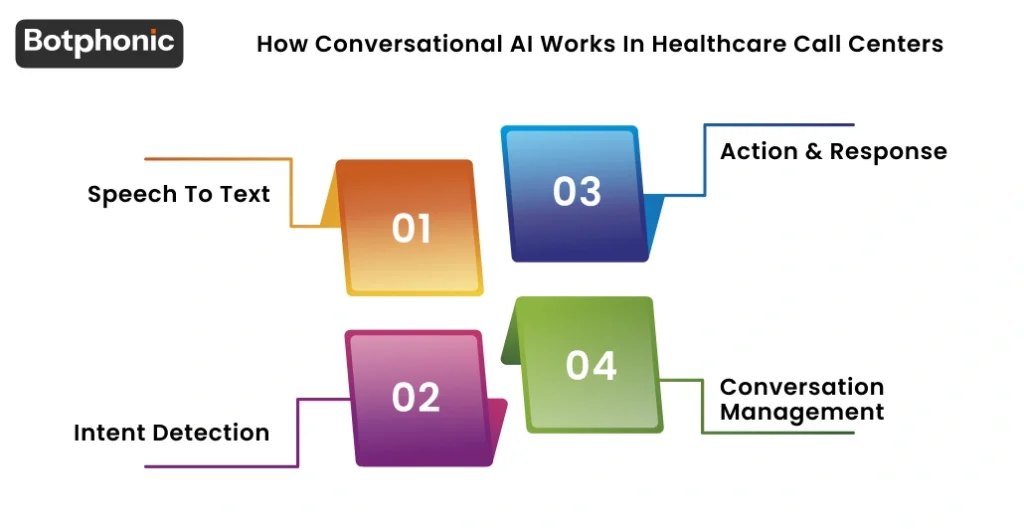
In healthcare call centres, conversational AI listens to the patient’s request (what it hears), understands intent and processes context, then responds with the right course of action or response.
No more one-size-fits-all menus like on traditional phone systems, but rather today’s AI listens and speaks in human language. This often involves four steps:
- Speech to Text: Changes voice commands into text.
- Intent Detection: Figures out what the caller wants (e.g., book an appointment, inquire about test results).
- Conversation Management: Determines the optimal option to respond or act on.
- Action & Response: Fulfils the request or escalates to a human agent.
And chatting AI can even extract available data from clinic calendars and patient records to confirm appointments or send reminders.
 NOTE
NOTE
Conversational AI vs Traditional IVR Systems
A traditional IVR system requires callers to punch numbers to make choices. For instance, “Press 1 for your appointments, 2 to be transferred to billing…” These types of menus create a source of frustration for patients, especially if their needs do not align exactly with the options.
Conversational AI IVR, however, can listen to what a patient is saying in natural language and understand it. So rather than the numbers, patients can instead now say:
- “I have to cancel my appointment.”
- “Can you please text me my test results?”
- “Is Dr Smith available tomorrow?”
As a result, the interaction is quicker, more human and much more effective. No longer do patients feel stuck in bizarre menu loops.
Why Healthcare Call Centres Need Smarter Communication Systems
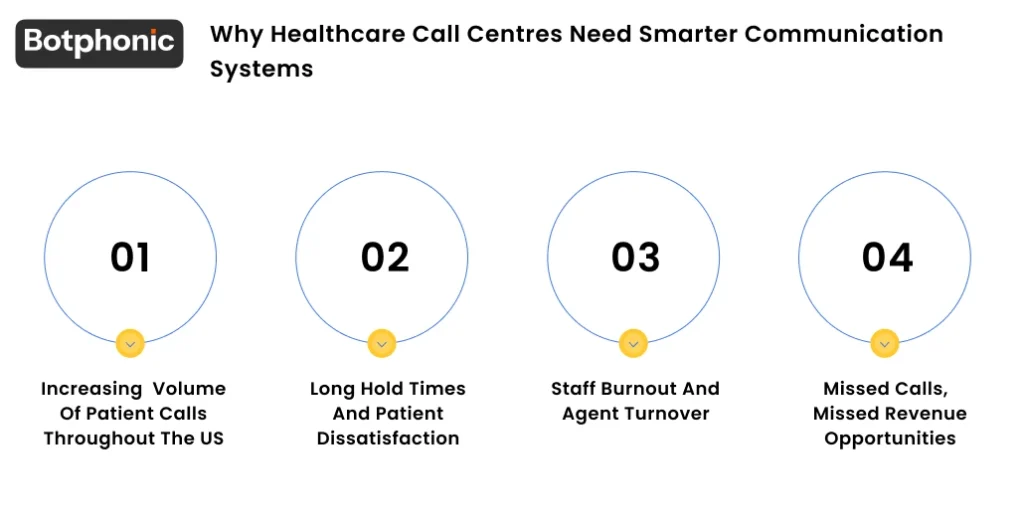
Healthcare call centres handle thousands of calls on a daily basis, from scheduling appointments to emergency questions. Many centres are still using these outdated systems that cause bottlenecks, delays and awful patient experiences. Smarter communication systems, such as AI that can converse with you, make these transition problems disappear.
Increasing Volume Of Patient Calls Throughout The US
Healthcare providers experience growing call volumes because of ageing populations, more preventative care visits, follow-ups and chronic disease management. No, most patients would rather have a phone call than wait for a portal message or e-mail.
Call centres without automation are often not able to keep up during peak periods, and patients must hold or call back multiple times.
Long Hold Times and Patient Dissatisfaction
Long waits irritate patients and reduce loyalty. Many callers simply hang up or abandon calls before they talk to an agent. This is bad for patient satisfaction , and it sends a message of poor service quality.
Conversational AI slashes hold times by responding immediately to typical questions and transferring more complicated cases to humans sooner.
Staff Burnout and Agent Turnover
Health care call centre representatives juggle repetitive and high-stress duties. Answering the same queries all day leads to burnout, diminished morale and rampant turnover which means higher recruitment expenses.
AI can take over mundane undertakings, freeing human employees to deal with sophisticated, significant interactions that lack empathy or judgment.
Missed calls, missed revenue opportunities
Every call that goes unanswered is another lost appointment or referral. Missed calls equate directly to lost revenue and patient satisfaction scores, especially in the fast-paced clinic or doctor’s office.
AI call assistant answers calls 24/7 and helps minimise missed opportunities whilst also increasing operational efficiency.
The Role of Healthcare Call Automation in Modern Clinics and Hospitals
Appointment reminder Call Automation is at the heart of how today’s clinics & hospitals are coping with increasing patient communication demands. It enables teams to answer more calls, get back faster and be consistent without adding pressure staff.
Now, instead of humans managing all the interactions, healthcare organisations have deployed AI to handle routine conversations and allow agents to concentrate on care-critical conversations.
NOTE
What Healthcare Call Automation Really Does
Healthcare call automation uses AI voice systems for predictable and routine phone calls. It picks up phone calls immediately, knows what patients want and handles tasks automatically without a human being in the loop.
Automation such as booking appointments, providing clinic hours, billing questions and routing of calls. Its lines of operation are alike; it means its posts 24 hours daily, never holds customers when they’re on hold.
Types of Calls That Can Be Automated Safely
Automatically stay connected to many of your non-clinical calls without compromising patient trust or care quality. These calls have specific rules that should be followed and don’t need an application of medical judgment.
Typical ones are appointment booking, reminders, insurance checks, prescription renewal requests or clinic location and simple FAQs. These are the calls that AI manages well and consistently.
How Automation Supports, Not Replaces, Human Agents
When is a healthcare call automation not a human agent? It eliminates the drudgery of repetitive tasks that suck time and spirit. Agents can concentrate on complex, emotional or time-sensitive patient conversations.
This balance can boost agent morale and decrease burnout. Patients are also getting help faster because AI is resolving simple issues before routing difficult cases to staff.
 PRO TIP
Key Benefits of Conversational AI for Healthcare Call Centers
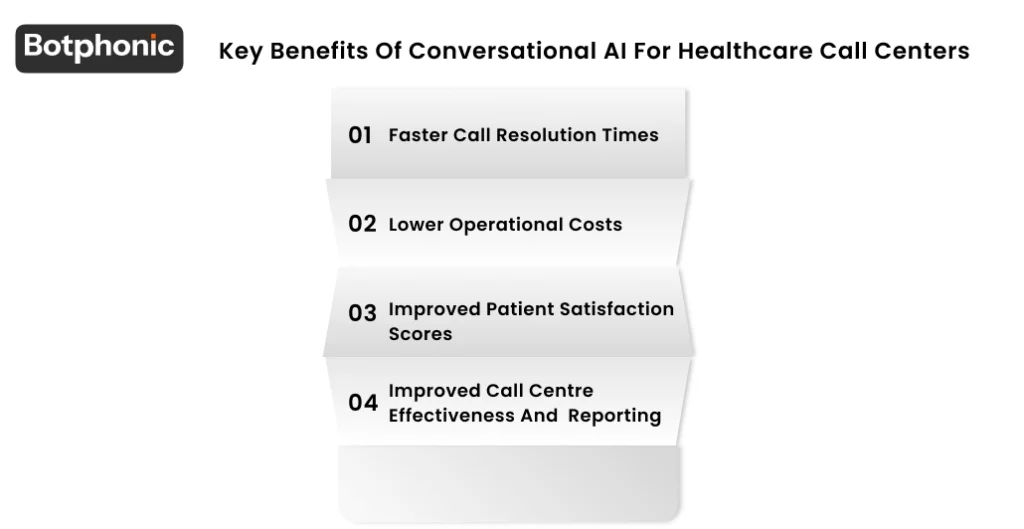
Healthcare call centres are seeing measurable added value from conversational AI, reducing time, boosting accuracy and elevating patient satisfaction. These advantages translate into efficiency of operation and patient satisfaction numbers.
Faster Call Resolution Times
Smart phone call automation is able to tackle a variety of patients’ needs in just seconds. Patients don’t spend time in long lines waiting to schedule visits or to ask questions.
When routine calls are handled by A.I., human agents respond more quickly to complex matters. This decreases the total call resolution time between center and the caller’s location.
Lower Operational Costs
Call centres for health care are big spenders on employee staffing, overtime, and training. Conversational AI decreases the number of calls processed by humans.
Automation makes it possible for businesses to grow without doubling the headcount. This creates predictable costs and allows for more optimal resource planning.
Improved Patient Satisfaction Scores
Patients appreciate fast answers and seamless conversations. Conversational AI answers immediately and speaks in a natural, polite voice.
The practice of uniformity increases the satisfaction score and diminishes gripes about long hold times or calls that go unanswered.
Improved Call Centre Effectiveness and Reporting
Conversational AI automatically monitors call volume, types of intents, resolution rates and high-peak hours. Supervisors have a real-time view of call centre activity.
These understandings assist staff in resource allocation, workflow management, and determining common patient concerns.
Patient calls never slow, but your team shouldn’t feel overwhelmed day in and day out. Botphonic enables healthcare call centres to automate the conversations and take every call, keeping patient communication seamless while reducing staff workload and operational complexity.
Contact Us Today!Use Cases of Conversational AI Across Healthcare Organisations
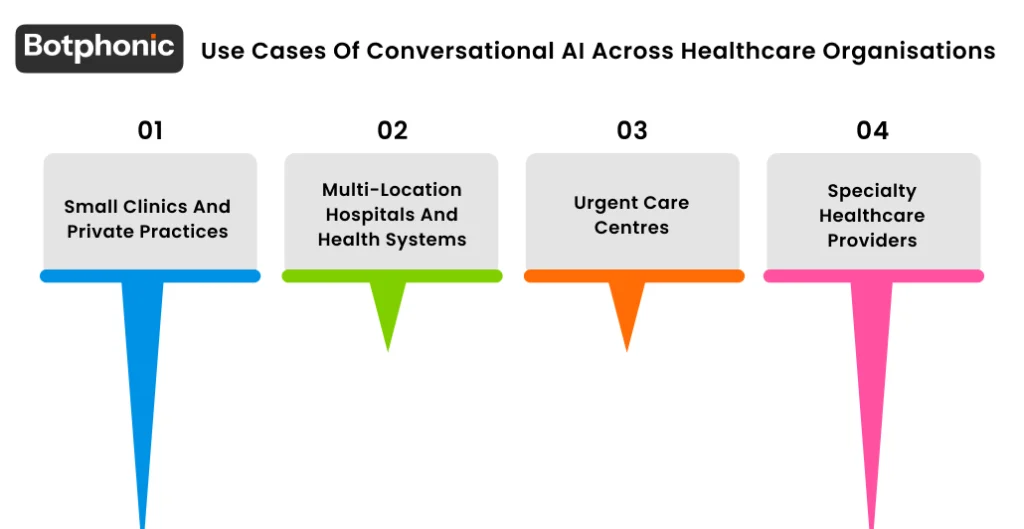
Conversational AI generalises to various healthcare settings. Small practices and large hospitals deploy it differently, but the underlying value is consistent: faster, more reliable patient communication.
Small Clinics and Private Practices
With little staffing, small clinics often experience failed calls. With conversational AI, every single call is answered, regardless of whether you’re busy at peak hours or if it’s after your closing time.
It gives small teams the image of a professional and responsive operation without needing to hire anyone else.
Multi-Location Hospitals and Health Systems
Thousands of calls are managed daily across departments within large hospitals. Conversational AI efficiently routes calls and manages common services, such as scheduling and billing.
This minimises ambiguity and helps patients get to the appropriate service department faster.
Urgent Care Centres
Urgent care centres have an uneven spike in calls. It can help manage surges in demand by capturing calls immediately and sending patients where they are needed.
This alleviates the bottleneck and increases patient flow, particularly during peak hours.”
Specialty Healthcare Providers
Specialists take detailed appointment requests and specific patient questions. Conversational AI handles intake, reminders and follow-ups with great efficiency.
This enables the specialists to concentrate on patient care rather than taking administrative phone calls.
How Botphonic Helps Healthcare Call Centres Communicate Better
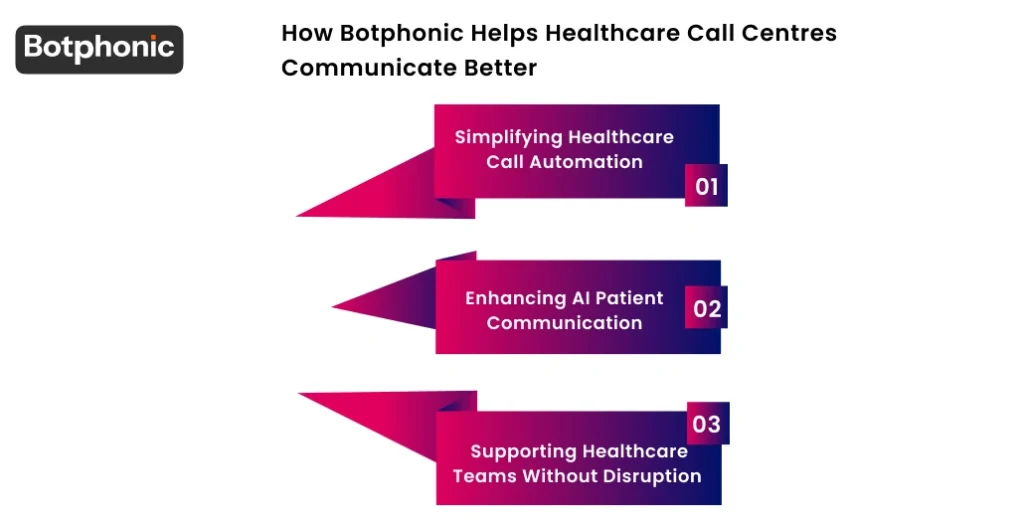
Here, healthcare call centres require generously simple to use tools that work without complication. Botphonic is built to enable clear communication and rapid setup, while allowing for trustworthy automation integrated seamlessly into daily health work.
Rather than asking teams to upend their processes, Botphonic fits into the current workflow and makes patient conversations better starting on day one.
Simplifying Healthcare Call Automation
Botphonic makes it easy to automate healthcare calls by automating repetitive call tasks. It picks up calls, comprehends the intent of patients and gets things done scheduling or routing a call without any downtime.
The system operates 24/7 to ensure that a patient query is never left unattended. They allowed clinics and hospitals to handle high volumes of calls without hiring staff or expanding hours.
Enhancing AI Patient Communication
Botphonic enhances AI conversation with patients by speaking the way people do, not as robots. Patients talk in their natural way, and the system responds in clear and polite tones.
This makes it a lot less frustrating and more streamlined. Patients receive immediate responses, and health care professionals ensure that call quality is even across all calls.
Supporting Healthcare Teams Without Disruption
Botphonic serves as an adjunct to health care teams, not a wholesale replacement. It eliminates mundane work so agents can concentrate on more sophisticated or delicate conversations.
The platform is easy integrate into current systems and workflows. It doesn’t require extensive training or technical know-how, so teams can start using it quickly.
Final Thoughts
Healthcare call centre conversational AI is not nice to have anymore. That’s why smarter communication systems are more critical than ever with soaring call volumes, patient expectations and staff burnout.
Healthcare call automation and AI patient communication enable clinics and hospitals to deliver care that is timely, efficient, and centered on the patient. Using the right platform, medical practitioners can better manage calls without compromising quality and trust.