Summarize Content With:
Quick Summary
Botphonic is designed to enable teams to have natural-sounding artificial calls in real time in a day, without engineers or jargon. It triumphs on the voice quality and rapid deployment.
Bland is designed to be constructed not merely to be composed. Its agentic workflow, its API depth, and its support of the custom LLM, should enable it to become the enterprise-grade option – should you have the technical horsepower to exploit it.
Introduction
Let’s begin with the thing that most of the reviews omit: there is no actual product choice when it comes to choosing between these two platforms. It’s a team decision. It does not require an answer on feature lists and more on how your organization operates, what level of technicality your team is, how quickly you need to move, and how complicated your conversations with customers actually are.
With that in mind, I have spent a grave portion of time, stress-testing both Botphonic and Bland, testing their demos, and setting up test campaigns, as well as, talking with individuals who use these tools in the field. What now comes is not a reformulated press statement. It is an actual meltdown, and the portions that will be particularly unwelcomed by either company.
Over the past eighteen months, AI voice calling has gone through the roof. A report from the U.S. Government Accountability Office states that generative AI is already helping transform daily tasks across much of society, and it even has potential to increase productivity across different industries. Where you used to require a full contact center staff to provide outbound sales calls, inbound support queues and appointment reminders, now only one engineer (or even a non-technical operator) can spin up a voice agent capable of making thousands of calls per day. Some of the platforms that have been pushing that change include Botphonic and Bland, although they have made very different bets on what the businesses actually need.
Botphonic: Built to the Rest of Us
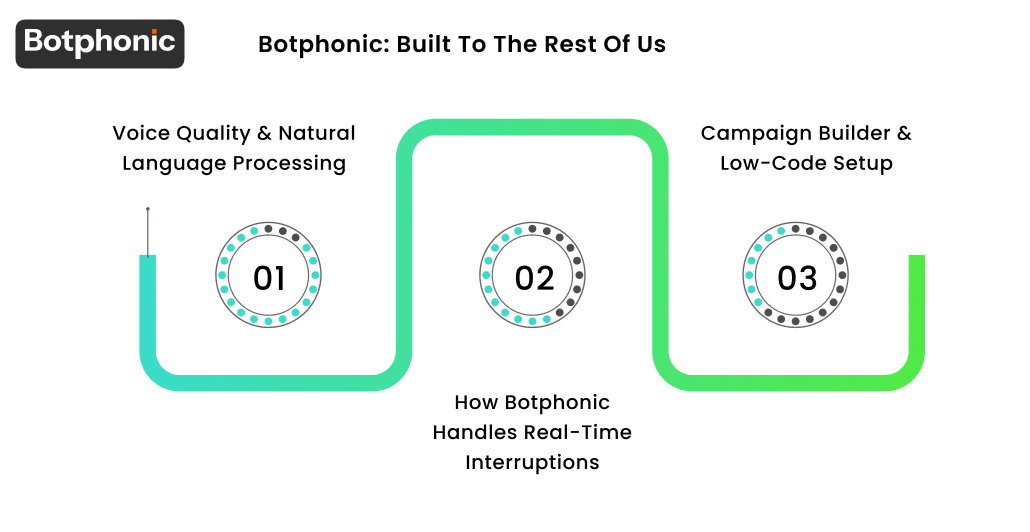
The Botphonic pitch is plain. Their vision is to become the place where any company can use AI call assistant that sounds and acts like a human to call a dental practice, a real estate brokerage, a middle-sized SaaS firm and never needs to write a single line of code. And honestly? They have been as near fulfilling that promise as most.
1. Voice Quality & Natural Language Processing
Botphonic has its reputation in the voice engine. The majority of AI voice assistants have what I would describe as the GPS problem – as soon as you start talking, you know it is not a person because it is stepping in the wrong place or making the wrong stress, or treating a joke like a concrete.
2. How Botphonic Handles Real-Time Interruptions
Botphonic has made an evident huge investment in correcting this. Their neural TTS engine manages to adjust its rhythm depending on the context, add micro-pauses where needed, and deals with interjections in the middle of the sentence with unexpected elegance. During the test calls, it was actually hard to identify the robotic tells that tend to reveal the voice AI.
Voice realism is not an added value, it is the distinction between a call that converts and the one that gets hung up on within the first eight seconds.
3. Campaign Builder & Low-Code Setup
Botphonic is a valid strength in its low-code campaign builder. You select an application use case – lead follow-up, appointment reminder, customer reactivation – pick a library of existing templates, edit the script, and attach your phone number. In the case of many teams, that would literally be hours of work on nothing to live calls. Through the dashboard, you can view real time call logs, sentiment snapshots and conversion tracking without any wiring up of a BI tool.
The price is per usage and the price is fairly transparent – you pay per minute of call time with volume-based tiered prices. This goes a long way to SMBs. You are not trapped in a seat based enterprise agreement that you will have to get three procurement approvals.
Where Botphonic begins to demonstrate its shortcomings: the point that the AI requires the ability to perform something complicated during the call. Need to find the record of a customer in your CRM? Real time deal stage update? Triggering a downstream API? They can be done, but they need to be worked around, and that includes post-call webhooks, external integrations, scripting. The platform was not designed around agentic depth and it becomes real when you poke it.
Botphonic: Strengths
- Voice naturalness competes with human callers.
- Painless low-code installation, up and running in hours.
- Deals with interruptions and turn taking effectively.
- Ready-made 20+ use case templates.
- Clear, small business-friendly pricing.
- Smooth dashboard that has embedded analytics.
Botphonic: Weaknesses
- Due to low complexity this might have a steep learning curve.
Bland: Experience Second, Infrastructure First
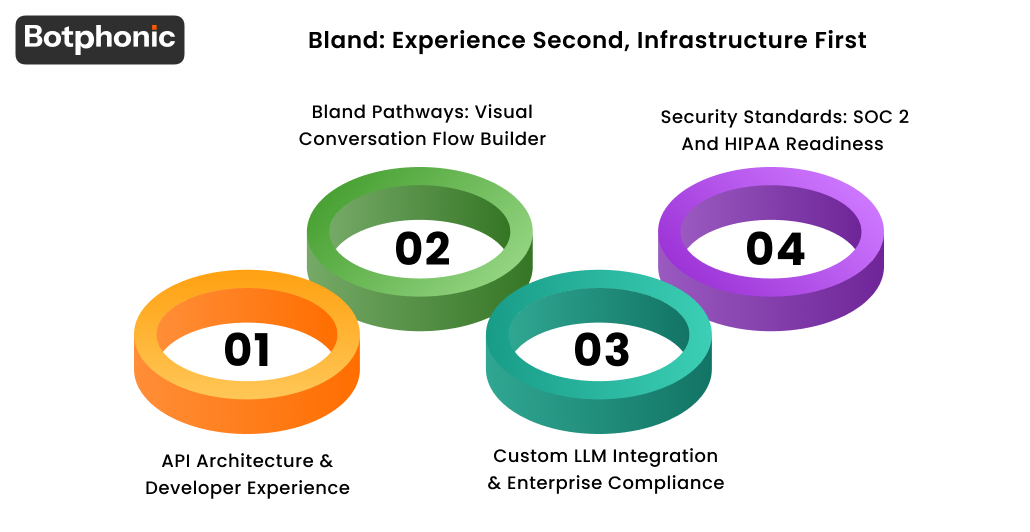
Bland treats voice AI like Stripe treats payments: provide developers with a perfectly crafted API, allow them to build whatever they want on top of it, and hope that the most sought-after products will be created. There is a cult following of engineering-led teams which that philosophy has genuinely deserved.
1. API Architecture & Developer Experience
The fundamental distinguishing factor is programmability. All aspects of a Bland call, including the logic of the conversation, the decision points, the live tool invocations, the post-call actions are all customizable via an API or in Pathways, their visual node editor. In case your sales process involves the AI receptionist checking an inventory database during the call before it gives you a price, Bland does so. Bland also does that in case you require the agent to act in a different way depending on the account tier of a customer, stored in Salesforce, prior to the first sentence.
2. Bland Pathways: Visual Conversation Flow Builder
The Pathways feature warrants a particular mention as it actually changed the ease of accessibility of Bland as a non-developer. Prior to Pathways, Bland was practically a developer product only. Today the operators can create complex branching conversation flows, via a drag and drop interface – conditions, loops, escalation paths, tool nodes, – without ever having to write code. It remains more difficult than Botphonic in terms of their approach based on templates, however it has become a lot less different.
3. Custom LLM Integration & Enterprise Compliance
Bland has no competition for custom LLM integration. In case you have a highly specific model that you have been training your company in a specific language, such as financial services language, medical terminology, and proprietary product knowledge, then you can directly integrate it into the calling infrastructure provided by Bland. It is a feature that Botphonic simply does not have and in regulated industries or in companies that have a specific language need; it is a true dealbreaker.
4. Security Standards: SOC 2 and HIPAA Readiness
Bland also provides SOC 2 certification and HIPAA-compatible settings on the compliance and security front. In the case of any business in the healthcare sector, financial services, or a regulated industry, this is not a choice but a minimum requirement. Botphonic is making efforts to have such certifications, and Bland is ahead in the present day.
 NOTE
NOTE
Bland: Strengths
- Fully programmable and controlled API.
- Live, mid-call tool calling (CRM, DB lookups)
- Custom LLM model support
- Traits of visual conversation logic.
- HIPAA-compatible and SOC 2-compatible settings.
- Growing to millions of calls a month.
Weaknesses
- Slopper learning curve in the absence of engineers.
- More time to initial production call.
- Slightly below Botphonic voice quality.
- Less transparent pricing on steroids.
- Template thinner than Botphonic.
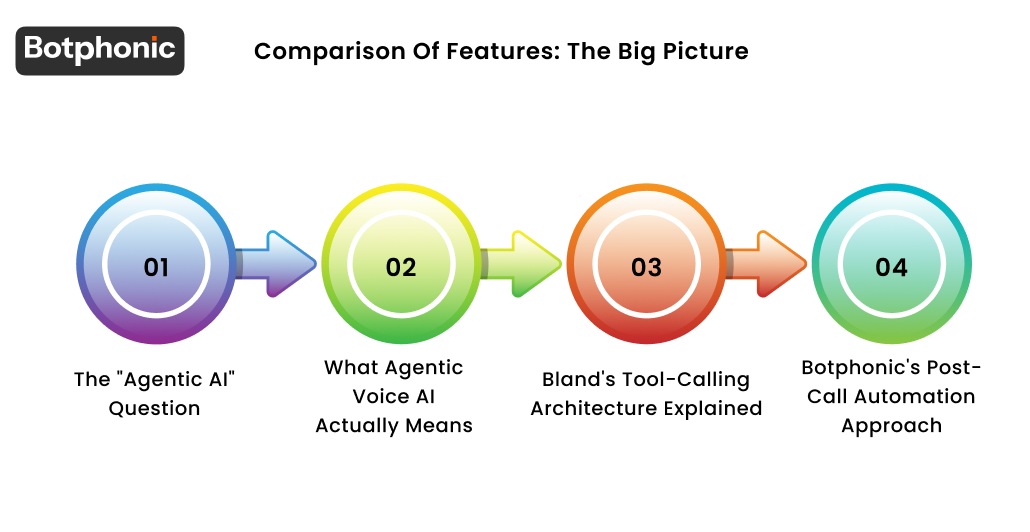
Comparison of features: the Big Picture
Here is where things lie on the metrics that are likely to count most when businesses are actually screening platforms – not just voice quality and ease of use, but the operational side of what makes the tool pass the first encounter with reality.
| Feature | Botphonic | Bland |
| Voice Naturalness | Best-in-class | Very strong |
| Code Setup | Low-code builder | Partial (Pathways) |
| API / Dev Control | Partial | Full API access |
| Custom LLM Support | Yes | Yes, plug your own |
| Mid-Call Tool Calling | Limited | Full support |
| Interruption Handling | Excellent | Good |
| Pre-built Templates | Extensive (20+) | Limited |
| Inbound + Outbound | Both | Both |
| Analytics Depth | Advanced | Advanced |
| Compliance (SOC2/HIPAA) | Available | Available now |
| Time to First Live Call | Days | Days to weeks |
| Pricing Transparency | Per-minute, clear | Volume-based, varies |
1. The “Agentic AI” Question
Now all the words agentic are flying about and much of it is racket. However, in the voice AI scenario, the term carries a different meaning and is truly relevant: can the AI actually perform actions on its own, in the middle of the call, without a human to veto every action?
2. What Agentic Voice AI Actually Means
Consider what that would appear like. A customer calls and inquires about the shipment of his order. A real agentic voice agent does not merely tell you to go and check on that, while reading off of the scripted response, but actually asks the order management system to take action, retrieve its current state, and communicate back with live information. Or it reviews if the customer has a pending credit and auto applies it before it gets transferred to billing. It is that freedom that makes the voice bot and a voice agent different.
3. Bland’s Tool-Calling Architecture Explained
Bland was constructed with this in mind. Its tool-calling architecture allows you to describe external functions that the AI can make calls to during a call – REST API calls, database reads, CRM writes – and the discussion proceeds around whatever the tool responses. This, in practice, allows you to create agents which actually execute end-to-end business processes, not just simulate them.
4. Botphonic’s Post-Call Automation Approach
Botphonic is less flamboyant. Post-call webhooks allow you to do post-call actions such as push a transcript into your CRM, change a lead status, send a follow-up email, and so on. That is most of the SMB use cases in a nutshell. However, in a situation where your workflow demands that the AI make a decision using live data prior to the call terminating, you will need to do a great deal of workarounds to get Botphonic to work, and it will not always be the correct fit.
Learn more: Top AI Call Center Vendors Compared for 2026
ROI: What Are the Real Numbers?
The feature comparisons are fine, but they do not line the pockets. Talk about AI call center ROI – and who is likely to see it.
1. For SMBs Using Botphonic
The Botphonic ROI case is clear at the SMB level. A department that might have required two or three full time sales development reps to provide outbound follow up can replace that capability or dramatically increase it with Botphonic automatic campaigns. Training cycles, sick days and recruitment overheads are eliminated, the math works quickly at a per-minute rate that is usually a fraction of the human labor cost, and training takes time. Payback periods of one to three months are not odd to thoughtfully deploying teams.
The most important caveat: Botphonic is most effective when the call itself is more or less structured. Lead qualification, follow-ups on appointment, follow-ups on satisfaction, follow-ups on making payments – these are very template friendly with smart AI call center. It is a different story with open-ended discovery calls or complex technical support contacts.
2. Mid- Market and Enterprise Using Bland
The story of Bland is even more difficult to summarize due to the variety of the use cases. However, the companies that reap the largest returns have a common characteristic, they’ve fully changed a workflow, not a task. Automating outbound collections by a fintech, replacing a third-party answering service by a hand-written intake agent in a healthcare network, an entirely API-driven logistics company with carrier check-in calls, and so on – these are not incremental improvements. They are cost cuts in structure.
The other side is that to pull out this type of ROI out of Bland, an actual investment is required. You require engineers to construct and support the integrations, a product owner who comprehends the conversation design, and an ops group that is ready to improve the quality of calls over time. None of that is free. However, in the case of the right organization, the cap on Bland ROI is truly large.
Application in the Real World: Use Cases
Comparisons of features theoretically are employed to a certain extent. What is more provocative is who uses which platform and what they get it used on. Following are the use cases of each tool that the tool is likely to work best.
Where Botphonic Wins in Application
1. Real Estate Lead Follow-Up
Agents make automated outbound AI calls to make calls on new inquiry forms within 60 seconds. The open rates on callbacks increased significantly as compared to email following up.
2. Healthcare Reminders- Appointment
Clinics and dental practices make AI reminder calls 48 hours and 2 hours prior. The rate of no-show reduced at a notable level in practices which implemented this workflow.
3. SaaS Trial Conversion Calls
The Botphonic auto-calls users in free trial on day three and day seven on their Botphonic SaaS accounts with personalized check-in scripts. The percentage of upgrades into paid plans was significantly higher.
4. Post Purchase Satisfaction Survey
E-commerce brands make after delivery NPS calls – customers assess their experience by voice and the AI records the sentiment scores automatically. Greater response rates compared to emails.
Where Bland Wins in Practice
1. Automation Fintech Collections
A financial technology firm has replaced the third party collections calling vendor with a black-box agent that verifies account status in real-time, negotiates payment plans and records the results to their main back office.
2. Healthcare Intake & Triage
Inbound patient intake is managed by Hospital networks using Bland agents which retrieve the medical records in-call, check insurance in real-time, and automatically direct patients to the right department.
3. Logistics Carrier Check-Ins
A logistics company has a carrier status call of hundreds per day through Blands API and it feeds into their TMS system and has no human dispatcher interaction.
4. Enterprise Customer Support Triage
Big companies also direct inbound support calls to a Bland agent who identifies issue category, account status, and, either solves the problem on his own or forwards the case to the appropriate team with full context loaded.
 PRO TIP
Pricing Analysis Breakdown and Unspoken Costs
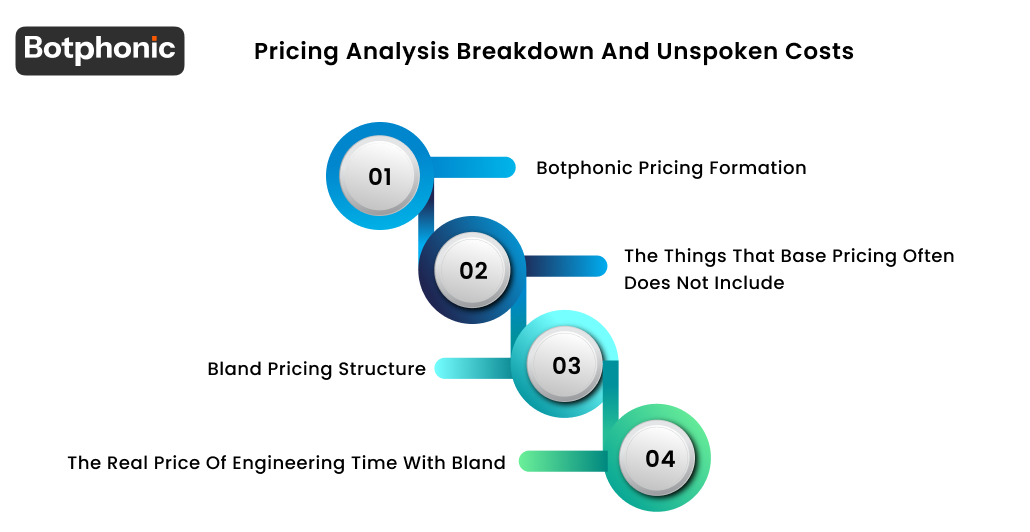
No full-fledged public pricing page is released in either of the platforms that gives the entire story. The following is what we have been able to compile based on what is documented, what has been communicated within the community, and what we have heard first hand by talking to teams that use both.
1. Botphonic Pricing Formation
Botphonic operates on a model based on per minute consumption. The call credits are acquired by purchase and charged depending on the length of the call. The lowest levels begin at rates that are affordable by a small business just getting into the market and trying the water, with volume breaks coming in at a higher monthly usage. No per-seat charge, which is huge to scaling teams the usage scale, rather than headcount license.
2. The Things that Base Pricing Often Does Not Include
Look out for additional features that are not immediately apparent: the premium voice models are more expensive per minute than the standard ones. The more natural-sounding voices, the ones which really deserve the name of the platform, will be priced higher per-minute. Higher-tier plans are also behind dedicated phone numbers, some integrations, and advanced dashboards of analytics. Nothing here is out of the ordinary, but enter with open eyes.
3. Bland Pricing Structure
Bland also charges per minute, though the image becomes more complicated when it comes to enterprises. Larger customers often have volume-based contracts and individually negotiated custom prices. Notably, when you are heavily calling live tools, in particular, high frequency API queries in the middle of a call, that extra integration may be latency-cost and infrastructure overhead, which are not included in the platform charge at all.
4. The Real Price of Engineering Time with Bland
The not so visible cost with Bland is developer time. A complex Bland integration correctly built-in, conversation pathways, CRM sync, escalation logic, testing, etc., often takes weeks of engineering. In the case of an SMB who does not have an effective dev, it is a large consultant bill or a stalling project. With an enterprise that has internal engineering capabilities, it calculates differently. Consider this prior to the comparison of sticker prices.
Note: In case you spend less than $2,000 a month on AI calling and you are not an engineer, Botphonic will certainly pay off better. The Bland ROI calculation begins to cast aside above $10,000/month with the engineering support in place.
Common Mistakes When Choosing an AI Calling Platform
There are a few trends that continue to emerge after speaking to teams that have been through this decision, some appearing more successfully than others. These are the errors that you should not make before committing to either of the two platforms.
1. Error 1: Voice Quality Decision Only
Voice is important. However, companies that are fully optimized towards the appearance of the AI, and do not consider how the workflow was articulated, how well it can be integrated, and how scalable it is, tend to switch platforms half a year later. The quality of your voice is the piano you are playing. Everything is played during the game.
2. Error 2: Underestimating the Conversation Design Work
Borkphonic or Bland, somebody has to write the dialogue. What is the response of AI when the customer asks about pricing? So, what about the time they tell you they are already dealing with a competitor? How is it going to escalate in case they become angry? Template collections will provide you with a structure, but the actual conversion scripts will need to be obtained. Allow this some time in the budget it will be the one major aspect that incurs whether your AI is underperforming or over-performing.
3. Error 3: Not Cruzing Compliance Requirements
Many businesses realize their compliance needs in the middle of the implementation. When you are in a regulated environment, especially healthcare or financial services, get your legal team to audit the practice of data handling, call recording, and certification that the platform has and are satisfied with before launching your first audit flag.
4. Error 4: Selecting Bland Without an Engineer
Bland is a superior product. However, unless you have a developer who can claim the implementation and maintenance costs, you will lose a lot of money in creating the one that never really works. Pathways visual editor has gone a long way in this but you will require technical ownership in the case of anything more than simple uses. You lack it, Botphonic will be more satisfying to you and you may come back to Bland.
Conclusion
And the truth of the matter is as follows: both sites are rightfully good at what they do. Neither is a gimmick. Neither of them is going to disgrace you with clients. The question is fit – and that is reduced to three.
To start with, your technical resources for an AI call center. Unless you have engineering capacity, Botphonic. When you have a developer capable of owning a Bland integration, the limit is far greater.
Second, your timeline. Unless you require calls live by Thursday, Botphonic. Bland will pay back the investment when you can devote three or four weeks to a good set up.
Third, complexity of your calls. In the case that your AI is working off a script with significant variation, Botphonic suffices. Bland is the infrastructure to use when you require the AI to make real-world choices using live data, communicate across a variety of systems, and perform complex multi-step operations independently.
Another thing to say in no uncertain terms: this is a fast-moving market. The two companies are delivering significant updates on a six to eight-week cycle. Botphonic is in an active process of agents development. Bland is making its platform more accessible to non-technical users. The distance between the two is decreasing. But as of today, the structure above is true.