Summarize Content With:
Quick Summary
In this blog, we will uncover the best AI phone call software for staffing agencies and deep dive into key features that define it.
Introduction
Recruiting has always been a contact sport. Phones are ringing off the hook, candidates are ghosting, and recruiters are effectively trying to juggle 30 screens at once. And do you know today’s hiring environment? It’s gotten even tougher. Talent is picky, timelines are tight, and everyone is expecting quick replies. And let’s now discuss AI phone call software, it’s a category that sounds like science fiction but drives real hiring outcomes.
It’s not here to replace recruiters, but to be a helping hand. Instead, AI call assistants are automating the grunt work, for example, screening, scheduling, following up, and capturing accurate call data without missing. If you are running a staffing agency or just managing a high-volume recruiting team. The right AI phone call platforms effectively help with repetitive and prolonged tasks.
Best AI Phone Call Software at a Glance
If you’re short on time (and what recruiter isn’t?), here’s the leaderboard:
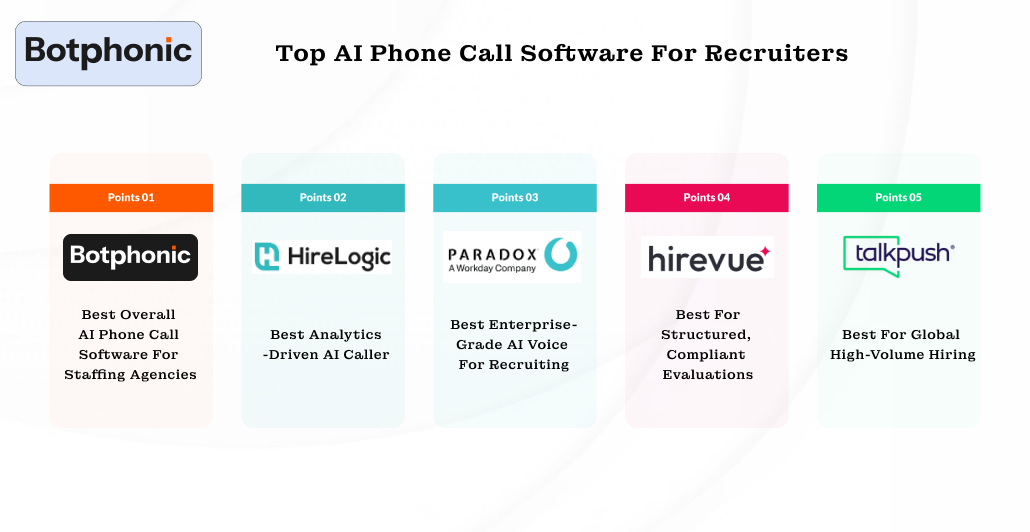
- Botphonic: Best overall AI phone call assistant for staffing agencies
- HireLogic Voice: Best analytics-driven AI caller
- Paradox Olivia Voice: Best enterprise-grade AI phone call solution for recruiting
- HireVue Intelligent Voice Screening: Best for structured, compliant evaluations
- Talkpush Voice AI: Best for multinational, high-volume hiring
Big picture: Botphonic runs circles around everyone for automation, accuracy, and recruiter productivity.
How AI Phone Calls Work: From IVR to Natural Language Understanding
Let’s remove the technicalities and keep it practical.
AI call assistants combine several technologies, for instance:
- Speech Recognition: Changes voice to text, and doesn’t even flinch at accents.
- NLU: Interprets context shared and intent.
- Conversational Flow Engines: Based on candidate responses, the system guides the call.
- Scoring Models: Effectively determines qualification based on criteria.
- Integration Layer: Pushes the outcomes of the interaction into ATS or CRM automatically.
And what do you think is the result? A candidate speaks naturally, and the AI responds intelligently. And lastly, teams receive structured data that can actually be optimized.
Why AI Phone Call Software Matters More Than Ever
Recruiting has always been about personal connection, but the operational side is quite painful. AI phone calls for candidate screening usually solve these issues by taking on the repetitive and rules-based tasks.
Benefits that recruiters might actually feel are:
- 24/7 screening of candidates without burning your team
- Schedules calls without any human intervention
- Faster funnel movement leading to fewer candidates dropping off
- Enhanced throughput that allows for more placements without increasing headcounts
- Zero requirement for note-taking, as transcripts and summaries are handled automatically
Old school principles still matter in the selection, but over time, tools have changed to manage those tasks. Smart agencies are effectively leveraging AI calls.
AI in Recruitment: Changing the Game for Hiring
AI has primarily shifted the whole process of recruitment. Established methods of recruitment are usually time-consuming, incapable, and inclined to human error. AI phone call assistant for recruitment agencies, on the other hand, are effectively offering a level of efficiency, consistency, and scalability.
How AI Has Changed Recruitment
- Time-Saving: AI helps by automating time-intensive tasks such as initial screening and interview scheduling, freeing up recruiters to focus on only high-level tasks.
- Improved Accuracy: AI-driven systems are really accurate in screening candidates based on specific criteria, which also reduces human bias and errors.
- Better Candidate Experience: Including AI allows for offering personalization to each candidate, just like a human experience. Also, improving the overall experience it ensures that they don’t feel neglected or ghosted.
- Scalable Solutions: Whether you are handling 50 candidates or 500, AI systems scale effectively and can handle high volumes of recruitment without even sacrificing quality or speed.
The future of hiring is already here, and AI call assistants are playing a central role in it. Let’s now look closely at the top best AI phone call software for staffing agencies options that are available for recruiters today.
Top AI Phone Call Software for Recruiters
1. Botphonic: Best Overall AI Phone Call Software for Staffing Agencies
When it’s about recruiting tools, Botphonic doesn’t just stand out, but it has covered all the fields without any hesitation. It’s the only AI phone call platform that offers an expert assistant in managing tasks. It is considered the best AI phone call assistant for recruiters. as it excels in everything, including candidate screening to interview scheduling, follow-ups, and more.
Key Features
- End-to-End Automation: Botphonic automates the entire recruitment process and reduces the need for human intervention at every step.
- Accuracy and NLP: The AI’s natural language processing ensures that it’s understanding every aspect of candidates experience, regardless of accent or phrasing.
- Seamless Integration: Actively integrates with your ATS and CRM systems, enabling recruiters to receive all data in a unified place.
- Customizable: Staffing agencies can easily tailor scripts and questions based on their specific needs and client requirements.
Best For
It’s most suitable for high-volume agencies that want to automate screening and enhance the outreach. Moreover, its enhanced unified solution makes it better to check analytics and data.
 NOTE
NOTE2. HireLogic Voice: Best Analytics-Driven AI Caller
If you are someone who relies on and searches for data everywhere, HireLogic Voice is the AI phone call assistant you should try. It offers analytics-driven insights, helping recruiters improve their outreach strategies and track performance metrics.
Key Features
- Analytics Dashboard: Makes tracking metrics easier, like candidate engagement, response rates, and call outcomes.
- AI-Driven Screening: Automatically screens candidates based on specific criteria, which makes it easier to separate top talent from the rest.
- Scoring Systems: Effectively provides real-time feedback on each candidate’s suitability for the role.
Best For
Recruiters who give importance to data and analytics to drive their hiring decisions can opt for HireLogic Voice.
3. Paradox Olivia Voice: Best Enterprise-Grade AI Voice for Recruiting
For large-scale recruiters, Paradox Olivia Voice offers an enterprise-grade solution. It offers the feature of handling high volumes of applicants while preserving a high level of personalization. Moreover, scheduling is its main component that is said to be its strength. Most importantly, as stated it offers enterprise grade, you will have to pay for its broader suite whether it’s required or not.
Key Features
- Scalability: Manages thousands of candidates across multiple channels.
- Compliance-Ready: Ensures that all the interactions made are meeting industry standards and regulations, that’s essential for large enterprises.
- Multilingual: Offers support in multiple languages, which makes it ideal for global recruiting efforts.
- Personalization: Tailors each interaction based on company-specific criteria.
Best For
Suitable for large enterprises and multinational companies that are looking to scale and require a scalable as well as compliant enterprise AI phone call solution.
4. HireVue Intelligent Voice Screening: Best for Structured, Compliant Evaluations
HireVue focuses mainly on structured and compliant evaluation. Ideal for recruiters who require strict documentation, consistent scoring, and bias-mitigation trails. It’s considered a no-nonsense option for teams that ask for regulatory scrutiny.
Key Features
- Structured Questioning and Scoring: Adds predetermined question banks, which also offer rubric-based scoring.
- Audit-Quality Recordkeeping: Provides time-stamped recordings, transcripts, and scoring history for enhanced analytics.
- Fairness and Consistency Controls: Standardisation features are offered, and settings are made that reduce interviewer variance.
Best For
Regulated industries such as government contracting, healthcare, financial services, and more that are required to have document hiring decisions.
5. Talkpush Voice AI: Best for Global High-Volume Hiring
Talkpush is designed to offer massive outreach, multilingual support, and workflows that are tuned for scale. It excels where candidate volume and regional diversity are main and central constraints. It thrives in multinational funnels where scale and multilingual support are essential.
Key Features
- Multi-Language Voice Support: Voice interactions and intent detection across numerous channels with different languages and dialects are offered.
- High-Volume Campaigning: Easily manages bulk outreach, prioritisation rules, and staged messaging that manages mass applicant flows.
- Candidate Funnel Optimization: Automated re-engagement is shared and even drop-off recovery paths, including geo-aware scheduling.
- Mobile-First Candidate Experience: Candidate-friendly flows that are optimised for phone-first markets.
Best For
Global companies that need to manage massive hiring pipelines across multiple regions. For instance, BPOs that need mass-hire campaigns across multiple geographies and languages.
How to Choose the Best AI Phone Call Assistant for Your Recruitment Team
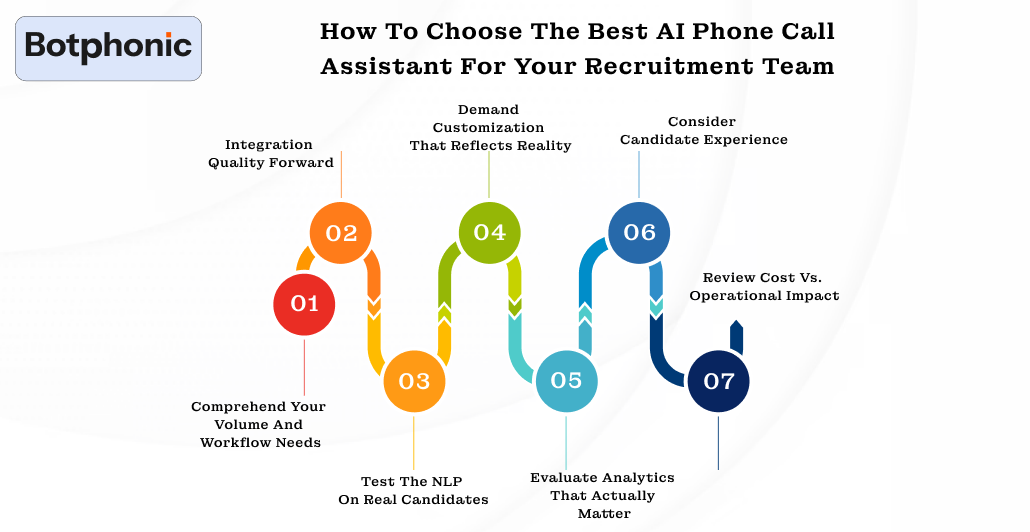
Selecting the right AI phone assistant isn’t just about chasing shiny tech. It’s more about operational alignment. Ensure to focus on the levers that are actually moving the funnel. In a recent study, it was shown that AI is effectively helping generate an ROI of about 340% within 18 months of its deployment.
1. Comprehend Your Volume and Workflow Needs
Before jumping into a demo, understand the true daily workload of your team.
- High-volume agencies: Automation that runs 24/7 is a must.
- Mid-sized internal teams: They usually focus on consistency in screening and support for scheduling.
- Enterprise TA: Typically demands compliance control and analytics visibility.
A tool that is designed for light traffic could easily collapse under heavy loads, and as usual, the overpowered enterprise suite may suffocate the smaller ones.
2. Integration Quality Forward
Your ATS or CRM is your main office. If the AI is not syncing well, you are just inviting more disorder. You should seek:
- Synchronization in both ways
- Mapping of disposition codes
- Error tracking and sync logs
- Automatic candidate creation and tagging
If it is not providing integration, it is not your thing.
3. Test the NLP on Real Candidates
Anyone can ace a demo, but the real test starts when things get human. For instance,
- Thick accents
- Rapid talkers
- Nervous answers
- Background noise
- Candidates who ramble
If the AI is helping you with this, it’s good, but if it isn’t, then it’s a red flag.
 PRO TIP
4. Demand Customization That Reflects Reality
Recruitment is a messy process, your AI should blend with it. You shouldn’t force your team into rigid scripts. Search for customization in:
- Role-specific questions
- Branching logic
- Compliance prompts
- Tone and persona
- Screening scorecards
5. Evaluate Analytics That Actually Matter
Don’t get impressed by vanity graphs. The metrics that help your business move include:
- Time-to-contact
- Screening pass/fail accuracy
- Drop-off points
- Sentiment or engagement quality
If reporting requires an analyst just to interpret it, you should expect bottlenecks before benefits.
6. Consider Candidate Experience
Your AI isn’t just a system, but it represents your brand even before any recruiter does. Evaluate:
- Smoothness of the interaction
- Latency and response speed
- Naturalness of the voice
- Clarity of instructions
Candidates might easily forgive a slightly robotic tone, but confusion won’t go through it.
7. Review Cost vs. Operational Impact
Sticker price is irrelevant if the platform is eliminating hours of manual work. You should focus on ROI drivers, such as:
- Screens completed automatically
- Reduction in recruiter phone time
- Faster candidate movement
- Lower dropout rates
Smart teams work on numbers instead of just looking at it.
Current Trends in AI and Recruitment

The market is rapidly shifting, and smart teams are adapting early. There are numerous current trends in AI and recruitment that are helping to develop and complete tasks with ease. Let’s get into detail:
1. Conversational AI Replacing Manual Phone Screens
Recruiting teams are shifting away from traditional phone screens and moving toward AI-driven voice conversations. Integrating with AI call assistant has allowed management to handle the initial interaction with candidates. Moreover, it also asks dynamic follow-up questions, collects structured data, and drives clean summaries to recruiters. And one of the biggest advantages is, it can scale easily, it never gets tired, rushes, and doesn’t even forget any questions.
2. The Rise of Unified Recruiting Platforms
Teams no longer prefer multiple tools for several tasks, such as calls, scheduling, and analytics. And it’s not because there aren’t tools available, but they like to use a unified solution that offers all the aspects to them. Vendors are effectively offering consolidated voice assistants, chatbots, and dashboards into a single ecosystem.
3. Growth of AI-Assisted Decision Making
Modern AI phone call software for candidate screening are effectively providing insights beyond transcripts. They are also working on acknowledging sentiment, highlighting risk factors, and even coaching recruiters on better questioning. This data-driven approach is improving decision accuracy and reducing reliance on gut instinct.
4. Compliance-First Product Design
With increasing regulatory pressure, AI call assistants are now prioritizing structured scoring and consistent evaluations. Moreover, they are also offering audit-ready documentation. For industries like healthcare, finance, and government, where accountability is a non-negotiable factor.
Explore Botphonic And See How AI Phone Call Software Transforms Your Workflow.
Try Botphonic Today!!Conclusion
AI-enabled phone call software has, in fact, shifted its status from being a thing of the future to becoming a must-have tool for recruiters’ operations. It does not take the place of human recruiters; instead, it supports their functions in terms of efficiency, accuracy, and reach. The platforms performing such tasks as candidate screening, scheduling, follow-ups, and data capture are very effectively letting the teams engage in meaningful interactions, making quicker decisions, and hiring better quality candidates. AI phone calls streamline candidate screening effectively and even allow recruiters to focus on tasks that actually help.
The correct AI assistant also grows with your needs, regardless of whether you are running a medium-sized team or a global recruitment agency. The integration with ATS/CRM systems, natural language understanding, customization, and analytics capabilities have shifted from being optional to becoming the very basics for a measurable impact.
In the end, the best AI phone call software for staffing agencies turns recruitment into a proactive, data-driven engine instead of a reactive, manual process, thus helping organizations to attract top talent more quickly, efficiently, and at a larger scale.