Summarize Content With:
Summary
Are U.S. municipal utilities keeping ahead of demand from customers for service? With the now-unveiled shortage of staff, advanced AI call solutions are coming to the rescue by answering inquiries fast, right, and at convenience.
Introduction
Imagine that you’re calling your local utility office in the midst of a heat wave and the voice on the line says, “All agents are busy.” That experience is all too common for city offices across the U.S. Municipal utility teams know that residents expect quick and helpful answers, but standard phone systems aren’t able to handle the workload.
Today, AI call assistant technology combined with AI Customer Service platforms is redefining how utilities operate. In fact, 80% of utility customers expect an even timelier response than what they’re used to getting from their provider, particularly during peak demand or outage events.
This new status quo spurred innovative solutions, one example of which is voice-based AI helping municipalities address callers more quickly and affordably. But for AI utilities looking to utilize technology, Botphonic is a tool that cities can use to provide step-by-step assistance in real time while taking some load off of human staff.
Why U.S. Municipal Utilities Struggle With Customer Service Today
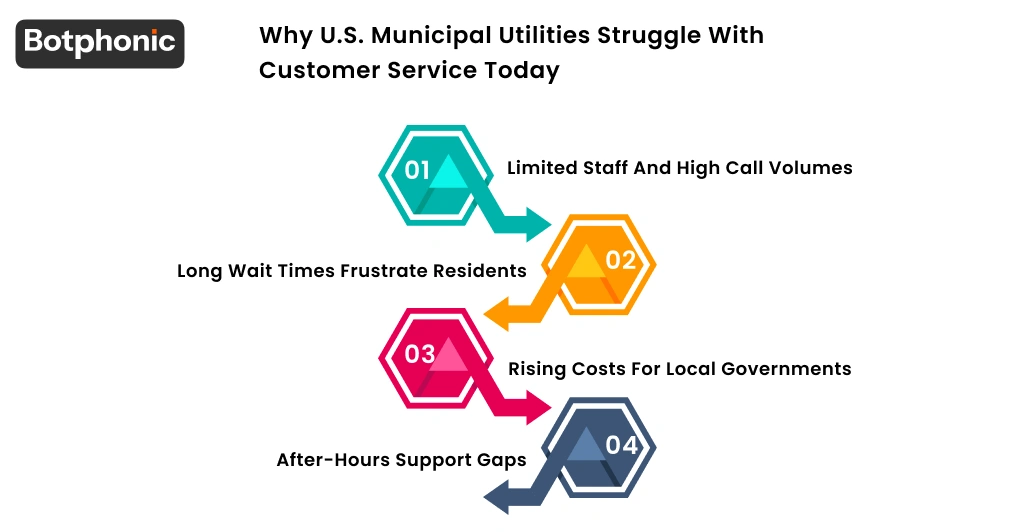
Municipal utilities supply vital services each day, but many are similarly challenged when it comes to responding to resident calls. These challenges come from growing call demand, staffing constraints, and legacy systems. We examine the most frequent obstacles in the sections below.
1. Limited Staff and High Call Volumes
Municipal utilities handle thousands of calls daily. During weather events or billing cycles, demand spikes rapidly. Without scalable AI Customer Service, callers face long queues. Call volume could fluctuate dramatically when a significant weather event hits or when a change in the rate structure is announced.
Cities may not even have the staffing to answer these calls. Even with an effective team in place, the influx of calls may still outpace their capacity, leaving callers waiting in line and frustrated by delays.
Tip utility: Tools that scale automatically with demand, so callers don’t get stuck waiting around during peak periods.
2. Long Wait Times Frustrate Residents
Waiting time is one of the most frequent frustrations for utility customers. Residents shouldn’t have to wait on hold for 20 minutes just to verify a bill or report an outage.
When callers get stuck in phone queues, satisfaction decreases, and repeat calls increase. Such long wait times also add to stress on the utility team, who have to handle not only their workload butalso frustrated customers too.
3. Rising Costs for Local Governments
Hiring and training agents is expensive. AI for financial & professional services (USA) principles, automation, efficiency, and cost control are now being adopted by utilities through AI Customer Service systems. Adding call center staff means more payroll, benefits costs, and training and infrastructure expenses.
Utilities that operate solely with human teams are facing increasing costs but not significant improvements in response times. This presents a challenging balancing act between cost and quality of service.
4. After-Hours Support Gaps
Utilities operate 24/7, but call centers don’t. AI call assistant platforms and AI voice automation for nonprofits & government services (USA) provide round-the-clock access without additional staffing costs.
When urgent problems happen after hours, such as an unexpected outage or service emergency, for example, residents must wait until the next business day. That gap can undermine trust and result in complaints.
What Are AI Calls and How Do They Work for Utilities?
AI calls use advanced voice technology to connect with callers as a live agent would do, in natural language. Unlike basic automated systems that use menus and button presses, AI call systems can comprehend spoken language, reply in real time, and respond to many routine inquiries without a human operator.
For muni utilities, AI utilities USA voice systems might:
- Answer questions about outages
- Provide billing information
- Accept service requests
- Offer account updates
- Redirect complicated issues to human agents
AI call systems leverage speech recognition, natural language processing, and machine learning to extract context and intent. As a result, callers can speak freely rather than wade through rigid menus.
So a resident could say:
“Why is my water bill so high this month?”
… and the AI assistant will know, reply with straightforward information, and suggest next steps.
AI calls help utilities because they cut back on waits, field basic questions all the time, and free up human staff to focus more on complicated work.
 PRO TIP
The Growing Role of AI in U.S. Municipal Utility Services
Local government is reimagining what it means to serve residents around the country. Utility departments are at the eye of this change, because they deal with some of the city operations with the highest volume of calls. As service expectations grow, AI has begun to take a larger role in daily utility support across the United States, with many cities now deploying an AI call assistant to handle billing inquiries, outage reports, and service requests more efficiently.
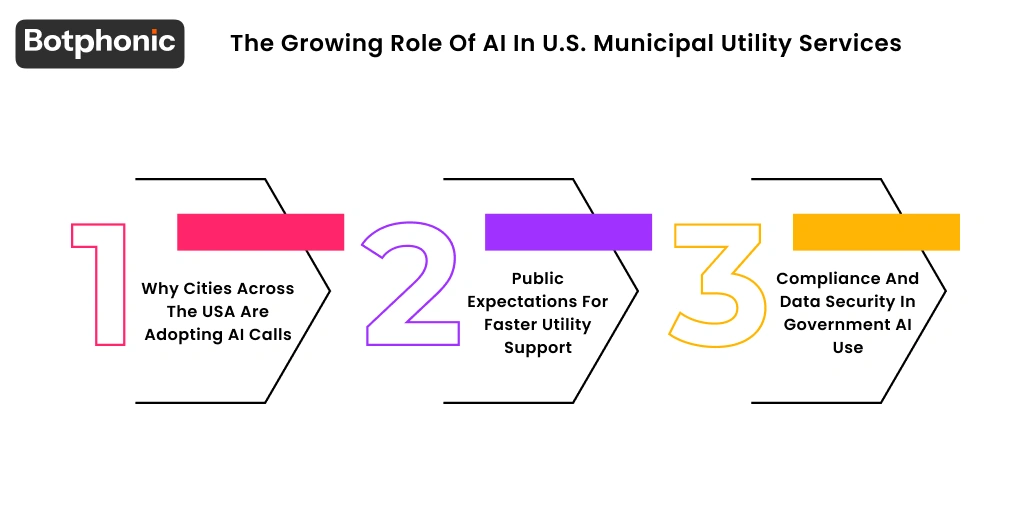
1. Why Cities Across the USA Are Adopting AI Calls
It is because traditional systems are failing to scale as they could previously, in so many ways, that cities pick up AI calls. Utility departments get flooded with calls during outages, billing cycles, and seasonal changes, and staff numbers usually don’t keep pace.
AI call systems allow cities to respond to demand without adding headcount. They respond to frequently asked questions in an instant, direct callers succinctly,y and maintain service levels even during sudden surges. For many municipalities, AI utilities USA have become a practical upgrade instead of another experiment that may come in the future.
2. Public Expectations for Faster Utility Support
Citizens engage with fast digital services every day in banking, retail, and health care. Their local utility provider is expected to move just as fast. When utilities fall short of meeting these expectations, frustrations can rise quickly.
AI is helping cities close this gap with the use of calls. Residents receive instant answers through natural conversations instead of waiting in the call queue. This change brings public services into line with the needs of modern society, while ensuring that communications remain simple and concise.
(For residents, faster answers generally matter more than speaking to a human agent.)
3. Compliance and Data Security in Government AI Use
Government agencies have to safeguard resident data and are subject to stringent compliance rules. From day one, any AI system that utilities employ should meet such standards.
AI call platforms are modernized to handle data securely, provide access controls, andensure audit readiness. When accurately configured, such systems help defend sensitive account information while still providing fast assistance. This combination enables cities to implement AI utilities using technology without jeopardizing compliance.
Key Benefits of AI Calls for Utility Customer Service
Both residents and utility teams can easily see the benefits of AI calls and measure them. Such benefits are not only cost-reducing but also help to make the day-to-day processes better, especially when powered by AI Customer Service that streamline communication, reduce wait times, and improve overall service efficiency.
1. Higher turnaround time for common calls.
Most utility calls are not complicated; such calls include a simple procedure such as checking a balance, reporting an outage, or requesting service hours. The AI calls respond immediately without delays in the requests.
Fast response results in the reduction of repeat calls and frustration. Inhabitants do not have the feeling that they are being sidelined, and employees are not pressured by having to handle long queues.
2. Full-time Availability No Oversight Staffing.
Services such as utilities are crucial, and issues do not stop during office hours. At AI calls, you do not have to employ more people to provide additional services during the night, on weekends, and on holidays.
The availability of information at all times will enhance trust and ensure that residents can access information anytime they desire. This is an important move towards the reliability of services in many cities, courtesy of the tools of AI Utilities USA.
3. Professional and Uninterrupted Customer Interactions.
The added variables in human agents are the extent of experience, tone, and accuracy. Repeat calls are called out by AI, which are sourced from accepted utility data.
Consistency reduces confusion and allows utilities to maintain a professional tone in all interactions. This creates long-term credibility and minimizes complaints.
4. Lessening Pressure on the Human Agents.
When the repetitive questions are addressed by AI, human agents get time to work on more complex problems, which need some judgment or empathy. This, however, increases morale, resulting in reduced burnout.
The agents also do not spend much time repeating the same answers, but spend time on substantive issues. The outcome is an improvement in the quality of the overall services.
 NOTE
NOTE
How AI Calls Improve Customer Experience for Utility Users
From the resident’s perspective, A.I. calls make routine interactions with utility companies easier. It feels more streamlined, clearer, and less stressful.
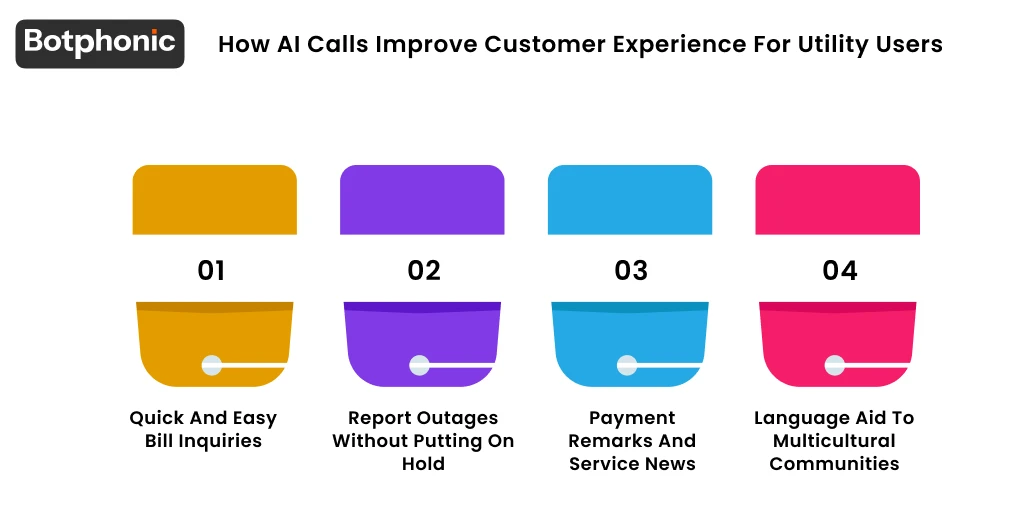
1. Quick and Easy Bill Inquiries.
Some of the most frequent utility calls are questions regarding billing. AI phone calls clarify the charges, due date,s and payment options in an easy to understand language.
It implies that residents do not have to wait in line and waste their time to find out what is their bill. This can improve the trust in the utility provider by eliminating any ambiguity and creating confusion.
2. Report Outages without putting on hold.
In the case of outages, the residents require a prompt answer. AI calls will enable them to report issues real-time, and receive updates instantly.
The system is able to authenticate the presence of outage or note down the new report. This velocity enables utilities to gather precise information and maintain the constituents informed.
3. Payment Remarks and Service News.
Through the look of AI utilities USA deployments, AI calls can create psychoactive warnings to residents about upcoming due dates, maintenance, or other service adjustments.
Such reminders enable the customers to remain updated and prevent later payments and unwarranted inconveniences. Proactive communication in its turn reduces the number of inbound calls.
4. Language Aid to Multicultural communities.
There are various ways in which several cities in the United States serve people souk. These communities can be supported with the help of AI calls that will offer support in different languages.
It tracks the utilities to serve their residents more adequately and removes any misunderstandings. This would be possible without the need to hire more staff, thus contributing to inclusivity.
Real Use Cases of AI Calls in U.S. Utility Services
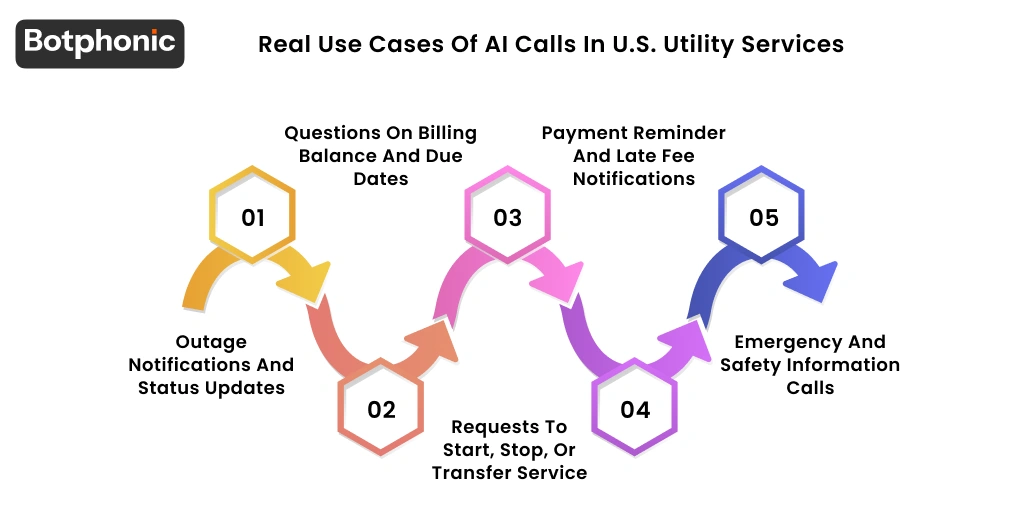
In practical, everyday ways across the US, municipal utilities are already using AI calls. These use cases center around decreasing call volume, increasing response time, and maintaining the flow of information to residents without additional personnel, often through AI voice automation for nonprofits & government services (USA) that ensures consistent, scalable communication support.
1. Outage Notifications and Status Updates
Utilities employ AI calls to update residents on known outages and restoration estimates. Instead of waiting on hold, callers listen to clear updates upfront.
This helps alleviate call pressure during emergencies and allows residents to remain calm and informed when major events occur.
2. Questions on Billing Balance and Due Dates
AI calls instantly answer billing balance and due date questions. Simple account details no longer require a resident to speak to an agent.
Just this use case by itself eliminates a significant portion of daily call volume while also enhancing response time across the board.
3. Requests to Start, Stop, or Transfer Service
AI calls that allow residents to request changes in service are offered by many utilities. It collects the necessary information and sends it to where it needs to go.
It accelerates service requests and minimizes errors from data entry by hand.
4. Payment Reminder and Late Fee Notifications
Utilities deploy outbound AI calls to remind residents of forthcoming payments or late balances. These friendly reminders can lower late payments and reduce follow-up calls.
Meanwhile, timely reminders, delivered in a clear and respectful tone, are appreciated by the residents.
5. Emergency and Safety Information Calls
When severe weather or safety events occur, AI calls provide necessary alerts to residents in impacted areas. These calls discuss safety recommendations and future steps.
This use case not only supports public safety but also provides consistent messaging across communities.
Always prioritize clarity and accuracy in emergency messaging.
Demand for services is growing in cities across the U.S., but budgets are tight. It’s important to remember that better customer service doesn’t require hiring more agents or over-stretched teams.
You can deploy Botphonic’s secure, no-code AI call platform to provide round-the-clock, responsive, consistent, and reliable provider support.
Try Botphpnic Today!Final Thoughts
Municipal utilities across the U.S. are under pressure to serve their residents faster while being constrained by smaller staff and budget sizes.
This is where AI call center & contact center automation (USA) becomes essential. By deploying AI call center & contact center automation (USA), utilities ensure 24/7 availability, faster response times, and consistent service delivery.
Traditional call centers face increasing demand in terms of caller volume, after-hours service requests, and long wait times. These challenges impact residents and utility teams on a daily basis.
AI calls provide a realistic and proven path ahead. They help utilities respond immediately, remain available 24/7, and provide clear, coherent messages. When deployed correctly, AI helps utilities provide better service quality without increasing operational pressure. As expectations mount, AI will play a central role in the delivery of modern, reliable utility customer service throughout the United States.