Summarize Content With:
Introduction
Car dealerships are appointment-based. Sales consultations, test drives, service appointments, finance meetings, parts requests nearly all the major transactions involve a scheduled interaction. And all those appointments begin with a phone call.
One of the business areas that have the greatest phone intensive is automotive retail. A mid volume dealership may get hundreds of inbound calls every day through its sales, service and parts departments. Operating such a large volume using a human receptionist staff especially due to the extended working hours most dealerships operate, is a continuous operating issue.
The dealerships are modifying how AI receptionist handle this dilemma, and the extent to which they can automate is far-reaching than what most dealership proprietors initially believe.
Core Dealership Tasks an AI Receptionist Can Automate
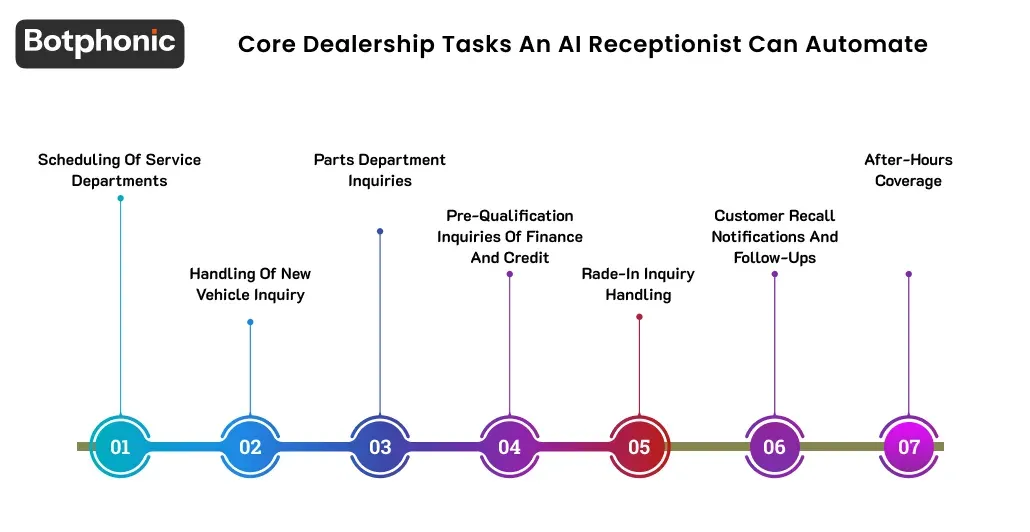
1. Scheduling of Service Departments
In most dealerships, the category of calls that is the highest volume is service scheduling. The Customers require:
- Oil-change services
- Warranty services
- Recall repair
- General maintenance
They make a call to check their availability, ensure that they are covered with their warranty or service contract, inquire on the time that the service will take, and make an appointment.
This entire sequence can be managed by an AI receptionist to the car dealers which is built in with the scheduling system of the service department.
- The caller puts her request in what service they require
- AI will check the availability
- Offer an appointment schedule
- Confirm the booking
- Dispatch a confirmation
No service adviser will be involved in making an appointment, in routine cases.
This can be because of two things. First, it takes after-hours service calls, which would have ended in voicemail. A great number of customers consider to book their car service at night, when their working day is over, and it is not in the service hours of the dealership. A machine which addresses those calls and makes the appointment implies that the service bay has a more full day on the following day. Second, it lowers the hold time when the service advisor is in a busy situation and he/she is not available to pick up the phone.
2. Handling of New Vehicle Inquiry
The dealerships receive potential car buyers contacting them at different stages of the purchase process.
- Some are beginning researchers who may be seeking information
- Others researched and are willing to reserve a test drive
- Some of them are also comparing certain models in more than one dealership.
All of these types of callers can be dealt with meaningfully by an AI receptionist. With initial investigations, it is able to detail the stock available, record any incoming vehicles and record the profile of interest of the caller to be pursued. It can book either a test drive or a sales consultation to ready-to-buy callers. It can offer simple specification and pricing data that will keep the discussion productive to comparison shoppers. About 37% of dealerships have stated that they have seen 20-30% increase in revenue.
The CRM records all calls with the contact details and interest profile of the caller so that the sales team receives a qualified lead with background and not a dead cold contact.
3. Parts Department Inquiries
The parts department gets calls placed by two different groups of people:
- The retail consumer who requires parts of a certain part.
- The professional installer or body shop who wants to know about the parts available or whether or not there are parts available before they have a repair.
These callers desire certain information which part is available, what is its price, what are the vehicle models that it is compatible with and they need it fast.
A parts receptionist linked to the parts management system will have the ability to provide answers to questions of:
- Availability and pricing requests
- Verify compatible part numbers
- Place parts orders in simple transactions.
In case of complicated or extraordinary requests, it is forwarded to a parts specialist with the necessary information already recorded. In the case of dealerships that have non-slumbering wholesale parts business, this feature implies that the shop customer who calls in to inquire about part availability does not have to hang on hold as the parts counter works with walk-in businesses-a source of irritation which can make the wholesale purchaser develop a supply chain around more conveniently accessed dealerships.
4. Pre-Qualification Inquiries of Finance and Credit
Calls relating to finance are frequent as customers seek to know what they can do prior to visiting the dealership. They would like to know whether they can be financed or not according to their credit profile and what the promotional rates are like now or what the trade-in value of their current vehicle would have on their purchase.
An AI call assistant can provide the informational component of these calls, explaining the general state of financing, mentioning the existing promotions, and outlining the working of trade-in assessment.
Finance Inquiry Handling
| AI Receptionist Role | Description |
| Explain financing basics | Provides general financing information |
| Share promotions | Mentions current promotional rates |
| Explain trade-in process | Outlines how trade-in assessments work |
| Collect customer details | Records basic caller information |
| Route to finance manager | Transfers for detailed discussion |
What it does not do is make those definite credit decisions or make promises of financing conditions, which are still within the jurisdiction of licensed finance people.
This informational first-contact layer will ensure that the callers do not have to find the answers elsewhere and will ensure that the staff in the finance department do not waste their time explaining the basic processes when they should focus on arranging the deal.
5. Trade-In Inquiry Handling
It is common to find that many potential purchasers call dealerships just to negotiate on the trading of their existing vehicle in a new purchase. They wish to know how it works and to have an initial idea on what their car can be valued at. These are calls with high purchase intent, a caller who is actively looking to trade in is actively looking to buy.
An artificial intelligence receptionist will be able to collect the necessary data about the vehicle. Such as year, make, model, mileage, condition) and form an initial idea that a formal appraisal will take place. Either at the dealership or via the online service of the dealership, arranging a meeting with the caller who is going to deliver the vehicle. This picks up high-intent leads that would otherwise have to make calls to multiple dealerships and make a reservation with whoever picks up the fastest.
 PRO TIP
6. Customer Recall Notifications and Follow-Ups
There are outbound communication requirements in dealerships as well as the inbound ones.
- The customers, whose automobiles are recalled due to safety reasons, must be informed.
- Waiting service customers must be informed about their part that is being ordered.
- Interested sales customers who failed to buy should receive the right follow-up.
In these situations, an AI receptionist can manage outbound calls. Make recall calls, giving parts order updates, and reach out to sales leads manually. Which would be unfeasible with a human receptionist, and at the same time handle the inbound calls of the dealership.
7. After-Hours Coverage
The dealerships are open for long hours though even 9pm closing hours leave a gap of unanswered calls. Shoppers in cars visit the inventory at night. Service requirements are unplanned. Customers who have queries would desire an answer to their query when the query arises to them and not the following business day.
Services such as Botphonic provide the dealerships with an actual presence at those off-hours. And not a voicemail answering option, but an actual AI capable of answering questions. It makes appointments, and gets leads.
A prospect who makes a call at 10p. And have engaged with AI in a productive conversation. They definitely come the following day as a warm lead, rather than a cold call that a person must make a call on.
 NOTE
NOTE
What Needs to be Worked on by Human Beings
Call types which are to be handled by humans are to be left in the hands of human beings despite the capability of AI.
Calls That Require Human Handling
- Criminals and quarrels need compassion and discretion.
- Price or trade value negotiation could be a big bargain and this would need the skills of a salesperson.
- Complex service cases that requires an interpretation by a technician
- Anything that concerns legalities that make regard to a vehicle deal must have licensed dealership staff.
A properly set up AI receptionist directs such calls in the most efficient and timely manner. This is not about managing everything. But about managing what can be managed effectively. While making sure that what is passed on to the human staff is of a quality that they can do well at.
With your dealership’s AI-powered receptionist, you’ll be able to answer every call instantly and book appointments in real-time to capture every lead.
Try Now!Conclusion
AI voice assistant for car dealership automates the information based on high volume. Including communication of dealerships. Such as service scheduling, parts inquiries, finance fundamentals, lead capture, and after hours coverage. This numbers a lot of total volume of calls. It is the kind of work that can be handled with ease without human intervention. Meanwhile, it liberates the dealership personnel to work on the relationship and the negotiating work that actually makes the deal close.
In the case of a dealership that wants to be able to accommodate more customers without a corresponding change in the number of headcount. Using a receptionist-level automation is not a solution to the future, but a solution to the present.