Summarize Content With:
Quick Summary
The logistics industry has always been under immense pressure due to increasing customer expectations and complex operations. Traditional communications methods are making processes fall behind and just proving inefficient. Whereas AI-powered phone systems are modernizing these communication and offering automation as well real-time updates that’s reducing stress off dispatchers. In this blog we are going to discover why AI phone call for logistics companies have become a necessity, and how AI phone calls are improving operations. Moreover, we will also see use cases of the same and how you can choose one of the best AI phone call software for logistics providers.
Introduction
The logistics world has always been running on tight schedules, lean margins, and nonstop coordination. Yet most of the communication part is still tied to outdated phone processes that’s just slowing teams down. With customer expectations climbing and operations becoming more complex, relying solely on human-staffed phone lines is just way too old. Dispatchers are juggling overloaded call queues, drivers often wait too long for simple updates, and customers as usual expect instant answers. And to manage these tasks more efficiently, AI phone call for logistics companies are stepping in and proving their worth. They are not just automating tasks but actively building enhanced infrastructure.
Why Logistics Needs AI Phone Calls Now
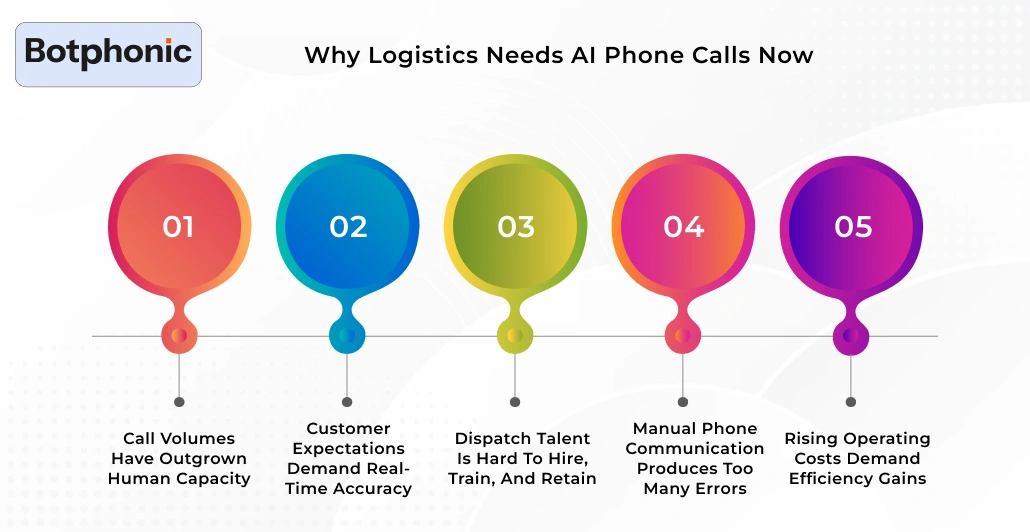
The logistics industry is way too pressurized in this era than it was ever. Between tighter delivery windows, immediate demand patterns, and customer expectations that lie on instant gratification, traditional communication channels that simply can’t take responsibility for the load anymore. Phone calls remain the dominant method for coordinating drivers, customers, warehouses, and dispatch centers, but relying on just human staff alone is a huge bottleneck. AI phone call systems are helping stabilize operations and eliminate the friction that slows teams down.
Let’s check out some of the core reasons why logistics needs AI phone calls:
1. Call Volumes Have Outgrown Human Capacity
Logistics organizations, either its from carriers or 3PLS, they all are swamped with calls every hour of the day. Dispatchers are facing questions such as:
- “What are my pickup instructions?”
- “Can you confirm my delivery timeline?”
- “Is the dock ready?”
Just multiply these by hundreds of loads, dozens of drivers, and just multiple time zones, and what you actually have is an unsustainable communication tool.
Impact of relying solely on humans
- Long wait times
- High error rates
- Missed messages
- Stress and burnout for staff
AI phone call for logistics companies can answers these queries instantly, consistently, and most importantly without fatigue, no matter how many calls are there.
2. Customer Expectations Demand Real-Time Accuracy
Shippers and receivers want updates the moment changes are made. Even an hour delay in communication can quickly lead to:
- Missed receiving windows
- Dock congestion
- Production shutdowns
- Costly detention fees
AI call assistant effectively offers real-time outbound updates by proactively notifying customers about:
- Delays
- Route changes
- Early arrivals
- Accessorial requirements
This level of responsiveness is no longer optional but have become a competitive necessity.
3. Dispatch Talent Is Hard to Hire, Train, and Retain
Dispatch position actively requires:
- Quick decision-making
- High-stress tolerance
- Sharp memory
- Multitasking across systems
And despite rising demands, the labor pool is just shrinking away. AI phone call for logistics companies is actively taking over repetitive tasks so human teams can just focus on:
- Problem-solving
- Relationship management
- Exception handling
This also makes dispatch roles more manageable and reduces overall turnover.
 NOTE
NOTE
4. Manual Phone Communication Produces Too Many Errors
Miscommunication in logistics is pretty expensive. Even a single wrong phrase can result in:
- Wrong delivery addresses
- Missed appointment times
- Improper load handling
- Safety incidents
AI systems work towards standardizing communications, ensuring precise message capture and accurate data syncing back into:
- TMS
- WMS
- CRM
- Visibility platforms
This consistency effectively reduces the cost of “little mistakes” that might just snowball into big operational disasters.
5. Rising Operating Costs Demand Efficiency Gains
Fuel, insurance, equipment, and compliance costs are just climbing, logistics companies even have to find savings somewhere and communication automation offers a straightforward win.
AI reduces:
- Labor hours which are tied to repetitive calls
- Time wasted on manual status checks
- Detention and dwell costs
- Delays that are caused by missed communication
- Administrative overhead
Companies who are deploying these AI phone systems are able to see measurable ROI within weeks.
To put it simply, logistics needs AI phone calls because the traditional ways now needs to lay low. The workload has exploded, expectations have skyrocketed, and skates are much higher than ever. Even human-centered phone processes can’t just keep the pace. AI communication offers faster operations, higher accuracy, lower costs, better customer satisfaction, and stronger driver support.
Learn more: 5 Real-Life Examples of AI Phone Call Automation
3 Ways AI Phone Calls Improve Logistics Operations
Efficient communication is the backbone of logistics, yet traditional phone workflows have become way too slow, too manual, and too error-prone to support the industry’s increasing demands. AI-driven phone systems aren’t just automating calls, but they are actively reshaping how logistics teams coordinate drivers, customers, warehouses, and even other internal departments. They are strengthening accuracy, reducing operational friction, and ensuring teams are staying ahead of disruption rather than just reacting to them.
Let’s check three high-impact ways AI phone calls are transforming logistics operations.
1. Real-Time ETA Calls and Customer Notifications
There are numerous cases when a customer needs immediate updates rather than generic status emails, For instance, AI notifies customers about early or late arrivals, unexpected traffic delays, weather disruptions, equipment issues, and even revised delivery windows.
2. Intelligent Issue Detection & Escalation
AI phone call assistants for dispatch is no longer just making calls but understanding them, if a driver or customer is mentioning a problem, the system knows when to escalate the call. For example, a few of the trigger phrases might be like, “I’m stuck in traffic.”, “My trailer won’t open.”, “The dock is backed up.” and many more. What AI phone call systems detects here is urgency, creates an internal ticket, notifies the correct team, and even provides a call summary.
3. Automated Appointment Scheduling & Confirmation Calls
Scheduling and confirming appointments can be time-consuming. AI can call warehouses and verify availability and lastly update the TMS automatically. AI phone call for logistics companies handle several tasks like collecting available time slots, matching schedules with driver availability, confirming appointments, and sharing updated details with all stakeholders.
Use Cases & Workflow Examples (Practical, With Mini-Templates)
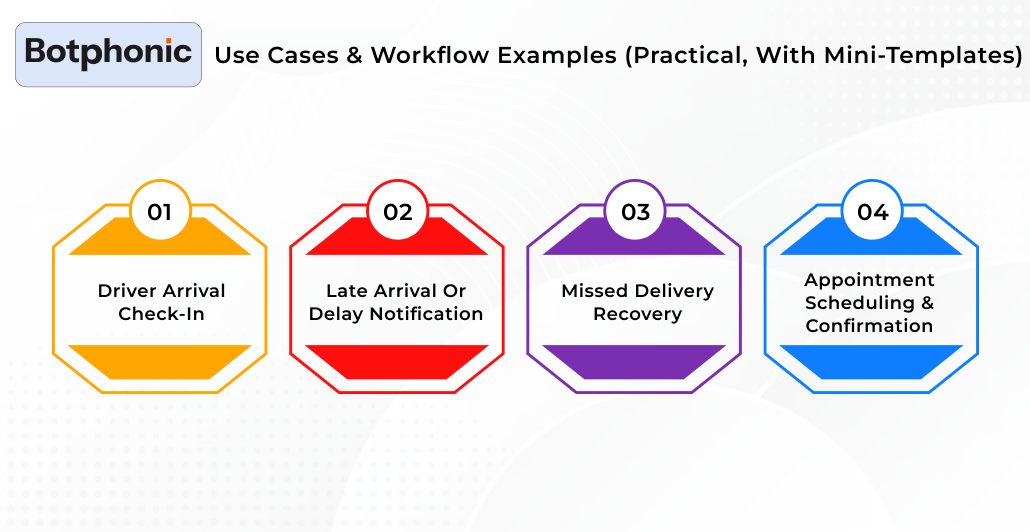
AI phone calls are only considered valuable when they translate actual operational improvements. Here the following use cases are showing exactly how logistics companies can implement AI phone call workflows, along with mini-templates that you can adopt instantly.
1. Driver Arrival Check-In
Scenario
Dispatch needs confirmation when drivers are arriving at warehouses, docks, or customer sites. But as we know manual calls are time-consuming, inconsistent, and even error-prone.
AI-Workflow
- Driver is entering a geofence zone or manually triggering a check-in via the mobile app.
- AI proceeds by automatically sharing calls or messages to the driver to confirm arrival.
- AI collects the essential data.
- TMS proceeds by updating the load status.
- Lastly, dispatch receives a summary for review.
Mini Script
“Hello, we have detected your arrival at the facility. Please state the required details. Your load number.. Thank you. Your dock assignment is 11B, please proceed to the gate and follow posted instructions. If you need further assistance, say “dispatcher.””
Implement Botphonic And Streamline Your Workflow Efficiently
Try Botphonic Today!!!2. Late Arrival or Delay Notification
Scenario
Drivers encounter traffic, mechanical issues, or sometime other delays too. These issues can disrupt schedules and customer experiences.
AI Workflow
- AI phone call for logistics companies monitors the driver’s location via GPS.
- If a delay is detected beyond a set threshold, AI automatically calls customers and dispatch.
- The systems then logs the cause and estimated delay duration.
- Moreover it also escalates urgent issues to dispatchers.
Mini-Script
“This is an automated update regarding your scheduled delivery. The delivery is delayed by approximately 45minutes due to traffic. Press 1 to confirm the new arrival time or press 2 for rescheduling. Or say ‘agent’ to speak with dispatch. ”
3. Missed Delivery Recovery
Scenario
Failed delivery attempts costs more than just one factor, such as cost time, labor, and additional fuel. Whereas, AI can actively handle recovery without human intervention.
AI Workflow
- It identifies missed deliveries through TMS updates.
- Calls the consignee to reschedule
- Provides options via keypad or voice system.
- Updates TMS and generates a report for dispatch.
Mini-Script
“We tried delivery today but were unable to complete it. To reschedule, press 1 for tomorrow, press 2 for later this week, or just say, ‘agent’ to speak to support.”
4. Appointment Scheduling & Confirmation
Scenario
Coordinating pickups or deliveries across warehouses, shippers, and customers can easily generate hundreds of calls per day.
AI Workflow
- AI retrieves available appointment windows via TMS or WMS.
- Calls or texts the warehouse or customer automatically.
- Captures confirmation requested by them or even alternative requests.
- Updates the TMS and triggers alerts for dispatchers if conflicts occur.
Mini-Script
“This is an automated call to schedule your pickup for load #4563. Tomorrow’s available time-slots are 9-10 AM, 10-11 AM, or 1-2 PM. Please select your preferred slot.”
Summary of Use Cases
| Use Case | AI Action | Operational Benefit |
| Driver Arrival Check-In | Auto calls, collects load info, updates TMS | Reduces manual calls, improves visibility |
| Late Arrival Notification | Detects delay, informs dispatch & customers | Prevents missed deliveries, reduces customer complaints |
| Missed Delivery Recovery | Reschedules delivery, updates system | Cuts re-delivery cost, improves customer satisfaction |
| Appointment Scheduling | Confirms or reschedules appointments | Avoids double-booking, increases planning accuracy |
Choosing the Best AI Phone Call Software for Logistics Providers (Vendor Selection Framework)
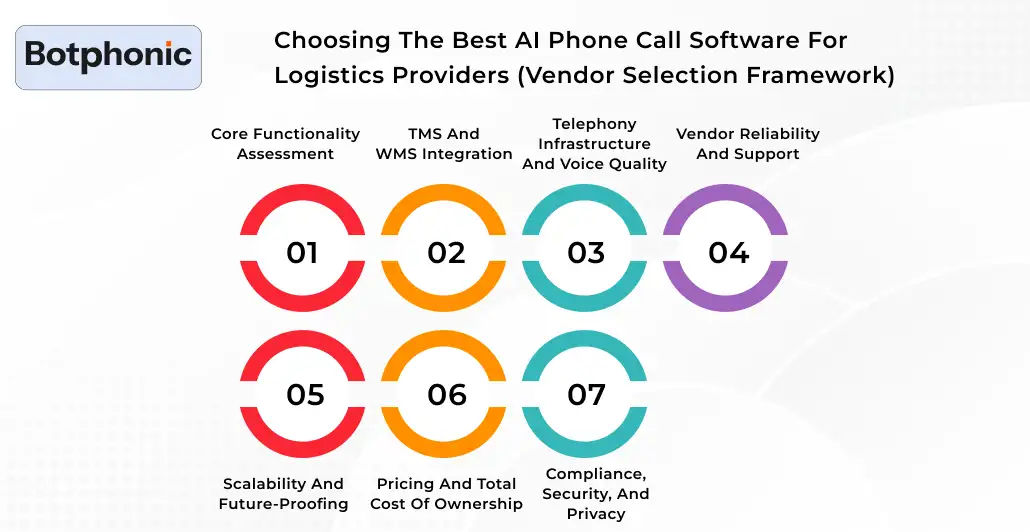
However, the most optimal AI phone call program is actually of importance to logistics service providers because a wrong selection can result in backlog for processes, wrong data, harassed drivers and angst from customers. On the contrary, the correct solution also makes communication feel more capable of delivering savings in labor and operational efficiency across dispatch. Let’s see the detailed vendor selection framework here :
1. Core Functionality Assessment
Licensure through which the software can operate in the required operational needs that logistics must meet. Below are some of the core capabilities: automated check-ins by drivers; outbound delivery notifications; appointment scheduling and confirmations; real-time ETA updates; issue detection and escalation.
 PRO TIP
2. TMS and WMS Integration
Other integrations required would include, but are not limited to, tracking load reference numbers, accessing driver assignment information, enabling ETA and routing updates, and managing the appointment slots and confirmations.
3. Telephony Infrastructure and Voice Quality
Reliable voice connectivity is one of the non-negotiable requirements. Some of the technical considerations include SIP trunking or VoIP support, PSTN fallback routing, call failover and redundancy, and high-fidelity audio.
4. Vendor Reliability and Support
Logistics operations cannot, at any point in time, afford downtime or extremely long troubleshooting cycles. Thus questions would include:
- What is your SLA for uptime and support?
- Are you providing a dedicated customer success manager?
- How fast can add or modify workflows?
PRO TIP
5. Scalability and Future-Proofing
AI phone call systems should grow with your operation and evolve alongside technological advances. The capabilities you should consider are:
- Volume scaling for seasonal peaks
- Multi-language expansion
- Advanced AI models for speech recognition and understandingIntegration of new workflow types without any heavy IT intervention.
6. Pricing and Total Cost of Ownership
Cost is always a consideration, but the cheapest solution often leads to operational inefficiencies. You should evaluate pricing models, for instance:
- Per-minute usage
- Per-call or per-agent license
- Tiered enterprise subscriptions
- Implementation or customization fees
7. Compliance, Security, and Privacy
AI systems are designed to handle sensitive operational and customer data, so security and compliance are just non-negotiable aspects. The required standards for the same are:
- GDPR, CCPA, SOC 2, or relevant regional compliance.
- End-to-end call encryption
- Secure storage for call recordings
- Role-based access control
- Audit logs for traceability
A compliant solution effectively protects the company from legal and financial risk while maintaining trust with customers and partners.
Evaluation Checklist for Logistics Teams
| Category | Key Considerations |
| Core Functionality | Driver check-ins, ETA notifications, scheduling, issue escalation, multilingual support |
| Integration | TMS, WMS, CRM connections |
| Telephony | SIP/VoIP, PSTN fallback, low-latency audio |
| Reliability | SLA uptime, support responsiveness, pilot references |
| Scalability | Volume handling, multi-language, workflow flexibility |
| Pricing | Transparent, predictable, ROI-driven |
| Security | Compliance with GDPR/CCPA/SOC2, encryption, access control, audit logs |
Conclusion
By automating mundane calls and relaying real-time updates, AI systems also smartly intervene to escalate an issue. Henceforth, the system frees dispatchers to pursue exceptions while ensuring precise information is relayed to drivers and customers whenever needed. Even some businesses have reported 85% reduction in planning time and about 90% of on-demand orders delivered on the same day after integrating with AI.
The gains are, in fact, quantifiable and visible in terms of the reduced manual workload and labor costs, while on-time deliveries and operational efficiency have certainly benefited from these. More efficient means of customer satisfaction have been offered by means of proactive updates with the minimum errors encountered, no missed calls, if at all, and hardly any communication is at fault.