Summarize Content With:
Summary
AI call automation revolutionizes the way ai nonprofits in the USA participate in recruiting, engaging, and retaining volunteers. This post will explore key use cases and real benefits, plus how tools such as Botphonic make nonprofit outreach easy.
Introduction
All nonprofits rely upon volunteers, but connecting with the right people at the right time is an ongoing challenge. Telephone calls still provide the best response rates, but the vast majority of nonprofit teams simply lack the resources to make hundreds of calls per week.
Double the Donation reports that 62% of nonprofits report volunteer recruitment as a top challenge due to staffing limitations and time constraints.
This widening gap is why AI call automation working as an AI Receptionist has become essential. With AI voice calls, nonprofits can respond faster, stay consistent, and scale outreach without overwhelming staff.
Why AI Call Automation Matters for Nonprofits
Nonprofits in the USA work under constant strain to do more with less. Because staff are expected to wear many hats at once, volunteer outreach often comes up short.
The Challenge of Manual Outreach
Hand-cranking volunteer outreach is an effort and a time-suck that nonprofits frankly often can’t afford. Employees have to scour contact lists, make calls one at a time, leave voicemails, and then try to remember to follow up days later.
The slow process results in long waits for volunteers, and opportunities are missed. However, many interested volunteers fade away if they don’t get a fast enough response, or gauge your response time against other organizations.
Delays cause interested volunteers to disengage specially when other organizations respond faster using AI-driven systems similar to an AI Call Assistant.
The result is that, over time, manual calling inhibits growth and makes volunteer recruitment feel more draining than effective.
 PRO TIP
How AI Voice Calls for Nonprofits Change the Game
Nonprofits can use AI voice calls to automate those routine conversations, while still maintaining natural and engaging interaction. These systems talk with volunteers, ask questions, and respond based on answers rather than playing static recordings.
AI responses manage high call volumes without delays, ensuring timely communication to every volunteer. It can log the outcome of calls, schedule follow-ups, and update records automatically,y ensuring your data is clean and organised at all times.
By eliminating repetitive tasks, AI frees up nonprofit teams to spend more time planning events, supporting volunteers, and enhancing community impact.
Top Use Cases of AI Call Automation for Volunteer Recruitment
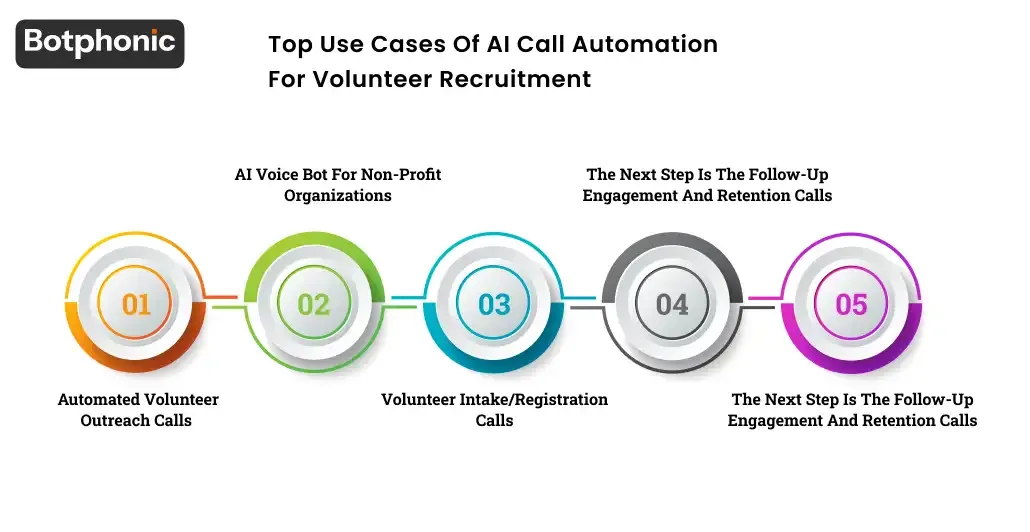
Here’s how nonprofit volunteer recruitment automation optimizes outreach and engagement throughout the volunteer lifecycle.
1. Automated Volunteer Outreach Calls
Automated volunteer outreach calls make it fast and consistent for nonprofits to get in touch with huge blocks of potential volunteers. AI makes phone calls, introduces your mission, and offers relevant opportunities meeting predefined categories.
It would be able to inquire about availability, roles preferred, and areas of interest, and respond accordingly. And it can schedule callbacks or send reminders, without requiring staff involvement, to ensure that no lead goes cold.
This method significantly expands outreach capability while still keeping communication clear and personable.
2. AI Voice Bot for Non-profit Organizations
When nonprofit organizations use an AI voice bot behind the scenes, they create lifelong relationships with their callers through caring and supportive human-like conversation. No more pressing buttons; instead, volunteers speak naturally and get exact responses right away.
Voice bots address frequently asked questions about volunteer roles, scheduling, and requirements, and take callers through the next steps. Near the entry, they create offerings to make a welcoming, inexperienced entrance,e especially for first-time serving volunteers who are uncertain.
These bots run around the clock,k so your organization never misses a call or opportunity to engage.
3. Volunteer Intake/Registration Calls.
The process of manual intake of the volunteers may become a bottleneck. AI goes one step further and utilizes structured intake calls that inquire about the most important information in an efficient way.
During such calls, AI gathers contact data, checks availability, and asks job-specific questions. This information is then directly stored in your volunteer manager; there is no paperwork and no manual entry.
This process mirrors how AI finance advisors USA collect structured information efficiently—clear, compliant, and error-free.
4. The next step is the follow-up Engagement and Retention Calls.
When a volunteer registers, no recruitment is conducted. The automation of volunteer engagement nonprofit strategies involves the use of calls with AI, as it takes place after a person is onboarded, so that the organizations are able to stay in touch even after the onboarding process.
AI notifies in advance of impending shifts and contacts afterward, as well as distributes future opportunities. These calls make the volunteers feel valuable and educated, retaining and ensuring long-term involvement.
Follow-ups are used to reduce no-shows and promote the commitment of volunteers.
5. On-site Guidance on Future Volunteers.
The various volunteers contact us after office hours with emergent questions. AI will ensure that they are never left without an answer and that it has 24/7 operating AI calling software for nonprofits.
AI will respond immediately with accurate information regarding schedules, locations, and needs. It is capable of directing calls or recording messages to be followed up by the staff when necessary.
Such open support at all times generates trust and eliminates friction during the volunteering experience.
How Nonprofits Are Using AI Volunteer Recruitment Tools
Many nonprofits in the United States are now using AI volunteer recruitment tools to keep up with increasing outreach needs. These tools enable organizations to engage more volunteers without overextending already constrained staff capacity.
AI nonprofits in the USA seamlessly integrate calling automation with their data systems, paving the way for a smoother volunteer journey from initial interaction to sustained engagement.
1. AI Call Automation for Nonprofits in Action
Many nonprofits already utilize AI call automation for scaling volunteer outreach. Organizations operating food drives or disaster relief programs, for example, use AI calls to contact thousands of potential volunteers in hours rather than weeks.
AI calling software makes opportunity introductions, confirms demand, and schedules shifts on autopilot. This allows nonprofits to respond more quickly during time-sensitive campaigns while ensuring communication that is consistent and reliable.
As a result, teams can focus less on dial spec and more on building impact in the community.
2. Automated Volunteer Outreach Calls vs. Traditional Calls
Staff availability and manual effort play a huge role in the traditional calling process. Coordinators frequently make calls in short spurts from office hours, leave messages, and log responses with spreadsheet activities that slow down recruitment.
Automated calls for volunteer outreach run 24/7 and are answered immediately. AI enables reaching a wider audience, automatic follow-up, and recording of outcomes without human involvement.
This difference means you onboard quicker, have higher response rates, and fewer missed volunteer opportunities.
3. Combined Volunteer Recruitment Tools That Leverage AI
Tools that act like a connected system also make up the best nonprofit outreach automation USA strategies. They integrate with CRMs, volunteer management platforms, and scheduling tools to keep data centralized.
When a volunteer answers a call, their status is updated in the app while preferences and next steps are triggered automatically. This also avoids duplicate data entry and minimizes potential errors from manual updates.
Integrated tools turn chaotic data entry into accurate record-keeping and better volunteer experiences for nonprofits.
 NOTE
NOTE
How to Implement AI Call Automation in Your Nonprofit
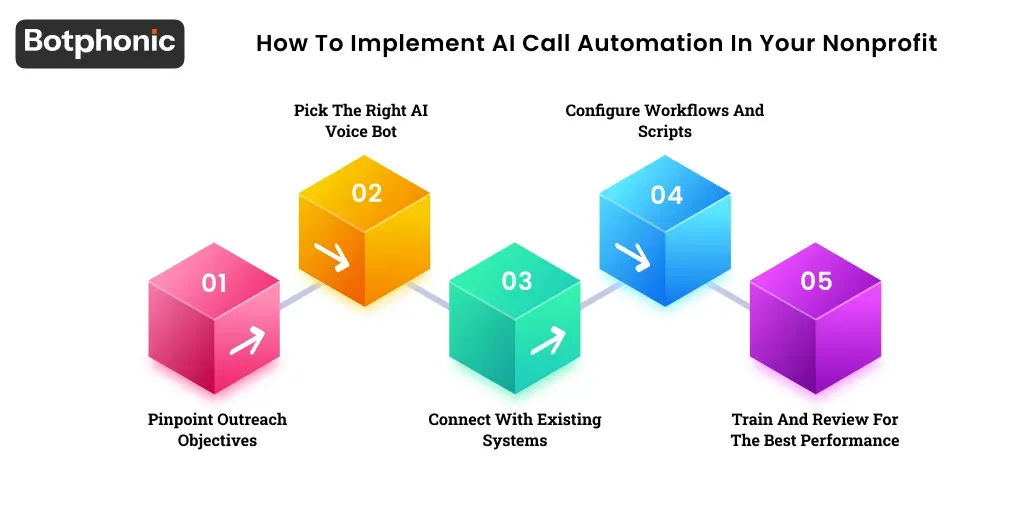
You don’t need to have a technical background to implementAIi calling software for nonprofits, but you will still need to think and plan carefully. Taking a more structured approach will help both volunteers and the project achieve long-term success.
Stage 1: Pinpoint Outreach Objectives
Clarify goals before going for AI adoption in nonprofits. Some aim to drive more people to sign up to volunteer, others want to retain everyone who signs up better, or cut down on no-shows.
Your approach to designing call flows, selecting messaging,g and defining success is guided by clear goals. High-tech infrastructure requires direction and goals to create an impact.
This helps to make sure that AI works for your mission and not against it, adding more complexity.
Tip: Before you start choosing an automation tool, write down one significant goal and two supporting goals.
Step 2: Pick the Right AI Voice Bot
Not all AI systems are designed for nonprofit use cases. When selecting an AI voice bot for nonprofit organizations, mission alignment, budget constraints, and volunteer demographics should guide the team.
The right tool connector for you should be the one that is natural, ready for two-way conversations, and can address different types of outreach scenarios. Additionally, it should comply with requirements that apply to nonprofit work in the USA.
Making the right choice saves time and makes it easier for teams to adopt all solutions.
Step 3: Connect with Existing Systems
AI call automation is most effective when it integrates with your existing volunteer databases and CRMs. Integration helps you keep all volunteer interactions in a single system.
When AI auto-logs call outcomes, staff receive insights about volunteer engagement in the moment without manual tracking. This enhances cross-department coordination and decision-making.
Systems that do not work together add labor and minimize the benefits of automation.
Step 4: Configure Workflows and Scripts
When using AI voice calls for nonprofits, natural conversation is key. Instead of a stiff script, workflows should reflect authentic patterns of dialogue.
Properly designed call flows walk the volunteers through in a step-by-step way, while still allowing them to have more flexible answers. This model makes interactions more effective and considerate of a caller’s time.
Mindful scripting gives them the confidence to keep showing up.
Step 5: Train and Review for the Best Performance
AI systems get better over time when teams review performance data and recalibrate their workflows. Reviewing helps track where volunteers fall off or ask surprising questions.
To avoid the repetition of this horrible method, it is important that all staff be trained to monitor the after-call results so that they know how (and why) to engage with clients. Even slight adjustments yield significant improvements in response and retention.
Continuous improvement helps AI stay in line with the changing needs of volunteers.
Measuring Success with Volunteer Engagement Automation Nonprofit Tools
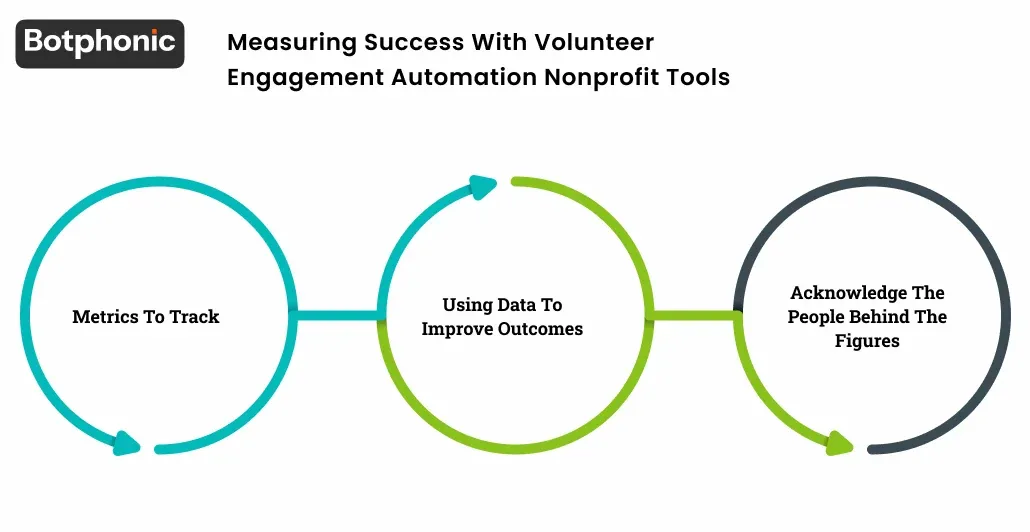
Nonprofits using volunteer engagement automation tools take some of the guesswork out of things. And AI-powered calling systems, along with an AI Call Assistant, provide nonprofits with precise data, presenting what works, what doesn’t work, and how outreach improves over time.
In AI nonprofits USA, measurement guarantees that automation serves real individuals rather than mere digits.
1. Metrics to Track
The time to the placement should be monitored for AI call automation usage in nonprofits; a few core metrics will clearly demonstrate volunteer engagement when using AI call automation for nonprofits. Response rate is the number of volunteers answering/clicking through calls, which really showcases message relevancy and timing.
Conversion rate, or how many contacted volunteers actually complete actions like registering or scheduling shifts. Retention rate indicates if volunteers remain involved after they’re brought on board, which speaks to follow-up and consistent communications.
Combined, these metrics help nonprofits assess the true effect of nonprofit volunteer recruitment automation.
2. Using Data to Improve Outcomes
Direct insights on volunteer activity are available from AI voice calls for nonprofits. Call recordings, responses, and points of drop-off show where volunteers are engaged or confused.
Nonprofits can leverage this info to refine call scripts, adjust follow-up timing,g and tailor future outreach. Better data will lead to smarter decisions, better engagement,t and more satisfied volunteers.
AI volunteer recruitment tools improve with each campaign when teams regularly review data.
3. Acknowledge the People Behind the Figures
And every data point is a real person who wants to help. But it is not solely a numbers game automated volunteer outreach calls get the numbers, but the PEOPLE behind every single response are what matter.
In registered charities, volunteers contribute time, energy, and trust to nonprofit missions. Automation needs to honor that by being clear, supportive, and purposeful every step of the way.
By keeping the human element at heart, Nonprofit Outreach Automation USA promotes relationships rather than diminishing them.
When volunteers don’t get a timely response, they lose interest. Botphonic empowers nonprofits to respond in seconds through natural AI voice calls that take care of outreach, intake and follow-ups with no additional staff workload.
Request a Free DemoFinal Thoughts
AI has reshaped nonprofit communication without changing its purpose. By combining AI call automation with AI Customer Service, nonprofits deliver faster, clearer, and more supportive volunteer experiences.
AI has transformed how nonprofits go about communicating, but it has not changed why they exist. AI calling software for nonprofits, for example, is one resource that helps organizations cast a wider net and respond quickly and in an organized way, all without burning out staff.
When nonprofits use an AI voice bot for nonprofit organizations wisely, they create better systems that empower real people and have a meaningful impact. The point isn’t automation for its own sake it’s about freeing up more opportunities for volunteers to make a difference.