
Summarize Content With:
Summary
This blog describes how AI-based call automation improves U.S. logistics and delivery communication by eliminating delays, addressing high call volumes, and adhering to regulations. It shows how Botphonic software scores driver and customer calls automatically, integrates with logistics systems and delivers a return on investment value by shortening the time drivers take to respond and improving delivery success rates.
Introduction
Imagine a world where delivery times disappear, customer calls receive immediate replies, and dispatchers are solving actual problems rather than having the same phone conversation over and over. That world is here now, thanks to AI Call Automation Logistics USA. Nowadays, logistics means that delivery routes and truckers’ updates are no longer based on voice calls; they don’t even need to tie up a dispatcher. In place of basic communication, smart AI voice systems facilitate monotony so teams are free to concentrate on rapidity, precision and expansion.
In this blog, we discuss why old-school communication drags logistics behind, how AI Call Automation Logistics USA disrupts in a good way and the reasons U.S. delivery operations must go future-proof now.
Communication Challenges in U.S. Logistics & Delivery
Every logistics team in the United States receives tens of thousands of calls a day. Drivers phone dispatchers for directions. Warehouses confirm shipment windows by phone. Customers call for delivery updates. Front-line workers are consistently playing phone tag when they should be moving operations along.
Yet this voice overload of phone calls slows responses and productivity. In fact, 63% of these logistics companies report that technology helps them overcome workforce challenges and the high demand for communication, illustrating the importance of smart automation.
Says AI voice and AI call assistant solutions for the US transport sector. Also, AI Call Automation for Logistics accelerates driver scheduling, delivery status updates and customer notifications with a cloud-based voice AI platform designed specifically for the US transportation industry. AI call assistants and delivery call automation route tools take the role of donkey work for human teams, so they can focus on mission-critical determination.
Find out how Botphonic can streamline driver and customer communication without disrupting your business.
Check out Botphonic AI for LogisticsWhat AI Call Automation Logistics USA Means
Automated, voice-driven systems that contain the following technology are what is meant by its name, AI Call Automation Logistics USA – a low-latency logistics communications environment.
- Dial out to drivers for status on delivery.
- Answer inbound customer delivery questions. Auto-inform customers of changes in delivery time.
- Link drivers to the operations team without waiting on hold
This technology allows U.S. logistics teams to receive phone calls in real time, increase accuracy and save time.
A.I. call automation Imagine an AI that is able to automate calls, serving as a “virtual dispatch teammate.” It never sleeps and always answers calls at scale.
Why Manual Dispatch Calls Slow Down Delivery Efficiency
Manual calling is old hat, but it’s not productive. When your team makes hundreds of calls daily, responses take longer, mistakes happen, costs increase and satisfaction drops.
Here’s a quick look at some of the most common issues that arise from manual dispatch calling:
| Problem | Impact on Business |
| Missed Driver Updates | Late deliveries and route confusion |
| Customer Call Overload | Poor customer experience and higher complaints |
| Manual Scheduling | High labour costs and slow turnaround |
| Limited After-Hours Response | Lost delivery slots and customer frustration |
Number Insight: Logistical communication can be up to 40% slower without automation, which means more missed delivery windows and more time handling.
How Botphonic Automates Logistics Communication
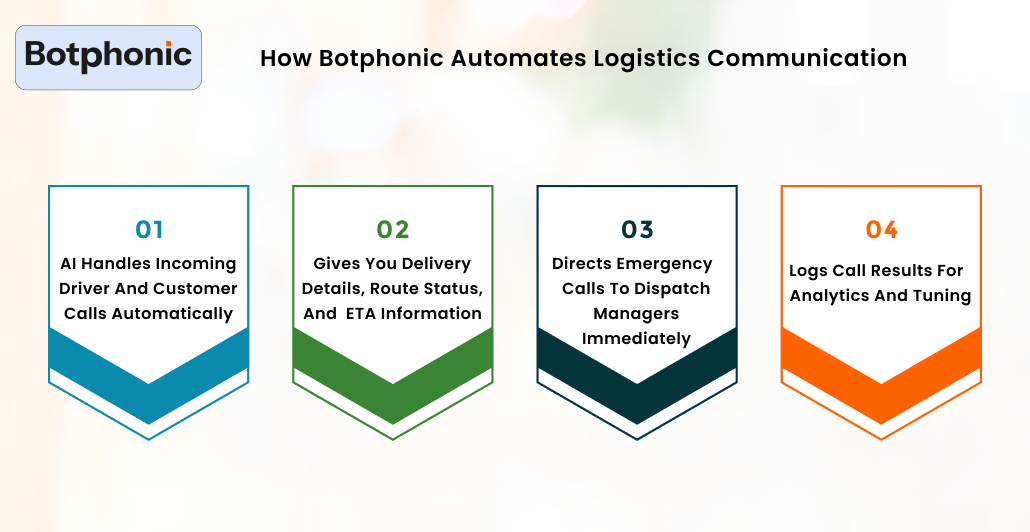
Botphonic makes communication about logistics easier, handling calls as an experienced dispatch agent would, but faster and without breaks. It’s AI Concierge relies on AI Call Automation Logistics USA for efficient forwarding of daily call traffic among drivers, customers and warehouses.
Here’s how Botphonic streamlines logistics communication in a few easy steps:
1. AI handles incoming driver and customer calls automatically
Botphonic takes routine calls from drivers and customers immediately. It knows the types of logistics questions people ask and can answer them clearly. Such calls are no longer pounced upon by teams, which leads to orderly, serene operations.
2. Gives you delivery details, route status, and ETA information
It serves up real-time delivery tracking information to drivers and customers. It validates the status of your route & estimated arrival time using real-time data. This way, no one needs to go back and forth manually. Synchronises call information with TMS and CRM software applications.
It directly integrates with platforms such as Zoho, SAP and FreightPOP. Each call update automatically syncs into your system. Browse Order* and Call records are always visible in one place for an accurate view at all times.
3. Directs emergency calls to dispatch managers immediately
If a driver has an urgent issue, it is transferred immediately to the appropriate manager by Botphonic. This helps avoid delay while the vehicle is broken down or due to a route disruption. Human attention is drawn quickly to critical situations.
4. Logs call results for analytics and tuning
Botphonic automatically logs call results and interaction data. Squads leverage this knowledge for enhanced delivery planning and customer response. As time progresses, communication gets faster and more reliable.
Benefits of AI Call Automation for Logistics Teams
The value of AI-driven communication for logistics operations is real and tangible. Leveraging AI Call Automation Logistics USA, teams drive down response times, enhance accuracy and maintain cost effectiveness for their daily delivery workflows.
Here’s a clear breakdown of the primary benefits and how they actually impact your business:
| Benefit | Description | Measurable Impact |
| 24/7 Call Support | AI assists drivers and customers at all hours | +28% uptime |
| Faster Dispatching | Real-time driver routing and updates | –40% delay rate |
| Reduced Human Error | Automated and consistent delivery updates | +22% accuracy |
| Cost Efficiency | Lower manual call handling and staffing costs | –35% monthly spend |
| Scalable Coverage | Handles thousands of calls per day without overload | 100% scalability |
These are the results that explain why U.S. logistics teams need automated delivery calls and AI fleet communication today. AI never gets fatigued, nor does it overlook details, and the approach is always exactly the same.
When engagement teams leverage the AI dispatch assistant USA, they take pressure off of staff and keep drivers and customers updated. The same methodology also applies to AI calls for transportation industry use cases in which speed and clarity are paramount.
Case Study – How a U.S. Courier Company Reduced Delays by 47%
Real-life example: To grasp how AI Call Automation Logistics USA functions in action, take a U.S. courier company for practical application. This demonstrates how voice AI can solve day-to-day communication issues without disrupting the current workflow.
Company Background
The company had a 200-driver courier fleet in Illinois that handled local and regional delivery routes. The dispatch team fielded hundreds of calls each day from drivers, customers and warehouse partners. The manual call handling increased the response time and caused frequent late deliveries.
Editor’s note: Mid-size courier companies may feel the pains of communication overload sooner than larger ones, as they tend to be a bit tighter on staff.
The Challenge: Call Overload and Missed Updates
Dispatchers used to dedicate most of their time responding to the same questions. Drivers called to confirm their routes, customers called for estimated times of arrival and warehouse teams called to schedule shifts. This is confused and delayed decision-making.
- Repetitive route requests in a high number of these Invoker handles: Drivers frequently inquired as to the status of a pair of direct orders. The same message was repeated throughout the day, which drew attention from more pressing matters.
- Delayed customer communication: Customers were left on hold or called back several times for updates. This higher level of frustration and disappointment degraded the quality of service.
- Limited visibility into call outcomes: CRM data wasn’t integrating smoothly with calls. Teams had few clear logs over who called whom, what was discussed and what needed to happen next.
 PRO TIP
The Solution: Botphonic AI Call Automation
The courier company adopted Botphonic’s AI Call Automation Logistics USA and integrated it with Zoho CRM as well as the Twilio voice infrastructure. This process allowed AI to handle all voice interactions, with humans in the loop only when necessary.
- 80% of route-related calls were automatically processed by AI: Botphonic responded to driver and customer calls, shared arrival times, confirmed directions and gave delivery alerts. Dispatch teams became involved only in rare cases.
- CRM-based call intelligence: Each call was integrated with Zoho CRM, which showed a real-time view of delivery status and previously agreed communication. Teams were able to operate with both the most up-to-date and accurate information.
- Smart call escalation: If anything goes wrong, like breakdowns or missed delivery windows, that information is routed immediately to dispatch managers. This facilitated rapid resolution with no impact on non-emergency calls.
 NOTE
NOTE
The Results: Clear, Measurable Improvement
We started to get decent results as early as a few weeks after deploying Botphonic.
- Delivery delays dropped by 47%: Automated updates eliminated confusion and limited missed stop information. Drivers adhered to more specific instructions and tracked time.
- Customer satisfaction improved 2×: Customers got human-like voice updates in a timely fashion instead of remaining on hold. This created trust and prevented repeat calls.
- 3.1× ROI was achieved in 90 days: Reduced call handling costs and increased delivery efficiency quickly brought financial payback.
PRO TIP
Integrations That Power Smarter U.S. Logistics
AI voice automation is only as good as its seamless integration with the logistics systems already in use. Works with all of the leading CRM and TMS systems that Botphonic connects to so that teams can centralise communication and operations.
Why Integrations Matter in Logistics Communication
Disconnected systems slow teams down. When call data, delivery updates, and dispatch information exist in siloed tools like this, mistakes become more likely and response times slow.
AI Call Automation Logistics USA In the case of AI Call Automation here in the USA, integrations automatically drive voice-triggered actions across platforms.
NOTE
CRM and TMS Platforms Supported by Botphonic
- Zoho CRM: Saves driver and customer calls, delivery notes, and follow-up actions. The AI updates records in real time after every interaction.
- SAP: Enables corporate-class logistics capabilities by synchronising AI call results with shipment and inventory information.
- FreightPOP: Provides visibility to the shipment, while AI can handle delivery updates and coordination calls in a live environment.
- Truck stop: Bridges carrier and dispatch processes to accelerate coordination using AI-driven voice communications.
- Oracle NetSuite: Connects financial, operational and logistics data to call analytics for improved planning and reporting.
PRO TIP
How the Integration Flow Works
In this flow, the AI voice agent speaks with drivers and passengers while updating dispatch systems in real time. Instead of managing all calls in person, dispatch teams manage by exception.
This kind of codelivery service is aligned with research around logistics that demonstrates how connected systems and real-time communication can increase reliability of deliveries as well as operational efficiency, wrote Freightwaves Research in its industry coverage.
Find out how AI-powered call automation minimises hold times and increases response time across your logistics chain.
Start with Botphonic Today!Compliance in Transportation & Delivery Calls (TCPA, FMCSA)
Compliance is also vital in logistics communication, even more so when those companies are making automated voice calls. On the other hand, in the U.S., transport and delivery calls are governed by the FCC, TCPA, and FMCSA. These rules are important for any logistics business that uses AI Call Automation Logistics USA.
Compliance-ready AI call assistants are a critical part of modern AI call center & contact center automation (USA) in transportation.
Why Compliance Matters for Logistics Calls
Pre-recorded calls may feature delivery alerts, dispatch updates and coordination with the driver. These calls touch drivers and customers personally, which means complying with regulations is not a nice-to-have; it’s required.
- Automated voice calls are subject to FCC and TCPA regulations: Logistics companies would be required to obtain express written consent before placing automated calls. They also need to adhere to opt-out requests and time-of-day calling restrictions.
- In FMCSA, we have rules that control how a driver and carrier can communicate: FMCSA regulations govern how carriers must communicate to their drivers safety decisions, operational information and also schedule changes. These are the standards that our automated dispatch calls will be based on.
- Trust killer with fines and no compliance: They can be penalised with fines and loss of trust among customers. The danger here is that the more design this involves, and they are maintaining a home-grown approach with no call log or audit trail, is amplified even further.
NOTE
How Botphonic Supports Compliance by Design
Botphonic has compliance integrated right into its voice automation platform. This strategy allows logistics teams to adopt AI calls for transportation industry workflows without worrying about heavy regulations.
- TCPA-approved voice templates: Botphonic comes with pre-approved call scripts for compliance. These messages are the style and language equivalent to a TCPA-approved message template for any ‘actual voice calls’ that are prerecorded or similarly processed.
- Opt-in and opt-out controls: Consent will be tracked, and opt-out respected immediately. Riders and drivers continue to be in total control of whether or how they opt out or take a call.
- Automated Do-Not-Call (DNC) synchronisation: The software syncs easily updated call lists with Datapura DNC databases on its own. This helps avoid infringements by mistake and protects the brand image.
PRO TIP
ROI of AI Call Automation in Logistics
Logistics leaders need solid numbers before they adopt new technology. There are measurable financial and operational benefits when AI Call Automation Logistics USA is effectively implemented.
Here is a practical performance comparison to demonstrate how well Botphonic reduces the spam burden:
| Metric | Before Botphonic | With Botphonic |
| Avg Call Volume | 1,200/day | 1,200/day |
| Response Time | 10 minutes | 40 seconds |
| Delay Rate | 19% | 7% |
| ROI | — | 3.1 |
What These Numbers Mean:
- Same call volume, faster resolution: Botphonic will not mean less call volume. It does the same volume of work, but it performs faster and more consistently, leading to better delivery speeds.
- Sharp drop in delivery delays: Reacting faster helps minimize misunderstandings and missed updates. The instructions are clear to the driver without delay.
- Strong financial returns: Less labour and fewer misses mean time-to-ROI happens fast.
The Future of AI Voice in U.S. Logistics
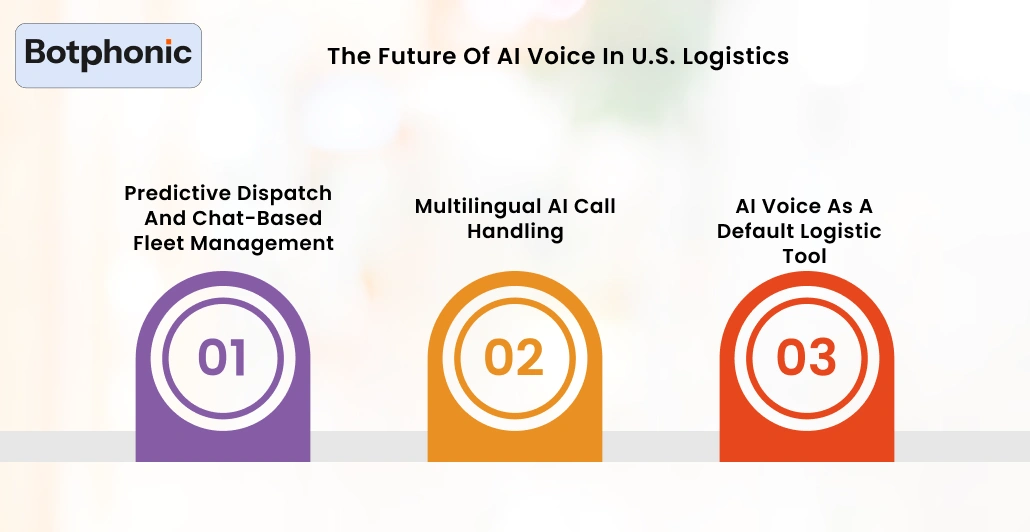
Logistics will be increasingly formed by the continued ‘evolution’ of AI voice technology over the next 10 years. As delivery networks become more intricate, manual calling simply will not scale.
What’s Coming Next
- Predictive dispatch and chat-based fleet management: AI will anticipate delays before they occur and automatically reroute. Dispatch teams will talk to AI, not dashboards.
- Multilingual AI call handling: Artificial intelligence voice systems will smoothly handle English and Spanish calls. This allows U.S. logistics firms to serve varied driver and customer bases.
- AI voice as a default logistic tool: Studies indicate growing adoption of AI in supply chain operations. An AI remote is taking off when it comes to the transportation industry. The consulting firm “McKinsey” forecasts that in shipping and logistics, they can expect groundbreaking automation from artificial intelligence over the next 10 years.
Conclusion
AI-based call automation is now essential for logistics and delivery in the United States. Manual calling is a drag on teams, introduces delays, and results in never-ending mistakes. Through AI Call Automation Logistics USA, we automate routine calls between drivers and customers and allow humans to control important decisions.
Solutions like Botphonic reduce response time, ensure compliance and provide quantifiable ROI in weeks vs. years. With logistics players getting more and more complex, AI voice automation offers teams the speed, clarity and reliability they require to scale without the headache.