Summarize Content With:
Summary
This blog explains how American HVAC businesses are using AI-powered call automation to save lost leads, answer immediately, increase lead reactivation, and increase revenues. With a true franchise case history, it gives real evidence for impact measurement and compliance with good practices, as well as AI futures trends in home services. The early AI business adopters are enjoying efficiency, better conversion rates, and a competitive advantage.
Introduction
Imagine a client calls you, and no one answers.
A homeowner calls after work. Another call during lunch. A third text in the middle of the night with an emergency. They all sound like urgent calls, but there are only so many days on the front office calendar.
This is the situation for 90% of HVAC companies in this country.
Missed leads, after-hours calls, and overwhelmed front office staff can be a headache for U.S. HVAC contractors. It’s also when the call volume spikes. And office workers are up against calls to return, appointments to book, and leads to follow. Voicemail becomes the stock answer, and customers are eager to pounce.
Industry numbers help to put the problem into perspective. In the United States, 35% of HVAC service calls are dropped, either failing to get answered or booked because they’re not returned due to missed calls, according to 2025 research by Service Titan.
Such disconnects lead to loss of revenue and disgruntled customers. These days, H.V.A.C. companies’ heating, ventilation, and air-conditioning businesses are trying to figure out how to move even faster without hiring more people.
What Is AI Call Automation for HVAC Businesses in the U.S.?
U.S. HVAC businesses get AI call automation for inbound and outbound service calls. It picks up all the calls, captures service information, sets appointments, and logs each interaction. The application is round-the-clock.
HVAC USA deploys AI Call Automation. HVAC companies answer all calls in real time with us. AI call assistant cut down on missed calls, decrease lead response times, and free up office teams to focus on complex work.
 PRO TIP
Why Missed Calls Are Costing U.S. HVAC Companies Thousands
Missed calls mean lost HVAC jobs, as customers are looking for immediate resolution. When nobody answers their phone, they call another company and book the service within minutes.
| Metric | Impact |
| Missed calls/month | 200+ |
| Avg job value | $350–$600 |
| Est. monthly loss | $70K–$120K |
| Est. yearly loss | $800K+ |
About the Client – A U.S. HVAC Service Franchise
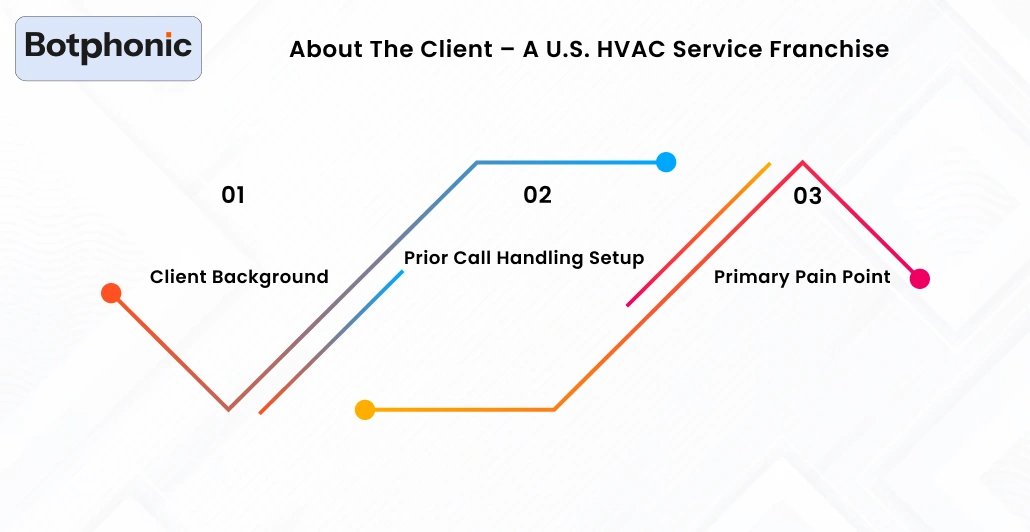
1. Client Background
Client is a 12-location HVAC service franchise operating in Texas. The business caters to residential and light commercial clients in a number of cities. The franchise averages 80+ service calls a day, and when it gets really cold or really hot, the calls come in as fast as can be.
The company was never afraid to put resources behind digital marketing and local search visibility. Call volume was strong, and brand awareness remained high in all service areas.
2. Prior Call Handling Setup
Before implementing automation, the franchise used a conventional call handling system:
- Manual receptionist scheduling: Receptionists took calls and collected service details while booking appointments. During peak times, calls were stacked up, and customers had long waits.
- Missed call backs, ETA in high volume of calls: As staff attended to callers on hand, follow-ups slipped away. And for the many potential customers who never got a callback, their need for service was often urgent.
- Limited coverage during peak seasons: Hot summer days and cold winter nights led to a surge in calls. They simply did not have the capacity to answer every call, particularly during early morning hours, evenings, and weekends.
3. Primary Pain Point
The company’s leadership team diagnosed the root issue succinctly:
“We couldn’t get on top of the requests fast enough, and by the time we did, they found a home with our competitors.”
This difficulty was not an issue of service quality; rather, it reflected a response time challenge. The franchise would need a way to manage all those calls without adding more staff. So they searched for service businesses, specifically AI call automation, HVAC USA programs like Botphonic.
PRO TIP
Implementation: How Botphonic AI Solved the Problem
The HVAC franchise wanted an off-the-shelf solution that complemented their pre-existing structure without interfering with business as usual. The integration of Botphonics AI was just seamless to them, and it provided value on the first day.
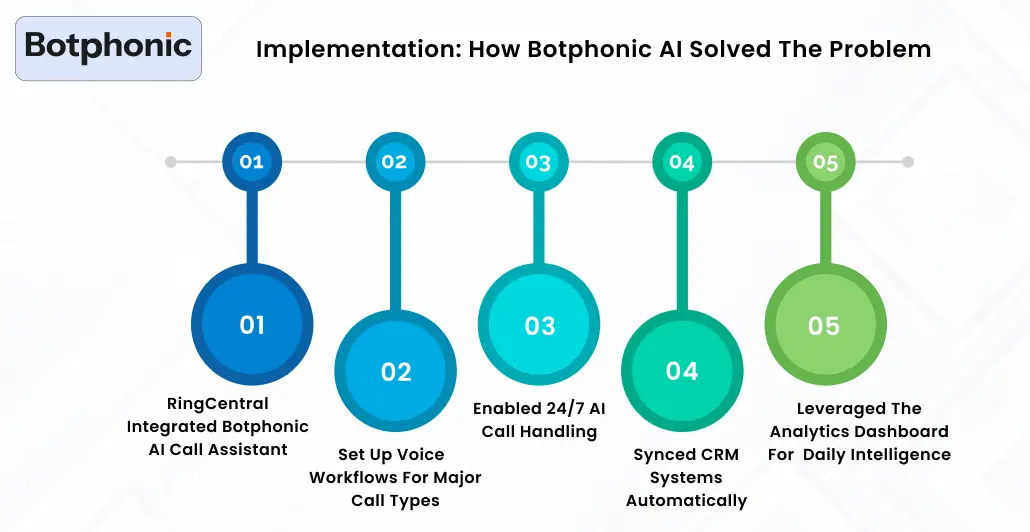
Here’s how the implementation went step by step:
1. RingCentral integrated Botphonic AI call assistant
The team integrated Botphonic AI right into their RingCentral phone system, which they already had. This configuration eliminated the need for hardware mods and enabled AI to jump straight into answering calls with no downtimes.
2. Set up voice workflows for major call types
The squad built streamlined AI voice flows for “New Booking,” “Maintenance,” and “Emergency Repair.” Every one of these workflows got to the point with each caller, was able to collect information, and helped facilitate faster scheduling.
3. Enabled 24/7 AI call handling
The AI agent responded to FAQs, confirmed appointments, and managed after-hours calls. Callers no longer reached voicemail, and even helps U.S. Retailers reduce missed customer calls, no matter the time of day or what day it was.
4. Synced CRM systems automatically
Botphonic AI connected all call logs and customer data to Jobber and ServiceTitan. Office staff used to log in clean records without data typing/administration.
5. Leveraged the analytics dashboard for daily intelligence
The dashboard included missed-call data, call dispositions, and response patterns. Managers utilized that data to tweak staffing and enhance service coverage.
Measurable Results (3-Month Snapshot)
Within 90 days, the HVAC franchise experienced obvious improvements in performance on all core metrics. The faster response times and fewer dropped calls meant more bite-sized bookings, resulting in more revenue.
| KPI | Before Botphonic | After Botphonic | ROI Impact |
| Missed Calls | 28% | <4% | –85% |
| Response Time | 3 hrs | 20 sec | 5.4 |
| Conversion Rate | 12% | 19% | 0.58 |
| Monthly Revenue | $120K | $187K | 0.55 |
The company got more leads, booked jobs faster and took pressure off office staff. Call Automation HVAC USA AI was a profit center, not just an overhead reducer.
PRO TIP
Benefits for HVAC and Home Service Providers
From operations to sales and customer experience, BotPhonics AI adds value. It’s virtually a win for HVAC and home service contractors from day one of installation.
| Benefit | Value |
| 24/7 Call Handling | Never miss service or emergency calls |
| Smart Lead Routing | Faster response from available techs |
| CRM Sync | Auto-updated call and customer data |
| AI Scheduling | Easy booking and confirmations |
| Cost Savings | Fewer front-desk hires needed |
Compliance & Data Security
AI Call automation allows HVAC businesses to move faster, but speed isn’t always enough in the U.S. market. How does an HVAC company ensure that they are done at the right time while complying with “do not call” lists and other communication laws, particularly when scheduling these reminders, follow-up calls, or any outbound outreach is handled by AI? Laws such as the TCPA are in place to prevent consumers from malicious intrusions; violations can result in hefty fines and a bad reputation.
When that’s an AI voice system doing the calling, they need to do what a human answering the phone must: treat it just like anyone else. Consent, transparency and good record-keeping are still paramount. AI systems you can trust are good for compliance, not a risk.
Botphonic has been designed with U.S. regulation in mind and encompasses many layers of compliance to safeguard HVAC and home service companies. It even helps boost U.S. real estate lead conversion.
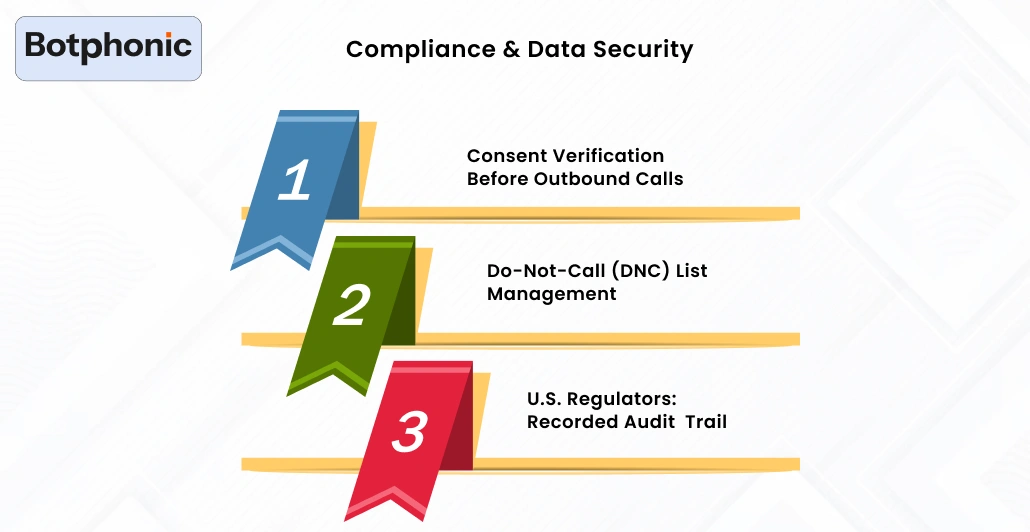
1. Consent verification before outbound calls
Botphonic confirms customer consent to receive service reminders, maintenance follow-ups and other outbound calls. This procedure guarantees that all AI call services are passed with customer permissions and conform to the specifications of the TCPA.
2. Do-Not-Call (DNC) list management
You simply upload your DNC list and prevent any call to a called line number. It helps a lot with accidental offenses and reduces the need for staff to check the list by hand.
3. U.S. regulators: Recorded audit trail
Each AI-powered call generates a comprehensive record that lists the purpose of the call, consent status and timing. Such records help HVAC companies prove they are in compliance during an audit or a regulatory review.
PRO TIP
Client Testimonial
Real world results are more important than just checklists of features. With Botphonic AI in place, the Texas-based HVAC franchise began to notice immediate change in call handling, technician deployment and revenue per lead.
“Botphonic AI enabled us to get 90% of missed calls and process them. Our service techs are busier, and the revenue per lead is up 40%.”
Future Outlook – AI in Home Services Across the USA
AI is transforming the home services industry in the United States. HVAC companies today are dealing with more demanding customers, tighter labour markets and increased competition. AI assists businesses in facing such challenges without necessitating burdening teams or raising costs.
The way you will engage with AI in home services won’t be as tame as just answering a call. For HVAC companies, AI will be a central operational layer for growth and planning and customer retention.
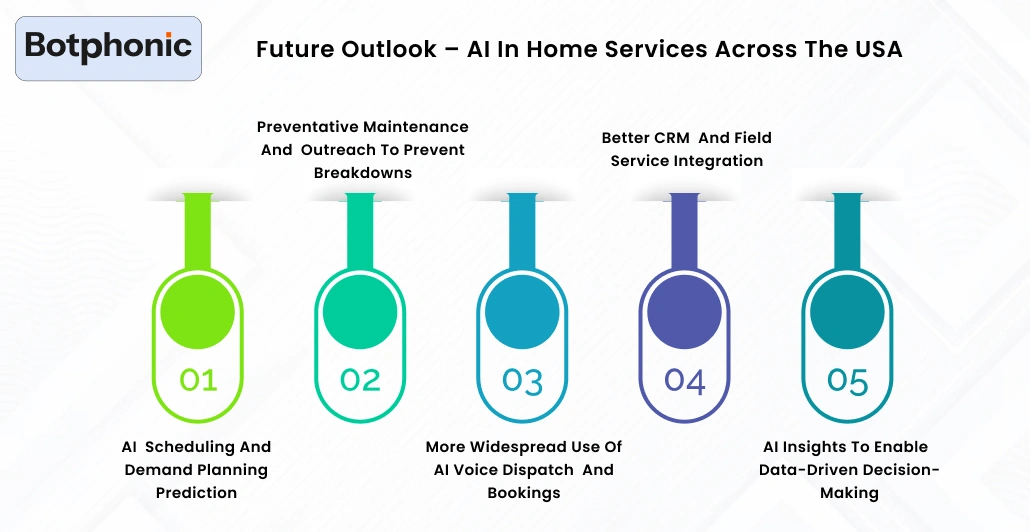
Below, you will find five of the trends that are paving the way to AI’s future in home services across the country:
1. AI scheduling and demand planning prediction
AI systems will crunch historical service data, weather and seasonal patterns to predict demand before it jacks up. Your HVAC business will have a plan in place, minimize technician downtime and prevent that last minute crush of work during extreme temperatures.
2. Preventative maintenance and outreach to prevent breakdowns
AI voice systems will call customers before a system fails using usage history and service records. This will limit emergency calls and allow HVAC businesses to transition towards planned, higher-margin preventive maintenance tasks.”
3. More widespread use of AI voice dispatch and bookings
HVAC and home service companies will begin replacing voicemail and overflow call centers with AI voice agents. These systems will manage scaling, dispatch, bookings, and follow-ups, all while ensuring that the delivery experience is consistent for customers.
4. Better CRM and field service integration
AI will integrate closely with platforms such as Jobber, ServiceTitan and Zoho FSM. This will facilitate the seamless updating of call lists, schedules and service personnel availability, which will lead to improved team coordination.
5. AI insights to enable data-driven decision-making
AI dashboards will help staffing, marketing and service coverage decisions. Entrepreneurs will see their call data to find wasted opportunities, speed up response times and better plan growth.
Industry research confirms this shift. IBISWorld projects that 60% of American home service companies will be using AI voice systems for dispatch and bookings by 2028.
HVAC companies that adopt AI Call Automation HVAC USA early will benefit from long-term gains in efficiency, customer satisfaction and revenue predictability.
PRO TIP
Conclusion
American HVAC companies suffer from lost calling revenue and slow response times. FairAI fixes this by answering every call, booking jobs faster and assisting our office teams when they’re busiest.
As this breakdown demonstrates, AI call handling, especially through advanced AI receptionist solutions for U.S. businesses is part of how HVAC companies can grow without adding staff or creating more stress on their operations. Early adopters of AI have a clear lead in speed, productivity, and consumer trust.
View how Botphonic AI records each call and changes missed opportunities into booked jobs.
Check Out Our Free AI Demo