

Summarize Content With:
Quick Summary
The market size for AI call centers has become an estimated $60 billion business, growing at 25% CAGR and will see 45% of customer engagements managed by AI by the end of 2026. Relevant data for your evaluation: AI managed calls lead to resolution rates of 98%, decrease time per call by 30%, improve CSAT by 10% during the first year, and decrease per call cost from $4-$7 per call (human) to less than $1 (AI). AI category leaders are not removing human agents – but allowing them to focus on complicated tasks with AI taking up to 70%-90% of the load.
This article brings together recent statistics, three relevant case studies from the real world (AI for insurance churn prevention, hybrid AI solution for financial services, real-time AI-based voice agents) along with future forecasts for 2027-2028. Try Botphonic for free 14 days trial or schedule a demo for 20 minutes.
19 Stats At a Glance
| Metric | 2026 Value | Notes |
| AI call center market size | $60B | Global forecast |
| Market CAGR | 25% | During 2026 |
| Customer interactions managed by AI | 45% | (vs. 20% in 2023) |
| Customer service via AI self-service | 50% | By end of 2026 |
| Companies globally using AI in call centers | 30% | As of 2025 |
| AI first-call resolution (real-time voice agents) | up to 98% | vs. ~70-75% traditional IVR |
| First-call resolution lift via predictive routing | +25% | US deployment data |
| Escalation reduction via sentiment analysis | −30% | US deployment data |
| Resolution time reduction | −30% | Telecom + retail sectors |
| Handling time reduction (with AI agent prompts) | −30% | Live-call assist |
| Cost savings on customer service expenses | −25% | Industry average |
| ROI increase within 12 months | +30% | Average AI implementation |
| CSAT score increase (12 months) | +10% | Average AI implementation |
| Agent productivity increase | +40% | Across deployments |
| Customer complaint reduction (proactive AI) | −20% | When intervention triggers used |
| Insurance churn reduction (named case study) | −28% | US insurance carrier, 12-month deployment |
| Botphonic, Serenity ROI (case study) | +150% | Year-1 ROI |
| Botphonic, Serenity conversion lift | +25% | On inbound inquiries |
| Botphonic, Serenity AHT reduction | −50% | Average handling time |
Why the AI Call Center Market Is Moving So Fast
Overall, the story of call center productivity was incremental in most of the past two decades: improved menu trees, more intelligent routing rules, stricter agent training. Marginal gains. This had not changed the technology behind it.
This ceased to be the case in the year 2024. Three things came together at the same time:
- Voice AI was developed to be natural. Latency of less than 300ms, accent support, barge-in support and 50 or more voice options per language meant that the conversation was no longer like talking to a robot.
- Large language models were found to be reliable in the intent detection task. In modern systems, the classification of caller intent has a 90 percent and above accuracy rate on the initial utterance by a number that was previously inaccessible five years ago.
- The price of its operation fell to mid-market rates. Cloud-native voice AI is now starting at less than 30/month to small businesses. A similar ability five years ago demanded six-figure enterprise agreements.
The outcome: by the end of 2025, 30 percent of businesses worldwide will be in some way using AI in their call centers. This number is expected to rise by the end of 2026 to majority adoption – as well as 45% of all customer interactions being AI-managed.
The current article gathers the recent market statistics, performance standards, named case studies and future projections. It aims to provide buyers with one source of up-to-date numbers – and to signal to the deploying decision-maker today where the market is heading tomorrow so the deployment decision of today does not become the technical debt of tomorrow.
State of AI Call Centers in 2026
Market Size and Growth Projections
The AI call center market is projected to hit a high of $60 billion by end of 2026 and grow at a 25% compound annual rate.
The drivers of growth fall into four groups:
- The maturity of voice AI, latency of less than 300ms, 98 percent first-call resolution on routine queries, and natural-sounding TTS have eliminated the technical objections that predominated in 2020-2023 buyer discussions.
- Prices of LLM inference Have decreased by about 90 percent since 2023, allowing per-call AI economics to operate at price points that small businesses can absorb.
- The segment that used to be unable to afford enterprise CCaaS now has cloud-native AI services starting under $50/month.
- Hybrid deployment patterns – after the pandemic, remote work became a standard, and cloud + AI became a standard architecture, rather than an experiment.
Adoption breakdown
- The global companies (2025 baseline) that use AI in their call centers amount to 30 percent.
- By 2026 (as compared to 2023) 45% of all customer interactions will be AI-managed.
- By the end of 2026, AI self-service will be used on half of customer service interactions.
The sub-segments with the highest growth rates: voice-first AI agents, conversational IVR (replacing button-menu IVR), and real-time agent assist (AI prompts surfacing relevant information to human agents during live calls).
Technologies Driving AI Call Centers
The modern AI call center is based on five categories of technologies:
- Conversational AI: NLP natural-language understanding, intent detection, entity extraction (account number, order ID, product name)
- Voice AI: Speech-to-text and text-to-speech with less than 300ms end-to-end latency.
- Sentiment analysis: Real-time emotion recognition based on vocal cues (pitch changes, change of pace, frustration indications)
- Predictive analytics: Churn prediction, drivers of callback timing optimization, intent scoring throughout the customer journey.
- Generative AI: Call summarization, post-call note creation, dynamic script adaptation depending on the conversation flow.
The change in structure in 2026: there are no longer independent point solutions. They are shipped by the leading platforms (including Botphonic) as an integrated stack with context shared across modules. The feeling score of a caller in minute 1 is used to inform the routing decision in minute 3, which informs the post-call summary, which informs the next-call prediction.
Integration with CRM and Omnichannel Platforms
The deployments of modern AI call centers are connected directly to Salesforce, HubSpot, and Zoho to CRM and pull in customer history during calls and write back transcripts, sentiment scores, and next-best-action recommendations. It is this integration layer that makes the difference between the term AI call center and voice chatbot; the AI requires context and CRM provides the context.
Cross channel coverage has become the norm. A voice-initiated customer can change to SMS or WhatsApp in the middle of a conversation without having to restart the context. The AI has only one thread across channels and surfaces it to a human agent in case it escalates.
Botphonic provides 50+ integrations such as Salesforce, HubSpot, Zoho, WhatsApp, and Zapier. The majority of deployments relate to the existing CRM within the time frame of less than 24 hours.
 NOTE
NOTE
AI Call Center Performance Metrics
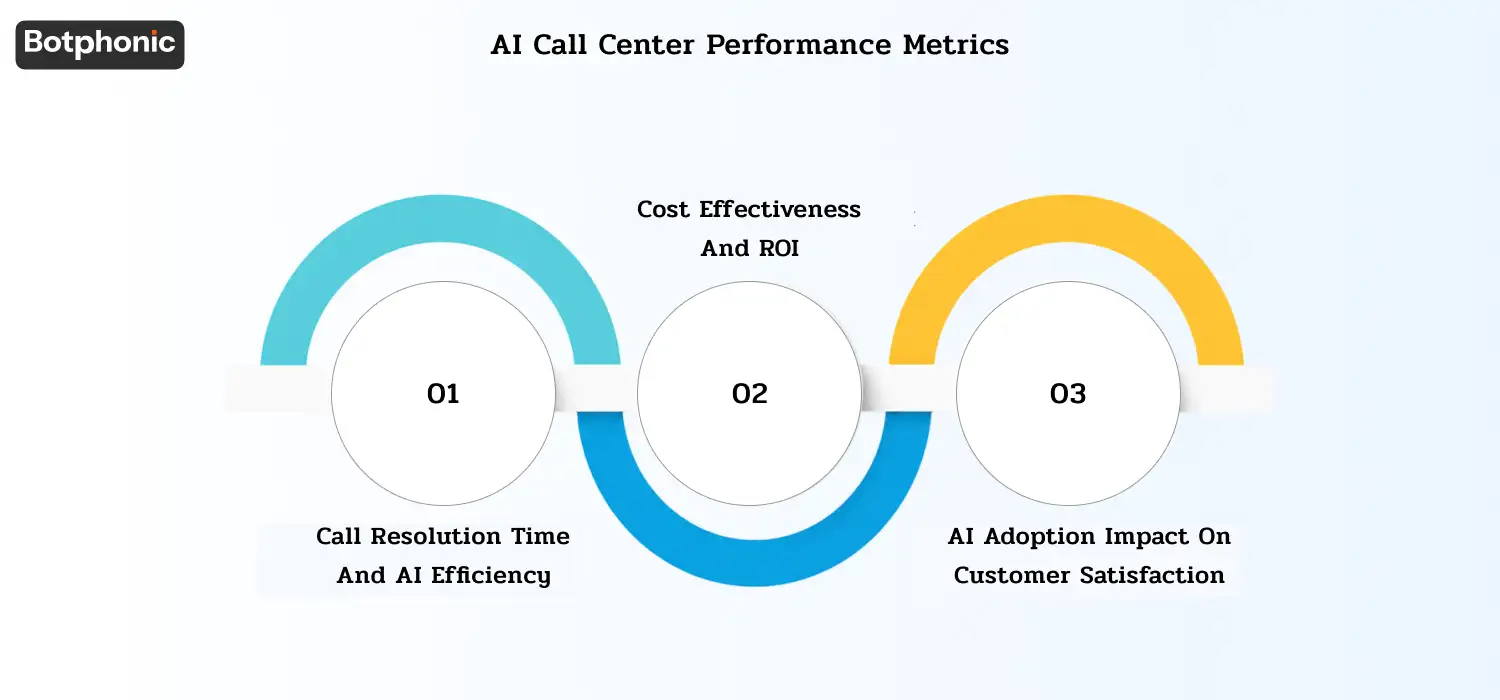
Call Resolution Time and AI Efficiency
AI-based call routing and self-service decrease the time of resolution in all industries:
- Reduce the average resolution time in telecom and retail systems by 30 percent.
- First-call resolution rate of up to 98 percent by real-time AI voice agents (with less than 300ms latency, complete CRM context, and live sentiment detection) – compared to an average of around 70-75 percent by traditional menu-driven IVR
- When AI is used to provide real-time prompting to human agents during live calls, reduction of handling time by 30%.
The 28-percentage-point difference between the first-call resolution of traditional IVR and modern AI voice agent is the largest single lever of CSAT that a CX team can have at its disposal today. In the case of most teams, halving that difference will recoup the AI implementation in the first quarter.
Cost Effectiveness and ROI
When AI manages the regular volume, the unit economics change drastically:
- A 25 percent savings on costs of customer service (industry average)
- Increase of 30% ROI in the first 12 months of AI implementation.
- The cost per-call decreases by nearly half (approximately 4-7 (human-handled) to <1 (AI-handled)) in cost.
In the case of a mid-market call center with 50,000 calls per month, the math usually breaks down to a 150K-300K in annual savings, again depending on the rate of automation. The curve of savings is not linear: the first 30 percent of calls are easy to automate (high-volume, repetitive), the next 30 percent calls demand some investment in training, and the final 10-15 percent of calls resolutely remain in the human-agent domain.
Enter your particular savings projection into the Botphonic ROI calculator – it takes into consideration your call volume, average handling time and the number of agents per call center to generate an annual figure.
AI Adoption Impact on Customer Satisfaction
The results of customers are also shifting:
- +10% improvement in average CSAT score within the first year of implementation
- −20% reduction in customer complaints when AI proactively intervenes (escalation, callbacks, and churn prevention based on sentiment)
- +40% improvement in agent efficiency — agents no longer have to answer low-value Tier-1 inquiries
The satisfaction of the agents also increases at an average of 15- 20 per cent in the first half year. The process is straightforward: the human agents cease to burn their day on the same five questions that exhausted their energies and begin working on the cases that actually need to be judged. The retention and engagement scores are both enhanced.
Key AI Call Center Trends for 2026
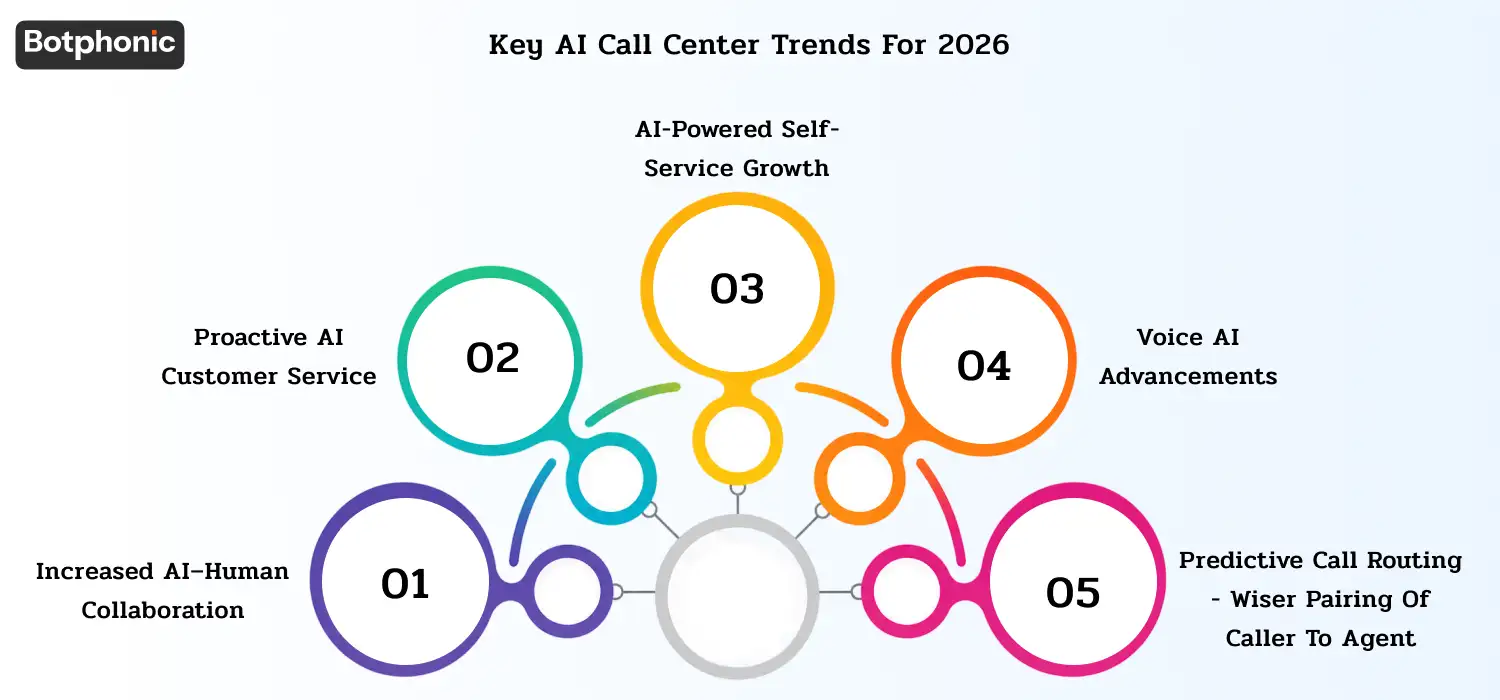
1. Increased AI–Human Collaboration
The most prevalent 2026 model is the AI as a co-pilot, not autopilot. Teams with high performance are using AI to process 70-90% of routine volume; humans process 10-30% – the cases that require judgment, empathy or authority. This is explained further below in the AI Human Synergy Framework.
NOTE
2. Proactive AI Customer Service
AI is shifting to proactive (intervene before churn) as opposed to reactive (answer when called). Production examples, currently in production:
- Identifying the patterns of frustration 30-60 days prior to the occurrence of cancellation calls.
- Promotions on calls When an account emits risk signals (receiving multiple short calls in a week, sentiment scores going down the wrong side of the curve)
- Personalized retention messaging: When sentiment scores fall below a set threshold, send personalized retention messaging.
The 20 percent decrease in the number of complaints by customers is provided by the companies operating this type of proactive AI. The mechanism is effective since it becomes dramatically more effective to intervene at the signal point than wait until the crisis point.
3. AI-Powered Self-Service Growth
By the end of 2026, half of all customer service interactions will be powered by AI self-service voice-first or chat-first, depending on the channel that customers prefer. Self-service deals with password reset, order status, balance checks, appointment booking and basic deflection of FAQ.
The 50% mark is important since that is the breakpoint at which the economics of the call center fundamentally alters. When half of your volume self-cleanses, you have to cut your headcount by half, too, or you redeploy that headcount to work with higher value, such as proactive outreach and account management.
4. Voice AI Advancements
In 2026, voice AI will entail:
- Natural-sounding TTS with 50+ voices and different accents per language.
- Multilingual automatic-detection, no menu option to select language.
- Barge-in support to allow the customer to interrupt the AI in the middle of the sentence.
- End-to-end latency of under 300ms is the norm; under 200ms is possible with the best platforms.
- Live accent and dialect processing.
The practical impact: Over time, on regular phone calls, customers calling in 2026 have an increasingly difficult time determining whether they are talking to a human or an AI. It is an attribute, rather than a flaw, but it does imply that compliance teams must make sure to be honest in their disclosure whenever customers request it.
5. Predictive Call Routing – Wiser Pairing of Caller to Agent
In addition to the simple first-available routing, the modern AI takes three data inputs to find the correct agent to call:
- Caller history and past interactions: Open tickets, previous escalations, lifetime value.
- Real-time sentiment and urgency: Frustration indicators in the initial 10 seconds, account-state context.
- Agent expertise and availability: Knowledge, and availability of agents, skills, current queue load, past successes with similar problems.
The US call centers which have implemented predictive routing report an increase of +25% in first-call resolution and the decrease of the number of escalations by the -30% margin when sentiment analysis is overlaid.
Real-World Performance: What AI Call Centers Are Performing Today
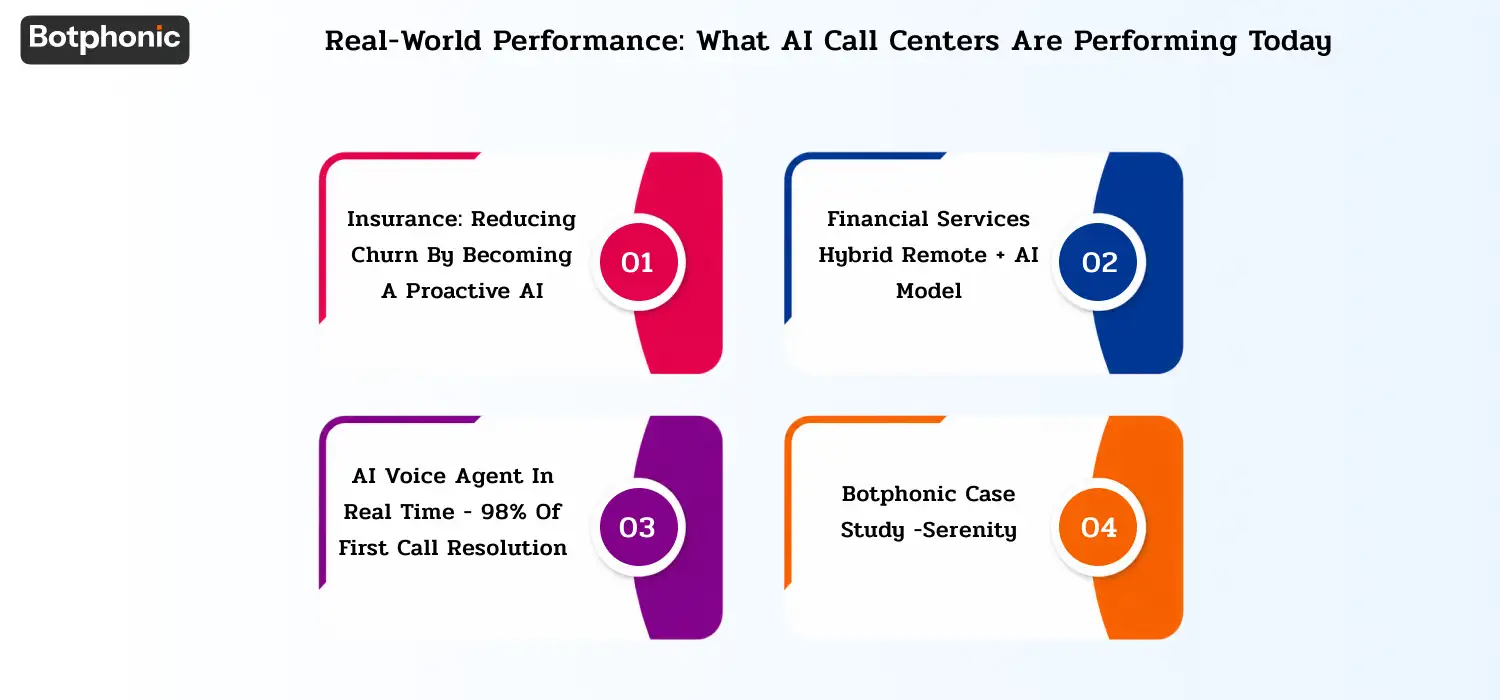
1. Insurance: Reducing Churn by Becoming a Proactive AI
One US insurance firm used AI to detect customer-call sentiment, identify at-risk renewal accounts, and implement early intervention through customized promotions and targeted retention messages. The outcome: -28% churn decrease in 12 months.
The process is more important than the headline figure. Rather than waiting to receive a call of frustration (which normally comes too late and the customer is already frustrated), AI detected frustration patterns 30-60 days before the routine service calls. The retention staff then received a daily worklist of at-risk accounts with full context, a recommended intervention playbook, and a clear next-best action. The work of the team no longer was to save the call (nearly impossible at the stage of cancellation) but rather to intervene with context (which actually works).
The follow-on effect: Agent satisfaction in the retention team increased due to a shift in attitude towards relationships, being active in nature rather than reactive in nature as before.
2. Financial Services Hybrid Remote + AI Model
A US call center in financial services switched to a hybrid workforce model with a strict division of labor:
- All Tier-1 inquiries, including balance checks, transaction history, basic disputes, hours and locations, basic fraud alerts are handled by AI.
- To solve more complicated cases, human agents are employed remotely to resolve applications of mortgages, frauds, retention saves, advisory discussions.
The results of operations: the cost of operation decreased, the number of calls resolved on the first call decreased, and the satisfaction of the agents increased as they did not have to field the same five calls all day. Geographic flexibility was also unlocked by the hybrid model since it was possible to hire agents anywhere and not just within the commute range of a contact center which greatly expanded the pool of talent.
The bonus effect: the process of compliance with regulations became simpler. The calls of remote agents were uniformly recorded and indexed, audit trails became standard, and over-the-shoulder review of supervisor coaching became uniform.
3. AI Voice Agent in Real Time – 98% of First Call Resolution
Current AI voice agents (with sub-300ms latency, full CRM context, and live sentiment detection) are up to 98 percent first-call resolution on routine queries – compared to 70-75 percent first-call resolution on routine questions using traditional menu-driven IVR.
The gap of 28-percentage-points is the single largest CSAT improvement that most CX teams can get. In dollar terms: in a 50,000-call/month center, the move to 95 percent first-call resolution recovering the value of repeat-call cost per month in the 70 percent to 95 percent range is about 12,500 calls worth of repeat-call cost per month, on average, before gluing in the CSAT and retention benefits.
4. Botphonic Case Study -Serenity
An actual Botphonic implementation of a customer-services process flow:
- 25% increase in conversion on inbound considerations.
- −50% call handling time
- −20% human errors in the scheduling and data entry.
- +15 percent agent satisfaction (as a result of unloading repetitive work)
- First year ROI of +150%
These are the results of typical mid-market deployments where AI is used to address routine questions and humans address more complicated cases. The leading indicator: the agents reported within the first two weeks that the queue felt different, that the number of repetitive calls was less, and the count of substantive conversations was higher.
The AI–Human Synergy Framework
| AI Strengths | Human Strengths |
| Speed and 24/7 availability | Difficult decision-making and judgment. |
| Scalability, accuracy and consistency. | Contextual comprehension in a series of conversations. |
| Predictive capabilities (intent, sentiment, churn risk) | Emotional intelligence and empathy. |
| Real-time sentiment analysis | Creativity and trust-building |
| Scalability of spikes instantly. | Dispute resolution and stakes-of-life saving. |
| Audit-compliant and audit-ready logs. | Strategic account management |
| Data-driven next-best-action recommendations | Reading between the lines and unstated issues. |
| Separate teams Multilingual coverage without separate teams. | Cultural fluency in subtle discussions. |
Challenges and Considerations for AI Call Centers
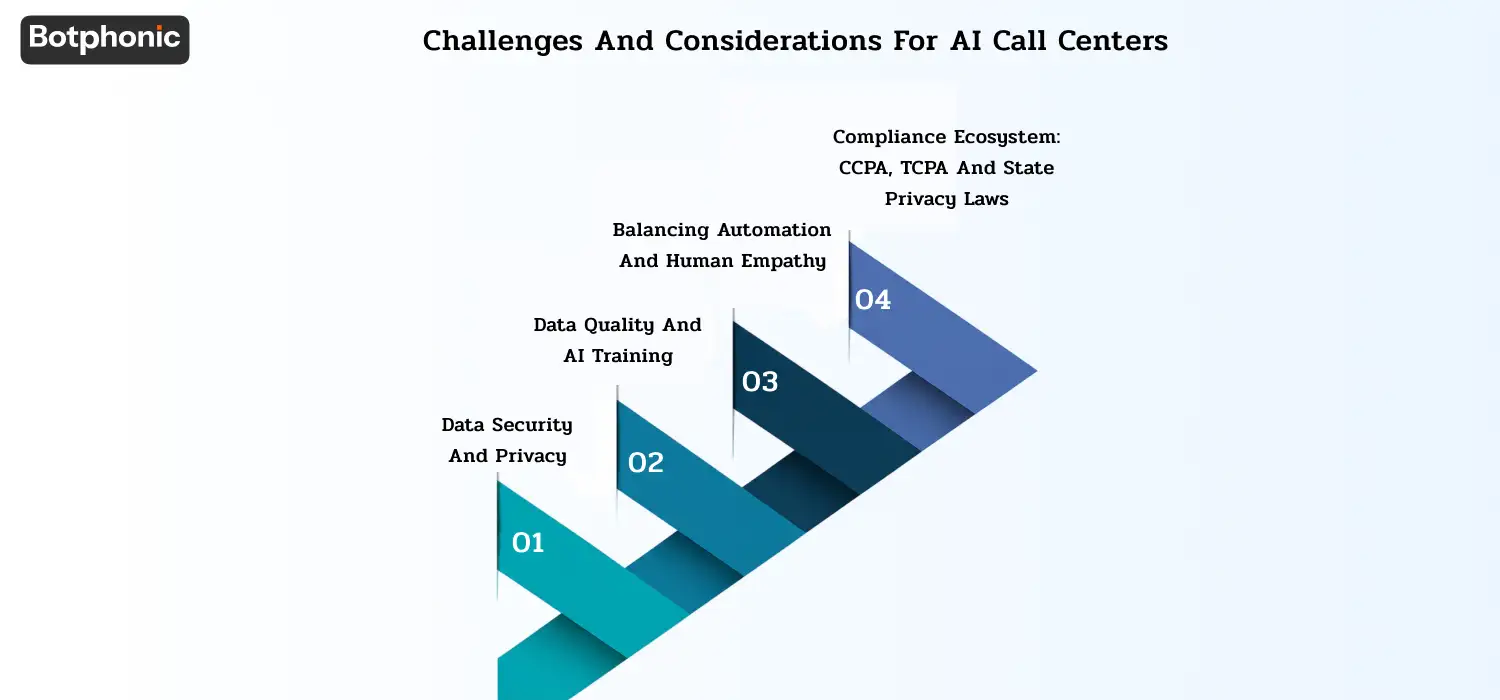
1. Data Security and Privacy
One of the most sensitive information that a company possesses is customer call data, including voice biometrics, financial data, health-related disclosures, payment card details. Vendors of AI call centers need to support:
- Encrypted recording of calls (in transit and at rest)
- Role-based access control.
- Complete audit records that can be accessed by compliance departments.
- Retention windows, which can be configured by data category.
Botphonic ships SOC 2 Type II, GDPR and HIPAA-ready out of the box. To any vendor being investigated, demand the certification paperwork personally and ensure that it is up to date – certification expires and must be renewed annually.
2. Data Quality and AI Training
The quality of AI can only be as good as the data that it has been trained on. Call centers that implement AI require to invest in:
- Clean training data – transcripts of actual calls annotated by intent and outcome.
- Ongoing A/B testing of prompts – minor phrasing variations can shift the rate of containment by 5-10 points.
- Feedback loops – Indicating that there are escalated calls that need to be reviewed and retrained.
Those companies that do not follow these steps will have AI that can handle textbook cases well and edge cases poorly. The deployment pattern that works: Within the first 90 days, allocate 5-10% of agent time to AI training feedback, and then decrease over time as the model stabilizes.
3. Balancing Automation and Human Empathy
AI-handling of calls should not be done in all cases. Cases involving grief (insurance death claims), high frustration (several prior escalations), high-stakes financial decision-making (large transactions), and a high sensitivity to legal matters should be kept with human agents.
The judgment call: what types of categories does your team default to humans, and what types of categories does AI attempt to solve first and escalate quickly? Most deployments follow the pattern of AI trying everything but the named exceptions list and being willing to aggressively escalate thresholds (sentiment dropping below a configured score, caller requesting a human, multiple failed attempts by AI) to ensure that no customer gets stuck in AI flows when they need a person.
4. Compliance Ecosystem: CCPA, TCPA and State Privacy Laws
US call center deployments must now take into consideration simultaneously three overlapping regulatory frameworks:
- CCPA / CPRA (California) consumer right to opt out of data collection, mandatory privacy disclosure on calls, deletion-on-request workflow.
- TCPA (federal) – Before outbound AI calls, automatic Do Not Call list honoring, opt-out keyword detection mid-call.
- State-specific legislation – Florida mini-TCPA, My Health My Data Act in Washington, stricter telemarketing windows in Maryland, outbound restrictions in Oklahoma.
The compliance reality of 2026: AI call center vendors should support encrypted call recording, per-call consent recording, audit logs that can be accessed by compliance departments, and configurable calling rules by state. Confirm that your vendor has certifications specific to regulated industries, prior to any rollout.
In the context of healthcare deployments, the extra must-have would be HIPAA compliance. In the case of financial services, GLBA. GDPR to European customers. The default: take the most relevant standard and reverse engineer it to your particular application.
 PRO TIP
Future Predictions for AI Call Centers
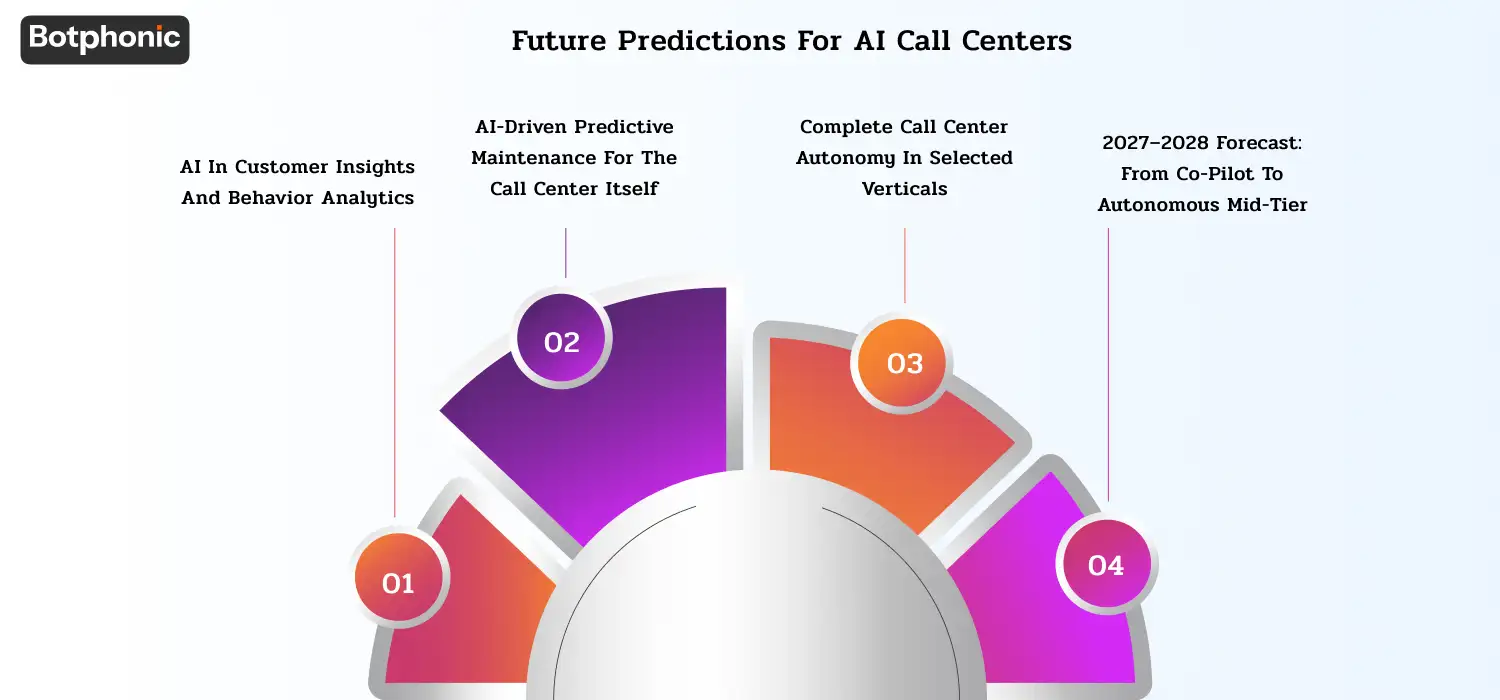
1. AI in Customer Insights and Behavior Analytics
By the end of 2026, all customer interactions will yield structured data: intent classification, sentiment trajectory, resolution outcome, satisfaction signals. This is the best source of truth of what the customers actually want, where they get stuck, and what the interventions actually move the metrics.
Firms investing in the analytics layer today will surpass those who continue to consider call data as exhaust. The best practice: weekly review of intent distribution changes, sentiment trend lines and containment rate by intent category – used as input to product, marketing and CX roadmap decisions.
2. AI-Driven Predictive Maintenance for the Call Center Itself
AI will also keep track of its own performance – such as when the intent recognition accuracy has dropped, when the escalation rates have suddenly increased, when the containment rate of a particular call flow has deteriorated unexpectedly. This is AI ops to the AI, and it eliminates a huge manual burden on CX teams operating large deployments.
The empirical impact: rather than CX leaders manually sampling 50 calls per week to assess AI quality, the system will automatically identify anomalies and areas of improvement. Engineering and CX teams no longer monitor but take action on signals.
3. Complete Call Center Autonomy in Selected Verticals
By 2028, dedicated low-risk verticals (high-volume eCommerce support, Tier-1 telecom support) will be capable of operating in practice autonomous: AI handles 95%+ of volume, humans serve as exception-processors and escalation-experts. Most of the regulated industries (healthcare, finance, legal) will remain in the hybrid mode due to compliance reasons – the human-in-the-loop requirement is not going away there.
4. 2027–2028 Forecast: From Co-Pilot to Autonomous Mid-Tier
When AI becomes a mid-tier complexity co-pilot (the co-pilot model), 20272028 is when it will be able to take over mid-tier complexity. Expect three shifts:
- Routine-complex queries are automated – scheduling under a multitude of constraints, mortgage pre-qualification, insurance quote generation. Now human controlled; by 2028 it will be AI-controlled with human authorization.
- Cloud + compliance is now a table stake: geographic distribution (data residency to meet EU, US-state requirements) is now a default vendor feature, not a premium feature.
- Such development of judgment-based skills (negotiation, complex troubleshooting, retention) will become mandatory and not optional, agents who do not develop judgment based skills (negotiation, complex troubleshooting, retention) will face displacement. Those companies that invest in retraining their agents today will be better off than those that fail to.
The strategic implication to CX leaders considering AI today: not merely one that will help you solve your 2026 problem, but one with the architectural flexibility to grow to the 2028 model. The products whose shipping capability combined with voice + sentiment + predictive + generative capabilities are integrated today are those that are positioned to be able to address the mid-tier complexity that is going to be present tomorrow.
How These Stats Translate to Your Call Center
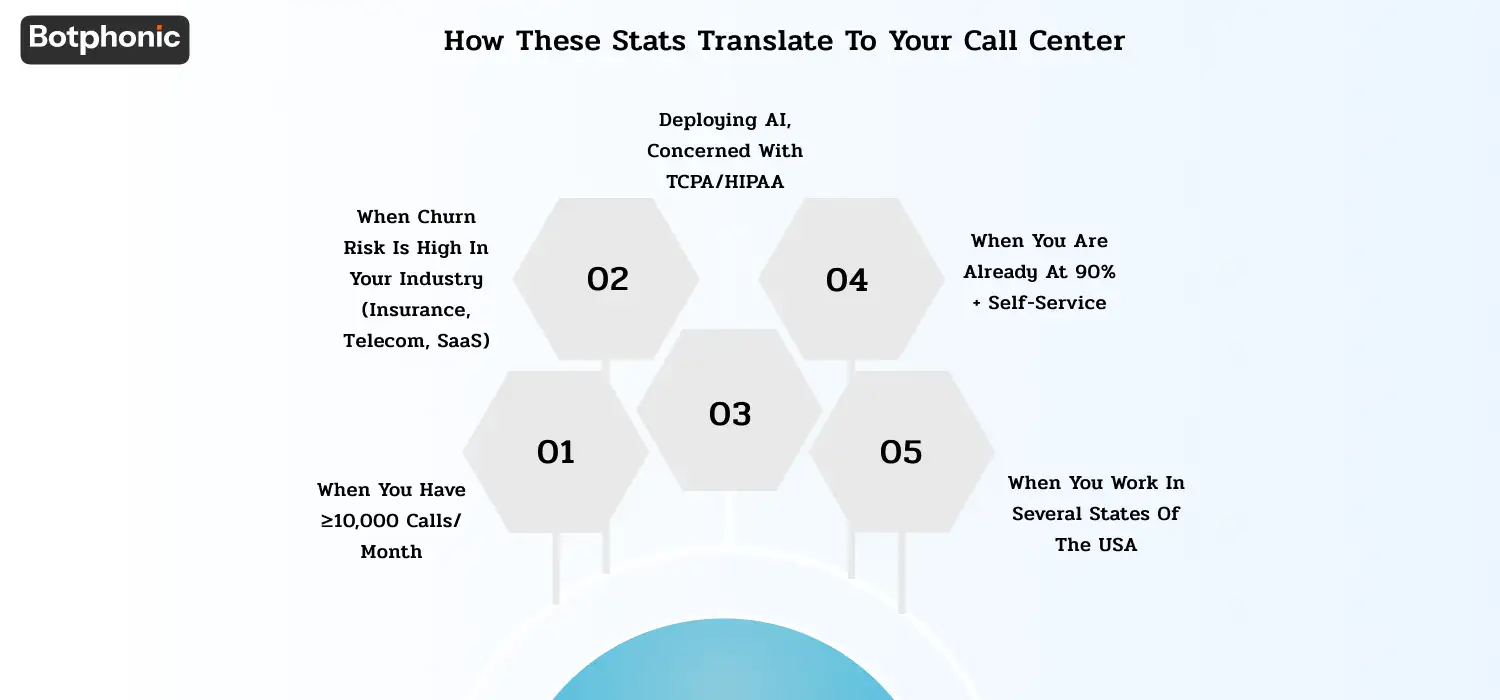
- When you have ≥10,000 calls/month – even a 30% reduction in the AHT restores considerable agent capacity (on average 4-6 FTEs worth at that scale). The payback period of AI implementation is typically within 90 days.
- When churn risk is high in your industry (insurance, telecom, SaaS) – proactive AI intervention can pay back the fastest. This case study of 28% churn-reduction insurance is reproducible in any subscription business.
- Deploying AI, concerned with TCPA/HIPAA, but looking to start inbound-only deployment to restrict regulatory surface area. Outbound AI calling imposes a significant compliance burden; inbound is less difficult to initiate.
- When you are already at 90%+ self-service through web/chat, then the logical next step is voice AI. Those calling you now are the ones that the chat bots failed to assist, meaning that voice AI is even more valuable in your case.
- When you work in several states of the USA – make sure that your vendor has provisions that comply with per-state telemarketing regulations. This patchwork of state regulations is truly complicated and one national policy will not undergo compliance scrutiny in more restrictive jurisdictions.
Work your own savings projection → the ROI calculator will take into consideration your call volume, your current AHT and your agent costs to generate your unique annual savings figure.
Deploy AI call centers before your customer run out of patience
Book Your Demo Now!!Conclusion
The AI call center market is beyond the early-adopter stage. By 2025, 30% of the companies will be running it, and by the end of 2026, 45% of customer interactions will be AI-managed. The technology is mature (sub-300ms latency, 98 percent first-call resolution achievable, full CRM integration), the unit economics work (1 vs. 4-7 per call) and the named case studies are public (28 percent insurance churn reduction, hybrid financial services models, multiple Botphonic deployments).
The other question is implementation: identify a vendor whose compliance posture is right, where your industry is concerned, then deploy it first to your top 5 query types first, and then monitor weekly then expand thereafter. Firms that do not start until 2027 will be at a disadvantage to firms that begin in 2025.
The next two years will divide the call centers that used AI as a side project and those that rebuilt around it. Both sides of that line represent a defendable position – but only one of them comes with a 25-percentage-point advantage on first-call resolution, and a 28-percentage-point gap.
Ready to see what AI looks like for your call center?
