Summarize Content With:
Quick Summary
The management of the property sector is experiencing a communication crisis. Instant, 24-hours service is required by tenants, and managers have to deal with numerous calls repeating, maintenance, and leasing requests. AI call center for property management are filling this gap by automating regular interactions and managing emergencies effectively. Meanwhile it also relieves human staff of tedious tasks to high-value work.
These systems will cease to be an experiment in 2026 as they are a strategic operational advantage, providing 24/7 coverage. Along with scalable response processing, and quantifiable cost reductions.
The integration of natural language understanding, smart call routing, and property management software integration makes AI an important aspect. It ensures that every call is answered and priority is given to critical issues with high satisfaction of tenants. The best option is to use hybrid: an AI call center for property management handles the process of answering standardized questions, and humans will have to work with complex and high-contact interactions, optimizing efficiency without compromising empathy or judgement.
Introduction
The heavy nature of property management has not changed, yet expectations of the tenant have surpassed the traditional systems. Lost leases through missed calls, and postponed maintenance increases risks and burnout among staff reduces efficiency. Introduce AI call center for property management: virtual front desks, which comprehend natural language, record important information, and automatically escalate urgent cases.
Compared to the old-fashioned phone menus, the modern AI manages calls smartly, recognizes emergencies and regular orders. Moreover, it does not experience any fatigue (24/7). The outcome is the shorter response time, less number of errors, less strain on the operation, and satisfaction among tenants.
In a market where responsiveness determines retention and revenue, adopting an AI call center for property management is not an answer to the selection of technologies, but an essential strategic one. They can turn property management into proactive operations that are scalable when implemented in a manner that is thoughtful with well defined call flows, integration, and optimized operations.
What Is an AI Call Center for Property Management?
An AI call center for property management is a voice-activated automation that is developed to process both incoming and outgoing calls between tenants – without a human operator answering them all. Imagine it to be a virtual front desk which operates 24/7, speaks natural language, gathers vital data, and sends complicated cases to the appropriate individual at the appropriate moment.
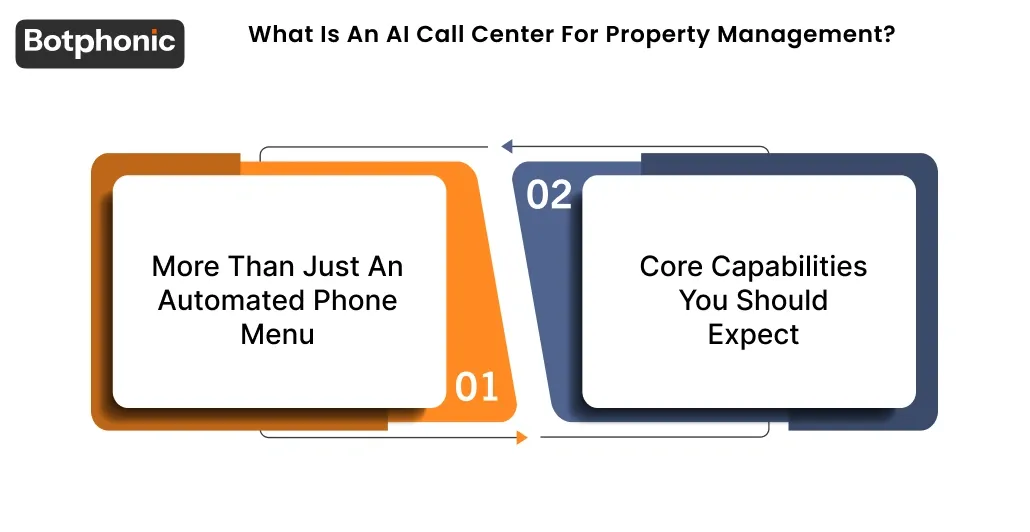
1. More Than Just an Automated Phone Menu
It is way more than phone trees or prompt recordings. Conventional IVR systems are a pain to tenants as they make them go through strict menus that in most cases do not respond to their real needs. Conversational AI is not only a keyword-based search over modern AI call centers but also intent interpretation. A tenant who reports that his bathroom is flooding receives a totally different answer than one who requests information about his or her lease termination dates, and the system is smart enough to respond in real-time and intelligently without human intervention.
The difference is important due to the fact that tenants are increasingly making judgements on property. Mostly, based on the speed and effectiveness in response. A natural, synthetic sounding AI interaction is much more impressive than being placed on hold. Even better than diverted to the voicemail at 9 PM.
2. Core Capabilities You Should Expect
Not every platform is equal, and a correctly developed AI call center for property management must include the following basic functions:
- Voice interaction with tenants in a natural language, in a variety of accents and phrasing styles.
- Automated processing of routine calls – office hours, rent due dates, status of application, queries on amenities.
- On-the-fly ticket generation and shipment to the vendor.
- Sophisticated increase to human employees in sensitive or tricky cases.
- Bi-directional access to live data with property management software.
- Follow up on the tenants after the call through SMS or email.
 PRO TIP
Why Property Managers Can’t Ignore This Anymore
That being said, the proportional scale and sheer amount of tenant communication has surpassed the capability of lean property management teams. One manager with 200+ units under him or her simply cannot be able to respond equally to leasing inquiries, maintenance calls, rent questions, and emergencies all at the same time, all day, all day. And for these types of concerns, here comes AI call center for property management to stabilize operations.
1. The Hidden Cost of Missed Calls
The effects are quantifiable and they multiply easily. A lost lease is a missed call by a potential tenant – the potential tenant will be calling the next property in the list. One of the building codes liabilities is a delayed maintenance response, and that is nearly bound to be a tenant relations issue. The tenant that is frustrated by being unable to get through when the time to renew is there is a non-renewal waiting to occur. These are not edge cases, they are the day to day reality of inadequately funded communication structures.
2. The Scale Problem Traditional Teams Can’t Solve
The number of calls may skyrocket with little or no notice during leasing season or rent cycle periods. The conventional personnel models can provide no solution to this one, either temporary personnel (at a high cost and unreliable) or unanswered calls (costly in other ways). Whereas, AI call centers for property management can easily absorb these volume spikes.
3. Staff Burnout Is an Existing Operational Risk
The other aspect that is seldom seen in calculators of ROI of the vendor is staff morale. When your leasing department is taking two hours a day to respond to the same five questions regarding parking, pet policy, and trash pick up days, it is not only an inefficiency, but also a retention issue. Monotonous calls with low complexity are a real cause of burnout in property management offices, which results in turnover. The volume is done by an AI assistant for real estate, the value-add work by your team.
Important Lesson: The actual price of the missed or poorly handled calls is not often well-calculated. Add loss of leasing income, lease dissatisfaction due to poor service, maintenance cost increase due to slow turnaround, and employee attrition due to call burnout and the ROI argument in favour of AI is very attractive in a very short time.
How AI Handles Maintenance Emergencies
The most stakes point in property management communication is the emergencies, and the place where the traditional setups fall most visibly. A human receptionist can lack a sense of urgency, be out of the office at 3 AM, or not be able to record the right information when needed. A failure point elimination happens across all three points through an AI system.
A properly configured AI call center for property management actively operates to eliminate those common failures even in emergency handling.
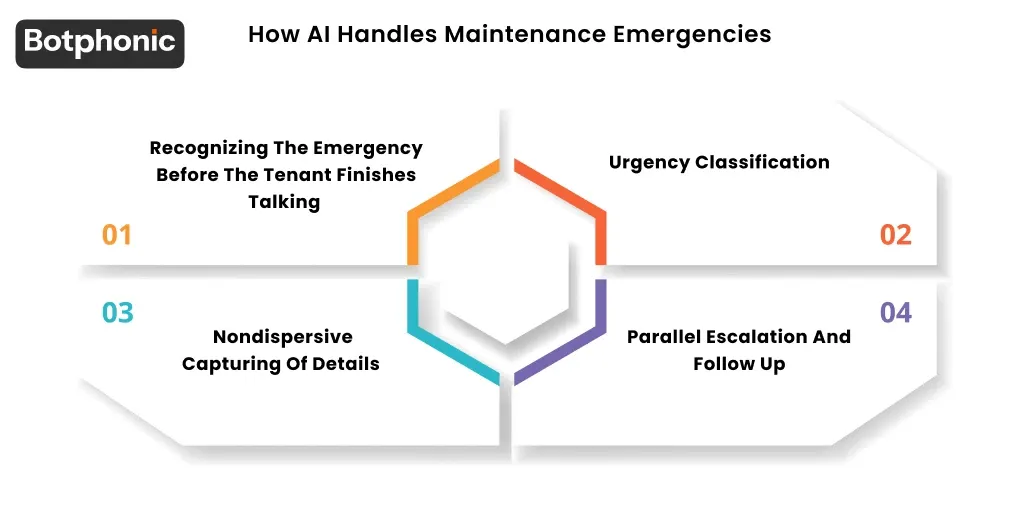
1. Step 1: Recognizing the Emergency Before the Tenant Finishes Talking
Once the call is connected, language is analyzed by the system in real time. There are words and phrases such as leak, flood, smell of gas, no heat, or sparking outlet etc as they are not handled as ordinary complaints but rather are considered as high-priority triggers that do not use regular routing at all.
The system of AI call center for property management does not require the tenant to finish explaining, but it initiates the emergency workflow immediately when the pattern is detected.
2. Step 2: Urgency Classification
All issues do not require the same speed of response. The AI call assistant implements a hierarchical system of urgency to each maintenance call:
- Emergency: Urgently dispatched (flood, gas burst, electric hazards, winter no heat)
- Urgent: Same day response required (appliance problem, lock problem, high pest problem)
- Routine: Scheduled and included in the regular maintenance periods (minor repair, cosmetic concerns)
This categorization of AI call center for property management will make sure that a burst pipe at 2 AM will receive a radically different treatment than a slow-draining shower – and that your on-call team is not dragged out of bed over something that can be postponed until the next morning.
3. Step 3: Nondispersive Capturing of Details
Short information leads to expensive repeating visits and delays in times of emergency. The AI voice agent will retrieve unit number, precise description of the issue, severity signals, contact data on tenants, and access instructions all registered automatically in your property administration framework.
The maintenance team comes in with the knowledge of what they are getting into rather than speculation.
4. Step 4: Parallel Escalation and Follow up
Soon after it is considered an emergency, the system sends the notification to on-call maintenance personnel, authorized vendors, and property managers concurrently through SMS, email, or an app notification.
No relay chain, No message passing, and No delay. Once sent, the system will provide the tenant with a confirmation message with an estimated response window. A feature that was previously unavailable with most manual systems and completes the communication loop.
- Intent Detection: Before making a call routing decision, high-risk language causes priority flagging.
- Urgency Classification: Calls are categorized into emergency, urgent or routine levels of calls with regular and rule-based logic.
- Information Capture: Unit, issue, severity, contact and access data are recorded without any human error or omission.
- Parallel Escalation: All the staff, vendors and managers are informed at the same time – no relay chain, no wait.
PRO TIP
Not every AI call center for property management is equally effective when dealing with simultaneous emergency calls. In case of a storm, power outage or incident on the building level, dozens of tenants can call simultaneously. Test your AI receptionist under load before going live and verify the number of calls simultaneously with the platform.
AI vs. Human Receptionists: An Honest Comparison
It is not helpful to propagate the narrative of an artificial intelligence replacing everyone. The more precise framing: AI will take over repetitive call-handling duties and allow human employees to do the actual work that involves judgement, empathy, and relationship-building. It is vital to know where the technology is doing well and where it is not to be able to properly deploy it.
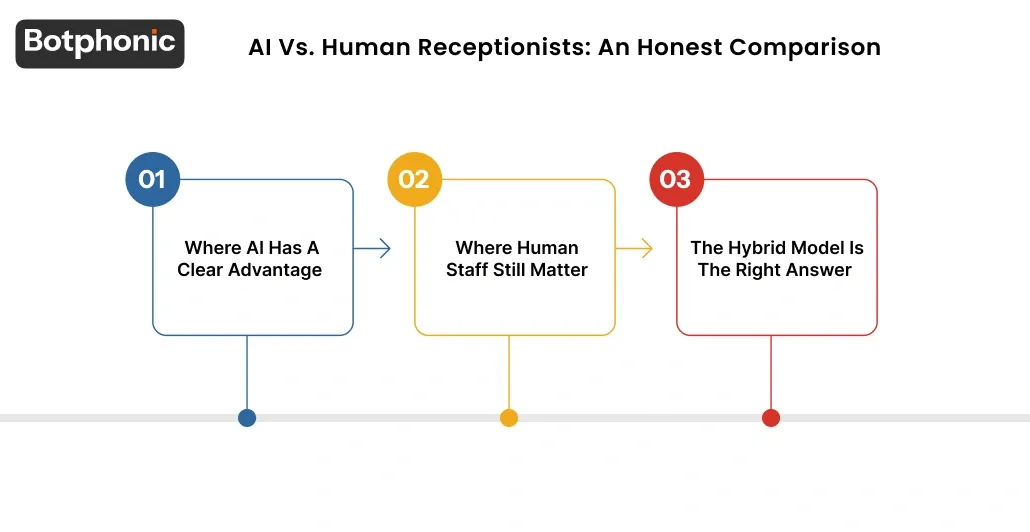
1. Where AI Has a Clear Advantage
AI comes out of hand easily when dealing with large volumes of interactions that are predictable. It responds to any call in seconds no matter what the time is, it can accommodate dozens of simultaneous calls that are not put on hold and provide the correct information every time. It does not have an off-day, does not provide obsolete rent rates, or even forget to record a maintenance request. This consistency is more valuable than most managers consider until they have tried the alternative.
2. Where Human Staff Still Matter
The holes in the AI capabilities are not imaginary and should not be covered with a sheet of paper. In a tenant who is angry over a litigation of leases or is calling to clarify them over a problematic personal circumstance that might impact their payment, emotional overtones and real empathy is not a luxury but a distinction between retaining a tenant and terminating a lease.
The complex edge cases, legal issues and complex multi step negotiations all involve human judgement that cannot be duplicated by existing AI. A human voice that tenants know by name is also beneficial to premium property and smaller communities where the loyalty is not promoted by a large group but on a personal level.
| Capability | AI System | Human Receptionist |
| 24/7 availability | Always on | Shift-dependent |
| Handling 10+ simultaneous calls | Scales instantly | One call at a time |
| Consistent, accurate information | Same every time | Variable by day/person |
| Emotional de-escalation | Limited | Strong suit |
| Handling disputes & edge cases | Needs escalation | Context + judgement |
| Cost per interaction | Significantly lower | Higher at scale |
| Relationship-building with tenants | Not its role | Long-term value |
3. The Hybrid Model Is the Right Answer
The winning strategy in 2026 will be a planned hybrid: The AI call center for property management will take care of the predictable 70-80 percent of the call volume, and human employees will work only in those cases when their services are indeed needed. It is not a concession to the shortcomings of AI, this is smart role design. Your employees turn into problem solvers and relationship managers and not call handlers. That is an improvement in the quality of jobs and not a degradation.
Note: Frame AI implementation to your team should be seen as a workload upgrade, not a threat.
In the case of automated repetitive calls, employees will move to the tenant relationship management and leasing support – higher value, more interesting work, which also happens to turnover. Engage your staff in the implementation process so that you can develop ownership, but not opposition.
What Does an AI Call Center for Property Management Cost in 2026?
In 2026, AI call center pricing has become more transparent but it continues to be piled on. The amount of subscriptions you will see on a sales deck is hardly the complete story. Knowing the entire cost setup initially is what makes the difference between a hassle-free execution and a cost-shocking execution.
1. Monthly Subscription Ranges by Portfolio Size
The majority of the platforms charge on a per-unit and per-month call basis. The following is an actual estimation of the possible locus of teams:
- Small Portfolio: $500–$1,500 per month
- Mid-Size Operation: $1,500–$5,000 per month
- Enterprise: $5,000–$10,000+ per month
- Setup Cost: $5,000–$20,000 one-time
2. Usage-Based Models: Adaptable But Changeable
Certain platforms are not charged as a subscription but on a pay-as-you-go basis. Common ones charge between $0.05 and $0.25 per minute of AI call handling or between $0.50 and $3.00 per interaction completed based on its complexity.
This model may be effective with smaller or lower-volume portfolios but it brings the variability of the budget into the leasing season and periods of emergency – months where you are likely to get a jump in your call volume (and consequently your bill) without any notice. When you use on-demand, create a buffer in your budget every month in peak times.
3. The One-Time Setup Cost People Underestimate
Implementation is not a plug and play. The appropriate implementation of an AI call center for property management needs to include conversation design, training on your own property data, customization of the workflow, and integration with your current property management software.
This is one of the stages that should not be overlooked or skipped, otherwise the system that is created will frustrate the tenants and give disjointed outputs. Establish budget 5000-20 000 initial and consider it as an infrastructure investment and not an overhead.
- Budget Warning: Keep an eye on the add-on prices that often do not come with the base pricing custom premium voice, advanced analytics dashboards, more software integrations, compliance capabilities to payment processing, and multi-language support might cost an extra $100-1000+ on top of the base price. Never sign anything without asking them to give you a complete price list.
- ROI Framing: This should not be judged by monthly cost. Estimate your cost-per-resolved-interaction with your current model, and compare it to the AI one. Once the AI call center for property management set up costs are amortized over 12-24 months, the majority will realize that AI will lower this number by upwards of 60 percent.
Labor costs typically eat up 40–50% of a residential estate’s budget, but automating routine tasks like access control, fee collection, and lighting can significantly reduce these management expenses.
How to Set It Up: A Practical Roadmap
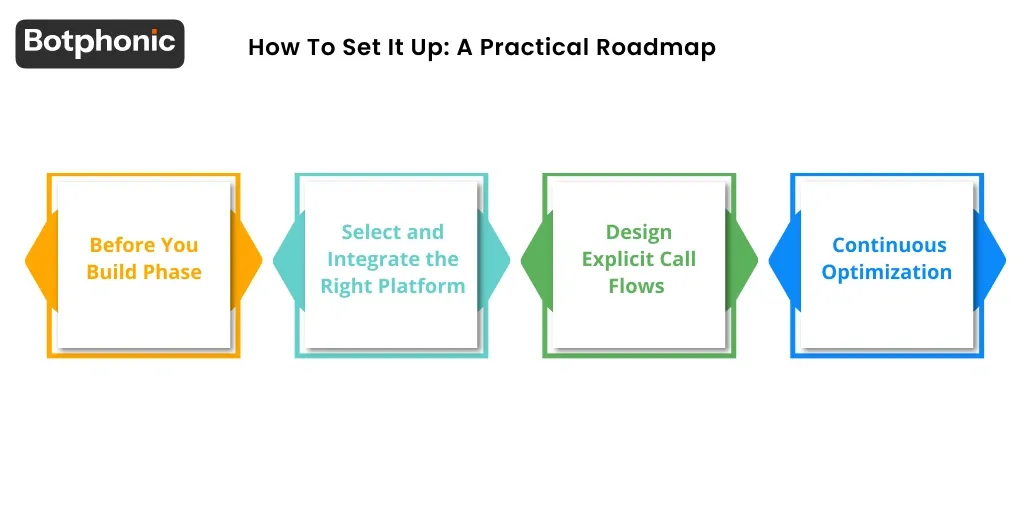
The deployment of an AI call center is more about the process design than it is about the choice of technology. Underdelivery on the platforms nearly always has the cause in a hasty or under-resourced implementation (not a product limitation). Here’s how to do it right.
1. Phase 1: Before You Build Phase
The first and most common error is to choose a platform without having a full comprehension of your call patterns. Retrieve at least three months of call logs and classify all the types of inquiries. You will most likely discover that 8-10 varieties of questions represent most of your volume.
Those are the initial automation targets, not due to their relative easiness to automate, but due to the value they provide when displaced off your team’s plate.
2. Phase 2: Select and Integrate the Right Platform
Select AI call center software that is specifically designed to manage the property, rather than a general-purpose voice bot that has been adapted to the real estate industry. The distinction is serious: you have to be platform-native with your property management software, have pre-built maintenance dispatch logic, and be able to access live tenant and unit data through calls.
After picking the system, you shall then connect it to your entire stack of maintenance tracking, CRM, and communication channels and later the calls shall go live.
3. Phase 3: Design Explicit Call Flows
This is where majority implementations are effective or unsuccessful. Document all of your call flows before laying a finger on the platform set up: how do calls enter, what are the questions asked at each stage, when does the system answer versus pass the buck and what happens when the answer of a tenant does not fit the pattern.
One way traffic creates disoriented tenants and redundant buildups. A smart AI call center for property management will enable you to:
- Map Your Call Types: Get the best 10 inquiry categories of your historical logs – these are your initial automation targets.
- Choose a Property-Specific Platform: Before short listing, confirm native PMS integration, maintenance dispatch capability and concurrent call handling.
- Write it out: Design All Call Flows: Record all decision trees, escalation trigger and fallback path prior to configuring anything in the platform.
- Integrate With Your Full Tech Stack: Link to property management software, maintenance tools and communication channels prior to go-live.
- Train With Real Tenant Language: Input real call excerpts into the training input, not scripts. Natural sounds are a result of real language.
- Run a Staged Rollout: Introduction on a single property within 30 days. Test gaps, quantify outcomes, and diversify to its wider portfolio.
- Track Metrics Monthly: Monitor Call answer rate, first call resolution, frequency of escalation and tenant satisfaction not quarterly, monthly.
4. Phase 4: Continuous Optimization
AI call centers are not plug and play tools. The questions asked by the tenants change with your properties, while policies are revised and new facilities are introduced. Look through your scripts of call flows at least once every quarter. Indicate recurring escalations that can be overcome with the introduction of a new automated path. The system must be made more effective each time you review it, it should be treated like one of your working assets, not a single installation.
Schedule a demo and stop making your callers wait to let them know about their favourite deal.
Try BotphonicConclusion
An AI call center for property management is an essential tool for realtors. Whether you consider it as an AI receptionist or just a simple AI assistant for real estate. The outcome is always going to be the same, that is faster responses, fewer missed opportunities and a resilient system that doesn’t crumble under pressure.
The main concern is no longer just automation but overall AI call center ROI. When repetitive calls are managed by reliable AI call center software, teams can simply focus on leasing, retention, and revenue.