Summarize Content With:
Quick Summary
Service agency AI call centers take the place of the old-fashioned telephone lines. With intelligent 24/7 client communication and automates the intake, routing, follow-ups, and reporting processes. Without losing the personalized touch that agencies are known to provide.
This guide is all about AI call center solutions for agencies. It elaborates in terms of ROI measurement, compliance, and workflow integration, and the trends of the future in 2026 and beyond.
Introduction
Communication with clients is an essential element for any service agency. Moreover, it is also one of the most resource-consuming aspects of work. Account managers answer the same status-update calls on repeat. Project enquiries are received out of hours. During the weekend new business leads are put on a voicemail queue. The outcome: smart individuals end up wasting hours in low-levels of dialogue rather than innovative or strategic tasks.
AI call center for service agencies are filling this loophole. A purpose-built AI call center is aware of agency workflows and retainers. Including project milestones, creative briefs, approval cycles and managing the communication layer. Meanwhile, it envelops them, unlike a generic contact center platform. By 2026, the technology has reached its maturity stage where both small and large agencies such as boutique studios and enterprises. Full-service networks are using it as a fundamental component of their client services stack.
The guide is a response to the questions that agency leaders are asking themselves: What improves? What gets automated? What stays human? And what is your business case to stakeholders?
How Can An AI Call Center Improve Client Support For Service Agencies?
The majority of agency clients are not patient. Instead of their account manager having time in between calls, they want a quick and informed response. An AI call center for service agencies delivers exactly that. Through a combination of natural language understanding, CRM integration, and intelligent escalation logic.
1. Real-Time Client Intake And Intelligent Routing
Once a client calls or starts a chat, the AI recognizes:
- Who they are
- What account they are a part of
- What they are most likely calling about without a human picking up the phone.
It is able to provide simple answers immediately. Such as, invoice status, deliverable timelines, next scheduled touchpoint and escalate call to the responsible agent. Cold handoffs are not given to account managers but with a pre-populated summary.
2. After-Hours Coverage Without After-Hours Costs
Agency clients work in different time zones. And a service agency AI call center is available 24/7. Eventually, it deals with after-hours calls, request logs and expectations regarding response time. It ensures that nothing falls through the cracks and no clients feel unaddressed. This is especially useful to agencies that work with e-commerce, media, or international enterprise clients. Agencies that need a quick response to a request or risk a deadline or a renewal.
3. Consistent Communication Quality At Scale
The larger the agency, the more difficult it is to keep the tone and accuracy of all client interactions. AI receptionist maintain a minimum communication standard with approved language. Including up-to-date project information, and defined escalation routes despite personnel attrition or project overload.
 PRO TIP
Which Tasks Can AI Automate Without Losing The Human Touch?
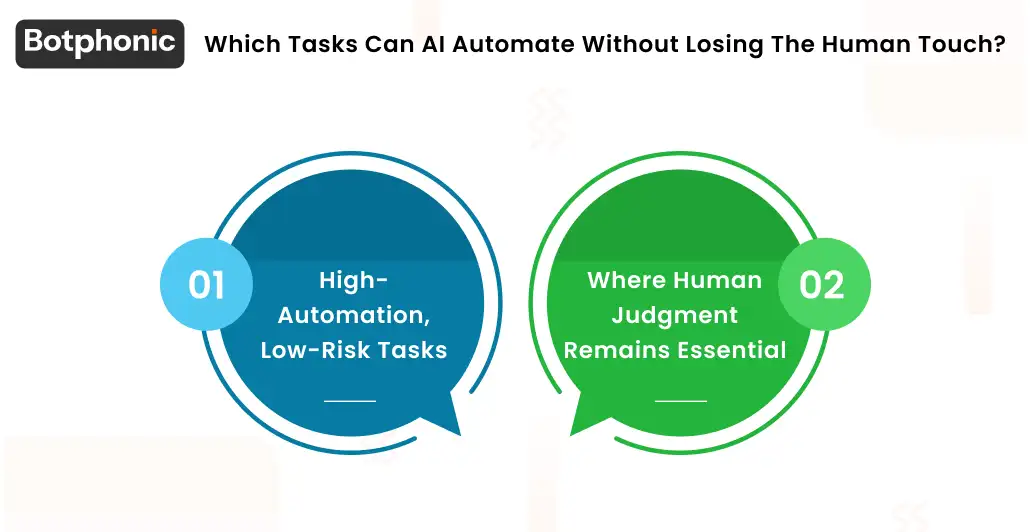
The anxiety that automation will render agency communication cold or transactional is quite comprehensible. Yet they are largely groundless in case the system is designed appropriately. The trick is to find out which tasks can really be of low value to human intervention. And which ones need empathy, judgment, or creativity.
1. High-Automation, Low-Risk Tasks
Regular Project Check In And Status Update
Pulling live data is possible to answer questions. Such as, where are we on the homepage redesign or when will the media plan be ready? AI call centers of service agencies answer these queries in seconds. Moreover, it enables account managers to have a conversation that really drives relationships forward.
Invoices Questions And Billing Concerns
The most common type of calls in any service business is billing questions. AI does the parts of balance confirmations as well as payment due dates. Even simple dispute logging without involving the team of finance personnel in every query.
Onboarding Workflows And Document Collection
The process of new client onboarding includes the gathering of briefs, signed agreements, brand assets, and access credentials. The AI call center with automated follow-up sequences will make sure that nothing comes to a halt because someone forgot to send a reminder.
2. Where Human Judgment Remains Essential
Human lead is beneficial in scope change discussions, relationship-crucial calls following a missed deadline, new business negotiations and creative feedback sessions. The most ideal AI call center in service agencies does not attempt to automatize these. It expedites the transfer to a human and makes sure that human is ready.
An optimally set up AI call center is capable of automatically processing approximately 60-70% of the incoming client communication volume, and enhancing the quality and speed of the remaining 30-40 percent that gets to your labor force.
How Do Service Agencies Measure ROI From AI Call Centers?
To justify the investment in the AI-powered assistant for agencies. It is necessary to have a clear measurement framework. The positive side is that the effect can be observed in various aspects. Some of them are apparent, others are not.
1. Direct Cost And Time Savings
Track hours recaptured divided by account manager per week multiplied by their loaded hourly cost. Automating the routine call handling normally results in significant time-savings. Resulting 6-10 hours per manager per week being shifted to billable or high-value work. This covers most call center platforms in the middle tier of AI at a blended rate. Even at a modest scale in the first quarter.
2. Retention And Satisfaction Rates With Clients
The metrics of response time, resolution rate, and Net Promoter Score (NPS) are expected to increase significantly. Following the implementation of an AI call center to serve agencies. The quicker response is directly related to the score of client satisfaction and satisfied clients renew. Measuring first-response time pre- and post-deployment as a leading indicator.
3. Conversion Of Leads And New Business Rate
Inbound new business calls that are done without delay. Instead of being placed on the next available business development individual convert at much higher rates. The AI qualifies the lead, books a discovery call, and sends confirmation. Ensuring no human intervention is involved in the initial contact.
4. Important Metrics Dashboard To Develop
The ROI dashboard that is useful in an AI-based call center of a service agency should monitor KPIs. For instance, average handle time, the rate of first-contact resolution, and the rate of escalation by the type of call. Also, including client satisfaction score per account, the number of hours saved per team member, and the rate of inquiries to new business.
 NOTE
NOTE
Can AI Handle Complex Or Creative Client Requests?
This is the initial question that most of the leaders of the agency ask. So, it should be answered in a subtle way. The existing AI systems, especially the large language models driving enterprise-grade AI call centers for service agency systems. It can truly converse on sophisticated levels. They are able to discuss innovative ideas, read between the lines and present strategic advice. Capability, however, is not the same as appropriateness.
1. Where AI Adds Value In Creative Conversations
The structured layer of creative communication can be effectively managed by AI call assistant. Ensuring the brief receipt as well as summarizing the revision feedback to the team. Moreover, it includes justifying the creative decision based on the pre-approved talking points, and controlling the communications of the approval stage. These are high-volume, repetitive touch-points with volume being processed by AI so that the creative directors can work on the real work.
2. The Escalation Model For Complex Requests
When a client makes a call with a really vague or emotionally charged creative request, such as “We need to rethink the entire brand direction” a well-designed AI call center in service agencies does not bother to resolve it. It accurately summarizes the request, establishes relevant expectations and resorts to the right strategist or creative lead with a formal summary in place. The human comes into the conversation knowing, and not responsive.
What Are The Compliance And Security Considerations?
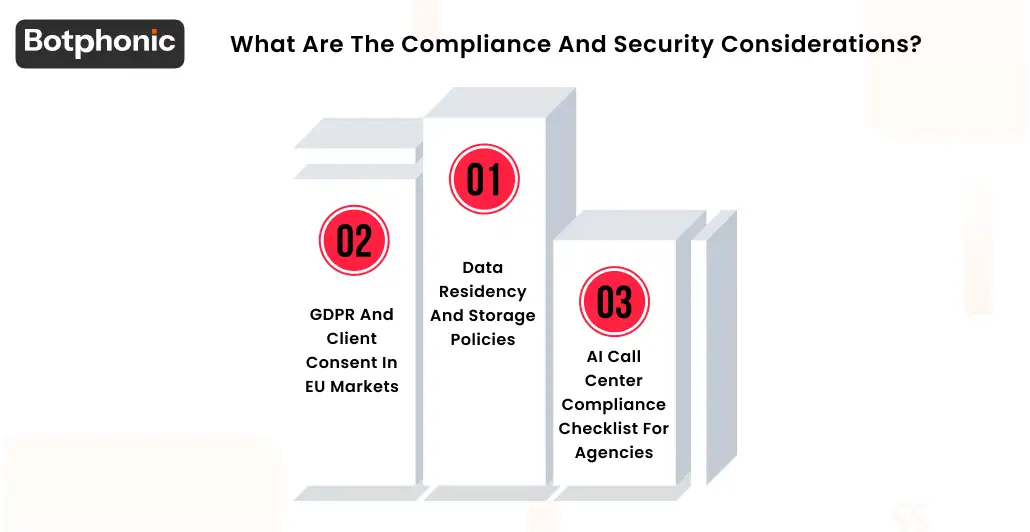
In the case of agencies dealing with regulated agencies, such as healthcare, finance, legal, government, the use of AI to make service calls to service agencies must be considered in terms of data processing, consent, and audit.
1. Data Residency And Storage Policies
Know the location and duration of call recordings, transcripts and extracted data. Qualified AI call center providers provide data retention policies that are configurable, regional data residency, and the option of complete exclusion of certain types of calls to AI transcription.
2. GDPR And Client Consent In EU Markets
In the case of the agencies that work in or deal with clients in the European Union, compliance with GDPR is a must. It includes telling those who call that their communication is being addressed by an AI, seeking consent when necessary, and ensuring there is a clear data processing agreement with your AI call center provider. There should be a disclosure statement at the beginning of any interaction handled by AI with the help of automated scripts.
3. AI Call Center Compliance Checklist For Agencies
Prior to deployment: ensure that your vendor is certified to SOC 2 Type II, review the data processing agreement, test the flow of consent disclosure, define which categories of clients should be handled by humans only, and develop a breach notification procedure with your provider.
Learn more: Best AI Call Center Automation Software in 2026
How Do You Integrate AI Call Centers Into Existing Agency Workflows?
Technical and operational integration of AI call center for marketing agencies is usually easier than the teams anticipate as long as the implementation is incremental and the stakeholders are engaged prior to implementation.
1.CRM And Project Management Integrations
The best integrations will allow the AI call center to be linked to your CRM (HubSpot, Salesforce, or agency-specific tools such as Workamajig or Function Point) and your project management stack (Asana, Monday, Teamwork). The AI will be in a position to respond accurately and not approximate to client queries when it is able to retrieve live project data.
2. Phased Rollout Approach
Begin with after-hours cover and routing of new inbound business – the least risky applications where AI can add obvious value with minimal impact to the current business processes. After getting the team relaxed and the set-up adjusted, extend to routine account management calls. The process of full deployment normally requires 6-10 weeks of a middle-sized agency.
3. Change Management For Account Teams
Position the AI call center as a service agency tool as the one that will process the calls that your team does not want to receive rather than relationship management. Engage the account managers in system training on the rules of escalation and types of calls – the AI becomes more intelligent and more accepted.
Which Trends Should Service Agencies Watch In AI Call Centers
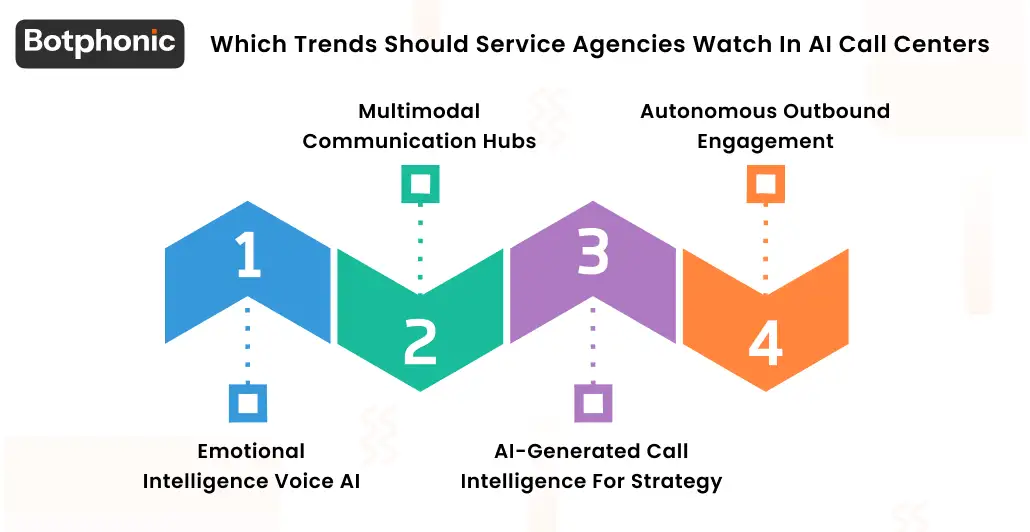
In 2026, AI call center space is developing at a very fast pace. Agencies that are ahead of these trends would have a significant competitive edge in terms of client experience and operational efficiency.
1. Emotional Intelligence Voice AI
The AI-call center platform to service agencies next generation is adding real-time sentiment analysis – identifying frustration, urgency, or confusion and changing the tone or initiating an escalation automatically. It makes the calls that are handled by AI more responsive and lessens the chances of a customer being made to feel disregarded by an automated phone system.
2. Multimodal Communication Hubs
Agencies are finding themselves in need of a single AI layer that can deal with voice calls, email, chat and even asynchronous video messages. An integrated AI call center platform that can take care of all these channels under a single interface, including shared context and a single client record are becoming the norm in progressive agencies in 2026.
3. AI-Generated Call Intelligence For Strategy
In addition to calls, major agentic concierge could easily address a significant number of client queries and now create structured intelligence based on each client interaction: trending sentiment over time, common pain points, new scope requests, and health scores of clients. This data is strategic gold to an agency – raising awareness of retention risks prior to them turning into resignations and finding upsell opportunities in trends that the team would never have identified manually.
4. Autonomous Outbound Engagement
Outbound AI features – proactive check-in calls, renewal nudges, satisfaction surveys in a conversational form – are undergoing pilot to production at agencies that are interested in expanding touchpoints with clients without having to expand staff. Service agencies having an AI call center that can both initiate and receive contact changes the economics of managing relationships with clients completely.
Join hundreds of digital and creative agencies already using AI call centers to reclaim hours, retain clients, and scale without growing headcount.
Schedule a DemoConclusion
An AI call center for service agencies is no longer a hypothetical investment, but it is a viable, quantifiable improvement to one of the most resource-intensive aspects of agency operation. After-hours access, intelligence-escalation, CRM integration, compliance-ready information management, etc. the technology in 2026 is advanced enough to be rolled out with confidence and intelligent enough to manage the complexity of actual agency-client relationships.
The agencies that are prevailing in client experience today are not the biggest in terms of account team size, but the ones that have automated the predictable so that their employees can attend to the irreplaceable. The way to do it is through an AI call center of service agencies.