Summarize Content With:
Quick Summary
This guide takes you through each step: choosing a platform, conducting a transparent assessment, and working with what occurs when the time elapses, and upgrading to full production. The templates below can enable contact center directors in a 200-seat operation to make a well-informed, data-driven choice, as well as founders with customer support responsibilities in a fast-growing SaaS company.
Introduction
When your business continues to channel all of your incoming calls to a human agent, you are bearing a cost structure which is already being ripped out by your competitors. An artificial intelligence crossing the threshold in 2026: AI in call centers is no longer a technology on a vendor roadmap. It is a production-scale infrastructure layer, which is managing millions of live customer conversations per day.
Nevertheless, the difference between article reading about AI call assistant in call centers and the actual implementation may seem to be very wide – particularly when it comes to mid-size businesses that cannot possibly risk spending six figures on a new system that fails to perform. This is the reason why AI-based call center free trials are so important. A properly arranged trial will allow you to load-test the technology with your actual call volumetric, your actual customers and your actual agent processes before a single dollar of licence fee has been exchanged.
Why Companies Are Resorting to AI
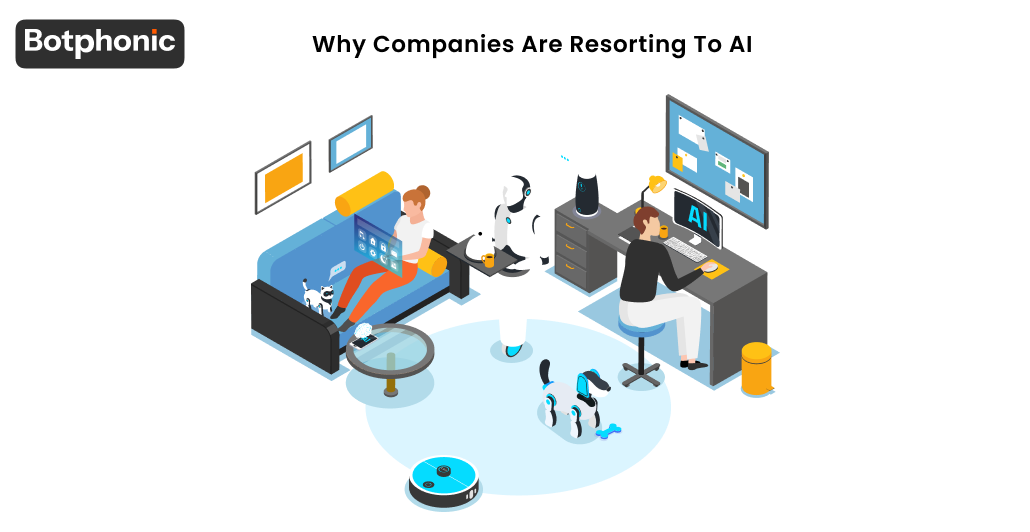
The old IVR menus, the ones that were made notorious with their press 1 to bill, press 2 to tech support trees, were not customer-friendly. They were geared towards cost accountants. They minimized live-agent minutes at the cost of all aspects of customer experience speed, accuracy, satisfaction, and trust.
Call center artificial intelligence reverses that equation. The latest AI call center software can detect the intent of callers in normal speech within the first three seconds of a call and redirect the call to the correct queue or self-service process in real time, and can, when it is appropriate, fix the problem completely without the human agent ever coming on the line.
How has it changed during the previous 24 months?
There are two forces that have come together to make 2026 a critical year in call center AI solutions. To start with, inference costs at large language models have reduced by about 80 percent between 2024 and 2026, which means that conversational AI is now economical even when measured against the high-volume, low-margin businesses of retail and utilities. Second, enterprise telephony providers the Five9s, Genesys Clouds and Talkdesks of the world took the capability of LLM directly into their platforms, eliminating any requirement of businesses to assemble APIs themselves.
The outcome: today an AI call center free trial provides you with the functionality that would have taken 6 months of dedicated integration projects three years ago. Trials Now typical trial-tier features include real-time transcription, sentiment analysis, agent assist prompts, automated after-call summaries and predictive routing.
 NOTE
NOTE
What does AI in the call center actually do (under the hype)?
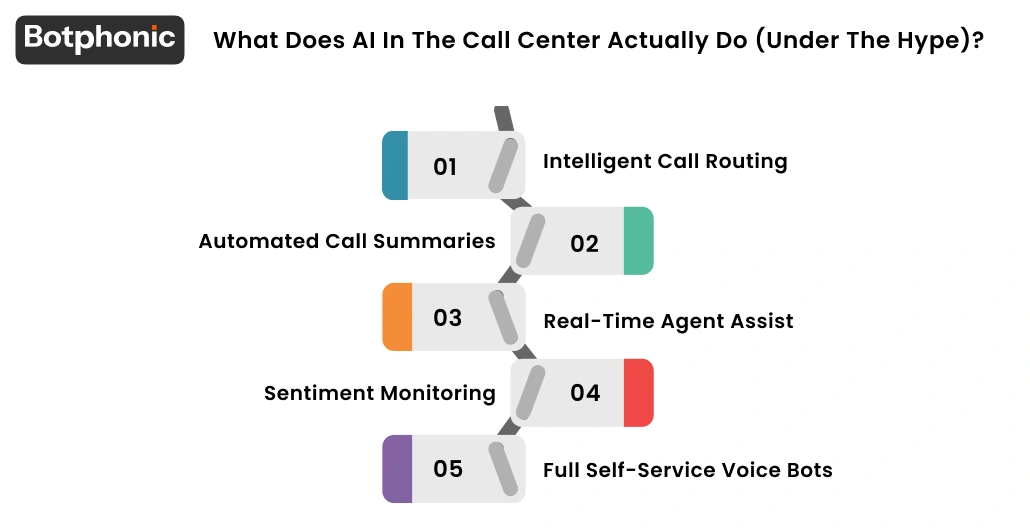
The most inflammatory use cases are by vendors last, fully autonomous voice bots that will never sleep, AI based on churn risk detection during a call, real-time translation in 60 languages. These abilities are available and they are functional. However, when it comes to assessing a trial, the most impactful applications used by the majority of businesses are much more mundane and much more dependable:
- Intelligent call routing: Call people to the correct agent or queue according to intent, history and agent skills – no touch-tone menu.
- Automated call summaries: Do away with post-call work by allowing the AI to create a detailed summary and a follow-up note in the CRM when a call is terminated.
- Real-time agent assist: Display the articles of the relevant knowledge base, proposed responses, obtained compliance alerts on the agent screen when the call is being made.
- Sentiment monitoring: Flag calls where the customer frustration is getting out of control to allow supervisors to act before the complaint turns into a churn event.
- Full self-service voice bots: Very high-performing where narrow and transactional use is required (account balance, order status). The rates of containment can be different; trial hard.
Choosing the Right AI Call Center Free Trial for Your Business
The trials of not all the call center AI solutions are equal. Other vendors provide an actual sand box including real call traffic; others provide you with a scripted simulation environment which has little relation to actual production. It would save weeks of evaluation time to know how to read the fine print before you sign up to an AI call center free trial.
The Three Trial Archetypes
In the big systems of artificial intelligence call center, the trials are usually grouped into three systems:
| Type of trial | Length of trial | Live calls permitted | Best For | Watch Out |
| Sandbox demo | Unlimited | No | Early-stage research | Does not model reality. |
| Time-based full access | 14-30 days | Yes | Serious evaluation | Clock begins upon signing up, not first use |
| Volume-capped pilot | Unlimited | Limited | Low-volume teams | Caps can conceal the scaling problems |
The gold standard of time-limited full-access trial that is linked with live calls traffic is applicable in most companies that do a significant assessment of the AI of a call center. In case the vendor provides a demo environment exclusively, it is significant data regarding the belief in the actual functionality of the product.
Platform comparison: major AI call center free trial options (2026)
| Platform | Trial Length | Card Required | AI Features in Trial | Ideal For |
| Botphonic | 14 days | No | Inbound and outbound sales, Email outreach, Workflow automation | SMBs and Enterprise both |
| Five9 | 30 days | Yes | IVA, agent assist, WFM AI | Enterprise (500+ seats) |
| Talkdesk | 21 days | Yes | AI routing, autopilot bots, QA scoring | Mid-market |
| Dialpad AI | 14 days | No | Real-time transcription, AI CSAT, coaching | SMBs and start-ups |
| Genesys Cloud | 30 days | Yes | Predictive routing, bot builder, analytics | New business, omnichannel |
| Freshdesk Contact Center | 21 days | No | Freddy AI, smart IVR | SMBs on Freshworks stack |
 PRO TIP
How to Review an AI Call Center Free Trial Like Experts
The majority of the teams evaluate an AI call center free trial in the manner that they would with software: clicking around, checking whether it functions, developing a hunch. This method is a sure way of making average decisions. A professional evaluation converts the trial into a time-boxed experiment, which is pre-specified to have hypotheses, baseline metrics, and a pre-specified scoring rubric.
Step One: Before The Trial Begins, You Have To Set Your Baseline
Pull 90 days of your present day contact center data. For determining best AI call center automation you require, at least, average handle time (AHT), first call resolution rate (FCR), customer satisfaction score (CSAT), average queue wait time, after-call work (ACW) time, and cost per contact. Unless you can quantify it today, there is no way the call center AI platform will be able to demonstrate that it improved it.
An evaluation plan for a week.
1. Week 1: Infrastructure and integration
Integrate your telephony stack, CRM and knowledge base. Ensure that recording of call, transcription, and agent screen information is flowing in the right direction. A gap in integration in this case will translate to a data gap that will nullify your metrics. This is a plumbing week and not a performance week.
2. Week 2: Assisted routing and routing tests (controlled AI)
Send a specified amount of inbound calls (usually 20-30 percent of volume) via the call center artificial intelligence routing engine. Compare measure intent classification accuracy, routing accuracy and initial CSAT with your baseline cohort. Enable agent support in your pilot team and monitor ACW time.
3. Week 3: Containing bot and self-service
In case your use case relies on self-service voice bots (order status, frequently asked questions, account management), it is high time to see how containment rates work when under the pressure of the real call. A reasonable set up of a bot during week one of activity is a 30 40 percent containment rate. A lower value than 20 percent is an indicator of an intent-model problem or configuration.
4. Week 4: Full-volume stress test and decision preparedness
Expand to full call volume. Weed out your top two or three most important use cases in weeks 2 and 3 data. Make a go/no-go scorecard with your original baseline metrics. Document configuration debt, things the platform could do, but you have not had time to configure them, so that you are fairly comparing them.
The Seven Questions Every Assessment Should Answer
Your team is supposed to have a clear-cut response to all these questions before the trial is concluded. In case any of them are not answered, prolong the trial or advance to a vendor proof-of-concept engagement before concluding a contract.
- Intent Accuracy: What was the first attempt percentage on correctly classifying by intent of the AI? Target: >85% to deployment that is production-ready.
- Integration Reliability: Did CRM sync, call logging and data export work automatically during the trial period?
- Agent Adoption: What is the percentage of agents who are utilizing AI assist features by the end of week 4? The change-management and not technology warning sign is low adoption.
- CSAT Delta: Did AI-routing calls and control group calls have different customer satisfaction scores? Flat/negative or flat delta is disqualifying.
- Latency And Voice Quality: Is there any voice quality or responsiveness reported to have been impaired by the AI layer by callers or agents?
- Data Compliance And Data Security: Does the platform satisfy your regulatory needs (PCI-DSS, HIPAA, SOC 2) as indicated through their regulatory documentation?
- Vendor Support Quality: The responsiveness of the vendor during the trial? The leading indicator of the quality of support after the sale is the quality of support during a free trial.
The best AI call center free trial is the one that you are actually trying to break the platform, not the one where you are trying to affirm a decision that you have already made.
-VP of Customer Operations, mid-market SaaS company
What Happens When The AI Call Center Free Trial Is Over?
When your trial clock expires, it does not mean the conclusion of your assessment, it marks the start of a negotiation. The knowledge of what usually happens following a call center AI free trial provides you with a leeway that otherwise would not have been the case.
The Three Most Usual Post Trials Outcomes
| Problem | Condition that Triggers the outcome | What to do |
| Automatically upgraded to paid plan | on credit card, with auto-renewal conditions | Including trial terms Include auto-renewal terms, cancel before trial: undecided, dispute if unexpected: within 48 hrs. |
| Account Suspended | No card; trial terminated in nature | Extension request 7-14 days – extension requests are practically always given by vendors in ongoing assessments |
| Migration to free tier | Platform has permanent free tier | Assesses feature degradation Can be quite serious; free tier can sometimes lack the AI features you were testing. |
Why Did I Get Charged For A Free Trial?
This is among the frustrations that are most prevalent to businesses using the AI solutions of call center free trials. The response is practically always the same: the site would require a credit card to sign-up and the trial conditions would be automatic converting to a paid subscription upon the expiry of the trial period. Free trial does not imply that you do not need to pay anything, and it does not imply that you will receive a reminder email about the charge before it appears.
Best practice: whenever you subscribe to any AI call center free trial, you need to have a reminder in your calendar 48 hours before the trial runs out. Either go ahead with purchase negotiations formally using that window, or cancel your account and export your data.
NOTE
Where AI Call Center Free Trial Will Cause The Greatest Benefits
Artificial intelligence in call centers is not a universal solution. The industries and applications in which a trial is likely to generate compelling ROI data has a certain similarity, namely, large volumes of inbound contacts, which are cyclical, and the AI has sufficient signal to be useful each time.
| Industry | Top AI Use Case | Typical AHT Reduction | Trial Focus |
| E-commerce & retail | Order status, returns, WISMO | 35–50% | Self-service bot containment |
| Financial services | Account queries, fraud alerts | 25–40% | Compliance scripting, PCI call flows |
| Healthcare | Appointment scheduling, triage | 30–45% | HIPAA-compliant AI routing |
| Telecoms & utilities | Billing disputes, outage reporting | 30–40% | Sentiment-triggered escalation |
| SaaS & tech | Tier-1 support deflection, onboarding | 20–35% | Knowledge base integration accuracy |
In the case of a business that is very regulated, such as healthcare, financial services, legal, etc., do use much of your AI call center free trial period specifically to test compliance features. The consent to record calls, PCI-DSS pause and resume card data, and HIPAA-compliant data processing cannot be faulted and you can say that you can count on production deployment.
Where AI adds less value (for now)
The issue of transparency is important in judging the use of artificial intelligence in call centers. There exist actual constraints. On the one hand, some emotionally intense, complicated dialogues; bereavement, medical emergency, severe complaints, and so on are the areas where human judgment and empathy are superior to any current AI in the market. A properly programmed call center AI solution is aware of that and redirects such calls to human agents in a fast and graceful manner. Any seller that says that his AI can deal with different types of calls equally well is push selling.
Between Free Trial and Full Rollout: A Pragmatic Transition Strategy
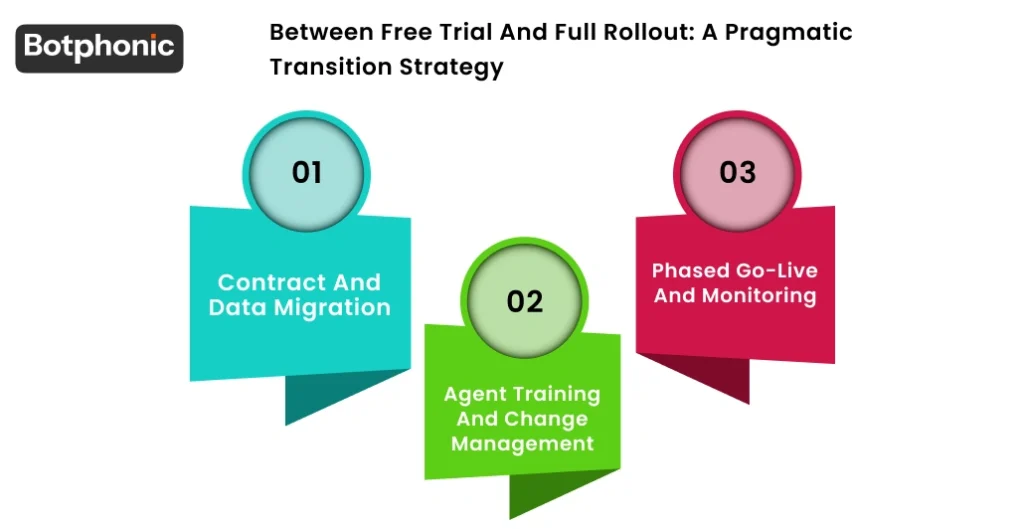
The implementation project does not end with the decision to go beyond the free trial period offered by the AI call center. Companies that consider purchase to be the endpoint and not the beginning of business do not always deliver on the return on investment they had promised to their stakeholders.
A six weeks post-trial transition system
1. Weeks 1-2: Contract and data migration
Negotiate contract terms according to trial performance information but not according to vendor list prices. The trial measures you have provide you with an objective basis on which to discount the requests. Move the call recording audio, the history of transcription, and the data about the performance of the agent on the trial environment to the production environment. Ensure that historical data is compatible in a standard manner.
2. Weeks 3-4: Agent training and change management
Culture is the most prevalent reason behind failed call center AI deployments. Agents who feel insecure about the technology turn off AI assist features, and the ROI case is washed away. Sell the rollout as something that will eliminate drudge work (ACW, note-taking, knowledge retrieval), and will make agents more comfortable when dealing with more demanding calls.
3. Weeks 5-6: Phased go-live and monitoring
In two waves, expand your trial cohort up to full-population of agents. Daily monitor intent classification efficiency, containment, CSAT, and AHT during the first 30 days. Designate an artificial intelligence administrator in charge of calls only in this window and his or her sole task is to tune the AI model using your data on call pattern.
The 90-Day Review
Set up an official 90-day business review with your vendor. Take your base measures prior to the trial and present day production values. Any difference in performance between trial performance and performance should be explained – and a remediation plan supported by the SLA of the vendor.
See how Botphonic works under real call volumes, real routing logics, and real compliance requirements.
Request a Free DemoConclusion
The technology behind the artificial intelligence of call centers has become stable enough that the question is not whether it works anymore, it does, with the right applications, but whether your organization is prepared to harvest the benefits of it in a systematic way. Call center AI free trial is the most effective tool that can be used to answer this question without risking any money. Even the McKinsey reports have stated that companies who excel in customer onboarding on juts trial itself can see upto 15% increase in trial conversion rates.
The companies that benefit most in their trials of AI solutions to call centers are not the ones with the largest budgets and the advanced technology stack. They are those that establish objective success criteria prior to the trial, they run experiments and not demos, they take agent adoption as seriously as they take system integration.
Begin with a 14 or 30-day trial with one of the sites discussed herein. Relate it to the actual call traffic. Measure what matters. And do not make a decision on a slide deck.